
Updated October 2026 for version 3.0 of the paper.
One of the strongest gene signals for scoliosis does not point at bone. It sits near LBX1, a gene that in mice builds one of the two main classes of sensory relay neurons in the spinal cord: the cells that pass on touch and pain, some of them carrying signals about where the body is.
That was a strange place to find a spine gene. It sent me looking.
The pieces were spread across fields that rarely talk to each other: genetics, nerve development, position sense, balance, body schema research, brain imaging and computational neuroscience. Others had already argued that scoliosis involves the nervous system, among them Herman in 1985 and Burwell in 2008. What I added was a specific mechanism, built on how the brain predicts the body, and a set of tests that could prove it wrong.
The result is the Neural Generation Hypothesis, a free preprint on Zenodo (read the full paper). Here is what it says, in plain language.
The Core Argument
The Neural Generation Hypothesis (Miller, 2026; version 3.0) proposes that, where the sensorimotor loop is intact, the part of an adolescent idiopathic scoliosis curve that a person can actively correct (what active self-correction removes beyond passive flexibility) is held by the body schema, the brain’s non-conscious predictive model of the body. In one proposed entry route, the sense of where the trunk is has been degraded, so drift during the growth spurt is too slow to be signalled as change. It is not corrected, and the body schema’s slow learning moves its reference toward the curve until the curve is treated as straight. Growth-driven uneven loading sets how large the curve becomes, and the hypothesis does not claim that part. It is posted as a preprint (not peer reviewed), states the evidence for each link, and proposes eleven testable predictions with results that would refute it (https://doi.org/10.5281/zenodo.19342098).
Your posture is not a position you hold. It is a prediction your brain makes, moment by moment, from an internal map of your body called the body schema.
The map runs on sensory data. When the data is clear, the map is accurate. When it is blurry, the map works with what it has.
Here is what the paper proposes happens during the growth spurt. The spine drifts a tiny amount each month. With clear body sense, the nervous system notices and corrects it. With blurry body sense, the drift is too small to register, so nothing corrects it. Meanwhile the map keeps quietly updating to match the body it is in. Month by month, the curve becomes the map’s new “straight,” and the body is held there.
The map is not too slow. It updates toward the curve instead of back to straight.
That is why the paper focuses on one part of the curve: the part you can straighten yourself when you actively try, beyond what simple flexibility allows. If the map is holding that part, the map is worth measuring. How big a curve grows is a separate matter. Uneven loading on growing bone drives that, and the paper does not claim it.
The Idea in One Picture
This is the paper’s main figure, redrawn in plain words. Solid lines are shown by research. Dotted lines are ideas the paper proposes and has not yet tested. Follow the numbers.
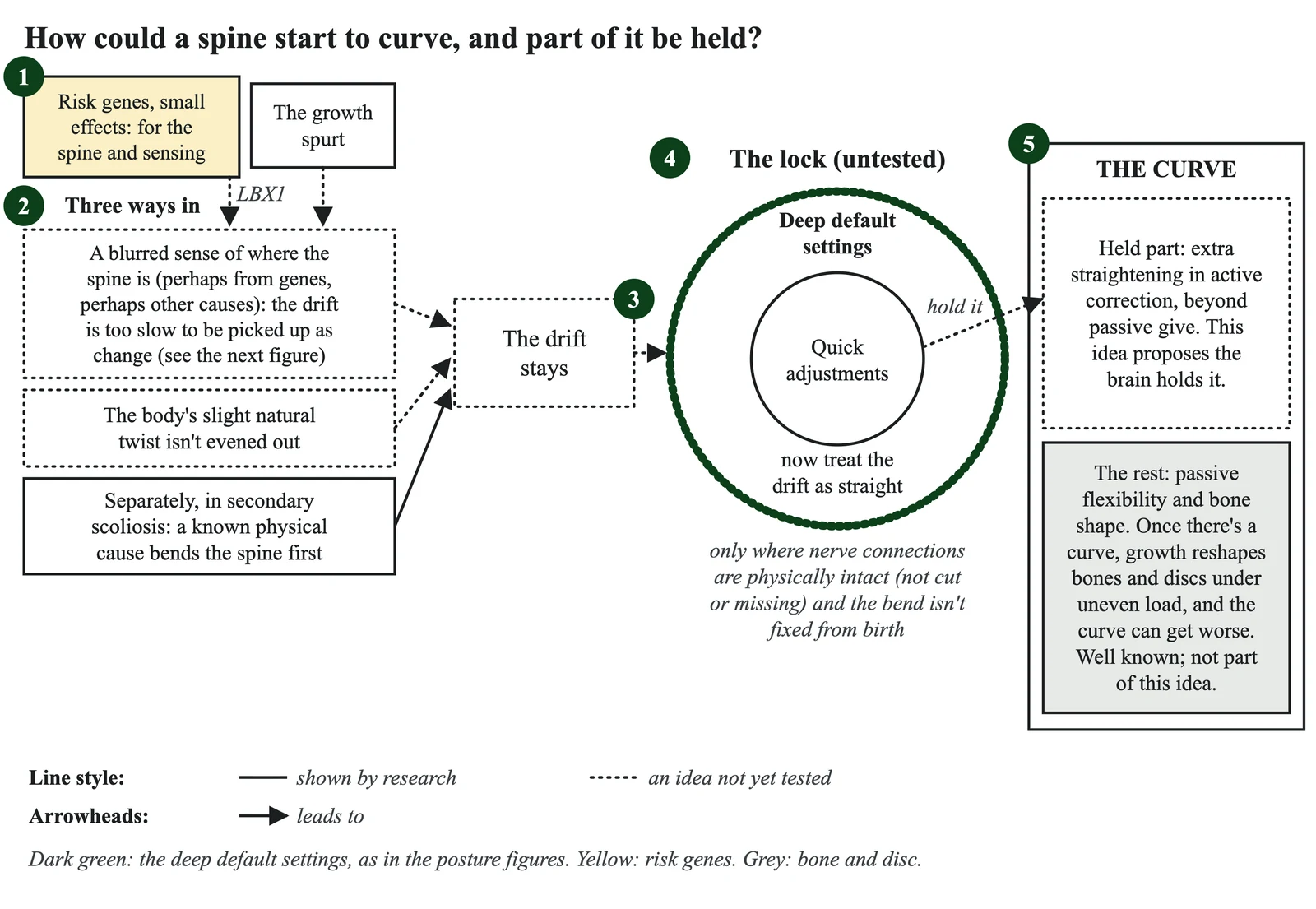
- Two starting conditions. Risk genes, each with a small effect: some sit near genes for spinal cartilage and discs, and one sits near LBX1, a gene that, in mice, helps build sensory nerve cells in the spinal cord. And the growth spurt, when the spine grows fast.
- Three ways in. The paper proposes that a blurred sense of where the spine is lets a slow drift go unnoticed, or that the body’s slight natural twist is not evened out during growth. Separately, in secondary scoliosis, a known physical cause bends the spine first. That last route is well established.
- The drift stays. Whichever way in, a small sideways shift persists instead of being corrected.
- The lock. The proposal at the heart of the paper: the brain’s deep default settings slowly get used to the drift and start treating it as straight, and the quick adjustments that keep you upright then hold the body there. This is untested. The paper says it can only happen where the nerve connections are intact and the bend is not fixed from birth.
- The curve has two parts. The held part is the extra straightening a person gets when they actively correct, beyond what passive flexibility allows. The paper proposes the brain keeps this part in place; it is the only part the hypothesis is about. The rest, passive flexibility and bone shape, is not claimed: once a curve exists, growth and uneven load on bone can make it worse, which is well known.
Notice what the picture does not say. The arrow from the genes is dotted: whether the LBX1 risk works through sensing is not yet known. And the lock has not been shown. Those are the parts the paper sets out to test.
The main figure of the Neural Generation Hypothesis (Miller, 2026; version 3.0) has three parts. First, how a curve can begin: small-effect risk genes (structural loci such as PAX1 and GPR126, and a locus near LBX1 whose route through sensing is unconfirmed) and the growth spurt feed a proposed sensory route in which drift is too slow to be signalled as change; a second proposed route is unregulated asymmetry, in which the body’s normal slight twist is not damped; an established secondary route begins with a structural load. Second, the proposed lock: through use-dependent learning, the body schema’s slow loop moves its reference toward the persisting deviation and treats it as straight, only where the sensorimotor loop is anatomically intact. Third, what follows: the fast loop holds the moved reference, producing the held part of the curve (active minus passive correction), which is the only part the hypothesis claims; passive flexibility and bone shape follow established growth-driven loading. The lock and both proposed routes are untested.
The Gene That Started Everything
An Instagram commenter challenged my framework by citing genetic evidence from the NIH. That challenge sent me to the published research. What I found changed the direction of everything.
One of the strongest and most replicated genetic signals in adolescent idiopathic scoliosis lies at the LBX1 locus, identified by genome-wide association (Takahashi et al., 2011, Nature Genetics) and replicated across populations, with modest effects (pooled odds ratio about 1.2). In mice, Lbx1 is required for one of the two major classes of dorsal-horn sensory interneurons, which relay touch and pain, some of which handle position signals within the spinal cord (Gross et al., 2002; Satoh et al., 2016). Whether scoliosis risk at this locus acts through these neurons is not confirmed. A 2024 mouse study (McCallum-Loudeac et al., Human Molecular Genetics) deleted a 189 base-pair region near Lbx1 that overlaps the human signal. The mice scored worse on a sensorimotor test at 4 weeks and showed about 6 degrees of vertebral rotation as adults, but the deficit later converged with normal mice and the deletion also changed neighbouring genes. Two other well-replicated genes, PAX1 and GPR126, act on the spine’s cartilage and growth plates.
The genetics point two ways. Some risk genes, PAX1 and GPR126, shape the spine’s own cartilage and growth plates. One sits near LBX1, on the sensing side.
A 2024 mouse study tested that region. Mice missing a small stretch of DNA nearby did worse on a sensorimotor test at four weeks old, and as adults their vertebrae were rotated by about six degrees.
The paper follows the sensing side. Whether that is the right side is what the tests are for.
What’s shown, and what isn’t
- Shown: scoliosis risk genes exist, and uneven loading during growth drives how big curves get.
- Shown in animals: losing position sense entirely can start a curve. Untested in teenagers with AIS.
- Seen in people, but only after the curve appeared: weaker position sense and altered balance in a subgroup. These could be a result of the curve rather than its cause.
- Suggestive: the mouse study above. The deficit faded later, and the deletion also changed nearby genes.
- Not yet tested: the steps that belong to this hypothesis. Drift too slow to notice, the map updating toward the curve, the stress and social loops, and whether the held part can change.
The paper rates every link this way. That is the point of a hypothesis: it says what would prove it wrong.
How a Drift Could Slip Past
The second figure zooms in on the first way in. It asks one question: if the nervous system is watching the body all the time, how could the spine drift without being corrected?
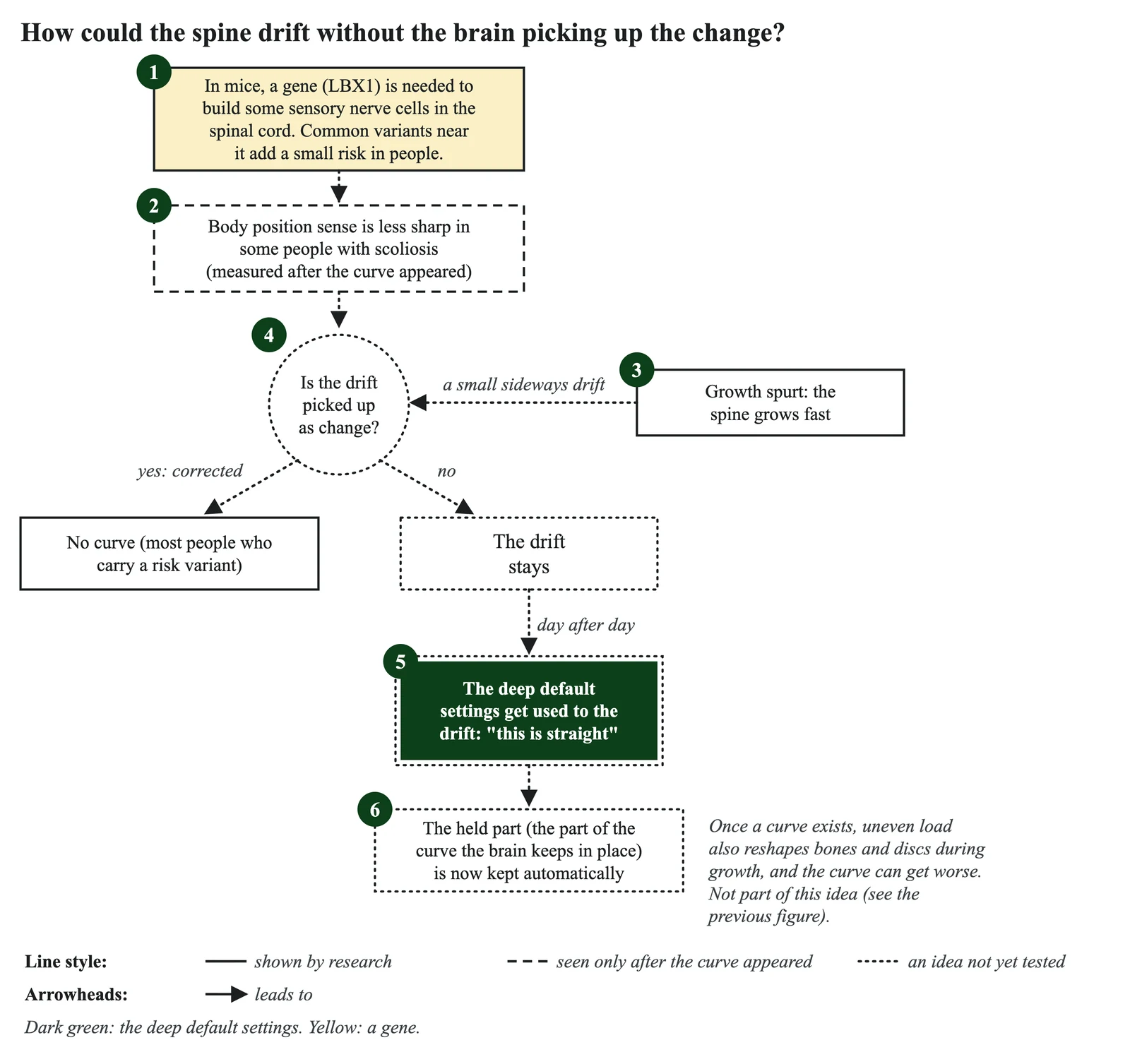
- In mice, LBX1 is needed to build some of the sensory nerve cells in the spinal cord. In people, common variants near it add a small risk.
- Body position sense is less sharp in some people with scoliosis. This was measured after the curve appeared, so it could be a result of the curve.
- During the growth spurt the spine grows fast, and a small sideways drift is assumed.
- The key question: is the drift picked up as change? If it is, it is corrected. The paper offers this as one reason most people who carry a risk variant never develop a curve.
- If it is not, the drift stays, and day after day the deep default settings get used to it: “this is straight.”
- The held part of the curve is now kept automatically. Separately, once a curve exists, uneven load reshapes bones and discs during growth, and the curve can get worse. That is not part of this idea.
Every dotted line and box is a proposal. The paper names the tests that would check it, including a measure of how well the trunk detects slow drift.
Figure 3 of the Neural Generation Hypothesis (Miller, 2026) proposes a sensory route. In mice, Lbx1 is required for some dorsal-horn sensory interneurons, and common human variants near LBX1 add small risk; trunk position sense is less accurate in a subgroup of patients, measured after onset. During growth a slow drift is assumed. If the drift is signalled as change, the fast loop corrects it, proposed as one reason most risk-allele carriers have no curve. If it is not, the deviation persists and use-dependent learning is proposed to move the body schema’s reference toward it until it is treated as straight; the fast loop then holds the moved reference. These steps are untested, and the paper proposes measuring slow-drift detection in the trunk to test them.
The Numbers
The paper includes rough arithmetic to show the idea is at least possible. The spine’s drift during the growth spurt is small month to month. People with scoliosis need, on average, a bigger movement before they notice it: about 1.6 degrees more in the studies that measured it, at the neck, elbow and knee rather than the trunk. Small monthly drift against a raised detection threshold is how a change could slip past unnoticed.
It is an illustration. Measuring it directly in the trunk is one of the tests.
A 2022 meta-analysis of 11 case-control studies in adolescent idiopathic scoliosis pooled two of them for motion detection: thresholds about 1.6 degrees higher than in controls, measured at the neck, elbow and knee rather than the trunk (low-certainty evidence, measured after onset). In one cohort, about 30% of patients had a trunk position-sense deficit, and they had larger curves, but in a one-year follow-up the deficit did not predict which curves progressed. The Neural Generation Hypothesis (Miller, 2026) proposes that during growth, spinal drift too slow to be signalled as change goes uncorrected and is absorbed by the body schema; this step is untested.
If the paper is right, the part of the curve a person can actively correct is not a failure. It is the system’s best prediction given the sensory input available.
Your posture has a pattern. Most people never get shown what it is.
Two minutes. A few honest questions. Find out where to start, and why.
Three Loops That Help It Stick
Once a curve forms, the paper proposes three loops that help keep it in place.
The position-sense loop. In people with scoliosis, the position-sense deficit is larger in larger curves. If the curve blurs the signal that would detect it, the loop feeds itself.
The stress loop. A body that feels under threat is proposed to trust its own signals less, so drift is even less likely to be noticed.
The social loop. Distress and the weight of a diagnosis may push the same way.
None of these decides a curve’s shape. They make a small asymmetry more likely to stay. The first loop rests on a measured link, although which way it runs is still open. The other two are proposals.
Eleven Testable Predictions
The paper makes eleven predictions and says which results would count against it, with proposed numbers for the main tests. Two can be run soon.
The first uses data that already exist. A large birth cohort tested children’s balance at age 10 and checked for scoliosis at 15, leaving out anyone already curved at 10. If the hypothesis is right, poorer balance and sensory measures before onset should go with a higher chance of a curve later.
The second can be added to brace care that is already happening. When a brace comes off in a teenager who has finished growing, the hypothesis predicts that how they perceive their own trunk at that moment should predict how much correction they later lose.
Part of why these tests have not been run: of 27 studies of body representation in scoliosis, 24 measured body image (how teenagers feel about their appearance) and only four measured the body schema.
What This Means
“Idiopathic” does not mean “without cause.” It means no cause was found with the tools used. Current tools measure the structural output. The paper proposes that whatever holds part of the curve works across the nervous system, how genes are switched on and off, autonomic state and the social environment, and the usual clinical pathway does not assess any of them as a contributor to that part of the curve.
The Neural Generation Hypothesis (Miller, 2026) proposes three loops that may maintain the actively correctable part of a scoliosis curve. The proprioceptive loop: the position-sense deficit is larger in larger curves (a measured association whose direction is open). The autonomic loop: a threat state is proposed to lower the weight given to body signals, making drift less likely to be corrected (untested). The psychosocial loop: social stress and the diagnosis itself are proposed to act the same way (untested; current studies report distress as an effect of scoliosis). The loops are not proposed to set the curve’s shape, only to make an existing asymmetry more likely to persist.
The paper does not claim to have proven any of this. It claims something testable, and says how to test it.
If the hypothesis holds up, “idiopathic” may need revision. Not because the clinical category stops being useful, but because part of what it covers may turn out to be measurable.
Common Questions About the Neural Generation Hypothesis
Has the Neural Generation Hypothesis been proven?
No. It is a hypothesis, posted as a free preprint on Zenodo and not yet peer reviewed. Some of its building blocks are well supported, such as scoliosis risk genes and curves growing with growth. The steps that belong to it, including the lock, are untested, and the paper lists eleven predictions that could prove it wrong.
Does it say scoliosis starts in the brain?
Not quite. It proposes that the extra part of a curve a person can correct actively, beyond passive flexibility, is held by the brain’s model of the body, and that a blurred sense of body position during growth is one way in. Growth and uneven loading on bone still decide how large a curve gets.
Is scoliosis caused by the LBX1 gene?
No single gene causes adolescent idiopathic scoliosis. Variants near LBX1 add a small risk, and most people who carry them never develop a curve. Whether that risk works through sensory nerve cells is not yet known. More in The Scoliosis Gene That Points to the Nervous System.
Does this mean a curve can be reversed?
The paper does not claim that. Whether the held part of a curve can change, and how, is one of its untested predictions. No trial has yet shown that changing how the body is sensed changes a curve.
How does this relate to bracing and Schroth?
It is not a replacement for standard care. Bracing during growth and scoliosis-specific exercise such as Schroth are the standard conservative treatments with trial evidence. The hypothesis adds a question about what the nervous system is holding, and proposes ways to test it, including when a brace comes off.
Where can I read the paper?
It is free on Zenodo: The Neural Generation Hypothesis of Adolescent Idiopathic Scoliosis. The figures in this article are plain-language versions of the paper’s Figures 2 and 3.
The Syntropic Core Connection
The paper is the theory. The Syntropic Core method is the practice the paper grew out of.
The method is built around the three loops the paper describes. Proprioceptive precision training targets the first loop. Autonomic state regulation targets the second. Reframing a “structural defect” as a prediction that may be updatable targets the third. This is what members of the Posture Dojo community practice.
The paper did not come first. The practice came first. The paper is the proposed science underneath what the community has been doing. It gives names to what practitioners and members have been noticing in their own bodies for years.
Read the Paper
Samuel Aza Miller. Posture Dojo Research. 2026.
202 references. 7 disciplines. 11 testable predictions. One hypothesis: the part of the curve a person can actively correct is held by the brain’s predictive model of the body. The “idiopathic” designation may reflect a measurement gap, not an absence of cause.
Related Reading
- The Scoliosis Gene That Points to the Nervous System
- The Scoliosis Research That Points to the Nervous System
- Why Scoliosis Treatment Hasn’t Changed in 60 Years
- How Your Brain Controls Posture: The Body Schema
- Why Awareness Changes Your Posture (And Effort Doesn’t)
Sources
- Miller, S.A. (2026). The Neural Generation Hypothesis of Adolescent Idiopathic Scoliosis: Converging Evidence from Genetics, Proprioception, and Predictive Coding. Version 3.0. Preprint, Zenodo. DOI: 10.5281/zenodo.19342098
- Takahashi, Y., et al. (2011). A genome-wide association study identifies common variants near LBX1 associated with adolescent idiopathic scoliosis. Nature Genetics, 43(12), 1237-1240.
- McCallum-Loudeac, J., Moody, E., Williams, J., Johnstone, G., Sircombe, K.J., Clarkson, A.N., Wilson, M.J. (2024). Deletion of a conserved genomic region associated with adolescent idiopathic scoliosis leads to vertebral rotation in mice. Human Molecular Genetics, 33(9), 787-801.
- Gross, M.K., et al. (2002). Lbx1 specifies somatosensory association interneurons in the dorsal spinal cord. Neuron, 34(4), 535-549.
- Herman, R., Mixon, J., Fisher, A., Maulucci, R., Stuyck, J. (1985). Idiopathic scoliosis and the central nervous system: a motor control problem. Spine, 10(1), 1-14.
- Burwell, R.G., Dangerfield, P.H., Freeman, B.J. (2008). Concepts on the pathogenesis of adolescent idiopathic scoliosis. Studies in Health Technology and Informatics, 135, 3-52.
- Lau, K.K.L., Law, K.K.P., Kwan, K.Y.H., Cheung, J.P.Y., Cheung, K.M.C., Wong, A.Y.L. (2022). Timely Revisit of Proprioceptive Deficits in Adolescent Idiopathic Scoliosis: A Systematic Review and Meta-Analysis. Global Spine Journal, 12(8), 1852-1861.
- Bertuccelli, M., Cantele, F., Masiero, S. (2022). Body image and body schema in adolescents with idiopathic scoliosis: a scoping review. Adolescent Research Review, 8, 97-115.
- Satoh, D., Pudenz, C., Arber, S. (2016). Context-dependent gait choice elicited by EphA4 mutation in Lbx1 spinal interneurons. Neuron, 89(5), 1046-1058.
- Cao, Y., Min, J., Zhang, Q., Li, H., Li, H. (2016). Associations of LBX1 gene and adolescent idiopathic scoliosis susceptibility: a meta-analysis based on 34,626 subjects. BMC Musculoskeletal Disorders, 17, 309.
- Lau, K.K.L., Kwan, K.Y.H., Cheung, J.P.Y., Law, K.K.P., Wong, A.Y.L., Chow, D.H.K., et al. (2025). A substantial proportion of subjects with adolescent idiopathic scoliosis display spinal and peripheral proprioceptive deficits. Bone & Joint Open, 6(10), 1164-1170.
- Lau, K.K.L., Kwan, K.Y.H., Cheung, J.P.Y., Law, K.K.P., Wong, A.Y.L., Chow, D.H.K., et al. (2026). Association of proprioceptive deficits with curve progression and treatment outcomes in subjects with adolescent idiopathic scoliosis: a prospective cohort study with 1 year of follow-up. North American Spine Society Journal, 27, 100899.
- Friston, K. (2010). The free-energy principle: a unified brain theory? Nature Reviews Neuroscience, 11(2), 127-138.
The Posture Dojo is a free community exploring the science of how your body generates posture. No corrections. No exercises. A different operating system. Join the conversation here.
Comments
One response to “The Neural Generation Hypothesis: What the Paper Says and Why It Matters”
[…] The Neural Generation Hypothesis: What the Paper Says and Why It Matters […]