Close your eyes. Point to your left kneecap without looking.
You did not have to think about where it was. You did not need a mirror. You did not need to touch your leg first. Something inside you already knew.
Now consider: how?
You have no camera inside your body. No GPS chip in your knee. No sensor display projected onto the back of your eyelids. And yet your finger landed within a centimeter of the target. Maybe closer.
That accuracy comes from a system most people have never heard of. It is called the body schema. And it is the single most important concept in posture that almost nobody is talking about.
The body schema is the brain’s non-conscious internal model of the body’s position, shape, and movement capabilities in three-dimensional space. First described by neurologist Jacques Paillard in 1999, the body schema is distinct from body image. Body image is what you see in the mirror and think about your appearance. Body schema is what the brain uses to generate every movement and posture without your conscious involvement. You do not decide where to place your foot when walking. The body schema generates that prediction automatically. When this model is accurate, posture organizes effortlessly. When it degrades through injury, chronic pain, or prolonged inactivity, the brain’s predictions become inaccurate and posture deteriorates. The body schema lives in the parietal cortex and is continuously updated by sensory input from two pathways: direct touch and feel, and the cerebellum’s timing and coordination system.
Your posture is not a position you hold. It is a prediction your nervous system generates continuously, based on an internal model called the body schema. Change the model. The posture changes.
That sentence is the key to everything on this site. Every article. Every protocol. Every result. It all traces back to this one idea: your brain is running a model of your body, and your posture is the output of that model.
After 20 years of working with my own 85-degree scoliosis, I learned that my spine was never the problem. The problem was the model my nervous system was running. Every therapist I saw was trying to change the output. None of them were looking at the software generating it.
This article is going to show you how that software works.
What is the body schema and why does it control your posture?
The body schema is your brain’s three-dimensional model of your own body. Its position. Its shape. Its boundaries. Its movement capabilities. Every moment of every day, this model is running. It is the reason you can reach for a coffee cup without looking at your hand. The reason you can walk through a doorway without measuring your shoulders against the frame.
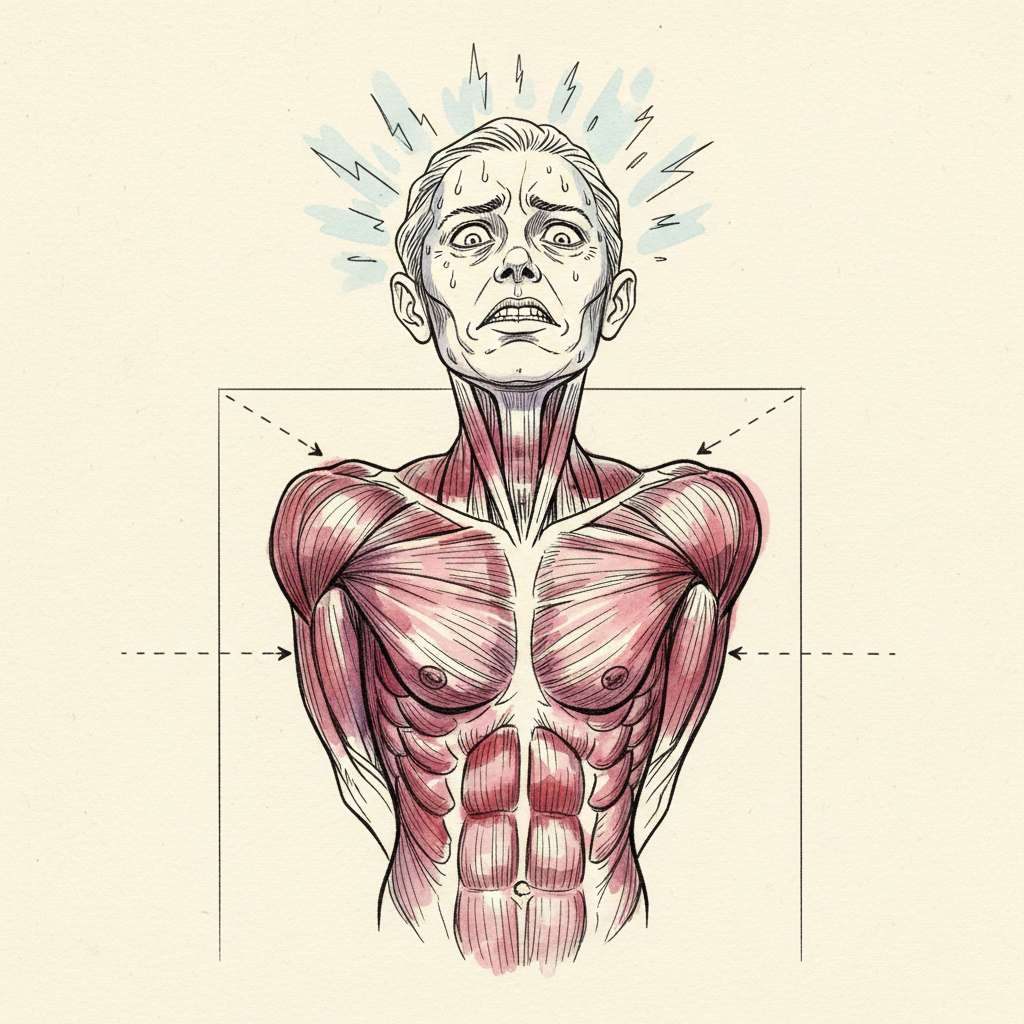
Neurologist Jacques Paillard established the critical distinction in 1999 [1]. There are two separate systems the brain uses to represent the body. Body image is the conscious one. It is what you see in the mirror. What you think about when someone asks you to describe your posture. It lives in the temporal and frontal cortices of your brain.
Body schema is the other one. Non-conscious. Automatic. Running below your awareness at all times. It lives in the parietal cortex. And it is the one that actually generates your posture.
This distinction matters more than almost anything else in posture science. Here is why.
When you stand in front of a mirror and pull your shoulders back, you are working with body image. You are using conscious visual feedback to override a pattern. The moment you walk away from the mirror, the override disappears. Because the body schema never changed. This is why posture keeps reverting.
The body schema does not care what the mirror showed you. It has its own map. Its own measurements. Its own predictions about where every part of you is in space right now. And those predictions are what the motor cortex executes.
Your body schema is your Temple. Not in the spiritual sense. In the architectural sense. It is the structure your nervous system inhabits. Some rooms are lit. Some are dark. The dark rooms are where your body has gone offline.
Think about that. There are regions of your body right now that your brain has a sharp, detailed map of. Your fingertips. Your lips. Your tongue. These regions have massive cortical real estate. The map is rich, detailed, constantly refreshed.
And there are regions where the map has gone blurry. Degraded. Lost resolution. Your mid-back. Your deep hip rotators. The muscles between your shoulder blades. These regions may have gone years without sending the brain a clear signal. The map for those areas has faded like a photograph left in the sun.
The blurry regions are where your posture breaks down. Not because the muscles are weak. Because the brain cannot accurately predict what those muscles should be doing. A weak muscle can be strengthened. A blurred map requires a completely different intervention. It requires the brain to receive clear, novel sensory information from that region. It requires the map to be redrawn.
How your brain generates posture as a prediction
Your brain does not wait for sensory information to arrive and then react. It predicts. It generates a model of what it expects to happen next and then checks the incoming data against that prediction. When the prediction matches the input, nothing happens. When the prediction does not match, the brain generates a signal called a prediction error, and the model updates.
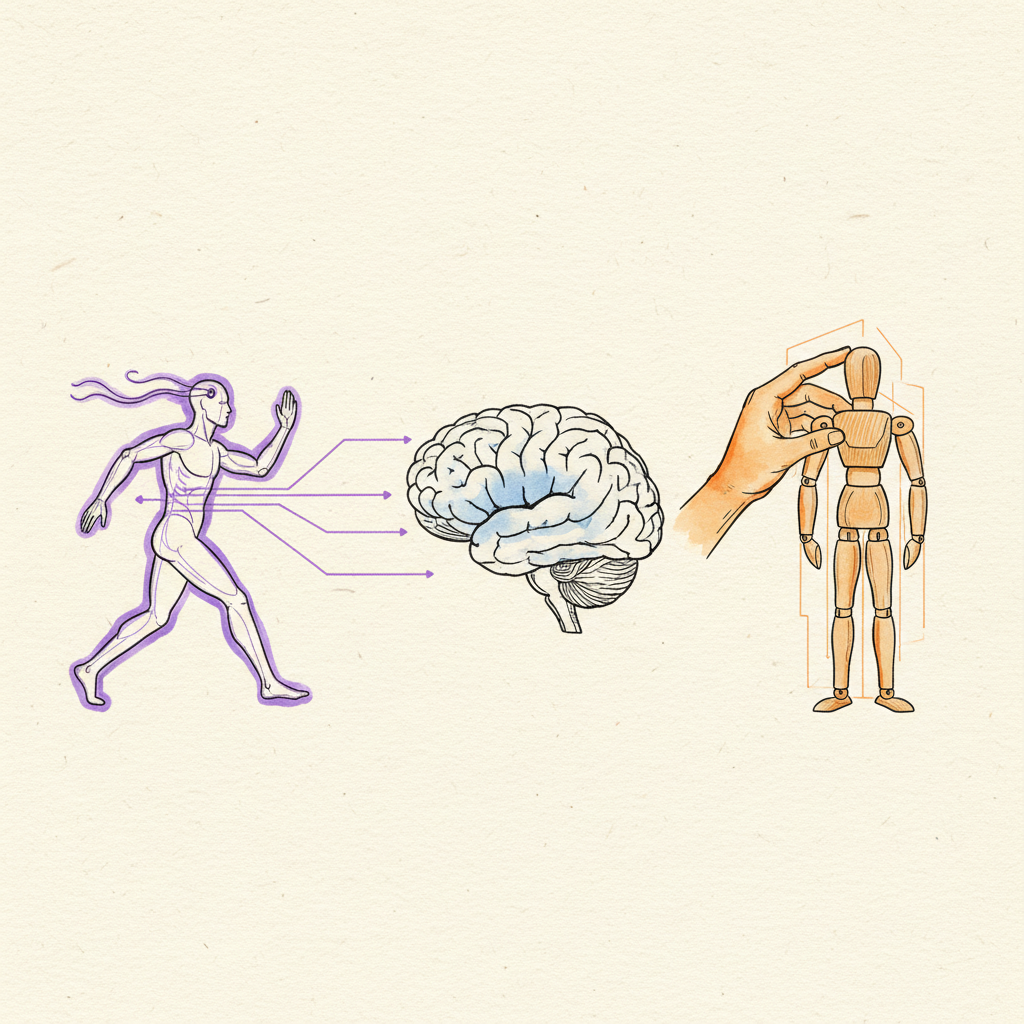
This is predictive coding. It is one of the most well-supported frameworks in neuroscience. Karl Friston’s free energy principle established the mathematical foundation [2]. Andy Clark’s work brought it to embodied cognition [3]. The core idea is this: the brain is not a reactor. It is a prediction engine.
The brain controls posture through an internal prediction system, not through conscious muscle commands. Two parallel sensory pathways carry proprioceptive information from the body to the parietal cortex, where the body schema lives. The first pathway delivers raw sensory data: what am I touching, what position am I in? The second pathway runs through the cerebellum, which compares actual movement against predicted movement and generates correction signals. These two streams converge in the parietal cortex, which continuously answers the question “where am I in space?” The answer to that question becomes the postural prediction that the motor cortex executes. Every posture you hold is the output of this prediction. Changing posture permanently requires changing the prediction, which requires changing the sensory input the parietal cortex receives from both upstream pathways.
Apply this to posture and the implications are enormous.
Your posture right now is a prediction. Your brain’s model says: this is where the head sits, this is the curve of the spine, this is the position of the pelvis. And the motor cortex executes that prediction without your involvement. You do not decide to slouch. Your body schema predicts the slouch, and the motor system delivers it.
Two parallel pathways feed information to that prediction. The first is the direct somatosensory route. Nerves in your feet, your joints, your skin carry raw sensory data up through the brainstem to the somatosensory cortex and then to the parietal cortex. This pathway answers the question: what am I touching right now? What position am I in?
The second pathway runs through the cerebellum. Same starting point. Same nerves. But this route detours through the brain’s timing and coordination center. The cerebellum compares your actual movement against the predicted movement and generates error correction signals. This pathway answers a different question: where am I in the movement? Am I on track or off?
Both pathways converge at the parietal cortex. Two streams of information arriving at the same destination. One says what you feel. The other says how that compares to what was expected. Together, they update the body schema.
Or they don’t. And that is where the problem lives.
Why “sit up straight” fails at the neurological level
You have heard this instruction a thousand times. From parents. From teachers. From physical therapists. Sit up straight. Stand tall. Pull your shoulders back.
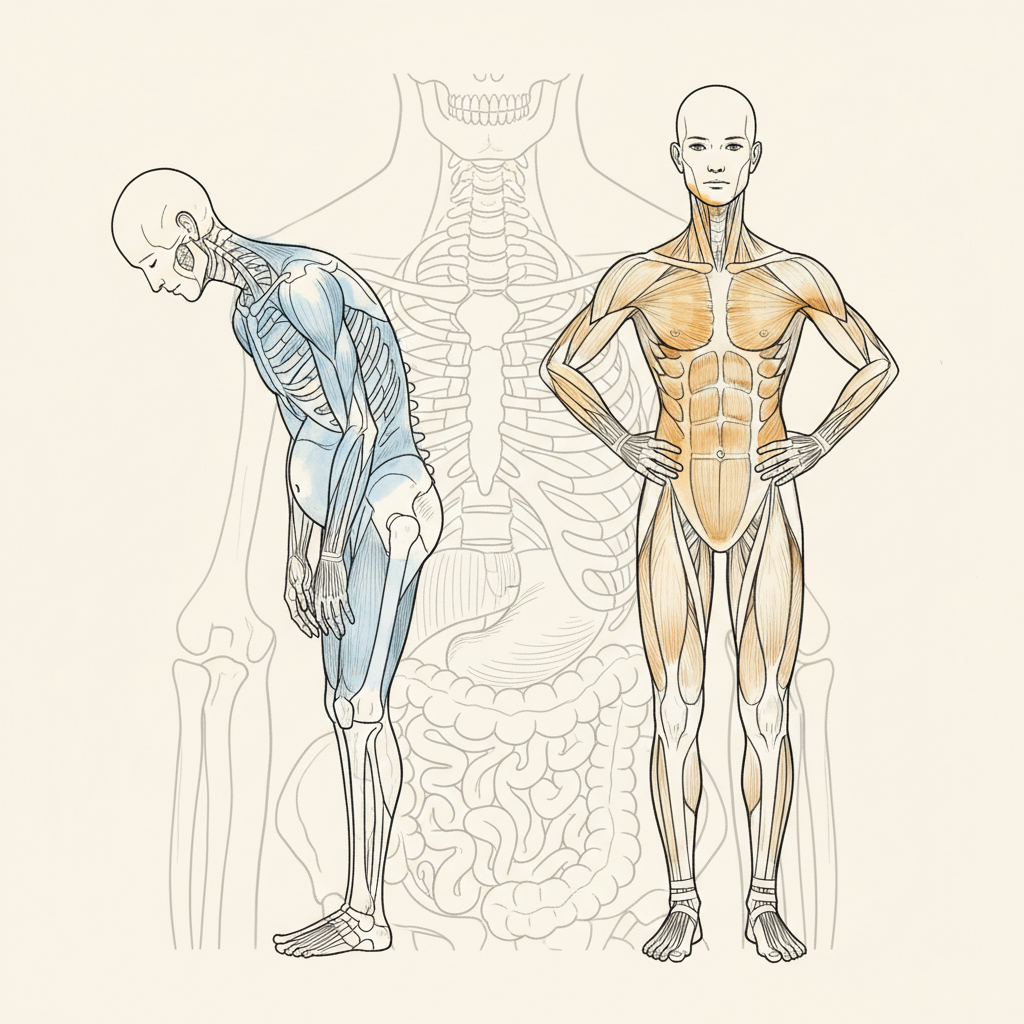
It does not work. Not because you lack discipline. Not because your muscles are weak. It fails because of the architecture of the brain itself.
The instruction “sit up straight” lands at the motor cortex. The executor. The part of the brain that carries out commands. And the motor cortex obeys. Temporarily. You straighten up.
But the body schema in the parietal cortex has not received any new information. It did not update. Its prediction of where your body should be has not changed by a single millimeter. So the moment your attention drifts, the prediction reasserts itself. You slouch again. Not because you failed. Because the prediction won.
Posture corrections do not hold because they target the wrong system. When you consciously straighten up, the instruction goes to the motor cortex, which executes the command temporarily. But the body schema in the parietal cortex, which generates the postural prediction, has not changed. The moment conscious effort stops, the prediction reasserts. Research by Tsao and Hodges (2008) showed that people with chronic postural dysfunction have measurably reorganized motor cortex representations of the trunk. The brain’s map has physically changed. Manual correction, stretching, or effortful posture adjustments temporarily override this map but do not update it. Three conditions must be met for the body schema to actually update: the sensory input must be novel and clear, the nervous system must not be in a threat state, and the input must not be cancelled by a voluntary motor command. Most posture correction violates all three.
This is not a discipline problem. It is an addressing problem. The instruction went to the wrong part of the brain. It instructed the executor instead of the predictor.
There is a deeper layer. When you consciously command a movement, your brain generates what neuroscientists call an efference copy. Think of it as a receipt. The brain says: I just told the body to do this, so I already know what it will feel like. And because the brain already predicted the sensation, the sensation gets cancelled. It does not register as new information. It does not update the map.
This is the mechanism. Effortful correction generates a motor command. The motor command generates an efference copy. The efference copy cancels the sensory evidence. The body schema receives nothing new. Nothing updates. You are working as hard as you can to change your posture, and the very effort is preventing the change.
I spent years doing exactly this. Pulling my shoulders back against an 85-degree curve. Engaging my core. Holding myself in positions that were supposed to retrain my posture. None of it held. Not because the positions were wrong. Because the approach was addressing the executor, not the predictor. The software kept running the same model.
The three conditions for changing your body’s internal model
If effortful correction does not update the body schema, what does?
Three conditions must be met simultaneously for the body schema to accept new information and update its prediction. This framework emerges from the synthesis of predictive coding research, thalamic gating literature, and efference copy mechanisms.
Condition one: the sensory input must be novel and sufficiently precise.
The brain assigns a confidence level to its existing prediction. A posture you have held for ten years has a very high-confidence prior. New sensory evidence must exceed that confidence threshold to trigger an update. This is why a single good therapy session often does not hold. The evidence was real. But it was not precise enough or repeated enough to outweigh the brain’s confidence in the old prediction.
The input needs to be something the brain did not predict. Unexpected. Clear. Salient. A novel sensation that creates genuine prediction error.
Condition two: the brain’s threat filter must be open.
Your thalamus acts as a gate [8]. Under threat, under chronic pain, under stress, the thalamus suppresses sensory signals from affected body regions before they reach cortical processing. This is the anatomical mechanism behind what researchers call cortical smudging. The body map blurs. Not because the signals are not being sent. Because the gate is filtering them out.
Lorimer Moseley’s research demonstrated this through two-point discrimination testing [7]. People with chronic back pain could not distinguish two points of touch on their lower back that healthy subjects could easily differentiate. The signals were traveling from the skin. But the thalamic gate was narrowing what reached the cortex. The map degraded.
The same intervention does nothing in a threat state but works immediately once the nervous system shifts. Same technique. Same therapist. Same body part. Different result. Because the gate opened.
This is what it means when researchers describe safety as the prerequisite for sensory updating. It is not a philosophical statement. It is an anatomical one. The thalamus must allow the signal through before the body schema can receive it.
Condition three: the input must not be cancelled by a voluntary motor command.
This is the efference copy problem described above. When you consciously command a movement, the brain pre-cancels the expected sensation. The evidence gets deleted before it arrives at the body schema.
This creates a paradox. Trying to fix your posture is the thing that prevents your posture from updating. The effort itself blocks the mechanism of change.
Now look at what standard posture correction does. You straighten up (motor command, condition three violated) while feeling frustrated with yourself (threat state, condition two violated) and the resulting sensation matches exactly what you expected (no novelty, condition one violated). Zero of three conditions met. This is not just ineffective. It is structurally incapable of working.
A client named Marcus put it perfectly when this clicked for him. He said: “So the software is generating the hardware pattern? That is not how I have been thinking about it.”
No. It is not how anyone has been thinking about it. That is the problem.
The entire posture industry is built on the assumption that posture is a hardware problem. Tight muscles. Weak muscles. Misaligned joints. Treat the hardware, fix the output. But the body schema is software. It generates the hardware pattern. And until the software updates, the hardware will keep returning to its predicted configuration. Every time.
What happens when the body schema degrades
When the body schema loses accuracy in a region, three things happen. Each one makes the problem harder to solve.
The brain’s body map blurs.
Moseley and Flor’s research on cortical smudging showed that chronic pain or prolonged inactivity causes the somatosensory cortex to lose resolution at the affected region [7][5]. The brain’s map of that area literally degrades. Where there was once a detailed representation of individual muscles, joints, and segments, there is now a smeared approximation.
You can test this yourself. Have someone touch two points on your lower back simultaneously, a few centimeters apart. Can you feel two distinct points? Or does it feel like one? The answer tells you something about the resolution of your body schema in that region.
Sensory Motor Amnesia is a condition identified by Thomas Hanna in which the brain loses voluntary control over muscles it has been holding in chronic contraction. The muscles are not physically damaged or shortened. The cortical map for those muscles has degraded. The brain can no longer access them voluntarily. The muscles remain contracted not because of tissue stiffness but because the brain has forgotten how to release them. In a clinical study of 103 patients, Hanna Somatic Education, which uses pandiculation (a voluntary contraction followed by extremely slow release with full sensory attention) to restore cortical access, achieved 81% pain reduction in an average of 2.8 sessions. Sensory Motor Amnesia explains why tight muscles stay tight despite stretching. Stretching addresses muscle length. Pandiculation addresses the brain’s control of muscle tone. They are solving different problems.
The motor map reorganizes.
Tsao, Galea, and Hodges showed in 2008 that people with chronic postural dysfunction have measurably reorganized motor cortex representations of the trunk [6]. The brain’s map of how to move those muscles has physically shifted. This is not a feeling. It is measurable with transcranial magnetic stimulation. The motor cortex has literally remapped.
The reorganization persists beyond tissue healing. Hodges and Moseley demonstrated that protective motor patterns installed during pain continue to run after the pain resolves [9]. The tissue is fine. The compensation continues. Because the brain’s model still includes the pain prediction, and the motor cortex is still executing the protective strategy.
The brain loses voluntary access to chronically held muscles.
Thomas Hanna identified this phenomenon and called it Sensory Motor Amnesia [4]. The muscles are not damaged. They are not shortened. The brain has lost the ability to voluntarily control them. The cortical map for those muscles has degraded to the point where the brain can no longer tell them what to do. Or what to stop doing.
This is why your tight muscles stay tight despite years of stretching. Stretching addresses muscle length. But the tightness is not a length problem. It is a control problem. The brain is holding those muscles in contraction and has forgotten that it is doing so.
Hanna’s clinical data is striking. In 103 patients treated with pandiculation, a technique that uses voluntary contraction followed by extremely slow release with full sensory attention, 81% experienced pain reduction [4]. Average treatment: 2.8 sessions. The technique works because it does not stretch the muscle. It restores the brain’s cortical access to the muscle. It redraws the map.
Three phases. You voluntarily contract the muscle (which forces the brain to find it on the map). You slowly lengthen while paying full attention (which feeds the body schema high-resolution sensory data). You completely release (which establishes a new resting baseline). The brain has to feel before it can update. Sensation before motor output. This is the Hebbian constraint on body map plasticity.
The sensory hierarchy that governs the body schema
Not all sensory inputs are equal. The body schema has a priority system. Some inputs override everything below them in the hierarchy regardless of how well the lower tiers are organized.
This is the body’s safety hierarchy. Safety comes first. Then sensory updating. Then motor output. Sequential, not parallel.
At the top of the sensory hierarchy: vision and jaw. Your suboccipital muscles, the tiny muscles at the base of your skull, have 36 spindles per gram of tissue. That is the highest sensory density in the human body, documented by Robert Schleip’s research on fascial plasticity [10]. Those muscles are not movers. They are sensors. They tell the brain exactly where the head is in space.
Body schema and body image are two separate brain systems that are often confused. Body image is your conscious perception of your body, processed in the temporal and frontal cortices. It involves how you see yourself, your emotional relationship to your body, and your aesthetic judgments. Body schema is a non-conscious sensorimotor model maintained in the parietal cortex. It generates every posture and movement automatically, without your awareness. Neurologist Jacques Paillard demonstrated this dissociation in deafferented patients who could point to where they were touched (intact body schema) but could not describe their body’s position verbally (impaired body image). For posture, this distinction is critical. Mirror-based posture correction targets body image. It changes what you see. But the body schema generates posture below conscious awareness. Lasting postural change requires updating the schema, not the image.
The head position is the output of the cerebellar model. Everything below the skull organizes around wherever the brain predicts the head to be. This is why forward head posture is never just a neck problem. It is the entire body schema organizing around a head prediction that has drifted forward.
Below vision and jaw in the hierarchy: the cerebellar integrator. This is the timing and error correction system. It calibrates the relationship between predicted and actual movement. When this tier degrades, coordination suffers. Balance becomes uncertain. The body schema starts generating conservative predictions. Do less. Move less. Stay safe.
Below that: the diaphragm, hip joints, and ground contact. These are the foundation inputs. They tell the body schema about pressure, support, and the relationship to gravity. When these signals are clear, the foundation of the prediction is stable. When they are noisy or absent, the entire prediction becomes less certain.
The hierarchy means something specific. You cannot breathe your way out of a jaw problem. The jaw lives above the breath in the hierarchy. You cannot strengthen your way out of a visual tracking problem. The eyes live above the muscles in the hierarchy. The body schema updates from the top down.
When the hierarchy fails, when the dominant inputs are sending inaccurate or threatening information, the nervous system produces a characteristic pattern. Weight shifts forward. Knees lock. The pelvis tilts anterior. The lumbar spine arches. The chest lifts. The head pushes forward. This is systemic extension. It is the threat response rendered anatomically. The nervous system reaching for the posterior chain to stabilize a system that has lost its spatial reference.
You are not choosing this pattern. Your body schema is predicting it. Because from the schema’s perspective, given the information it is receiving, this is the best available strategy.
How to actually update the body schema
If the body schema generates posture as a prediction, then lasting change requires updating the prediction. Not overriding it. Not fighting it. Updating it.
The nervous system’s own priority sequence gives you the order of operations.
First: establish safety. The brain’s threat filter must open before new sensory information can reach the body schema. This is not a warm-up. It is not a nice-to-have. It is a neurological prerequisite. If the thalamic gate is closed, no amount of good technique will reach the map. The signal gets filtered out before it arrives.
What opens the gate? Slow breathing. Non-threatening environments. The absence of performance pressure. Gentle, non-demanding awareness directed toward the body. Not effortful attention. Not vigilant monitoring. Quiet curiosity.
Second: deliver novel sensory input. The body schema updates from prediction error, not from prediction confirmation. The input must be something the brain did not expect. Proprioceptive exercises that place the body in unfamiliar positions. Two-point discrimination training that rebuilds map resolution. Attention-based practices that give the body schema new data from regions it has stopped monitoring.
The input does not need to be large. Research on central magnification shows that the brainstem amplifies sensory signals between peripheral arrival and cortical processing. A small, clear input gets amplified before it reaches the body schema. It needs to pass the thalamic gate. It needs to be something the brain did not predict. But it does not need to be forceful.
Third: allow integration. After a genuine prediction error, the brain needs time to consolidate. Three to five breaths of staying with the felt change. Not moving on. Not adding more input. Staying. This is the window in which the body schema rewrites its prediction. Skip it, and the old prediction reasserts.
Permanent posture change requires updating the brain’s internal model of the body, called the body schema, rather than repeatedly correcting the body’s position. Research in predictive neuroscience shows the brain generates posture as a prediction based on sensory input. Effective approaches follow the nervous system’s own priority sequence. First, establish safety: the brain’s threat filter must open before new sensory information can reach the body schema. Second, deliver novel sensory input: proprioceptive exercises, two-point discrimination training, and attention-based practices that give the body schema new data it did not predict. Third, allow integration: the brain needs a consolidation window of three to five breaths of staying with the felt change. Approaches that skip safety (forcing correction), deliver predicted input (habitual stretching), or cancel evidence through effortful motor commands (consciously holding yourself upright) will produce temporary results that revert because the prediction was never updated.
Approaches that skip safety, deliver predicted input, or cancel evidence through effortful motor commands will produce temporary results that revert. The prediction was never updated. The brain just waited you out.
The model is the problem. The model is also the solution.
Every postural intervention you have ever tried was either working with the body schema or against it. Most were against it.
Stretching a muscle that the brain is holding in contraction. Against it. The brain re-contracts the muscle as soon as you stop stretching. Because the prediction never changed.
Strengthening a muscle that the brain has stopped recruiting. Against it. The brain routes around the strengthened muscle and maintains the compensation. Because the motor map never updated.
Consciously holding yourself in a corrected position. Against it. The efference copy cancels the sensory evidence. Nothing updates. You get tired. You stop. The prediction reasserts.
Working with the body schema looks different. It starts with safety. It delivers sensation the brain did not predict. It asks for nothing. It waits.
This is not a passive process. It is precise. It requires understanding which tier of the sensory hierarchy is driving the problem. It requires knowing the difference between an input that updates the map and an input that gets cancelled before arrival. It requires working with the brain’s own update mechanism instead of trying to bypass it.
Your body schema built your current posture over years. Maybe decades. It did not build it by accident. It built it as the best available prediction given the information it was receiving. Change the information. Give it a clearer signal. Open the gate. Let the prediction error land.
The model updates. The posture follows.
That is not a promise. It is a mechanism. And mechanisms do not require your belief. They require the right conditions.
—
Your body schema is generating your posture right now. The question is whether the model it is running is accurate. If you want to understand how to update it, join the free Posture Dojo community at posturedojo.com where we break down the science and practice of working with your nervous system instead of against it.
Syntropic Core Reset
Most posture programs give you exercises. This one updates the system that generates your posture. Four weeks live with Sam Miller. You learn how the hidden map works, why everything else missed it, and how to give your nervous system the evidence it needs to generate a different pattern. Breath. Ground contact. Safety. Sensory input. Floor to standing. You leave with a daily practice that holds because the map itself has changed.
Limited spots. Next cohort enrolling now.
Sources
- Paillard, J. (1999). Body schema and body image: a double dissociation in deafferented patients. In G.N. Gantchev, S. Mori, & J. Massion (Eds.), Motor Control, Today and Tomorrow (pp. 197-214). Sofia: Academic Publishing House. [T1]
Foundational body schema definition. Non-conscious sensorimotor model distinct from body image. - Friston, K. (2010). The free-energy principle: a unified brain theory? Nature Reviews Neuroscience, 11(2), 127-138. [T1]
Predictive coding framework. Brain generates predictions and updates only from prediction errors. - Clark, A. (2015). Surfing Uncertainty: Prediction, Action, and the Embodied Mind. Oxford University Press. [T1]
The brain as prediction machine. Action as prediction fulfillment rather than response to stimulus. - Hanna, T. (1988). Somatics: Reawakening the Mind’s Control of Movement, Flexibility, and Health. Da Capo Press. [T1]
Sensory Motor Amnesia. Loss of cortical control over chronically held muscles. Clinical data (n=103, 81% pain reduction). - Flor, H., et al. (1997). Phantom-limb pain as a perceptual correlate of cortical reorganization following arm amputation. Nature, 375, 482-484. [T1]
Cortical reorganization. The brain’s body map physically changes in response to chronic conditions. - Tsao, H., Galea, M.P., & Hodges, P.W. (2008). Reorganization of the motor cortex is associated with postural control deficits in recurrent low back pain. Brain, 131(8), 2161-2171. [T1]
Motor cortex reorganization in chronic postural dysfunction. Brain’s trunk map degrades with chronic back pain. - Moseley, G.L., & Flor, H. (2012). Targeting cortical representations in the treatment of chronic pain. Neurorehabilitation and Neural Repair, 26(6), 646-652. [T1]
Cortical smudging. Two-point discrimination. Treatment must target the map, not the tissue. - Porges, S.W. (2011). The Polyvagal Theory: Neurophysiological Foundations of Emotions, Attachment, Communication, and Self-Regulation. W.W. Norton. [T1]
Neuroception and safety hierarchy. Unconscious threat detection as prerequisite for sensory updating. - Hodges, P.W., & Moseley, G.L. (2003). Pain and motor control of the lumbopelvic region: effect and possible mechanisms. Journal of Electromyography and Kinesiology, 13(4), 361-370. [T1]
Pain reorganizes motor strategy. Protective motor patterns persist beyond tissue healing. - Schleip, R. (2003). Fascial plasticity: a new neurobiological explanation. Journal of Bodywork and Movement Therapies, 7(1), 11-19. [T1]
Suboccipital muscles: 36 spindles per gram, highest sensory density in the body. Fascia as sensory organ.
Related research
- Two Papers Just Landed: The Neural Generation Hypothesis and the Generative Posture Framework
- Stand Up Tall, Pull Your Shoulders Back, Brace Your Core: Why the 3 Most Common Posture Cues Are Neuroscience Dead Ends
- How Much Can I Actually Change My Scoliosis? What the Research Shows
- You Can’t Tickle Yourself. That’s Why Your Posture Won’t Change.
Comments
4 responses to “How Your Brain Actually Controls Your Posture: The Body Schema Model”
[…] brain maintains an internal model of your body in space. Neurologists have called it the body schema since Head and Holmes first described it in 1911. Paillard formalized the distinction in 1999. […]
[…] The Scoliosis Gene That Proves It’s a Nervous System Problem | How Your Brain Controls Posture | Your Diagnosis Describes a Shape, Not a […]
[…] at the screen. The screen is not the source. The projector is. Your muscles are the screen. The body schema is the projector. Every postural instruction you have ever received went to the wrong […]
[…] brain maintains a spatial model of your body. Researchers call it the body schema [3]. This model generates your posture as a continuous prediction. Not a fixed shape. A prediction, […]