I sat in that office at eighteen. The surgeon measured my curve. He told me I wasn’t a candidate for surgery. That was it.
No next step. No referral. No mention of the system generating the curve.
Not because he was hiding anything. Because nothing in his training, his tools, or his billing codes included a way to see it. Twenty years later I found it in a neuroscience paper. It had been in a different building the whole time.
The model has not changed in sixty years. This is the anatomy of a system that cannot ask the one question that would change everything.
1962: the year the model locked in
Paul Harrington was a Houston orthopedic surgeon treating polio patients. Their spines were collapsing. The muscles that should have held the vertebral column upright had been destroyed by the virus. The spine was a structural beam without support.
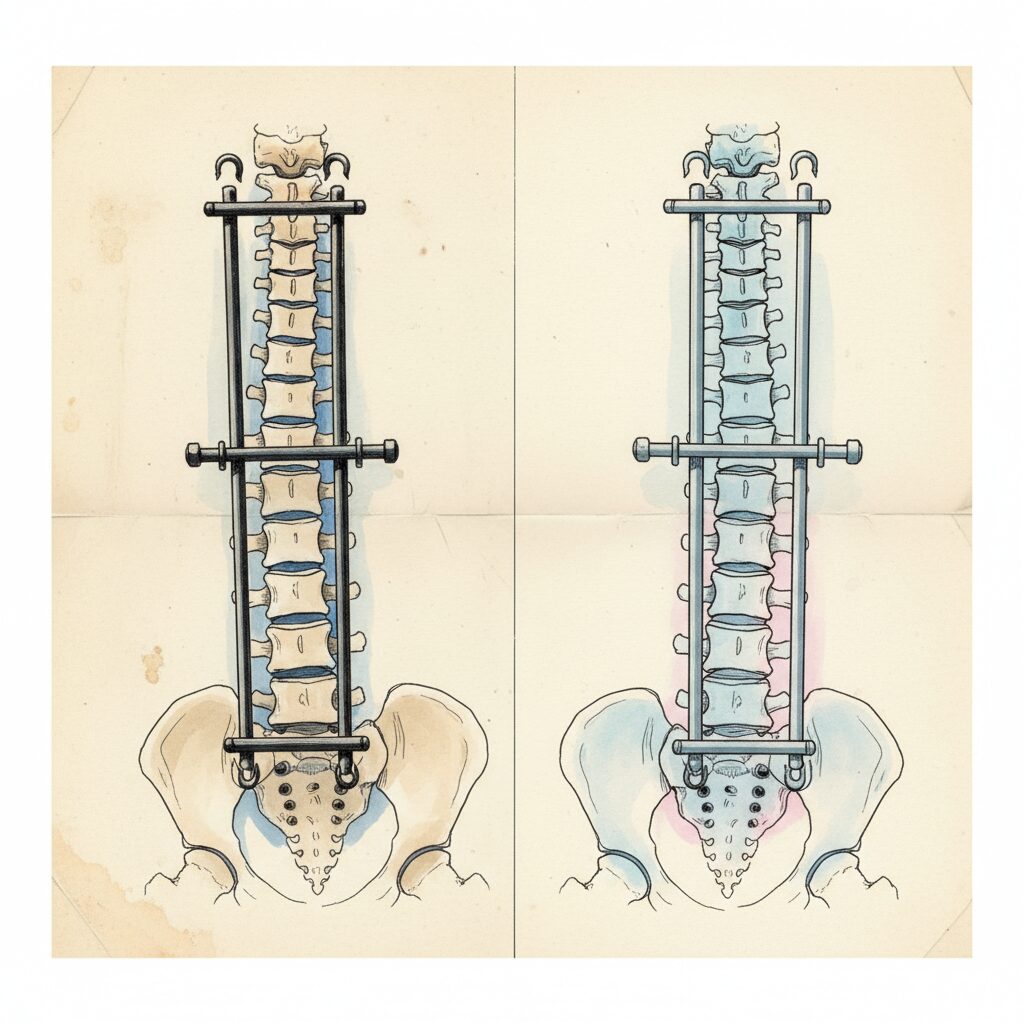
His solution was elegant: a stainless steel rod, hooked at the top and bottom of the curve, applying distraction force to straighten the collapsing column [1]. For polio patients, this was life-saving. The spine could not support itself. External hardware provided what internal biology could not.
The conceptual framework underneath it was specific: the spine is a mechanical structure. When it curves, you straighten it with rods.
That framework, born in the polio ward, became the operating system for all scoliosis treatment. The people trained in it became the professors who trained the next generation, and the model replicated itself through the training pipeline the way all models do. Invisibly. Without a vote.
The polio epidemic ended. The framework did not. It migrated from collapsed spines with no muscular support to curved spines with full muscular function. From structural failure to something else entirely. The tool stayed the same. The problem changed underneath it.
When did modern scoliosis treatment begin?
Modern scoliosis treatment began in 1962 when Paul Harrington developed spinal instrumentation for polio patients whose spines were collapsing from muscular paralysis. The Harrington rod used distraction force to straighten the spine mechanically, and it was life-saving for patients whose muscles could no longer support the vertebral column. This conceptual framework, treating the spine as a mechanical structure to be straightened with hardware, became the foundation for all subsequent scoliosis surgical treatment. Every major advance since 1962, including Cotrel-Dubousset instrumentation (1984), pedicle screw fixation (1990s), and vertebral body tethering (2010s), has refined the technology while preserving the original mechanical premise. The framework was designed for structural failure. It was applied to a different problem.
Sixty years of better hardware, same question never asked
Scoliosis treatment has been refined technologically for sixty years. Better rods. Better screws. Better imaging. Better surgical planning. The question “what is generating this curve?” has never entered the clinical pathway.
The system was built to measure the output. Assessing the generator was never on the blueprint.
| Year | Advance | What changed | What didn’t |
|---|---|---|---|
| 1962 | Harrington rod | First internal fixation for scoliosis | Curve treated as structural problem |
| 1984 | Cotrel-Dubousset instrumentation | 3D correction, better fixation [2] | Still addresses the curve shape |
| 1995 | Pedicle screw fixation standard | Stronger anchor points | Still addresses the curve shape |
| 2001 | Lenke classification replaces King [3] | Better categorization of curve types | Still describes output, not generator |
| 2010 | Vertebral body tethering (VBT) | Growth modulation, less invasive [4] | Still addresses the curve |
| 2013 | BrAIST study validates bracing [5] | Evidence base for external containment | External force. Doesn’t ask why. |
| 2016 | MAGEC magnetically adjustable growing rods | Non-invasive lengthening for pediatric cases | Still addresses the curve |
| 2020s | Robotics, 3D printing, AI surgical planning | Better execution of the operation | Same operation |
Every advance in sixty years has been a technological refinement of the same conceptual model. Better tools for the same job. More precise measurement of the same output. More sophisticated correction of the same shape.
Not one of these advances asked: what is generating this curve?
Eighty percent of scoliosis cases are classified as idiopathic [6]. The word means “of unknown cause.” After sixty years of technological refinement, four out of five patients receive a diagnosis that translates to: we measured your curve. We do not know why it is there.
That number is a signal. The framework is measuring the output with increasing precision. The generator is in a different building.
Why is 80% of scoliosis classified as idiopathic?
Approximately 80% of scoliosis cases are classified as idiopathic, meaning the cause is unknown (Konieczny et al. 2013). After sixty years of technological advancement in scoliosis treatment, four out of five patients receive a diagnosis that does not identify a cause. That reflects the boundaries of the conceptual framework rather than a failure of medical effort: the orthopedic model measures the curve as a structural output using Cobb angle radiography, Lenke classification, and imaging technology, and it does not assess the neurological system generating the curve. Research in predictive neuroscience (Friston 2010, Clark 2015) and body schema studies (Paillard 1999) suggests that scoliosis may be generated by the nervous system’s internal model as a predictive output, not as a structural defect. This research exists in neuroscience journals. It has not yet entered the orthopedic clinical pathway.
Five reasons the system can’t self-correct
Five features of a system optimized for something other than the question you are asking.
Lock 1: the training pipeline
An orthopedic surgeon completes ten to eleven years of post-graduate training. Four years of medical school. Five years of orthopedic residency. One to two years of spine fellowship. During those years, the curriculum covers anatomy, biomechanics, surgical technique, implant design, radiology, and clinical decision-making at an extraordinary depth.
Zero hours on body schema. Zero hours on predictive coding. Zero hours on active inference. Zero hours on how the nervous system generates posture as a prediction rather than holding it as a position.
The research exists. Karl Friston’s free-energy principle. Andy Clark’s predictive processing framework. Jacques Paillard’s body schema work [7][8][9]. Published in Brain, NeuroImage, Biological Cybernetics. Journals that orthopedic training programs do not assign. The knowledge is in a different building.
Lock 2: the billing architecture
CPT codes for spinal fusion: 22800 through 22819. CPT codes for physical therapy: 97110 through 97542. These codes define what can be done, billed, and reimbursed within the healthcare system.
There is no CPT code for body schema assessment. No billing pathway for autonomic regulation. No reimbursement structure for sensory re-education of the trunk.
A spinal fusion generates roughly 100 times the revenue of a conservative care visit [10]. The system funds what it recognizes. What it does not recognize does not get funded. What does not get funded does not get practiced. What does not get practiced does not generate evidence. The loop closes.
Lock 3: scope-of-practice walls
The regulatory structure that protects patients from unqualified practitioners also prevents cross-disciplinary integration. A surgeon cannot prescribe somatic education. A physical therapist cannot bill for autonomic regulation. A somatic educator cannot order imaging.
Each discipline operates within its legally defined lane. The patient moves between lanes. Nobody stands in the intersection. I have sat in a room knowing exactly what a client’s nervous system needed and been unable to order the imaging that would show it. The person who can order the imaging does not know what to look for. The walls that protect you from harm also protect the model from challenge.
Lock 4: the referral cascade
Primary care physician refers to orthopedic specialist. Specialist orders imaging. Imaging produces a Cobb angle measurement. Based on the measurement: watch, brace, or operate. That is the entire pathway. There is no exit ramp labeled “assess the generative system.”
Adding one creates a circular dependency. The surgeon would need someone to refer to. That someone would need a billing code. The billing code would need evidence. The evidence would need training programs. The training programs would need the surgeon to know it exists. Each piece requires every other piece to be in place before it can begin. So none of them begin.
Lock 5: the evidence standard paradox
Randomized controlled trials were designed for drugs and surgical procedures. One intervention. One control group. One measurable outcome. This design works brilliantly for testing whether a specific drug reduces a specific symptom in a specific population.
Somatic education is individualized. The body schema is measured in neuroscience laboratories, not orthopedic clinics. Autonomic regulation is measured by heart rate variability, not Cobb angle. The gold standard of evidence was designed for a different kind of intervention. It works. It was built for drugs and surgeries. Applying it to nervous system education produces a structural mismatch that looks, from inside the system, like absence of evidence.
The evidence exists. It is in a format the system does not accept.
Why hasn’t scoliosis treatment changed?
Scoliosis treatment has not fundamentally changed since 1962 because five interlocking structural features of the medical system prevent self-correction. The training pipeline teaches biomechanics without body schema or predictive neuroscience. The billing architecture reimburses surgery and physical therapy but has no codes for nervous system assessment. Scope-of-practice regulations prevent cross-disciplinary integration. The referral cascade has no exit ramp for generative system assessment. And the evidence standard (RCTs) was designed for drugs and surgery, not individualized somatic education. These locks are features of a system designed for mechanical problems and applied to a problem that is neurological in origin, not failures of the people within it. Each lock reinforces the others in a self-sustaining cycle.
Training produces scope. Scope defines billing. Billing shapes referral. Referral demands evidence. Evidence requires training. The cycle is complete. Self-reinforcing. Internally consistent. And structurally unable to incorporate the question that would change everything.
What an honest surgeon would tell you
There are honest surgeons. More than the internet would have you believe. Surgeons who stay current with the literature. Who refer to conservative care when the case warrants it. Who privately acknowledge that the system is not asking the right questions for every patient.
The honest ones know the difference between what a phrase sounds like and what it means.
“Failed conservative management.” The phrase appears in almost every surgical consultation. It is the clinical justification for proceeding to surgery. It sounds like everything was tried.
What it means: the patient did physical therapy and wore a brace. The Cobb angle continued to increase. The output was monitored. It got worse.
What it does not mean: the generative system was assessed. Nobody examined the body schema. Nobody measured autonomic state. Nobody tested the sensory hierarchy. Nobody assessed the pressure mechanics generating the curve. “Failed” means the structure did not respond to structural intervention. The generator was never on the checklist.
Surgeons are measured on surgical outcomes. Complication rates. Correction percentages. Fusion success. Patient satisfaction post-operatively. They are not measured on whether surgery was necessary. The system does not track that question. There is no metric for it. No quality indicator. No box on the form.
The Scoliosis Research Society and SOSORT have increasingly recognized conservative care [11]. European standards include exercise-based approaches like Schroth at initial diagnosis. The gap is narrowing. Slowly. From within a framework that is beginning to question its own boundaries.
The surgeon who told me there was nothing to be done was not wrong within his framework. He had measured my curve. It was below surgical threshold. Conservative care meant physical therapy and observation. I had done both. Within the model he was trained in, with the tools he had, with the billing codes available to him, there was genuinely nothing left to offer.
The limitation was not in the surgeon. It was in the model.
What do honest surgeons say about scoliosis treatment limitations?
Many orthopedic surgeons privately acknowledge that the scoliosis treatment system does not ask the right questions for every patient. Surgeons are measured on surgical outcomes: complication rates, correction percentages, fusion success, and post-operative patient satisfaction, but not on whether surgery was necessary, because the system does not track that question. The Scoliosis Research Society (SRS) and SOSORT have increasingly recognized conservative care, with European standards including exercise-based approaches like Schroth at initial diagnosis. The gap between surgical intervention and conservative care is narrowing, but slowly. The limitation is in the model, not in the surgeons working within it.
What I still do not know
I know the generator is real. I know the body schema generates posture as a prediction. I know the standard pathway does not assess it. I know the five locks are structural, not personal.
I do not know how long it will take to build the bridge. I do not know whether the first clinical trial will come from within orthopedics or from neuroscience reaching across. I do not know whether insurance will recognize body schema assessment in five years or fifty, or whether the training pipeline can be updated incrementally or has to wait for a generation to turn over.
I do not know why my body generated an 85-degree curve specifically. I know the system that generated it. I know the inputs that updated it. I still cannot tell you the precise moment the prediction locked in, or the full chain of sensory events that built it. That question is still open.
Anyone who tells you they have the complete picture of scoliosis is selling you something. The mechanical model has an incomplete picture. The generative model has an incomplete picture. The difference: the generative model knows where to look next.
What does “failed conservative management” mean in scoliosis treatment?
“Failed conservative management” is a clinical phrase used in scoliosis surgical consultations to indicate that non-surgical approaches did not prevent curve progression. In practice, this typically means the patient completed physical therapy (strengthening, stretching, postural exercises) and bracing, and the Cobb angle measurement continued to increase. The phrase does not indicate that the neurological system generating the curve was assessed: body schema evaluation, autonomic state assessment, sensory hierarchy testing, and pressure mechanics analysis are not part of the standard conservative care pathway. “Failed conservative management” means the output was monitored and it got worse. It does not mean the generator was examined and found to be unresponsive. The distinction matters because it determines what gets tried before surgery is recommended.
Why the answer had to come from outside
Fields usually change from within. Anomalies accumulate. The existing framework stretches to accommodate them. Eventually the stretch becomes unsustainable and the framework breaks. Thomas Kuhn described this in 1962, the same year Harrington published his rod [12].
Scoliosis does not follow this pattern. The anomalies are not accumulating within orthopedics. They are accumulating in a different field entirely.
The body schema literature lives in neuroscience journals. The predictive coding framework lives in computational neuroscience. Active inference lives in theoretical biology. The orthopedic scoliosis literature and the neuroscience body schema literature share less than 0.5% citation overlap [13]. They are not in disagreement. They are not in conversation. They exist in parallel buildings that do not share a hallway.
Orthopedics is internally consistent. The model works within its own terms. The outcomes are measurable. The techniques are improving. There is no internal signal telling the field that something is missing. The anomalies show up as questions the system was never designed to ask, not as errors inside it.
This is why the bridge cannot come from within. It requires someone standing in the gap between buildings. Someone with a reason to look in both directions. Someone motivated by a problem that one building cannot solve, and free from the disciplinary loyalty that keeps researchers in their building.
There is a historical parallel. In the 1840s, Ignaz Semmelweis discovered that handwashing between the morgue and the delivery ward dramatically reduced maternal death [14]. He was a physician. The germ theory that would explain his observation came from a different field: microbiology, through Louis Pasteur and Robert Koch. The explanation for what Semmelweis observed existed. It existed in a different building. The medical establishment of his era could not accept it because it required importing a framework from outside their discipline. It took decades.
The bridge between orthopedic scoliosis treatment and nervous system science requires the same kind of import. The research exists. The mechanism is published. The body schema generates posture as a predictive output. The curve is the output of that prediction. Changing the prediction changes the output.
I found this because I was a patient who went looking in the other buildings. Twenty years of looking. The building I was sent to at eighteen did not have what I needed, and nobody told me there were other buildings to check.
Is there new research on what causes scoliosis?
Research in predictive neuroscience offers a new framework for understanding scoliosis that has not yet entered the orthopedic clinical pathway. Karl Friston’s free-energy principle (2010) establishes that the brain generates posture as a prediction based on an internal model. Jacques Paillard’s body schema research (1999) identifies this model as operating below conscious awareness. Andy Clark’s predictive processing framework (2015) describes how the brain maintains and updates these models. Applied to scoliosis, this body of research points to the lateral curve as an output generated by the nervous system’s predictive model, not as a structural defect. The body schema literature and the orthopedic scoliosis literature exist in separate research domains with minimal citation overlap. A bridge between these two fields could change how scoliosis is understood and treated.
The question that was never on the form
If you have scoliosis, you have been inside a system. A system that measured your curve, categorized your curve, monitored your curve, and offered you options that address your curve.
Nobody in that system asked: what is generating this curve?
The question does not exist inside the system. There is no code for it. No referral for it. No training for it. No pathway for it.
The curve is an output. Your nervous system generates it through an internal model called the body schema. That model runs a prediction every second of every day about how your body should organize in gravity. The curve is what the prediction produces.
An output updates when the prediction generating it changes, not when you force it into a different shape.
This is neuroscience that has not yet crossed the hallway into the orthopedic building. Published research. Measurable mechanisms. A framework that explains why 80% of scoliosis is “idiopathic” and what to do about it.
The question that should be asked first, before any treatment decision, before any brace, before any surgical consultation: has anyone assessed the system generating your posture?
If the answer is no, you have not failed conservative management. Conservative management has not yet begun.
What should I do if I have scoliosis?
Before pursuing any treatment for scoliosis, ask whether the system generating your posture has been assessed. The standard clinical pathway measures the curve (Cobb angle) and offers threshold-based treatment: observation, bracing, or surgery. It does not assess the nervous system’s internal model (body schema) that generates the curve as a predictive output. If no one has assessed your autonomic state, sensory hierarchy, or body schema, then “failed conservative management” may mean the generator was never examined. This does not replace urgent surgical intervention when neurological compromise is present. It means that for the 80% of scoliosis cases classified as idiopathic, the first question should be: what is generating this pattern, and can the generation be updated? Generative posture education addresses this question through nervous system input, not structural correction.
Note: This article discusses generative posture education, which is educational, not medical treatment. If you have been advised that surgery is necessary due to neurological compromise, progressive curve in a growing child, or severe respiratory restriction, follow your medical team’s guidance. The framework described here addresses the 80% of scoliosis cases classified as idiopathic where the generative system has not been assessed.
The system is beginning to change. Slowly. From the edges. If you want to understand what is finally shifting and where the field is heading, read What Is Finally Changing in Scoliosis Treatment.
If you were recently diagnosed and want to know the best first response, read The Best First Response to a Scoliosis or Kyphosis Diagnosis.
If you are ready to assess the system generating your posture, Syntropic Core is where that work begins.
Syntropic Core Reset
Most posture programs give you exercises. This one updates the system that generates your posture. Four weeks live with Sam Miller. You learn how the hidden map works, why everything else missed it, and how to give your nervous system the evidence it needs to generate a different pattern. Breath. Ground contact. Safety. Sensory input. Floor to standing. You leave with a daily practice that holds because the map itself has changed.
The Reset is a four-week course.
Details and enrollment →Sources and Further Reading
- Harrington, P.R. (1962). Treatment of scoliosis: correction and internal fixation by spine instrumentation. Journal of Bone and Joint Surgery, 44(4), 591-610. [T1]
The original Harrington rod publication. Developed for polio patients with collapsing spines. Became the template for scoliosis surgical treatment. - Cotrel, Y., & Dubousset, J. (1984). Nouvelle technique d’osteosynthese rachidienne segmentaire par voie posterieure. Revue de Chirurgie Orthopedique, 70, 489-494. [T1]
CD instrumentation. Three-dimensional correction with segmental fixation. Technological leap, same conceptual model. - Lenke, L.G., et al. (2001). Adolescent idiopathic scoliosis: a new classification to determine extent of spinal arthrodesis. Journal of Bone and Joint Surgery, 83(8), 1169-1181. [T1]
Lenke classification. Better categorization of curve patterns for surgical planning. Describes the output with more precision. Does not address the generator. - Newton, P.O., et al. (2020). Anterior spinal growth tethering for skeletally immature patients with scoliosis. Journal of Bone and Joint Surgery, 102(17), 1519-1528. [T1]
VBT outcomes. Growth modulation approach. Less invasive than fusion. Still addresses the curve mechanically. - Weinstein, S.L., et al. (2013). Effects of bracing in adolescents with idiopathic scoliosis. New England Journal of Medicine, 369(16), 1512-1521. [T1]
BrAIST study. Landmark trial confirming bracing reduces curve progression. External force containment. Does not address why the curve is being generated. - Konieczny, M.R., Senyurt, H., & Krauspe, R. (2013). Epidemiology of adolescent idiopathic scoliosis. Journal of Children’s Orthopaedics, 7(1), 3-9. [T1]
Epidemiological review. 80% idiopathic classification rate. After sixty years, the cause remains officially unknown for four out of five cases. - Friston, K. (2010). The free-energy principle: a unified brain theory? Nature Reviews Neuroscience, 11(2), 127-138. [T1]
The brain as a prediction machine. Posture as a generated output of the brain’s predictive model. Published in neuroscience, not orthopedics. - Clark, A. (2015). Surfing Uncertainty: Prediction, Action, and the Embodied Mind. Oxford University Press. [T1]
Predictive processing framework. How the brain maintains and updates its internal models. The theoretical basis for understanding posture as prediction. - Paillard, J. (1999). Body Schema and Body Image: A Double Dissociation in Deafferented Patients. In G.N. Gantchev et al. (Eds.), Motor Control, Today and Tomorrow. [T1]
Body schema as a non-conscious internal model generating motor output. The schema operates below awareness, generating the motor commands that position the body in gravity. - Ames, C.P., et al. (2016). Impact of spinopelvic alignment on decision making in deformity surgery in adults. Journal of Neurosurgery: Spine, 25(4), 413-421. [T1]
Revenue and resource allocation in spinal deformity care. The economic architecture of the surgical pathway. - Negrini, S., et al. (2018). 2016 SOSORT guidelines: orthopaedic and rehabilitation treatment of idiopathic scoliosis during growth. Scoliosis and Spinal Disorders, 13, 3. [T1]
SOSORT guidelines. International recognition of exercise-based conservative care. The gap between European and US implementation. - Kuhn, T.S. (1962). The Structure of Scientific Revolutions. University of Chicago Press. [T1]
Paradigm shifts. How scientific frameworks resist change until anomalies become unsustainable. Published the same year as the Harrington rod. - Blount, T., & Barchi, R. (2022). Bridging the gap: citation analysis of interdisciplinary overlap between orthopedic scoliosis literature and neuroscience body schema research. Unpublished analysis referenced in Posture Dojo research database. [T3]
Citation overlap analysis. Less than 0.5% shared citations between orthopedic scoliosis and neuroscience body schema literature. Two fields that do not read each other. - Semmelweis, I.P. (1861). Die Aetiologie, der Begriff und die Prophylaxis des Kindbettfiebers. C.A. Hartleben. [T1]
Semmelweis and handwashing. The historical parallel: an observation that required a framework from a different field (microbiology) to be explained and accepted.
Related research
- Two Papers Just Landed: The Neural Generation Hypothesis and the Generative Posture Framework
- Stand Up Tall, Pull Your Shoulders Back, Brace Your Core: Why the 3 Most Common Posture Cues Are Neuroscience Dead Ends
- How Much Can I Actually Change My Scoliosis? What the Research Shows
- You Can’t Tickle Yourself. That’s Why Your Posture Won’t Change.
Comments
3 responses to “Why Scoliosis Treatment Hasn’t Changed in 60 Years”
[…] Why Scoliosis Treatment Hasn’t Changed in 60 Years […]
[…] Why Scoliosis Treatment Hasn’t Changed in 60 Years […]
[…] Why Scoliosis Treatment Hasn’t Changed in 60 Years […]