This is the full long-form (5,200+ words, seven research lines). Lighter entry points: The Scoliosis Gene That Proves It’s Not a Spine Problem and Not Everyone Has the Gene.
There are seven lines of published research that, taken together, point toward an answer to a question the orthopedic model has long left open.
Multiple independent research lines converge on the nervous system as the origin of adolescent idiopathic scoliosis (AIS), and together they challenge the traditional orthopedic model. The question may not be unanswerable: evidence from genetics, proprioception, brain imaging, and body schema research points in one direction. Gross et al. (2002) established that the primary scoliosis gene, LBX1, specifies proprioceptive relay neurons, not bone cells. McCallum-Loudeac et al. (2024) found, in a CRISPR mouse model, that deleting a scoliosis-linked genomic region produced proprioceptive deficits and vertebral rotation. Our hypothesis is that in many cases of AIS, the body’s internal model, working with less reliable sensory input during a fast-growth window, helps generate the curve. That is supported in animals and not yet shown in people. If it holds, treatment should address sensorimotor integration as well as the structural curve.
No single research team assembled them. The geneticists published in genetics journals, the proprioception researchers in neuroscience journals, the brain imaging teams in radiology and spine journals, the body schema researchers in rehabilitation journals, the sensory weighting researchers in biomechanics journals, and the predictive coding theorists in computational neuroscience journals.
Each line is peer-reviewed, each is independently replicated, and each points at the same conclusion from a different angle.
My argument in this piece: in many cases of adolescent idiopathic scoliosis, the nervous system may be where the curve starts.
Not a single gene acting alone. Not a weak muscle. Not a defective bone. The body’s internal model, working with less reliable sensory input during a fast-growth window. Each piece of evidence for this is already published. Putting the pieces together is my synthesis, and it has not been tested as a whole. It is sitting in separate journals, in separate departments, in separate citation networks that do not talk to each other.
This article connects them. We published the full synthesis as an open-access preprint: The Neural Generation Hypothesis of Adolescent Idiopathic Scoliosis.
Is there evidence that scoliosis originates in the nervous system rather than the spine?
Multiple research lines point toward the nervous system as a likely origin of adolescent idiopathic scoliosis (AIS). McCallum-Loudeac et al. (2024) found, in a CRISPR mouse model, that deleting a scoliosis-linked genomic region produced proprioceptive deficits and vertebral rotation. Gross et al. (2002) established that the primary scoliosis gene (LBX1) specifies proprioceptive relay neurons, not bone cells. Simoneau et al. (2006) documented altered sensory weighting in AIS patients. Picelli et al. (2016) found body schema distortion. Formaggio et al. (2022) and Payas et al. (2024) documented cortical processing differences. Paramento et al. (2024) systematically reviewed 61 studies reporting balance, EEG and MRI differences in AIS. Hitier et al. (2015) documented vestibular dysfunction. Each finding is published independently. Together they point in one direction: degraded sensory input to the body schema may drive asymmetric postural output. That synthesis is ours and is not yet established in people.
Line 1: the genetics say “nervous system”
The number one gene associated with scoliosis is LBX1. It was identified in a genome-wide association study in 2011, replicated across multiple ethnic populations in studies involving over 34,000 subjects.
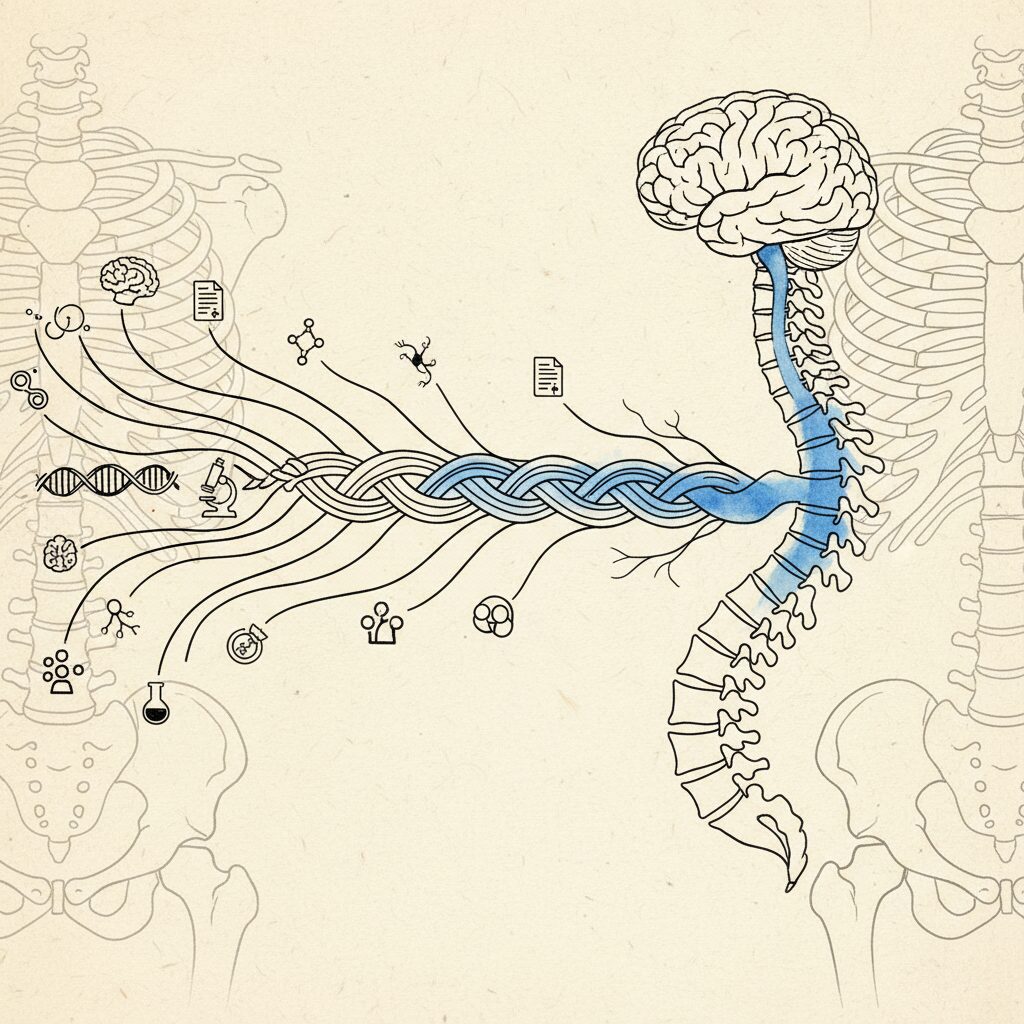
The primary genetic link to scoliosis, the LBX1 gene, does not directly cause spinal curvature. It specifies the development of proprioceptive relay neurons, the cells that carry body position data to the brain. In a 2024 CRISPR mouse study, McCallum-Loudeac et al. demonstrated that disrupting LBX1 function produces measurable proprioceptive deficits at four weeks of age, before any vertebral rotation appears. The spine starts straight while the nervous system’s ability to track body position is already impaired, and vertebral rotation emerges only after puberty, during a period of rapid growth that the compromised sensory system struggles to manage. Genetic predisposition for scoliosis operates through the nervous system’s sensory processing, not through direct effects on bone structure, which makes the genetic basis of scoliosis a question about neurological function rather than skeletal development alone.
When the media reports this, the framing is: scientists found a scoliosis gene. The implication is that the gene builds curved spines.
It does not.
LBX1 is a transcription factor that specifies somatosensory association interneurons in the dorsal spinal cord. It determines whether developing cells become proprioceptive relay neurons or viscerosensory relay neurons. Proprioceptive relay neurons carry body position data to the brain. When LBX1 function is disrupted, the spinal cord develops with degraded proprioceptive hardware.
The 2024 CRISPR mouse study showed what can follow, in mice. Mice with the disrupted LBX1 regulatory region showed proprioceptive deficits at four weeks. Measurable sensorimotor decline. No vertebral rotation. The spine was still straight. The nervous system was already impaired.
Vertebral rotation appeared later. After puberty. After the growth acceleration that the impaired sensory system could not track.
The genetics do not point at bone. They point at the sensory relay system that feeds the brain’s model of the body.
Published: Gross et al., 2002, Neuron. McCallum-Loudeac et al., 2024, Human Molecular Genetics. Takahashi et al., 2011, Nature Genetics.
Line 2: proprioception is degraded before the curve
This is not new. Proprioceptive deficits in scoliosis have been documented for over two decades. Meta-analyses confirm it. AIS patients show larger repositioning errors, higher motion detection thresholds, and abnormal somatosensory evoked potentials compared to controls.
Recent evidence points to proprioceptive deficits as a cause of scoliosis, not a consequence of it. The old assumption ran the other way: spinal curves distort the body, so body maps and proprioception degrade. The 2024 CRISPR mouse study by McCallum-Loudeac et al. inverted that assumption by demonstrating proprioceptive deficits, including a 1.8-fold increase in hindlimb faults during grid walk testing, at four weeks of age, before any observable vertebral rotation. The sensory impairment in the nervous system comes before the structural change in the spine. Assaiante and colleagues reported in 2012 that adolescents with idiopathic scoliosis, like other adolescents their age, did not use proprioceptive information well to control posture, and concluded that dynamic proprioception is the part scoliosis most likely affects. The nervous system is mishandling how it processes and prioritizes sensory input, which argues for targeting sensory processing dysfunction early in development rather than waiting for the curve to manifest.
But the field has treated proprioceptive deficits as a consequence of scoliosis. The curve distorts the body, the body map becomes inaccurate, the proprioception degrades. A reasonable assumption if you believe the curve comes first.
The 2024 mouse study inverted that assumption. Proprioceptive deficits preceded the curve. In these mice, the sensory problem came first. The spine followed. Whether the same order holds in human AIS has not been shown.
Schlösser’s structured evidence review classified “neurological/motor control disorder” as having moderate evidence as an etiological factor in AIS. Moderate. Not weak. Not speculative. Moderate evidence that the nervous system is involved in causing the condition, not just responding to it.
Assaiante and colleagues reported in 2012 that adolescents with AIS, like other adolescents, did not use proprioceptive information well to control posture with their eyes closed. They concluded that dynamic proprioception is the part scoliosis most likely affects. My read: during the growth years, the channel that would detect the asymmetry is not being fully listened to.
Published: McCallum-Loudeac et al., 2024. Assaiante et al., 2012, PLOS One. Schlösser et al., 2014.
Do proprioceptive deficits cause scoliosis or result from it?
The temporal relationship between proprioceptive deficits and scoliosis has been debated, but recent evidence supports a causal role for sensory dysfunction. McCallum-Loudeac et al. (2024) demonstrated in a CRISPR mouse model that proprioceptive deficits (measured by SNAP assessment, P=0.0043, and grid walk testing with 1.8-fold increased hindlimb faults, P<0.0001) were present at 4 weeks of age, before any vertebral rotation was detectable. Vertebral rotation appeared only post-pubertally. Assaiante et al. (2012) found that adolescents with AIS, like healthy adolescents, did not use proprioceptive cues efficiently for postural control, and concluded that dynamic proprioception is the part most likely affected. Schlösser et al. classified neurological/motor control disorder as having "moderate evidence" as an etiological factor. The 2024 mouse study provides the strongest evidence to date that proprioceptive impairment precedes and likely contributes to spinal curvature rather than resulting from it.
Line 3: the brain is working harder
If the sensory relay is degraded, the brain should show signs of compensating. It does.
The brain compensates for the degraded sensory input associated with scoliosis by spending more neural effort on body position. Formaggio et al. (2022) measured brain oscillatory activity in adolescent idiopathic scoliosis and found increased theta power over central brain areas alongside lateralized alpha activity over the sensorimotor cortex on the side of the spinal curve, a signature of extra neural resources dedicated to interpreting body position. Paramento et al. (2024) reached a similar conclusion in a systematic review of 61 studies that reported balance, EEG and MRI differences in AIS. The brain is working harder to maintain a coherent body schema from impaired sensory data. Therapies that address brain-level sensory integration and processing, rather than spinal mechanics alone, could offer more effective long-term results in scoliosis.
In 2022, researchers measured brain oscillatory activity in adolescents with idiopathic scoliosis. They found increased theta power over central brain areas and lateralized alpha activity over sensorimotor cortex on the side of the curve. More neural resources dedicated to processing body position. The brain is working harder to read a noisier signal.
In 2024, a separate team used machine learning on brain volumetric measurements and found they could predict which adolescents had scoliosis from brain structure alone. The differences were in inter-hemispheric communication and sensorimotor region connectivity. The brains of AIS patients are wired differently in the regions that process body position.
A 2024 systematic review pulled together neurophysiological, balance, and motion evidence in AIS. The conclusion: neuroanatomical and neurofunctional changes in the brain, brainstem, and cerebellum play a role in the etiology of AIS. Not a peripheral role. A causal role.
The brain is not passively responding to a curved spine. It is processing body position differently. The sensorimotor cortex is working overtime. The wiring between hemispheres is altered. These are not downstream effects of a bone problem. These are signatures of a system that is generating posture from imprecise data.
Published: Formaggio et al., 2022, Scientific Reports. Payas et al., 2024, JOR Spine. Paramento et al., 2024, PLOS One.
Line 4: sensory weighting is shifted
Your brain does not treat all sensory channels equally. It assigns weight to each channel based on how reliable it is. When one channel degrades, the brain upweights other channels to compensate. This is Bayesian inference applied to motor control. It is how the prediction engine stays functional when one input goes noisy.
Simoneau’s research group has documented this process directly in AIS. In 2006, they showed that adolescents with scoliosis assign approximately 13% weight to vestibular input during balance control. Healthy controls assign approximately 6%. AIS patients are relying on their vestibular system twice as heavily as normal.
This is not random. This is exactly what a Bayesian system would do when proprioceptive input degrades. The proprioceptive channel becomes noisy. The brain cannot rely on it for precise body position data. So it shifts weight to the next best channel: the vestibular system. The inner ear. Gravitational orientation.
The problem is that vestibular input gives you orientation relative to gravity. It does not give you the fine-grained trunk position data that proprioception provides. Relying more heavily on vestibular data at the expense of proprioceptive data means the body schema is running on a coarser map. Good enough for standing upright. Not precise enough to detect and correct a slow rotational drift during growth.
The sensory reweighting is a compensatory strategy. One that allows the curve to accumulate undetected by the system that should be correcting it.
Published: Simoneau et al., 2006, BMC Neuroscience. Pialasse et al., 2015, Gait & Posture.
How does sensory reweighting contribute to scoliosis?
The brain assigns precision weights to different sensory channels based on their reliability, a process described by Bayesian inference models in motor control (Friston 2010). Simoneau et al. (2006) and Pialasse et al. (2015) demonstrated that adolescents with idiopathic scoliosis assign approximately 13% weight to vestibular input during balance control, compared to 6% in healthy controls. That is a 2-fold overreliance on vestibular data, consistent with compensation for degraded proprioceptive precision. The vestibular system provides gravitational orientation but lacks the spatial resolution of proprioception for detecting trunk rotation and segmental position. When the body schema relies disproportionately on vestibular input, it loses the fine-grained positional feedback needed to detect and correct slow asymmetric drift during adolescent growth. The sensory reweighting is itself an adaptive response, but it creates a condition where rotational errors can accumulate below the system’s correction threshold.
Line 5: the body schema is distorted
The body schema is the brain’s internal model of the body in space. Not the conscious image you have of how you look. The non-conscious, continuously running model that generates motor output. Where your shoulders sit. How your ribcage rotates. What your pelvis does when you walk. All generated by this model, all the time, below awareness.
The concept is over a century old. Head and Holmes described it in 1911. Paillard formalized the distinction between body schema and body image in 1999. This is not fringe neuroscience. It is foundational.
In 2016, Picelli and colleagues asked the question directly: do adolescents with idiopathic scoliosis have body schema disorders?
Yes.
AIS patients misperceive their own trunk alignment. The pattern is specific to the curve. Patients with thoracolumbar scoliosis overestimated their thoracic curve. Patients with combined curves underestimated one region and overestimated another. The internal model does not match the external reality. The map is wrong. And the wrong map is generating motor output based on its distorted version of where the body is.
Here is the number that should keep the research community up at night.
In 2022, Bertuccelli and colleagues published a scoping review of every study examining body representation in adolescents with idiopathic scoliosis. They found 27 studies published between 2000 and 2021.
Twenty-three of those studies looked at body image. How teenagers feel about their appearance. Whether scoliosis affects their self-esteem. Whether they are distressed about how their body looks.
Four looked at body schema.
Four out of twenty-seven.
For two decades, the research community has overwhelmingly studied how scoliosis makes teenagers feel about their bodies. It has barely studied how their bodies’ internal model is generating the curve.
Same word. “Body.” Completely different question. One asks about the psychological response to the condition. The other asks about the neurological mechanism producing it. The field chose the psychological question twenty-three to four.
Published: Picelli et al., 2016, Journal of Back and Musculoskeletal Rehabilitation. Bertuccelli et al., 2022, Adolescent Research Review. Head & Holmes, 1911, Brain. Paillard, 1999.
What is the body schema and how does it relate to scoliosis?
The body schema is the brain’s non-conscious internal model of the body in space, continuously generating motor output based on sensory input. First described by Head and Holmes (1911), formalized by Paillard (1999), and integrated with predictive coding by Friston (2010), the body schema is the generative model that produces posture. Picelli et al. (2016) documented that adolescents with idiopathic scoliosis have measurable body schema distortion, misperceiving their own trunk alignment in patterns specific to their curve type. Bertuccelli et al. (2022) reviewed 27 studies on body representation in AIS and found that only 4 assessed body schema while 23 assessed body image (conscious self-perception). The reviewers concluded that body schema alterations are “widely prevalent” but “disregarded and not properly evaluated.” The gap is hard to overstate: the generative model that produces posture has gone largely unstudied in the condition defined by abnormal posture.
Line 6: vestibular dysfunction is present
In 1995, Machida demonstrated that disrupting the melatonin-vestibular pathway in chickens produces scoliotic curves. Remove the signal that calibrates gravitational orientation, and the body generates an asymmetric shape. This was the first direct evidence that scoliosis could originate from a sensory processing disruption rather than a structural defect.
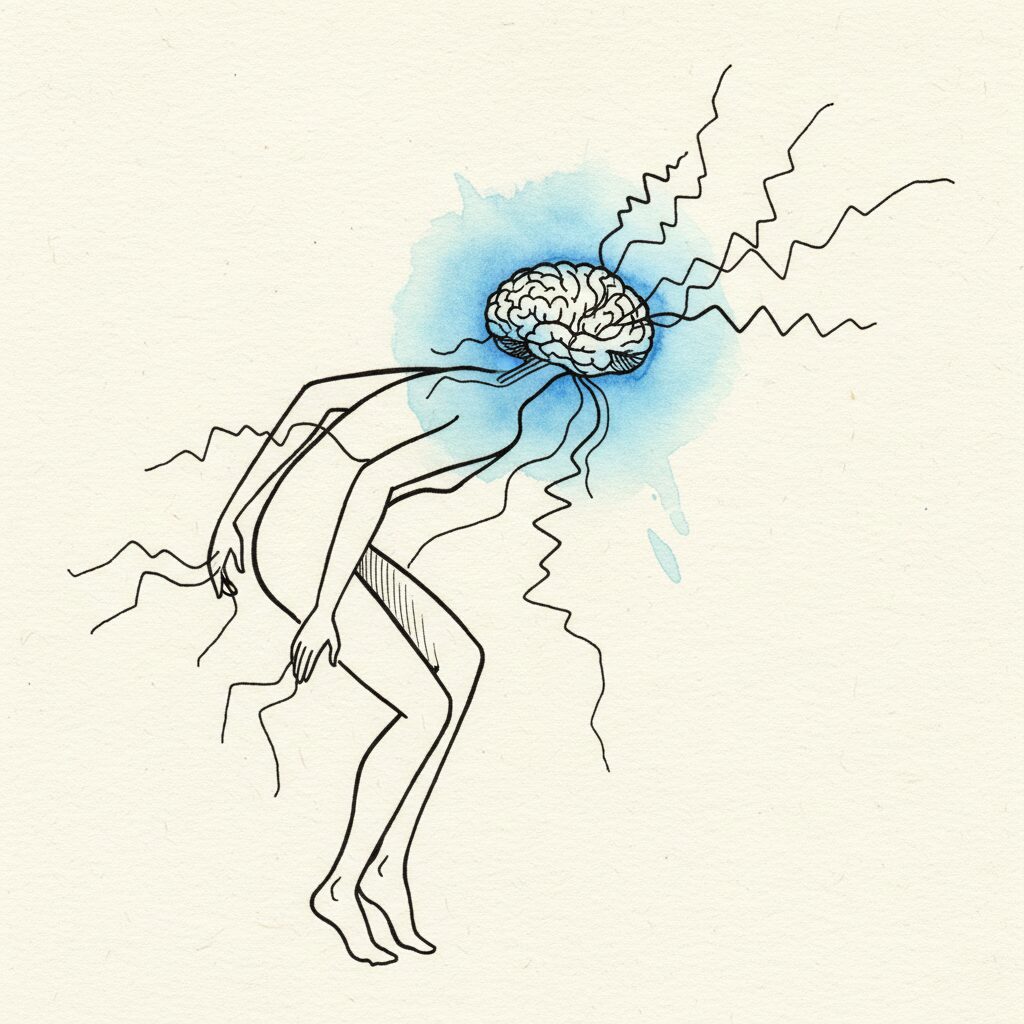
In 2015, Hitier published a systematic review documenting significantly higher rates of vestibular dysfunction in adolescents with idiopathic scoliosis compared to controls. The inner ear. The system that tells the brain which way is down. Altered in the population that cannot maintain a straight spine.
This connects directly to the sensory reweighting data. If the vestibular system is itself impaired in some AIS patients, then the brain is not just overrelying on vestibular input because proprioception is noisy. It is overrelying on a vestibular signal that is also degraded. Both major inputs to the body schema are compromised. The model is generating posture from imprecise data on two channels simultaneously.
Published: Machida et al., 1995, Journal of Bone and Joint Surgery. Hitier et al., 2015, European Spine Journal.
Line 7: predictive coding explains the mechanism
The theoretical framework that unifies all six lines has existed since 2010.
Karl Friston’s free-energy principle and the active inference framework it produces describe the brain as a prediction engine. Not a reactor. A predictor. The brain maintains a running model of the body and the world. It generates predictions. When sensory evidence contradicts the prediction, the brain updates the model. When sensory evidence is imprecise, the brain holds its existing prediction more tightly. It does not update. It trusts what it already believes over the noisy incoming data.
This is called precision weighting. The brain assigns confidence to each sensory channel based on how reliable it is. High precision inputs drive updates. Low precision inputs are ignored.
Apply this to scoliosis and the mechanism writes itself.
LBX1 variants degrade the proprioceptive relay. The proprioceptive channel becomes noisy. Low precision. The brain downweights it. The body schema holds its existing prediction more tightly. During adolescent growth, the skeleton changes rapidly. The body schema should be updating its model to track the growth. But the proprioceptive signal carrying the update information is imprecise. Below the precision threshold. The schema does not update. The body grows into a shape the schema is not tracking. By the time the asymmetry is large enough to register through the degraded channel, the schema has already incorporated the curve as baseline. The prediction now includes the curve. The curve is maintained not by the gene but by the schema’s own precision-weighted prediction.
Nothing here is speculation stacked on top of the evidence. It is what the evidence describes when you read it through a single lens instead of seven separate ones.
Published: Friston, 2010, Nature Reviews Neuroscience.
How does the predictive coding framework explain scoliosis?
Under Friston’s (2010) active inference framework, the brain maintains a continuous predictive model of the body (the body schema) that updates when sensory evidence is sufficiently precise. The brain assigns “precision weights” to each sensory channel: high-precision inputs drive model updates, while low-precision inputs are effectively ignored in favor of existing predictions. In adolescent idiopathic scoliosis, the primary scoliosis gene (LBX1) degrades proprioceptive relay neurons (Gross et al. 2002, McCallum-Loudeac et al. 2024), reducing the precision of proprioceptive input. Simoneau et al. (2006) confirmed this shift: AIS patients downweight proprioception and overweight vestibular input. During rapid adolescent growth, the skeleton changes faster than the imprecise proprioceptive channel can report. The body schema does not receive sufficiently precise error signals to update its model. Asymmetric growth accumulates below the correction threshold. The schema incorporates the curve as its new baseline prediction. The predictive coding framework explains why the curve self-maintains: the prediction now includes the curve, and the imprecise sensory channel cannot generate a strong enough error signal to overwrite it.
The chain
Seven published research lines. One chain.
1. Genetic susceptibility (LBX1) degrades the development of proprioceptive relay interneurons in the spinal cord.
2. Degraded proprioceptive relay reduces the precision of body position data reaching the brain.
3. The brain compensates by overweighting vestibular input, a channel with insufficient spatial resolution to detect slow rotational drift.
4. The body schema, running on imprecise input, cannot track rapid skeletal growth accurately during puberty.
5. Asymmetric growth accumulates below the correction threshold. The schema does not update because the error signal is too weak.
6. The brain incorporates the curve as baseline. The schema now generates posture that includes the curve. The distorted map becomes the map.
7. The curve further degrades proprioceptive accuracy because the body is now in a shape the sensory system was not calibrated for. The loop closes.
Every link is published. The chain is not. The geneticists see link 1. The proprioception researchers see link 2. The sensory weighting team sees link 3. The brain imagers see links 4 and 6. The body schema researchers see link 6. The predictive coding theorists built the framework that connects them all.
Nobody assembled the chain because each team is inside its own discipline, reading its own journals, attending its own conferences, citing its own predecessors.
That is a failure of synthesis, not of intelligence. We assembled the chain in a formal preprint: read the full paper here.
What this changes
If you accept this chain, three things follow.
First: “idiopathic” dissolves. Around eighty percent of scoliosis cases carry that label because no cause has been established. The mechanism described above is a candidate explanation for many of them. In my view the cause is not unknowable. It has been under-studied. The diagnostic model measures the output. The mechanism lives in the system generating the output. Different instruments. Different findings.
Second: “genetic” does not mean “fixed.” The gene set the parameters of the sensory relay. The sensory relay feeds the body schema. The body schema generates posture now, today, in real time. The gene is not running your posture. The schema is. And the schema is a prediction engine that updates when it receives sufficiently precise new evidence. The gene loaded the gun. The schema pulls the trigger. And the schema can be given new data.
Third: the intervention target shifts. If scoliosis is a bone problem, you brace it, strengthen around it, or fuse it. If scoliosis is generated by a body schema running on degraded sensory input, then the intervention is to improve the precision of the sensory input and create the conditions under which the schema updates its prediction. Not a different exercise. A different address.
The direction of investigation reverses.
Instead of: how do we correct the curve?
The question becomes: what is the body schema using to generate this curve, and how do we give it better data?
That is not a philosophical reframe. It is where the published evidence points when you read it as one body of work instead of seven.
What would change if scoliosis were treated as a nervous system problem?
If scoliosis is understood as generated by the body schema from degraded sensory input rather than as a primary structural defect, the clinical approach shifts fundamentally. The Cobb angle (Cobb 1948, Weinstein et al. 2008) would remain a measurement tool but would no longer define the diagnostic endpoint. Assessment would include proprioceptive testing, sensory weighting evaluation (Simoneau et al. 2006; Pialasse et al. 2015), and body schema assessment (Picelli et al. 2016). Intervention would target the precision of sensory input to the body schema and the conditions under which the schema updates its predictions, rather than mechanically correcting the spinal curve. This approach matches existing evidence-based conservative treatments (PSSE, Schroth method) that already incorporate sensorimotor retraining. It also explains why these approaches work when they work: they improve the quality of proprioceptive and vestibular input to the generative model. The body schema framework provides the theoretical mechanism that conservative treatment has lacked.
The emerging picture
This is not one study making a bold claim. This is seven independent research programs, across four decades, in six countries, publishing in different journals, each documenting one piece of a mechanism that becomes visible only when you read them together.
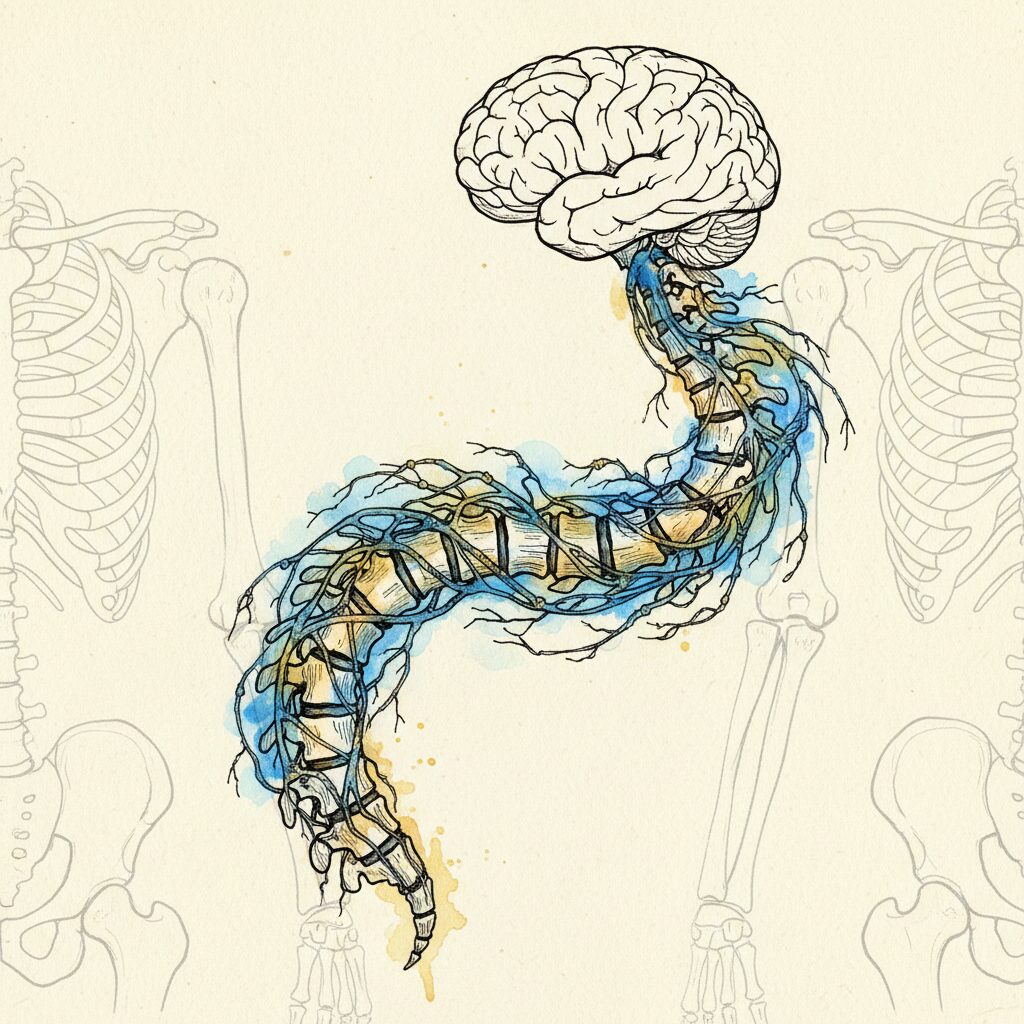
The genetics say the nervous system. The proprioception research says the nervous system. The brain imaging says the nervous system. The sensory weighting says the nervous system. The body schema research says the nervous system. The vestibular research says the nervous system. The predictive coding framework explains how the nervous system does it.
The evidence has arrived. It is waiting to be assembled.
Most people with AIS are told their curve has no known cause. Much of what I think answers that question is published across seven journals in fields that rarely read each other. Not because anyone is negligent. Because the model most clinicians are trained in does not look at the nervous system first.
The answer lives in the nervous system. In the body schema. In the prediction engine that generates posture from sensory input every second of every day.
In this view, the spine is the printout. Seven lines of research now point the same way. The full academic synthesis, a hypothesis and not yet a tested finding, is freely available: The Neural Generation Hypothesis (Zenodo preprint).
What medicine calls scoliosis, we recognize as a protective pattern that can be updated. That sentence is not a marketing claim. It is a synthesis of published evidence that the field has not yet synthesized for itself.
Start of the Generative Posture Series: Why 80% of Scoliosis Cases Have No Explanation (G-1)
Related: The Scoliosis Gene That Proves It’s a Nervous System Problem | How Your Brain Controls Posture | Your Diagnosis Describes a Shape, Not a Cause
Ready to work with the system that generates your posture? The Syntropic Core method addresses posture at the body schema level. Not the shape. The prediction that builds the shape. Learn more at syntropiccore.com.
Sources
- McCallum-Loudeac, J., Moody, E., Williams, J., et al. (2024). Deletion of a conserved genomic region associated with adolescent idiopathic scoliosis leads to vertebral rotation in mice. Human Molecular Genetics, 33(9), 787-801. [T1]
CRISPR mouse model. Proprioceptive deficits preceded vertebral rotation. Temporal sequence: nervous system first, structure second. - Gross, M.K., Dottori, M., Goulding, M. (2002). Lbx1 specifies somatosensory association interneurons in the dorsal spinal cord. Neuron, 34(4), 535-549. [T1]
LBX1 builds proprioceptive relay neurons, not bone. The #1 scoliosis gene is a nervous system gene. - Müller, T., Brohmann, H., et al. (2002). The homeodomain factor Lbx1 distinguishes two major programs of neuronal differentiation in the dorsal spinal cord. Neuron, 34(4), 551-562. [T1]
LBX1 determines excitatory vs. inhibitory interneuron balance in spinal cord sensory processing. - Takahashi, Y., Kou, I., et al. (2011). A genome-wide association study identifies common variants near LBX1 associated with adolescent idiopathic scoliosis. Nature Genetics, 43(12), 1237-1240. [T1]
Original GWAS identifying LBX1 as strongest genetic association with AIS. - Bertuccelli, M., Cantele, F., Masiero, S. (2022). Body Image and Body Schema in Adolescents with Idiopathic Scoliosis: A Scoping Review. Adolescent Research Review, 8, 97-115. [T1]
4 of 27 studies assessed body schema. 23 assessed body image. Body schema alterations prevalent but under-researched. - Picelli, A., Negrini, S., et al. (2016). Do adolescents with idiopathic scoliosis have body schema disorders? Journal of Back and Musculoskeletal Rehabilitation, 29(1), 89-96. [T1]
AIS patients misperceive their own trunk alignment. Body schema distortion confirmed. - Simoneau, M., Mercier, P., et al. (2006). Altered sensory-weighting mechanisms is observed in adolescents with idiopathic scoliosis. BMC Neuroscience, 7, 68. [T1]
AIS patients assign 13% weight to vestibular input vs. 6% in controls. Compensating for degraded proprioception. - Pialasse, J.P., Descarreaux, M., Mercier, P., & Simoneau, M. (2015). Sensory reweighting is altered in adolescent patients with scoliosis: Evidence from a neuromechanical model. Gait & Posture, 42(4), 558-563. [T1]
Neuromechanical model confirming altered sensory weighting in AIS. - Formaggio, E., Bertuccelli, M., Rubega, M., et al. (2022). Brain oscillatory activity in adolescent idiopathic scoliosis. Scientific Reports, 12(1), 17266. [T1]
Increased theta and lateralized alpha over sensorimotor cortex. Brain working harder to process body position. - Payas, A., et al. (2024). Prediction of adolescent idiopathic scoliosis with machine learning algorithms using brain volumetric measurements. JOR Spine, 7(3), e1355. [T1]
Brain structure predicts AIS. Compromised inter-hemispheric and sensorimotor connectivity. - Paramento, M., Passarotto, E., Maccarone, M.C., et al. (2024). Neurophysiological, balance and motion evidence in adolescent idiopathic scoliosis: A systematic review. PLOS One, 19(5), e0303086. [T1]
Systematic review of 61 studies. Impaired standing balance, EEG differences, and MRI changes in white matter, the vestibular system and motor-related cortex in AIS. - Assaiante, C., Mallau, S., Jouve, J.L., Bollini, G., & Vaugoyeau, M. (2012). Do adolescent idiopathic scoliosis (AIS) neglect proprioceptive information in sensory integration of postural control? PLOS One, 7(7), e40646. [T1]
Adolescents with AIS, like control adolescents, could not control posture efficiently from proprioceptive cues alone with eyes closed. Authors conclude dynamic, not static, proprioception is mainly affected in AIS. - Hitier, M., Hamon, M., Denise, P., et al. (2015). Vestibular pathology in idiopathic scoliosis: a systematic review. European Spine Journal, 24(10), 2252-2258. [T2]
Higher rates of vestibular dysfunction in AIS vs. controls. - Machida, M., Dubousset, J., et al. (1995). Role of melatonin deficiency in the development of scoliosis in pinealectomised chickens. Journal of Bone and Joint Surgery, 77(1), 134-138. [T2]
Disrupted vestibular-melatonin pathway produces scoliosis in animal models. - Schlösser, T.P., et al. (2014). Genetics and pathogenesis of adolescent idiopathic scoliosis. Scoliosis and Spinal Disorders, 9(1), 1-8. [T1]
Structured evidence review: moderate evidence for neurological/motor control disorder in AIS etiology. - Paillard, J. (1999). Body Schema and Body Image: A Double Dissociation in Deafferented Patients. Motor Control, Today and Tomorrow, 197-214. [T1]
Body schema as non-conscious generative model. Foundation of the posture-as-prediction framework. - Friston, K. (2010). The free-energy principle: a unified brain theory? Nature Reviews Neuroscience, 11(2), 127-138. [T1]
Predictive coding and precision weighting. The theoretical framework connecting all seven research lines. - Head, H., Holmes, G. (1911). Sensory disturbances from cerebral lesions. Brain, 34(2-3), 102-254. [T1]
Original body schema concept. Over a century of neuroscience supporting this framework.
The Posture Dojo is a free community exploring the science of how your body generates posture. No corrections. No exercises. A different operating system. Join the conversation here.
Related research
- Two Papers Just Landed: The Neural Generation Hypothesis and the Generative Posture Framework
- Stand Up Tall, Pull Your Shoulders Back, Brace Your Core: Why the 3 Most Common Posture Cues Are Neuroscience Dead Ends
- How Much Can I Actually Change My Scoliosis? What the Research Shows
- You Can’t Tickle Yourself. That’s Why Your Posture Won’t Change.
Comments
One response to “The Scoliosis Research Nobody Has Connected”
[…] The Scoliosis Research Nobody Has Connected […]