The injury healed months ago. The scan is clean. Your doctor says there is nothing structurally wrong. But the pain is still there. Same spot. Same intensity. Same pattern that shows up when you sit too long, when you wake up, when you try to exercise.
This article is for the post-injury case specifically: the tissue has healed but the nervous system has not gotten the memo. If your pain has always been there with no clear injury, the broader pattern is covered in Why Pain Keeps Coming Back.
You have tried meditation. You have tried brain retraining programs. You have tried telling yourself the pain is not dangerous. And some of it helped, for a while. But the pain keeps returning to the same address in your body, as if your nervous system has a bookmark it will not delete.
It does. And there is a reason it will not let go.
Pain is a prediction, not a report
Your nervous system does not wait for damage to produce pain. It predicts damage and produces pain preemptively. Pain is an output of the brain’s predictive model, generated when the system calculates that a particular area is under threat.
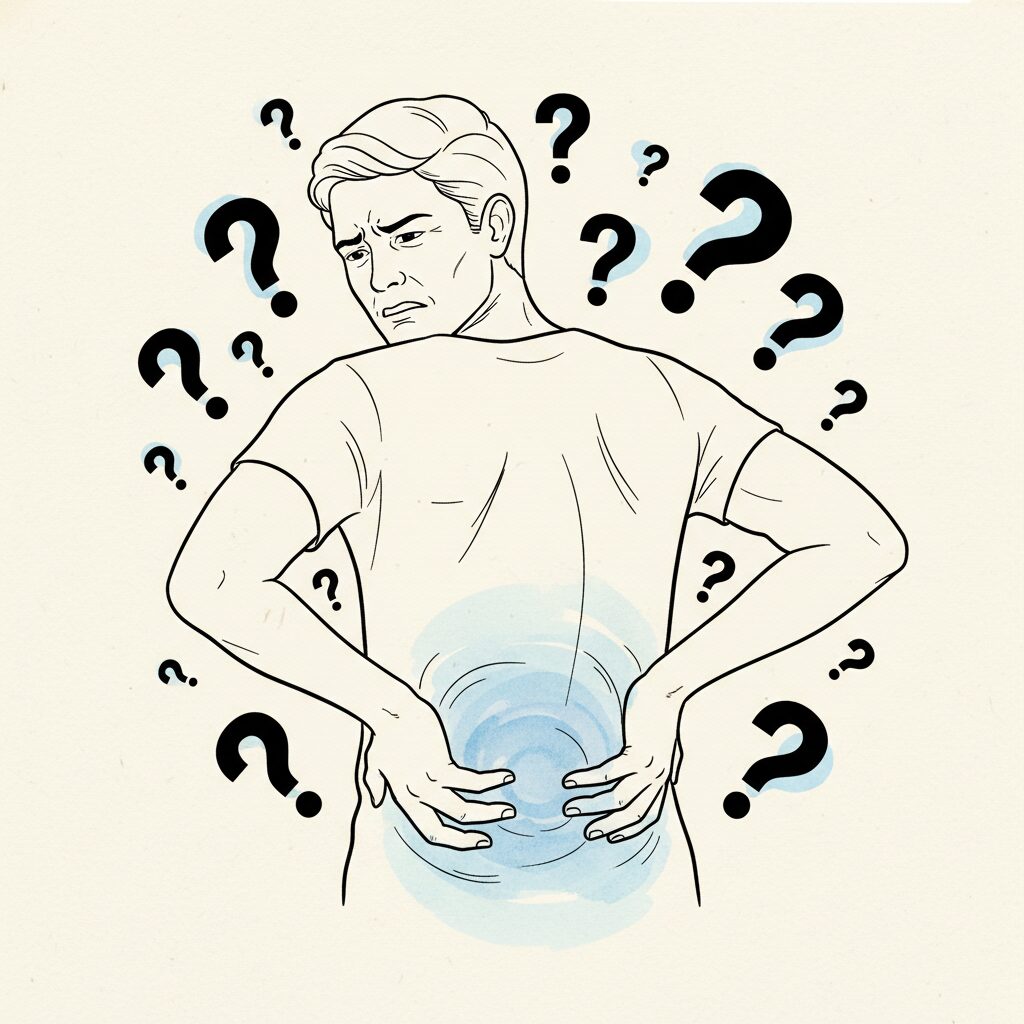
When you had an injury, that prediction was accurate. The tissue was compromised. The pain signal protected you. You moved differently, you guarded the area, you avoided load. All appropriate responses to real damage.
But the tissue healed. And the prediction did not update.
This is not a malfunction. This is how predictive systems work. They do not auto-correct when the original input changes. They correct when new evidence arrives that is strong enough to override the existing prediction. And in chronic pain, that evidence keeps getting blocked.
The four locks
Your nervous system holds onto pain through four interlocking mechanisms. Not one. Four. And they reinforce each other.
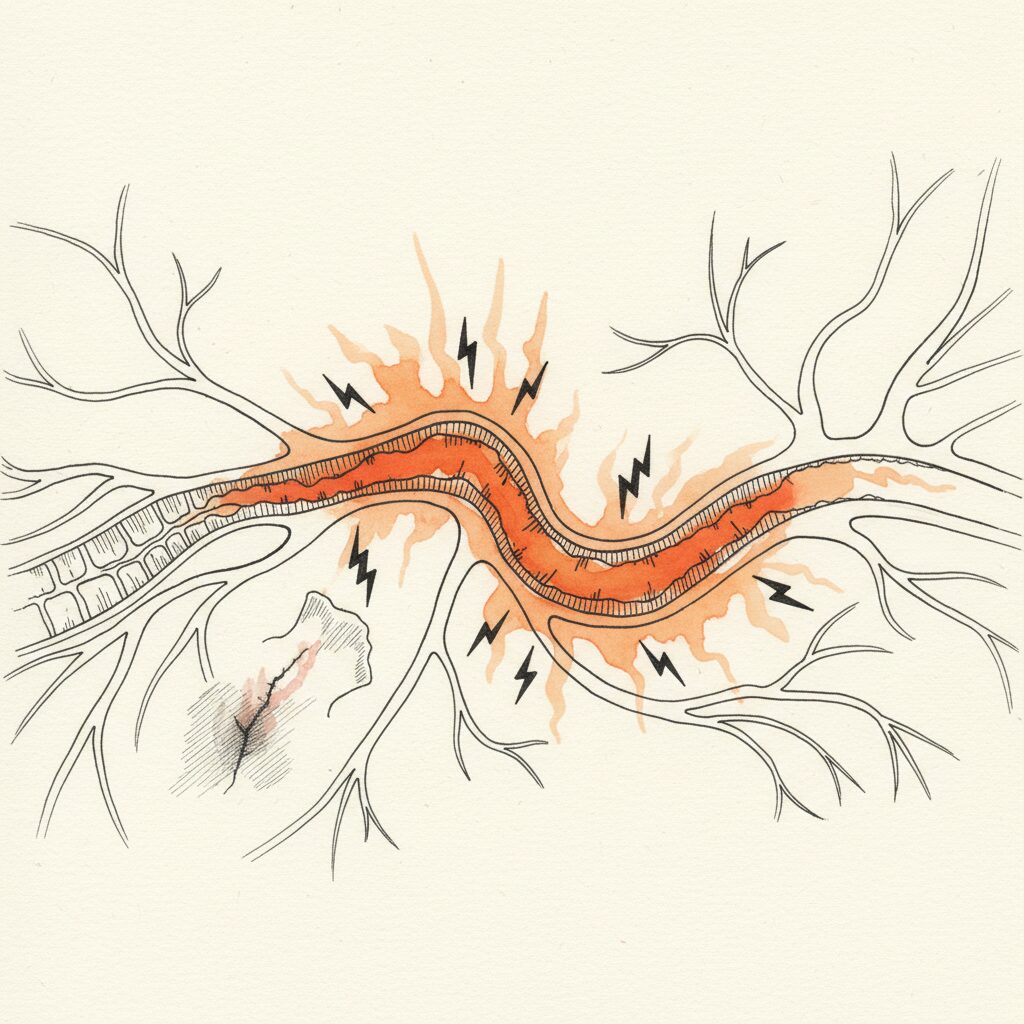
Lock one: the map changed. Chronic pain reorganizes the cortical representation of the affected area. The brain’s map of that body region becomes smudged, enlarged, or distorted. Moseley and Flor (2012) showed that these cortical changes are not byproducts of pain. They are drivers of it [1]. The map generates the territory.
Lock two: the motor pattern rigidified. When pain was present, your nervous system adopted a protective movement strategy. Muscles tightened in specific patterns. Range of motion narrowed. Variability decreased. Moseley and Hodges (2006) demonstrated that these motor changes persist even after pain completely resolves [2]. The pain is gone. The rigidity is not. Your body is still moving as if the injury is present.
Lock three: fear prevents the update. Fear-avoidance behavior keeps you from the movements that would generate prediction error. You avoid the positions that hurt. You guard the area. You move carefully around the pain. And every time you avoid, you confirm the prediction instead of challenging it.
Lock four: the autonomic state is stuck. Chronic pain keeps the nervous system in a sympathetic, threat-detecting state. Porges (2011) described this as a loss of ventral vagal tone, the state of safety that allows the system to explore, update, and reorganize [4]. In sympathetic dominance, the system is defending. It is not available for change.
Moseley and Flor (2012) demonstrated that chronic pain involves reorganization of somatosensory and motor cortical representations, creating a distorted neural map that generates pain independently of peripheral input. Vlaeyen and Linton (2000) showed that fear-avoidance behavior, driven by catastrophic interpretation of pain, prevents the very movements that would produce prediction error and update the cortical representation. These two mechanisms create a closed loop: the distorted map generates pain, the pain generates fear, the fear prevents movement, and the absence of movement prevents the map from correcting. Breaking this loop requires both new sensory input (to update the map) and a context safe enough to allow the movement that generates that input.
Why brain retraining addresses half the problem
Brain retraining programs, somatic tracking, pain neuroscience education, TMS protocols. These are not wrong. They are incomplete.
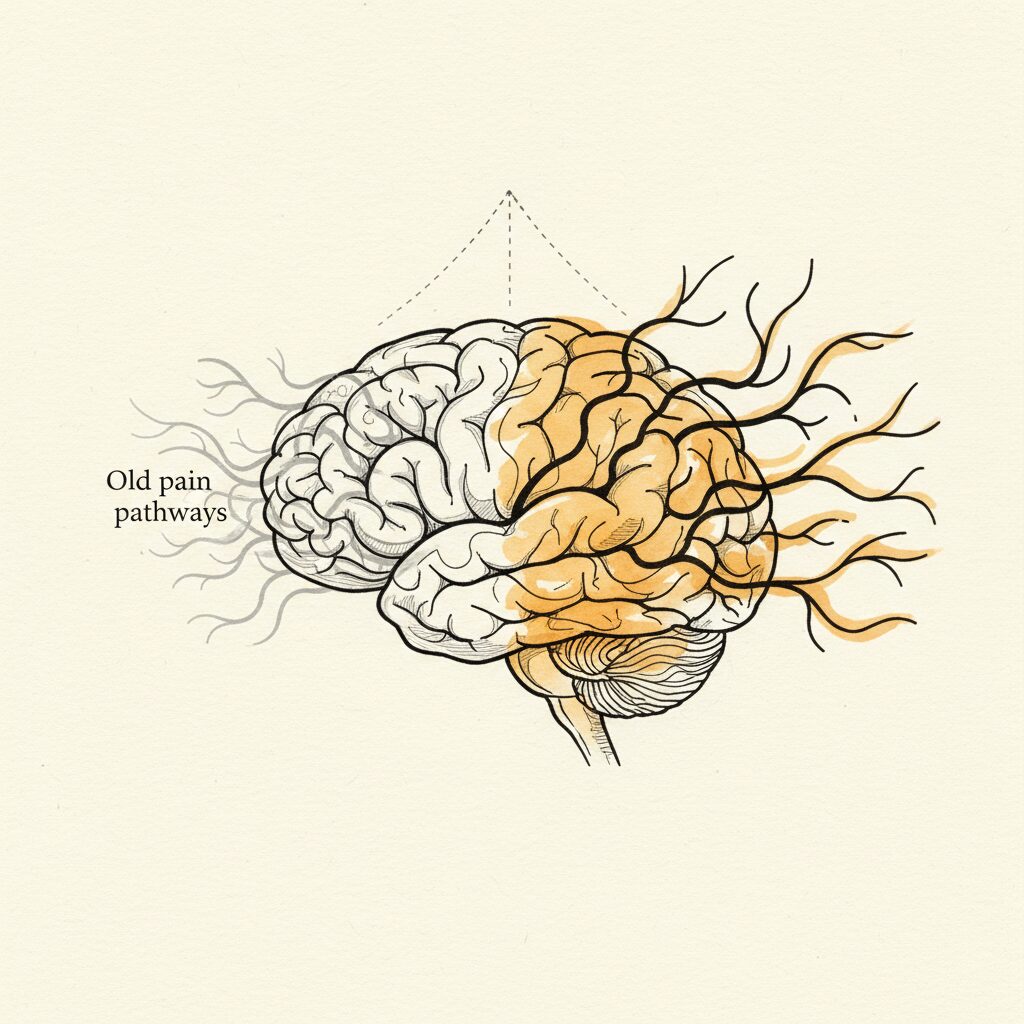
They address lock one: cognitive reframing and sensory re-education can begin reorganizing the cortical map. They address lock three: graded exposure and somatic tracking reduce fear-avoidance and allow the prediction to be challenged.
But they do not address lock two. The motor rigidity. The tension pattern that persists after the pain resolves. You cannot meditate your way out of a movement strategy that is structurally load-bearing. The muscles that tightened during the pain episode are now holding your spine up. They are not guarding a healed injury. They are compensating for a pressure system that went offline when the pain arrived and never came back.
And they do not fully address lock four. Telling your nervous system it is safe is different from giving it the physiological conditions of safety. Ventral vagal tone is not a thought. It is a state. It requires specific inputs: ground contact, reduced gravitational demand, exhale-dominant breathing, absence of effort.
What opens all four
Moseley and Hodges (2006) showed that pain-induced motor rigidity persists because the nervous system never returns to its original stabilization strategy. The system switched from pressure-based support to tension-based bracing during the pain episode and stayed there. Restoring intra-abdominal pressure provides the alternative motor strategy the system needs: hydraulic support that replaces muscular guarding. Simultaneously, the conditions that restore pressure, ground contact, reduced gravitational demand, exhale emphasis, shift the autonomic state from sympathetic dominance toward ventral vagal engagement (Porges, 2011). The motor pattern and the autonomic state are not separate problems. They are two expressions of the same protective response.
Lock one opens when new sensory input reaches the cortex. Not a thought about the body. Actual sensation from the body. Pressure returning to an area that has been empty. Deep stabilizers firing in a pattern the nervous system has not felt in months or years.
Lock two opens when the motor system receives an alternative strategy. Not relaxation. Not release. A different way to stabilize. Pressure instead of tension. When the deep system comes back online, the superficial bracing pattern becomes unnecessary. The rigidity dissolves because the compensation it was performing is no longer needed.
Lock three opens through felt experience, not cognitive reframing. When you feel something change in your body that you did not effort your way into, the prediction cracks. The nervous system received evidence it was not expecting. That is prediction error. That is the update.
Lock four opens through physiology, not psychology. Ground contact. Exhale. Reduced gravitational demand. The autonomic nervous system shifts states based on what it detects, not what you tell it.
Four locks. One key. Restore the pressure system, and the nervous system receives the conditions it needs to let go of the pattern it has been holding.
Not because you convinced it. Because you gave it something better.
—
Related: Why Your Body Holds Tension | Words Programming Your Posture | Why Stretching Never Fixes Chronic Tightness
—
Syntropic Core Resets address all four locks simultaneously: restoring pressure for motor reorganization, creating conditions for autonomic shift, generating prediction error through felt experience, and providing novel sensory input for cortical updating. See how it works.
Sources
- Moseley, G.L., & Flor, H. (2012). Targeting cortical representations in the treatment of chronic pain. Neurorehabilitation and Neural Repair, 26(6), 646-652. PMID: 22331213 [T1]
Chronic pain involves reorganized cortical representations. The body schema’s map of the painful area has changed. Treatment must update the map. - Moseley, G.L., & Hodges, P.W. (2006). Reduced variability of postural strategy. Behavioral Neuroscience, 120(2), 474-476. PMID: 16719709 [T1]
Motor patterns persist after pain resolves. The nervous system does not auto-correct when the injury heals. - Vlaeyen, J.W., & Linton, S.J. (2000). Fear-avoidance and its consequences in chronic musculoskeletal pain. Pain, 85(3), 317-332. PMID: 10781906 [T1]
Fear-avoidance behavior prevents the prediction error that would update the pain pattern. - Porges, S.W. (2011). The Polyvagal Theory. Norton. [T1]
Chronic sympathetic activation maintains the autonomic state that generates protective pain patterns. Ventral vagal tone is required for the system to update.
Related Reading
- why pain keeps coming back
- live with this pain forever
- back pain comes back every night
- chronic neck pain
- back pain and posture share the same source
- hip flexors won’t let go
- sciatica and posture
- best exercises for back pain
- stretching never fixes chronic tightness
- massage doesn’t fix chronic tension
Comments
2 responses to “Why Pain Persists After the Injury Heals (Clean Scan, Doctor Stumped, Pain Still There)”
[…] Why Pain Persists After the Injury Heals (Clean Scan, Doctor Stumped, Pain Still There) […]
[…] Why Pain Persists After the Injury Heals (Clean Scan, Doctor Stumped, Pain Still There) […]