Every night. The same pain. The same spot. You lie down and within minutes, sometimes seconds, it is there. The low back. The mid back. The place between your shoulder blades that burns like it has been carrying something heavy all day.
This piece is for one specific pattern: pain that returns when you go horizontal. The broader question of why any pain comes back is covered in Why Pain Keeps Coming Back. This article is for the people whose pain has a time stamp: lights out.
You have tried every mattress. Every pillow configuration. Every sleeping position the internet recommends. Side sleeping with a pillow between your knees. Back sleeping with a bolster under your legs. You spent a thousand dollars on a mattress that was supposed to change everything.
It did not change anything. Because the problem is not your mattress.
The muscles that never turn off
During the day, your spine needs stabilization. It needs something to hold it upright against gravity, to manage load, to protect the vertebrae and discs. Your body has two systems for this job.
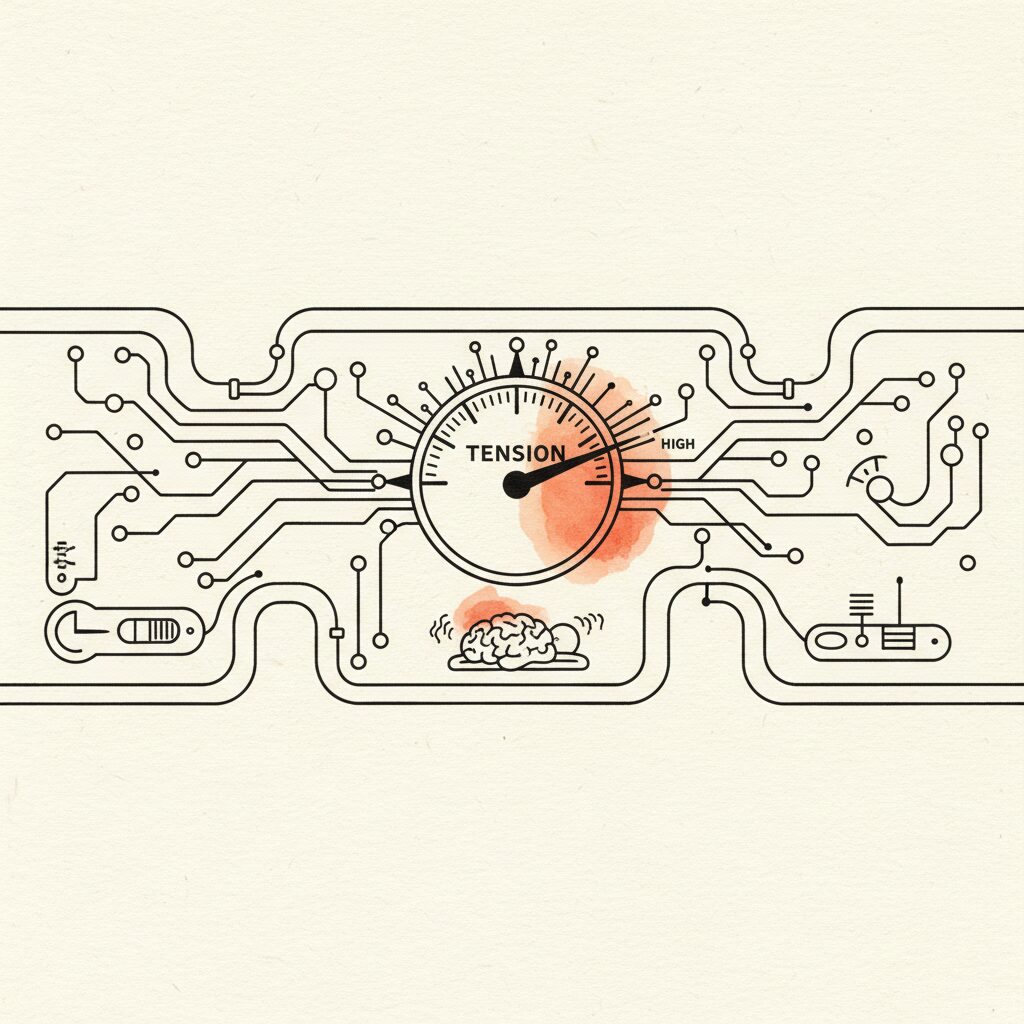
The primary system is hydraulic. The diaphragm descends, pressurizes the abdominal cavity, and the resulting intra-abdominal pressure stiffens the lumbar spine from the inside [2]. This system is automatic, efficient, and tireless. It runs on breathing.
The backup system is muscular. The erector spinae, the multifidus, the paraspinals, they grip the spine from the outside and hold it in position through tension. This system is effortful, metabolically expensive, and it fatigues.
In your body, the primary system is offline. The diaphragm is not performing its postural function. The pressure canister is not generating internal support. So the backup system has been carrying the full stabilization load. All day. Every day. For months or years.
By bedtime, those muscles are exhausted.
Why lying down does not help
Lying down removes gravity. The stabilization demand drops to almost nothing. This should be when the backup system shuts off. The muscles should release. The tension should resolve. Sleep should be relief.
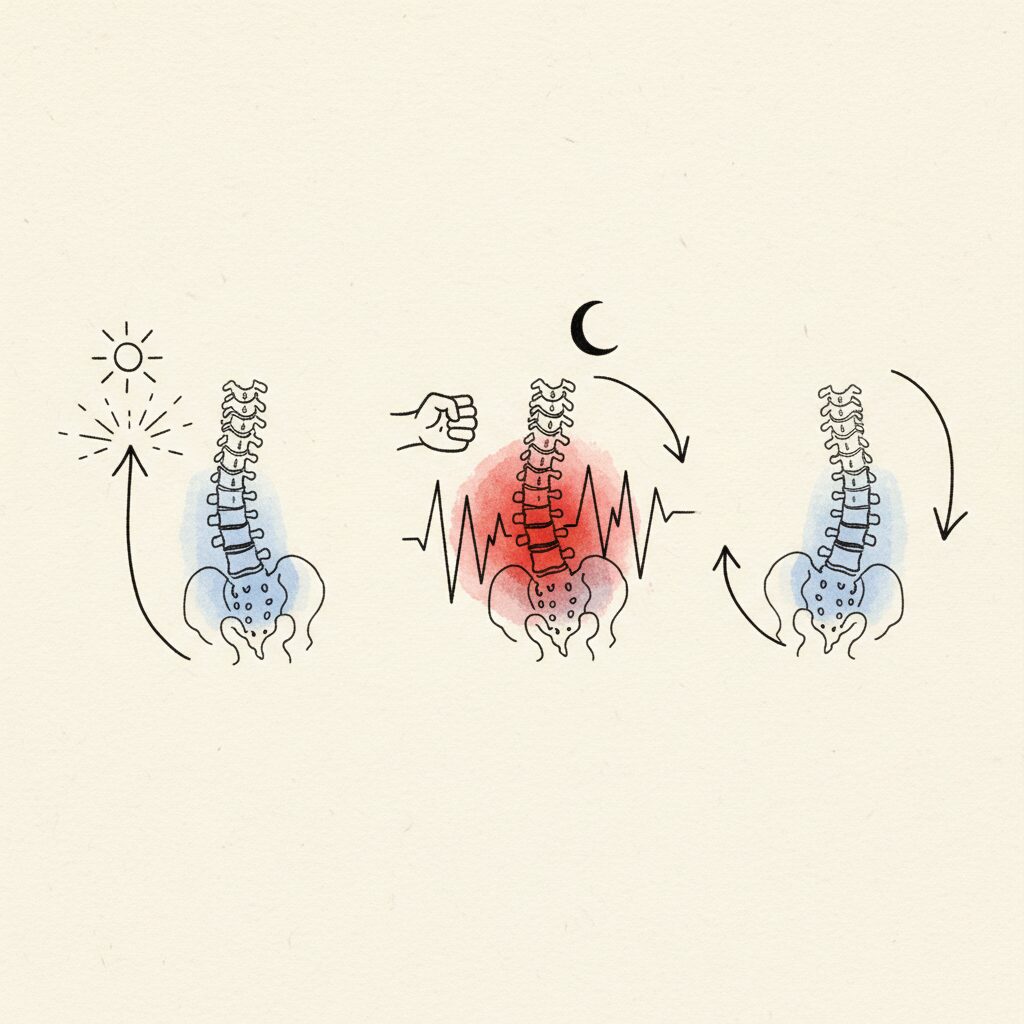
But the muscles do not release. Because the nervous system never received the signal that the primary system is back online.
Moseley and Hodges (2006) demonstrated that motor strategy rigidity persists even after the postural demand that generated it is removed. When the nervous system has adopted a tension-based stabilization strategy, it does not automatically return to pressure-based stabilization when the person lies down. The rigid strategy continues because the system never received evidence that the primary stabilizer is available. Hodges et al. (2005) showed that intra-abdominal pressure provides hydraulic spinal stabilization independent of muscular effort. Without this pressure system active, the nervous system maintains muscular guarding as a default, even in a supine position where muscular stabilization is unnecessary. The muscles grip because the nervous system says the spine is unsupported. Lying down changes the gravitational demand. It does not change the nervous system’s assessment of available stabilization resources.
The nervous system maintains the muscular guarding because, from its perspective, the spine is still unsupported. It does not matter that you are horizontal. It does not matter that gravity is no longer a threat. The nervous system’s assessment is based on the stabilization resources it knows are available. And the primary resource, pressure, is not available. So the backup stays on. The muscles keep gripping. The pain continues.
The autonomic state that follows you to bed
There is a second layer. The muscles are not just physically exhausted. They are being held in a state of activation by your autonomic nervous system.
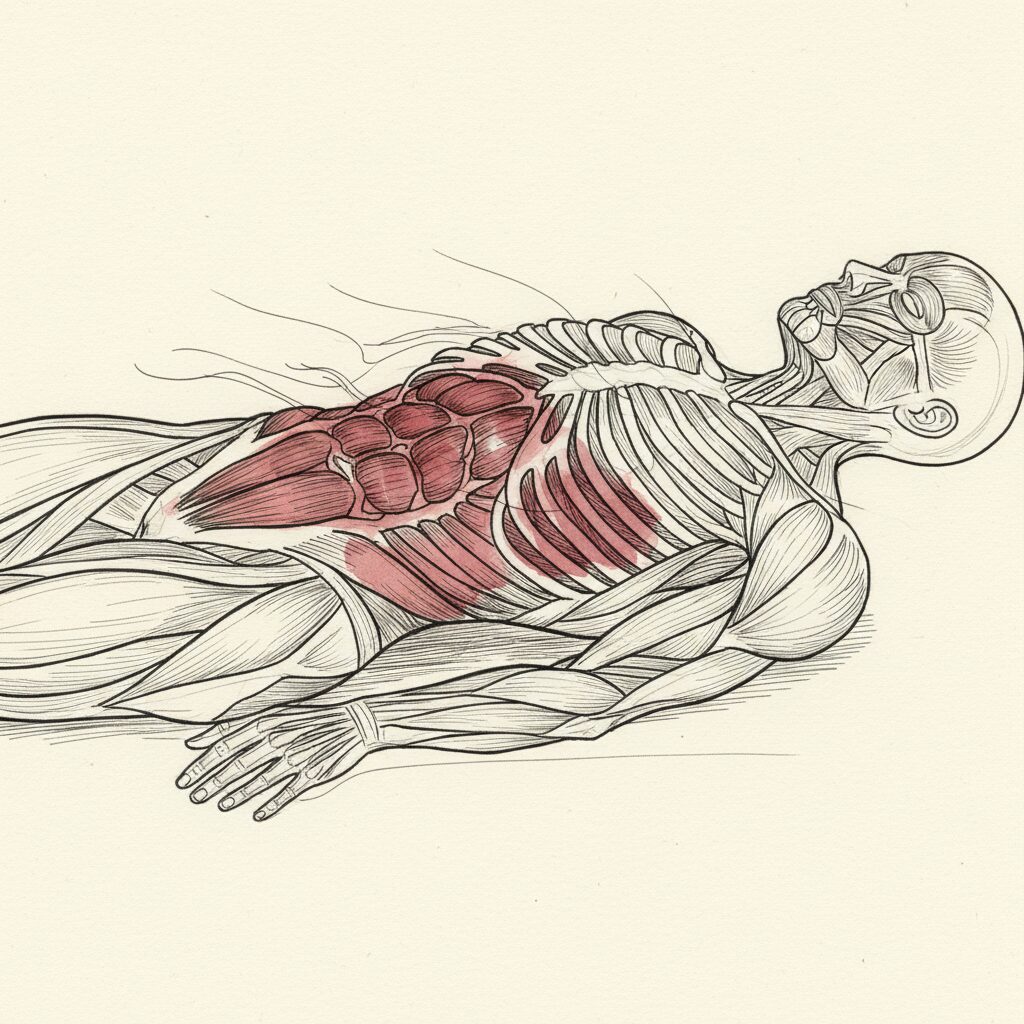
All day, your nervous system has been in a mildly sympathetic state. Alert. Braced. Managing threat, whether the threat is physical pain, postural instability, or the psychological stress of a body that does not feel safe. By bedtime, that state has not shifted. You lie down, but your autonomic system is still running the daytime program.
Porges (2011) described the polyvagal hierarchy: the nervous system shifts between ventral vagal (safe, social, restorative), sympathetic (mobilized, defensive), and dorsal vagal (shutdown) states. Muscle tone is modulated by autonomic state. In sympathetic activation, muscles maintain guarding patterns as part of the defensive physiology. The shift to ventral vagal, which normally occurs during the transition to sleep, permits muscular release, parasympathetic restoration, and the deactivation of protective motor strategies. When the nervous system does not shift out of sympathetic mode at bedtime, the muscles never receive permission to let go. The guarding continues. The person lies in bed with the autonomic signature of daytime threat running through muscles that have been overworking for hours. The result is pain that appears to be positional but is actually autonomic.
Sympathetic activation maintains muscle tone. It keeps the guarding patterns running as part of a defensive physiology that does not distinguish between “sitting at a desk” and “lying in bed” when the underlying autonomic state has not shifted. Your muscles are not releasing because your nervous system has not given them permission to release.
This is why the pain feels different from daytime pain. It is not sharper or more localized. It is a deep, burning fatigue. The muscles are not being injured. They are being asked to work when they should be resting. They are inflamed from overuse and still receiving the command to stay on.
What a reset before bed changes
Two things need to happen before your muscles will actually release at night.
First, the pressure system needs to come back online. When the diaphragm descends with postural intent and the canister pressurizes, the nervous system registers that the primary stabilizer is available. The muscles that have been carrying the full load all day receive the signal that their job is being covered. They can stand down. Not because you told them to relax. Because the system they were substituting for is back.
Second, the autonomic state needs to shift. From sympathetic to ventral vagal. From braced to safe. This shift is not a mental exercise. It is a physiological transition that follows from diaphragmatic function. When the diaphragm moves with its full excursion, the vagus nerve is mechanically stimulated. The autonomic state begins to shift. The muscles receive permission to let go.
The pain stops returning at night when the system that generates it during the day is taken offline before you lie down. Not with a stretch. Not with a foam roller. Not with a better pillow. With a reset that restores pressure and shifts your nervous system out of the state that keeps the muscles gripping.
Your mattress is probably fine. Your pillow is probably fine. Your sleeping position is probably fine. The problem is what you bring to bed with you: a nervous system still running the daytime program, and muscles that never received the signal to stand down.
—
Related: Do I Have to Live With This Pain Forever? | Does Sitting Make Your Scoliosis Worse? | Can Scoliosis Exercises Actually Reduce Your Curve?
—
A Syntropic Core Reset before bed restores the pressure system and shifts your autonomic state toward ventral vagal. The muscles that have been gripping all day finally receive the signal to stand down. Learn what that looks like.
Sources
- Moseley, G.L., & Hodges, P.W. (2006). Reduced variability of postural strategy prevents normalization of motor changes induced by back pain. Behavioral Neuroscience, 120(2), 474-476. PMID: 16719709 [T1]
Rigid tension strategies persist even when the postural demand is removed (lying down). The system does not automatically return to pressure-based strategy at rest. - Hodges, P.W., et al. (2005). Intra-abdominal pressure increases stiffness of the lumbar spine. Journal of Biomechanics, 38(9), 1873-1880. PMID: 16023475 [T1]
Without hydraulic stabilization during the day, muscles carry the full stabilization load. By night, they are exhausted and inflamed. - Porges, S.W. (2011). The Polyvagal Theory. Norton. [T1]
Sympathetic activation persists at bedtime. The nervous system has not shifted to ventral vagal. Muscles stay guarded because the autonomic state says “still under threat.”
Related research
- What It Actually Means to Complete the Trauma Cycle
- Your Body Doesn’t Need to Be Fixed. It Needs to Be Heard.
- The Exercise Your Therapist Should Have Given You After EMDR
- Your Body Never Finished Running: Why Trauma Lives in Your Posture
Comments
4 responses to “Why Back Pain Returns at Night (And What Recumbent Pain Means)”
[…] Why Your Back Pain Comes Back Every Night | Can Scoliosis Exercises Actually Reduce Your Curve? | Does Sitting Make Your Scoliosis […]
[…] Can Scoliosis Exercises Actually Reduce Your Curve? | Why Your Back Pain Comes Back Every Night | Why One Hip Is Higher Than the […]
[…] back pain comes back every night […]
[…] Why Back Pain Returns at Night (And What Recumbent Pain Means) […]