You stretch your neck. You foam roll your back. You book the massage. And for a few hours, maybe a day, something softens.
Then it comes back. The same tightness. The same spots. The same grip that no amount of stretching, rolling, or kneading seems to permanently resolve.
You are not failing. The approach is failing you. Because the tightness you are fighting is not the problem. It is the solution to a problem you did not know you had.
The system that came first
Before you ever fought gravity, before your first breath, before your muscles fired a single contraction, you were already organized. Already supported. Already held together.
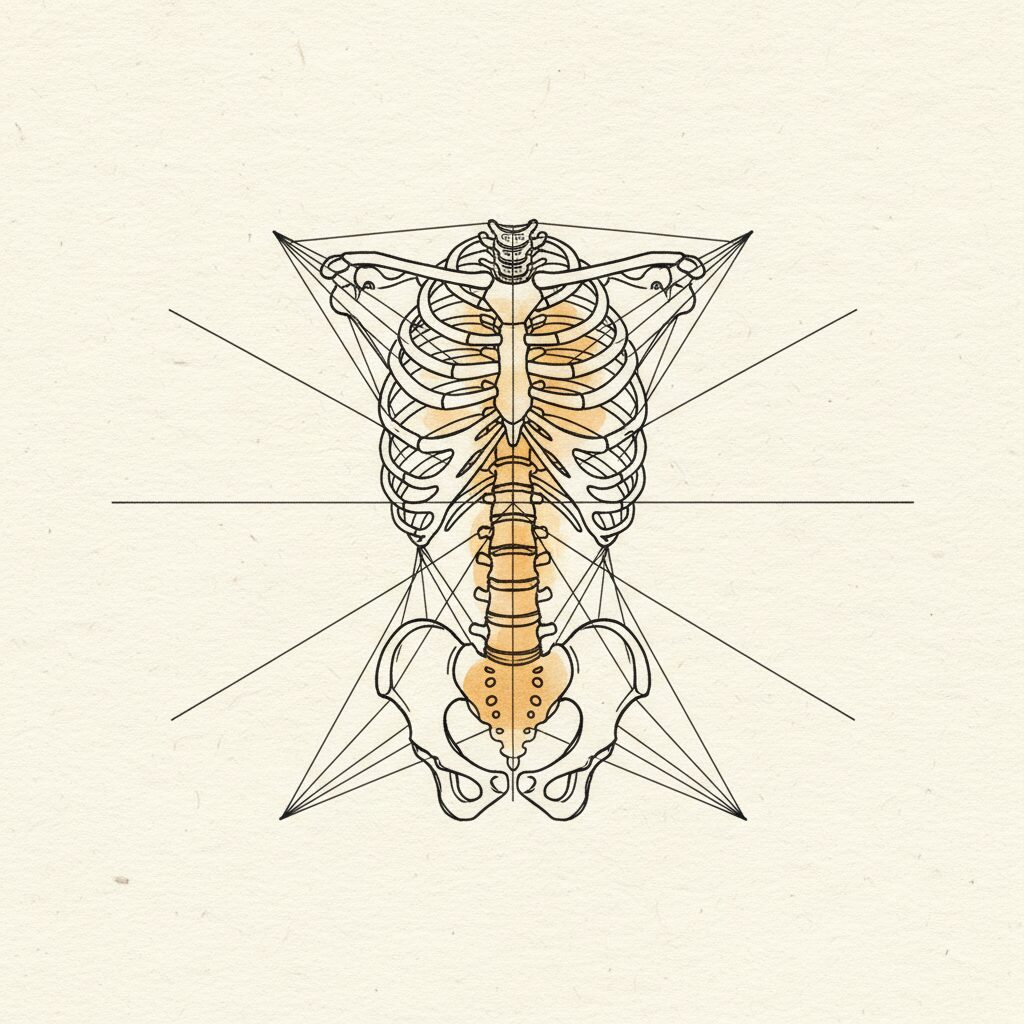
Not by muscles. By pressure.
In the womb, amniotic fluid surrounds the developing body with equal pressure from every direction [1]. No gravity vector to resist. No muscular effort required. The fetus floats in a pressurized vessel, and inside that vessel, your spine, your rib cage, and your diaphragm formed their shapes. Not by pulling against resistance. By developing inside pressure.
The primary curves of your spine, the thoracic and sacral curves, are pressure artifacts. They formed inside a hydraulic environment, not a gravitational one [5]. The architecture of your torso was shaped by pressure before you ever encountered the force that would challenge it.
The fetal environment provides omnidirectional hydraulic pressure through amniotic fluid. Beall et al. (2010) documented the pressure dynamics of amniotic fluid volume regulation, establishing that the fetus develops within a pressurized fluid compartment. Gramsbergen (2005) traced the phylogenetic and ontogenetic development of postural control, noting that the aquatic phase of development precedes the antigravity phase. The primary spinal curves form within this pressurized environment, establishing the structural geometry that will later support upright posture against gravity. The implication is that the body’s first organizing principle is hydraulic pressure, not muscular contraction.
Your diaphragm was practicing before you were born
By the tenth week of gestation, the diaphragm begins practicing pressure cycling [4]. These are called fetal breathing movements. They are not breathing. There is no air. They are pressure rehearsals.
The diaphragm contracts and releases, generating rhythmic pressure changes inside the developing torso. Months before birth. Months before the first breath. The organ that will become your primary postural stabilizer is already rehearsing its real job: not gas exchange, but pressure generation.
This distinction matters. Your diaphragm is a pressure organ first and a breathing organ second. Kolar and colleagues showed that in healthy adults, the diaphragm functions as a postural stabilizer, maintaining intra-abdominal pressure that supports the spine independently of respiration [2]. In people with chronic low back pain, this postural function is compromised. The diaphragm flattens. Pressure drops. And something else has to take over.
That something else is tension.
The trade your body made
Here is what happened. You were born into gravity. The pressure environment disappeared. Your body had to learn to generate its own pressure internally, using the diaphragm, the pelvic floor, the transversus abdominis, and the deep stabilizers that form the walls of your internal pressure canister.
When that system works, it works like the womb worked. Pressure from inside supports the spine. No conscious effort. No muscular grip. Hodges and colleagues measured this directly: intra-abdominal pressure alone increases spinal stiffness by 8 to 31 percent, with no voluntary muscle activation whatsoever [3]. Pressure does the work. Automatically. Anticipatorily. Before you even know you need it.
But when that system goes offline, through breath-holding, chronic stress, sedentary compression, injury, or years of being told to brace your core, the body has one remaining option.
Grip. Brace. Hold. Tension.
Every tight muscle you have been fighting is doing a job. The upper traps that will not soften. The hip flexors that retighten overnight. The jaw that clenches in your sleep. These are not malfunctions. They are structural compensations. The nervous system is using muscular tension to replace the hydraulic support that went quiet.
Hodges et al. (2005) demonstrated that intra-abdominal pressure (IAP) increases lumbar spinal stiffness by 8-31% with no voluntary muscle activation. This hydraulic stabilization mechanism operates automatically and anticipatorily, preceding conscious awareness of postural demand. When this pressure system is functional, the spine receives internal support that does not require muscular effort. When the system is compromised, as Kolar et al. (2012) showed in chronic low back pain patients with flattened diaphragms and reduced pressure generation, superficial muscles compensate by increasing tonic activation. The tightness patients report is not a primary dysfunction but a secondary stabilization strategy replacing lost hydraulic support.
Why nothing you have tried has lasted
This is why stretching gives temporary relief. You are lengthening a muscle that is under orders from your nervous system to stay short. The stretch overrides the command briefly. Then the command reasserts itself. Because the job has not changed. The pressure system is still offline. The muscle is still needed.
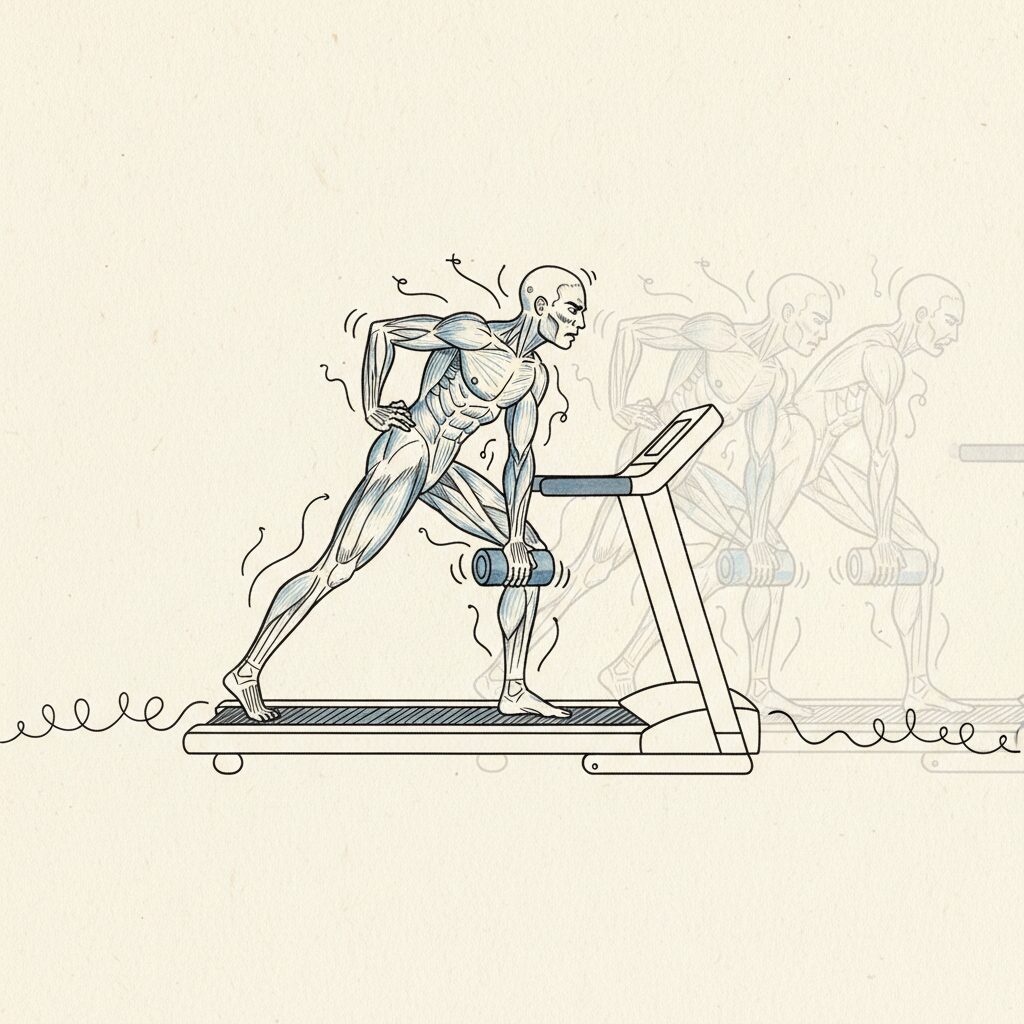
This is why massage does not fix chronic tension. The therapist releases the compensation. Your nervous system rebuilds it within hours. Not because the massage failed. Because the pressure deficit that created the tension in the first place was never addressed.
This is why core bracing makes it worse. Bracing adds more tension to a system already drowning in tension. It replaces the hydraulic system with a muscular one. The conscious, effortful, energy-expensive backup becomes the permanent strategy.
You were not too weak. You were not too tight. You were under-pressurized.
The system that already knows how to do this
The pressure system is not destroyed. It is suppressed. The diaphragm is still there. The deep stabilizers are still there. The architecture of the pressure canister, the one that formed inside the womb, is intact. It has been overridden, not removed.
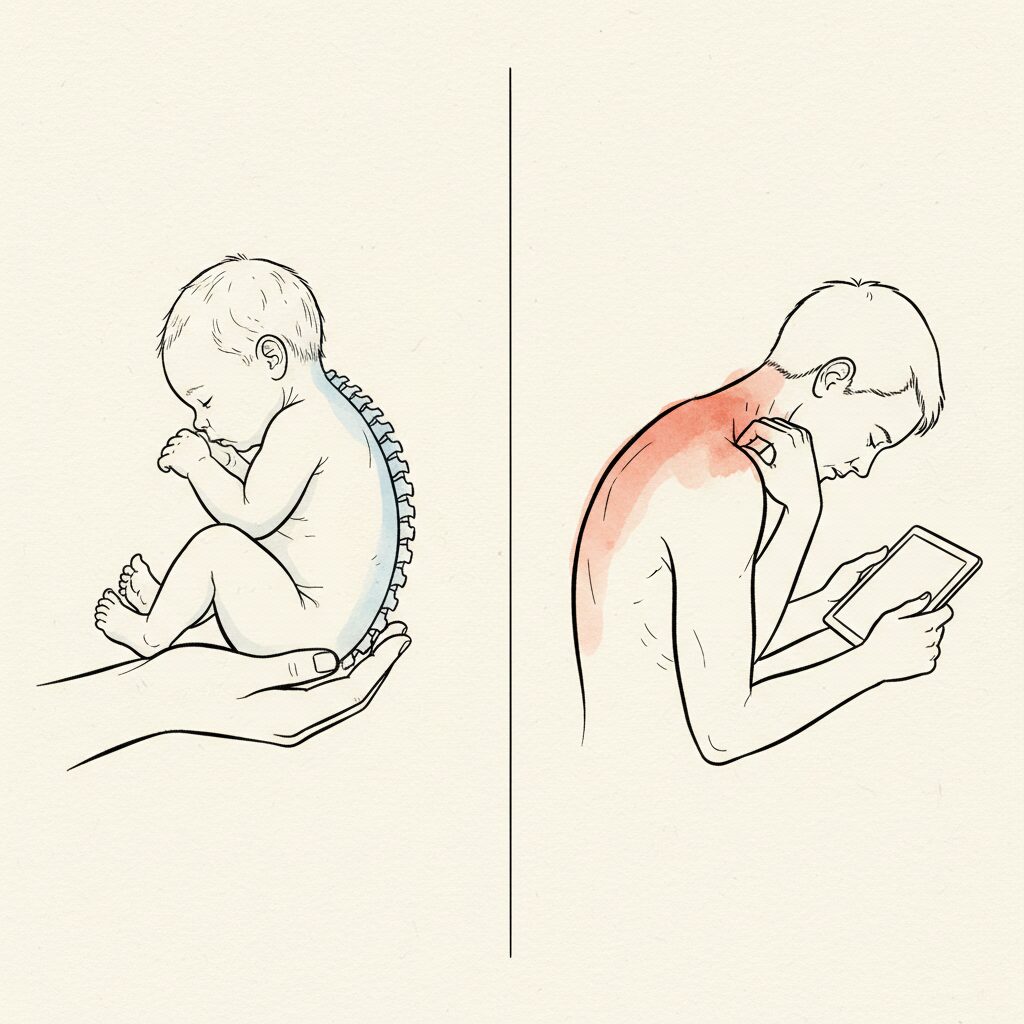
This is the difference between a muscle problem and a pressure problem. A muscle problem requires strengthening, lengthening, or retraining specific tissues. A pressure problem requires restoring the conditions that let the hydraulic system come back online. The hardware is not broken. It is turned off.
Syntropic Core Resets are designed around this principle. They do not target tight muscles. They do not stretch what grips. They restore the pressure system that makes the gripping unnecessary. The first reset you learn is a pressure reset. Lying down. Gravity reduced. Diaphragm restored to its dome. The conditions as close to the womb’s hydraulic environment as an adult body can get.
When the pressure comes back, the tension does not need to be released. It releases itself. Because the job it was doing is no longer its job.
You had this system once. Before gravity. Before effort. Before anyone told you to sit up straight or engage your core. Your body was organized by pressure. And it still knows how.
The question is not how to fight the tension. The question is how to restore what the tension replaced.
—
Related: The Collapse That Fixes Your Posture | Why Stretching Never Fixes Chronic Tightness | The Fastest Way to Release Tension
—
Syntropic Core Resets restore the pressure system your body was built around. Not by stretching what is tight. By reactivating what went quiet. Start with the first reset.
Sources
- Beall, M.H., van den Wijngaard, J.P., van Gemert, M.J., & Ross, M.G. (2010). Amniotic fluid water dynamics. Placenta, 31(1), 11-16. PMID: 19879647 [T1]
Amniotic fluid volume and pressure dynamics. The fetus develops in a pressurized hydraulic environment where tissues form inside omnidirectional pressure, not against gravitational resistance.
- Kolar, P., et al. (2012). Postural function of the diaphragm in persons with and without chronic low back pain. Journal of Orthopaedic & Sports Physical Therapy, 42(4), 352-362. PMID: 22236541 [T1]
Diaphragm as postural organ. The structure that generates IAP in adults was formed inside a pressure environment. Chronic LBP patients show flattened diaphragms and reduced postural pressure generation.
- Hodges, P.W., Eriksson, A.E., Shirley, D., & Gandevia, S.C. (2005). Intra-abdominal pressure increases stiffness of the lumbar spine. Journal of Biomechanics, 38(9), 1873-1880. PMID: 16023475 [T1]
IAP alone stabilizes the spine 8-31% with no voluntary muscle effort. Adult hydraulic support recapitulates the womb’s pressure logic.
- Tecklenburg, F.J.C., et al. (2015). Fetal breathing movements: A review. Ultrasound in Obstetrics & Gynecology. [T1]
Fetal breathing movements practice pressure cycling in utero beginning around week 10. The diaphragm rehearses its postural role months before birth.
- Gramsbergen, A. (2005). Postural control in man: The phylogenetic perspective. Neural Plasticity, 12(2-3), 77-88. PMID: 16097477 [T1]
Phylogenetic and ontogenetic development of postural control. The aquatic phase of development precedes the antigravity phase, establishing pressure-based organization before gravity-based challenges.