Your personal trainer told you to engage your core. Your physical therapist told you to brace your abs. Your Pilates instructor told you to pull your navel to your spine.
All three were telling you to turn off the most sophisticated postural system in your body.
Not weaken it. Not neglect it. Turn it off. Replace it with something slower, dumber, and less adaptive. And they did it with the best intentions, using the best information the mechanical model gave them.
The information was wrong.
The rigid cylinder problem
“Engage your core” treats your torso like a tube that needs to be stiffened. Stiffen the walls. Tighten the belt. Make it rigid so it can support load. This is the core stability model. It has dominated fitness, rehabilitation, and Pilates for thirty years.
Here is what it actually does inside your body.
The instruction generates a voluntary contraction. That contraction creates a rigid cylinder. A rigid cylinder cannot respond to perturbation. It can only resist it. The moment the perturbation exceeds the resistance, the cylinder fails. This is why people who “have a strong core” still throw out their backs picking up a sock.
But the damage runs deeper than mechanics.
The voluntary contraction generates an efference copy. A predicted version of what the resulting sensation should feel like, sent to your sensory cortex before the muscles even finish contracting. That prediction cancels the incoming proprioceptive signal [1]. The very act of bracing suppresses the sensory information your body schema needs to organize your posture in real time.
When you consciously brace your core, the motor cortex issues a voluntary command that generates an efference copy: a prediction of the sensory outcome sent to sensory cortex before the action completes. This prediction cancels the matching incoming proprioceptive signal through a process called sensory attenuation (Blakemore, Wolpert & Frith, 1999; Kilteni & Ehrsson, 2020). The result: voluntary bracing suppresses the proprioceptive feedback the body schema requires to organize postural tone in real time. Meanwhile, the postural control system operates through anticipatory, subcortical pathways that respond to gravitational demand automatically. Eriksson Crommert et al. (2011) demonstrated that transversus abdominis is the only trunk muscle whose activation co-varies with vertical center of mass position, independent of imposed load direction. This gravity-responsive, automatic recruitment is precisely what voluntary bracing overrides.
You are replacing a system that responds to gravity in real time with a system that responds to your conscious intention on a delay. That is not training. That is a downgrade.
Veltzke and colleagues demonstrated this in 2026. Weightlifters wearing belts reported increased stability. When researchers measured actual spinal stability, the belt made no objective difference [2]. The perception of bracing is not the same as postural control. You feel stable. You are not more stable. Your brain has been fooled by its own contraction.
What bracing does to your diaphragm
The deeper problem is architectural.
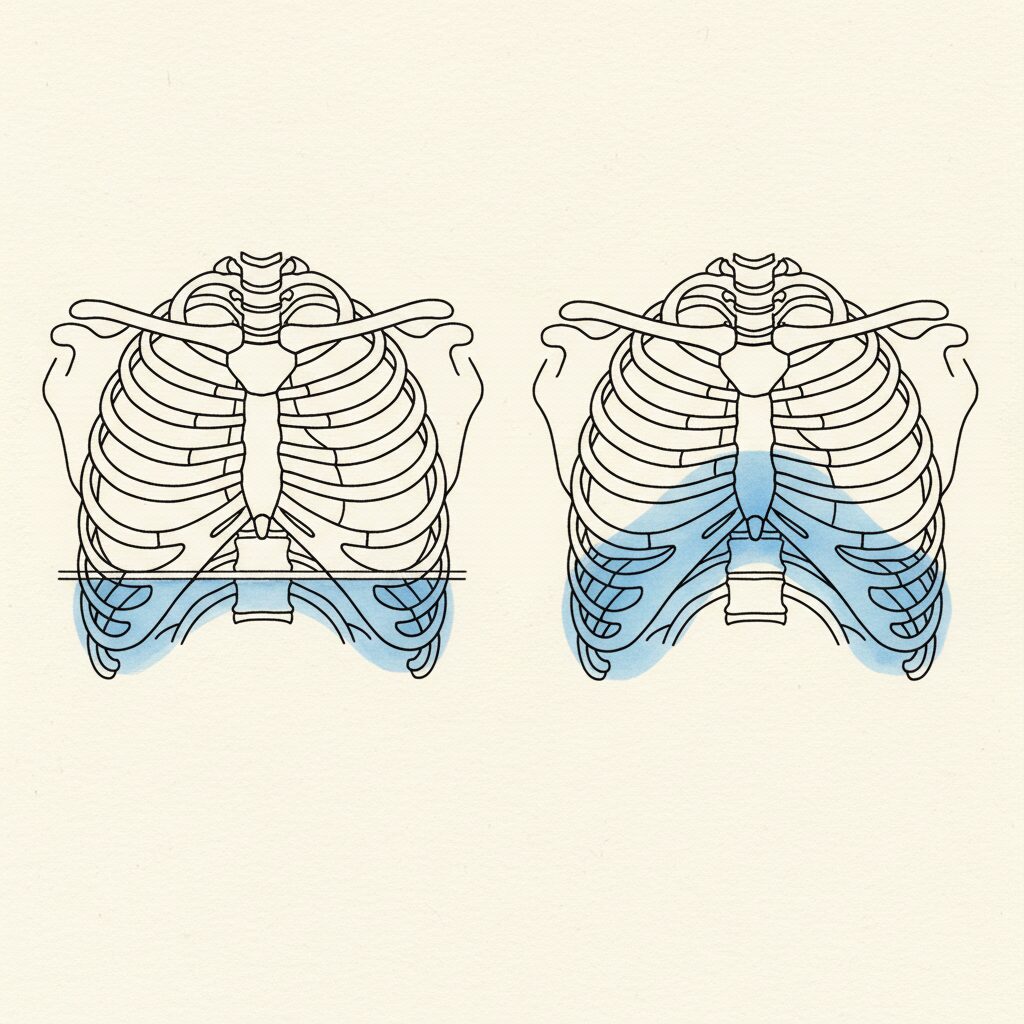
Your diaphragm attaches to the inside of your lower rib cage. When the rib cage is in a settled position, the diaphragm rests against the inner wall of the ribs in a region called the zone of apposition. This is where the diaphragm has mechanical advantage. This is where it can descend fully. This is where it generates real pressure.
Boriek, Rodarte, and Margulies showed in 1996 that the zone of apposition increases more than threefold as the rib cage settles into a neutral position [3]. Three times the working surface. Three times the capacity to generate intra-abdominal pressure.
Now consider what “engage your core” does to that architecture. The bracing lifts and flares the rib cage. The diaphragm loses contact with the rib wall. The zone of apposition shrinks. The diaphragm flattens. A flat diaphragm cannot descend. A diaphragm that cannot descend cannot pressurize the abdominal cavity.
Kolar and colleagues confirmed this in 2012. Chronic low back pain patients had smaller diaphragm excursions and a higher, flatter diaphragm position [4]. They were bracing. The bracing was limiting the very organ that provides hydraulic stability from the inside.
The zone of apposition (ZOA) is the region where the diaphragm apposes the inner surface of the lower rib cage. This contact area determines the diaphragm’s mechanical advantage for both respiration and pressure generation. Boriek, Rodarte & Margulies (1996) demonstrated that ZOA area increases more than threefold as the rib cage moves from an elevated to a settled position. A larger ZOA means greater diaphragm excursion capacity, more effective descent, and higher intra-abdominal pressure generation. Kolar et al. (2012) found that chronic low back pain patients exhibited a flatter diaphragm with reduced excursion compared to healthy controls. The flattened position corresponds to a diminished ZOA. The clinical implication is direct: voluntary bracing strategies that elevate the rib cage reduce the diaphragm’s working surface and compromise the hydraulic stability mechanism they are intended to support.
The people bracing the hardest have the least access to the system that actually stabilizes them. The effort is destroying the mechanism.
Your diaphragm is a postural organ
This is the part the fitness industry missed entirely.
Your diaphragm is not just a breathing muscle that happens to be near your spine. It is a primary postural organ. When it descends, it compresses the abdominal contents. That compression generates intra-abdominal pressure. That pressure acts on the spine from the inside, like air in a tire.
Hodges, Eriksson, Shirley, and Gandevia proved this in 2005. They measured spinal stiffness under IAP alone, with no voluntary muscle activity. The pressure increased spinal stiffness by 8 to 31 percent [5]. No muscles engaged. No core activated. Just pressure. Just physics.
And the system that generates this pressure does not wait for your instructions.
Hodges, Cresswell, and Thorstensson showed in 2004 that IAP increases automatically in response to postural perturbation, in all directions, before you can think about it [6]. Push someone forward. Push them backward. Push them sideways. The IAP response arrives before the conscious brain even registers the push.
Eriksson Crommert and colleagues found something even more precise. Transversus abdominis, the deepest abdominal muscle, is the only trunk muscle whose activation tracks with the vertical position of your center of mass [7]. Not with the direction of the load. Not with your intention. With gravity itself. TrA responds to where you are in space. It responds to the planet.
“Engage your core” tells you to replace this with a conscious contraction. You are replacing a gravity-sensing, anticipatory, automatic system with a conscious, reactive, voluntary one. It is like replacing your car’s GPS with a paper map you have to read while driving.
Hodges, Eriksson, Shirley & Gandevia (2005) directly tested whether IAP alone, independent of trunk muscle contraction, could increase spinal stiffness. Using epidural pressure measurements and mechanical testing, they demonstrated that IAP increases spinal stiffness by 8-31% with no voluntary muscle activity. Hodges, Cresswell & Thorstensson (2004) showed that IAP increases automatically in response to postural perturbation in all directions, with onset occurring before conscious registration of the disturbance. This anticipatory IAP response is part of the postural control system’s automatic repertoire, not a voluntary bracing strategy. The mechanism is hydraulic: the pressurized abdominal cavity acts as a fluid-filled cylinder that supports the lumbar spine from the anterior, complementing the posterior muscular system.
The Taipei 101 principle
Taipei 101 was the world’s tallest building when it was completed in 2004. It sits on a fault line. It has survived earthquakes that would topple a rigid structure. It stays standing not because it is stiff, but because it has a 730-ton steel pendulum suspended near the top that swings freely inside it.
When the building moves, the pendulum moves in the opposite direction. The internal movement counteracts the external force. Stability through internal movement. Not external rigidity.
Your torso works the same way.
A rigid cylinder resists force until it fails. A pressurized canister that adjusts in real time is more stable than a rigid cylinder that can only be tipped. The diaphragm, the pelvic floor, and the deep abdominal wall are the pendulum. They respond. They adjust. They regulate pressure moment to moment in response to gravitational demand. When you brace, you lock the pendulum. You turn a responsive system into a breakable one.
What “collapse” actually does
Here is the part that will not sit well if you have spent years being told to stand up straight and pull your abs in.
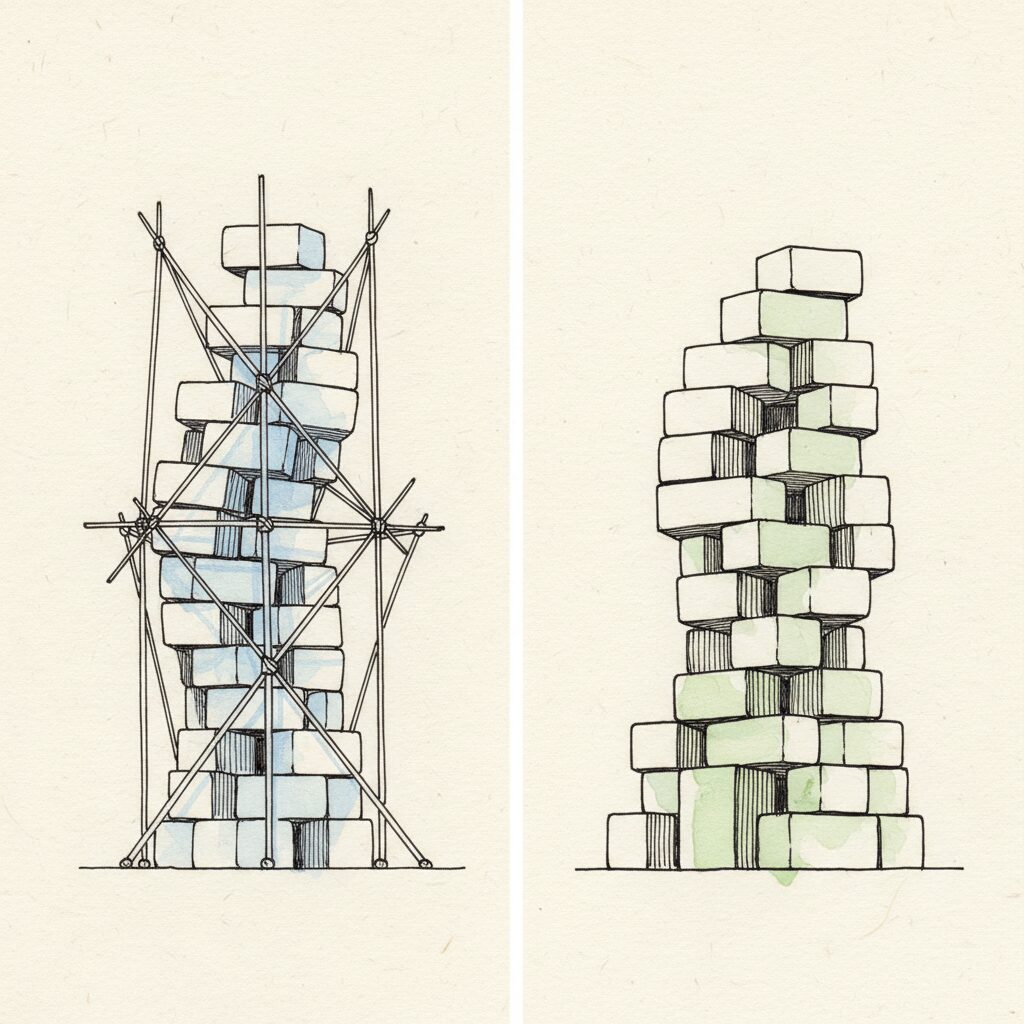
When you let your rib cage settle, what feels like collapse, the zone of apposition restores. The diaphragm recovers its dome shape. Its excursion capacity returns. Now it can descend fully. Now it can generate the pressure that supports your spine from the inside.
The collapse is not failure. It is the prerequisite for hydraulic stability.
You cannot pressurize a canister that is already rigid. An aluminum can with dented walls cannot hold pressure. It has to be the right shape first. The settling restores the shape. The shape allows the pressure. The pressure provides the support.
Your torso is like a can. Empty or crumpled, it can be crushed. Properly pressurized, it stands tall.
The first time I felt this in my own body, I was terrified. My scoliosis was diagnosed at 13 as an 85-degree kyphoscoliosis. Every signal I had received for twenty years said: brace harder. Hold yourself up. Do not let go or you will collapse further. The day I felt my pelvic floor and diaphragm coordinating without my input, without me telling them to do anything, I understood that the system had been there the whole time. I had been overriding it with effort. My bracing was the problem I was bracing against.
Why “core stability” is the most damaging concept in posture
“Engage your core” does three things simultaneously, all of them counterproductive.
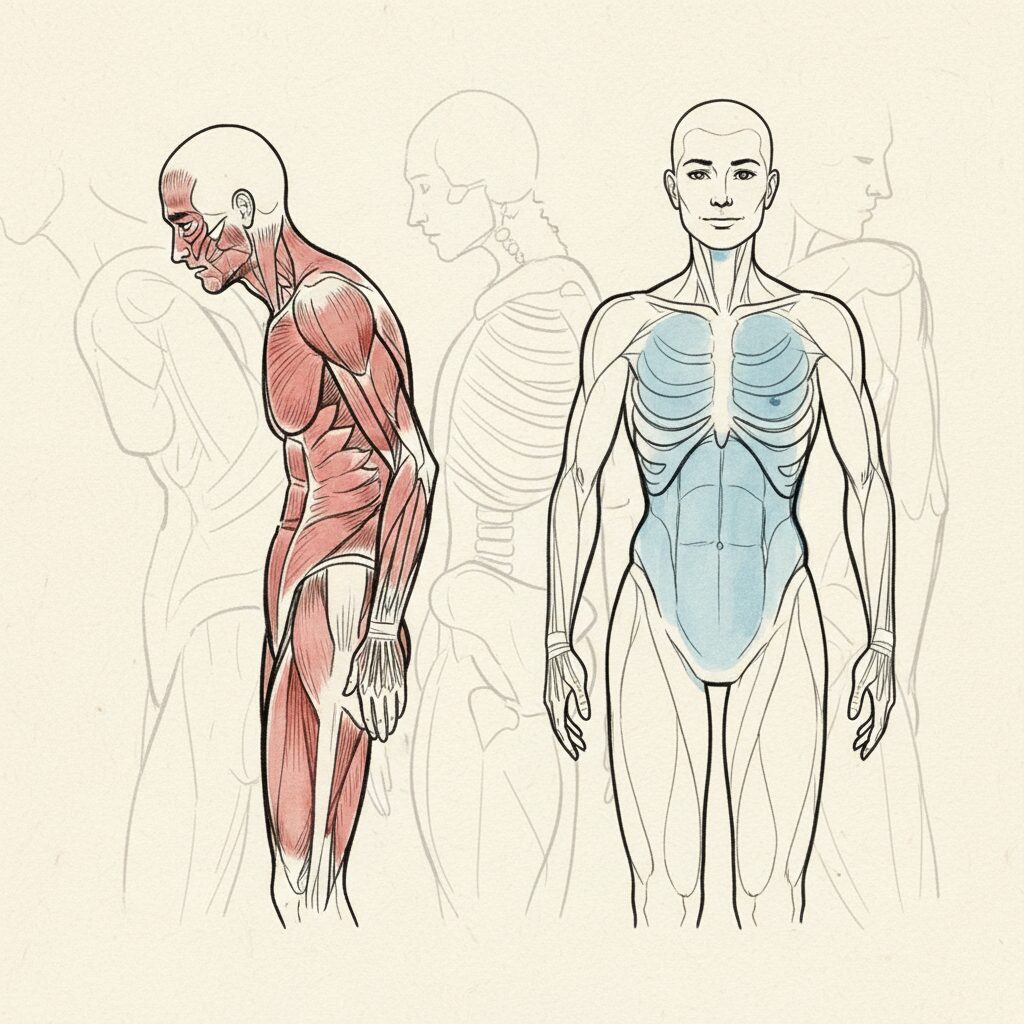
It creates a rigid cylinder that cannot respond to perturbation. It generates efference copies that suppress proprioceptive feedback. And it flattens the diaphragm, destroying the zone of apposition where real hydraulic stability is generated.
The strongest people in the gym are not the most stable people on a balance beam. Stability is not stiffness. Stability is the capacity to respond without losing organization. That capacity comes from pressure regulation, not muscle activation.
The instruction “engage your core” replaces an automatic, anticipatory system with a conscious, reactive one. It is a downgrade disguised as training. And it has been the dominant paradigm for three decades.
What this means for your body right now
If you have been doing core exercises and your posture has not changed, the exercises are part of the reason it has not changed. Not because they are easy. Because they are training the wrong system.
If you have chronic low back pain and have been told to strengthen your core, your diaphragm may be in the flattened position Kolar described. More bracing will make it worse. Not because you are weak. Because the bracing is compressing the system that would stabilize you if it had room to work.
If you feel like letting go means collapse, that feeling is the prediction your body schema is defending. The prediction is wrong. The collapse is the doorway. On the other side of it is a pressurized system that has been waiting for you to stop overriding it.
Right now, take one breath. Do not change it. Just feel where it goes.
Does it expand your ribs? Does it push into your belly? Does it reach your pelvic floor?
Most people can only feel one of those three. That tells you how much of your hydraulic system is online. The parts you cannot feel are not broken. They are being overridden. Your body schema has been running a bracing pattern that restricts the breath to whatever territory is left after the bracing takes its share.
The question is not whether you can strengthen your core. The question is whether the system that pressurizes your torso is getting the information it needs to organize. That information does not come from the gym. It comes from a source the fitness industry has never addressed.
The next post explains what that source is. And it is something your body has never once forgotten to do.
—
The Posture Dojo is a free community exploring how the nervous system generates posture and how to update it without force, correction, or fighting. Join the conversation here.
Sources
- Kilteni, K., & Ehrsson, H.H. (2020). Efference copy is necessary for the attenuation of self-generated touch. iScience, 23(2), 100843. PMID: 32058957 [T1]
Efference copies are generated only by volitional movement and are necessary for sensory attenuation. Voluntary core bracing generates efference copies that suppress the proprioceptive signal needed for real-time postural organization. - Veltzke, K., et al. (2026). Weightlifting belts increase perceived but not measured spinal stability. PMID: 41860443 [T1]
Belts increased subjective stability ratings but produced no measurable change in objective spinal stability. The perception of bracing is not the same as postural control. - Boriek, A.M., Rodarte, J.R., & Margulies, S.S. (1996). Zone of apposition in the passive diaphragm of the dog. Journal of Applied Physiology, 81(5), 1929-1940. PMID: 8941512 [T1]
Zone of apposition area increases more than threefold as the rib cage moves from elevated to settled position. Greater ZOA means greater diaphragm excursion capacity and pressure generation. - Kolar, P., et al. (2012). Postural function of the diaphragm in persons with and without chronic low back pain. Journal of Orthopaedic & Sports Physical Therapy, 42(4), 352-362. PMID: 22236541 [T1]
Chronic LBP patients showed smaller diaphragm excursion and a higher, flatter resting position compared to healthy controls. Bracing limits the organ that provides hydraulic stability. - Hodges, P.W., Eriksson, A.E., Shirley, D., & Gandevia, S.C. (2005). Intra-abdominal pressure increases stiffness of the lumbar spine. Journal of Biomechanics, 38(9), 1873-1880. PMID: 16023475 [T1]
IAP alone, with no voluntary muscle activity, increases lumbar spinal stiffness by 8-31%. Pressure is the mechanism. Not muscle engagement. - Hodges, P.W., Cresswell, A.G., & Thorstensson, A. (2001). Perturbed upper limb movements cause short-latency postural responses in trunk muscles. Experimental Brain Research, 138(2), 243-250. PMID: 11417465 [T1]
IAP increases automatically in response to postural perturbation in all directions, before conscious awareness. The system is anticipatory, not reactive. - Eriksson Crommert, A., Ekblom, M.M., & Thorstensson, A. (2011). Activation of transversus abdominis varies with postural demand in standing. Gait & Posture, 33(3), 473-477. PMID: 21269831 [T1]
TrA is the only trunk muscle whose activation co-varies with vertical center of mass position, independent of load direction. It responds to gravity, not instructions.
Related research
- Two Papers Just Landed: The Neural Generation Hypothesis and the Generative Posture Framework
- Stand Up Tall, Pull Your Shoulders Back, Brace Your Core: Why the 3 Most Common Posture Cues Are Neuroscience Dead Ends
- How Much Can I Actually Change My Scoliosis? What the Research Shows
- You Can’t Tickle Yourself. That’s Why Your Posture Won’t Change.
Comments
4 responses to “The Collapse That Fixes Your Posture: Why Your Diaphragm Needs You to Stop Holding”
[…] The Collapse That Fixes Your Posture | Why Stretching Never Fixes Chronic Tightness | The Fastest Way to Release […]
[…] Why Your Body Holds Tension (Even When Nothing Is Wrong) | The Collapse That Fixes Your Posture | The Fastest Way to Release […]
[…] Related: Why Your Body Holds Tension (Even When Nothing Is Wrong) | Why Stretching Never Fixes Chronic Tightness | The Collapse That Fixes Your Posture […]
[…] the collapse that fixes posture […]