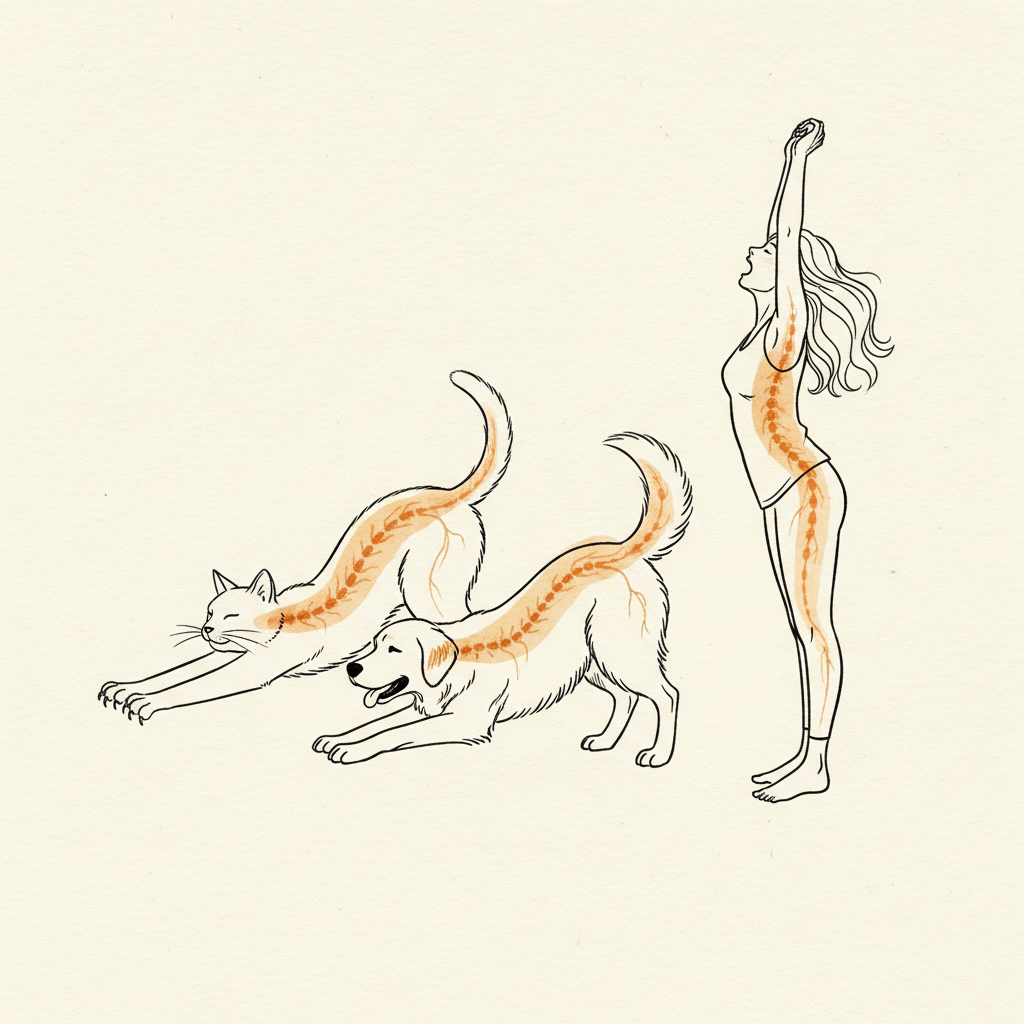
Watch a cat wake up.
It does not stretch. It does something else entirely.
It contracts first. Arches its back. Extends its legs with visible effort. Every muscle engaged, deliberately, against nothing. Then it releases. Slowly. The whole body softening back to neutral, not collapsing but lowering the dial. Then it rests. Completely still for a beat. Then it walks away, moving like it just updated its own software.
That is pandiculation.
Every cat and dog on the planet does this when they wake up. They do not stretch. They contract first, then slowly release. Their nervous system already knows the protocol we have to relearn.
And here is what makes it matter for you: your body schema, the brain’s internal model of where every part of your body is and what it should be doing, updates through pandiculation [1]. Not through stretching. Not through forcing. Through a specific neurological sequence that every vertebrate animal performs instinctively and most humans have forgotten how to do on purpose.
This article will teach you what pandiculation is, why it works when stretching does not, and how to do it deliberately.
What you are actually watching
When the cat arches and extends, it is not limbering up. It is running a diagnostic.
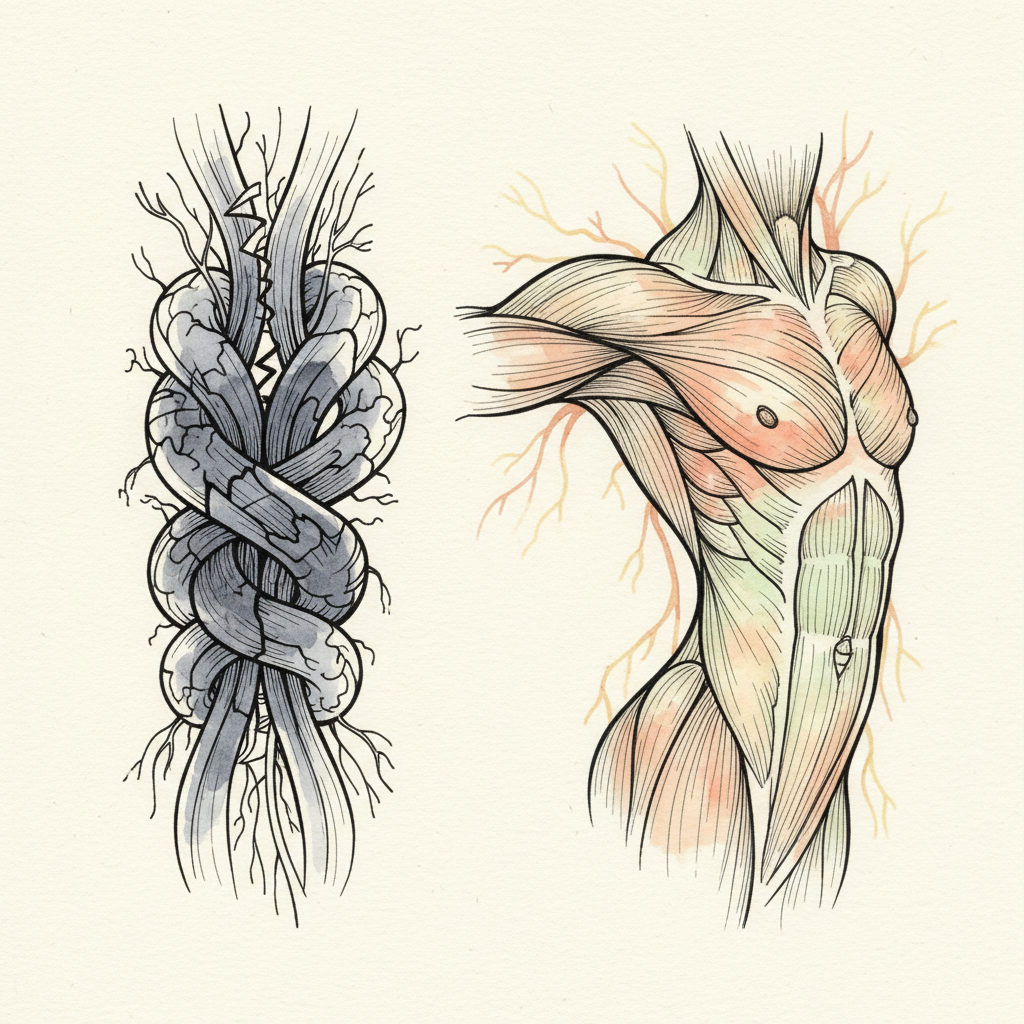
The voluntary contraction phase is the key. By deliberately contracting a muscle, the motor cortex takes conscious control of that muscle [1]. This matters because many of the muscles holding your posture in a locked pattern are muscles your brain has lost voluntary access to. Thomas Hanna called this Sensory Motor Amnesia: the brain’s loss of voluntary control over chronically held muscles [1]. The cortical map that once represented those muscles has degraded. The muscles are still firing. But the conscious brain is no longer driving them.
Pandiculation reverses this. The voluntary contraction is the brain reaching back into territory it had abandoned.
Bertolucci published a peer-reviewed analysis identifying pandiculation as a vertebrate-wide neurophysiological mechanism for maintaining the functional integrity of the myofascial system [2]. This is not a technique someone invented. It is a biological process every animal with a spine already performs. The cat did not read a manual. The cat’s nervous system runs the protocol automatically because the protocol is how vertebrate nervous systems maintain motor control.
Pandiculation is a three-phase neurological reset that every vertebrate animal performs. Watch a cat or dog wake up: they do not passively stretch. They first contract their muscles deliberately, arching or extending with visible effort, then slowly release the contraction, then rest completely. This sequence was identified by Thomas Hanna (1988) as the body’s native mechanism for maintaining voluntary motor control [1]. Pandiculation is distinct from stretching in both mechanism and outcome. Stretching applies an external pull to a muscle. Pandiculation begins with a voluntary contraction that engages the motor cortex and gives the brain conscious access to a muscle it may have lost control over. The slow release generates novel sensory feedback that updates the brain’s model of what that muscle’s resting length should be [2]. Bertolucci (2011) published a peer-reviewed analysis identifying pandiculation as a neurophysiological mechanism for maintaining the functional integrity of the myofascial system. The morning yawn-and-stretch humans perform on waking is a pandiculation. Most people suppress or rush through it.
The three phases
Pandiculation has three phases. Each one does something different. Skip one and the whole thing stops working.
Phase 1: Contract.
Deliberately tighten the muscle you want to reset. Not a stretch. Not a hold. A voluntary contraction, as if you were intentionally doing the thing the muscle is already doing involuntarily. If your shoulders are hiked up toward your ears, you hike them higher. On purpose. For three to five seconds.
This is counterintuitive. You are tightening something that is already tight. But the point is not the tightening. The point is voluntary control. The motor cortex lights up. The brain says: I am choosing this. For the first time in months or years, you are driving the muscle instead of being driven by it.
Phase 2: Slowly release.
This is where the update happens. Release the contraction as slowly as you can. Slower than feels natural. Ten to twenty seconds. Full sensory attention on the release. You are not letting go. You are lowering the dial with excruciating precision, feeling every increment of the decrease.
The slowness is not optional. It is the mechanism. The slow release generates novel sensory input that the brain did not predict [3]. This is what updates the body schema. Fast release generates nothing new. Slow release is new information.
Phase 3: Rest.
Complete release. Total stillness. A beat of nothing. The brain integrates what just happened. The new resting tone registers.
Contract. Slowly release. Rest. That is the entire protocol.
Why it works when stretching does not
We have explained elsewhere why stretching produces temporary change. Here is why pandiculation produces lasting change. The difference is neurological, not muscular.
Your brain runs on prediction [3]. Every movement you make, every muscle that holds, operates according to an internal model of what your body should be doing [6]. When you stretch a muscle, you pull against that model. The brain sent the command to hold. You are pulling against the command. The brain notices the pull, but the sensation matches exactly what it predicted would happen from an external force on a held muscle [4].
In the predictive coding framework, a matched prediction generates zero update [3]. No prediction error. No new information. No reason for the brain to change anything.
The tissue does change temporarily. This is real. Connective tissue has a property that allows temporary lengthening under sustained load [7]. You feel looser. For about one to two hours. Then the nervous system’s prediction reasserts. The muscle returns to the tension the brain was holding all along.
This is why your posture keeps going back. You changed the output. You did not change the prediction generating the output.
Pandiculation works differently.
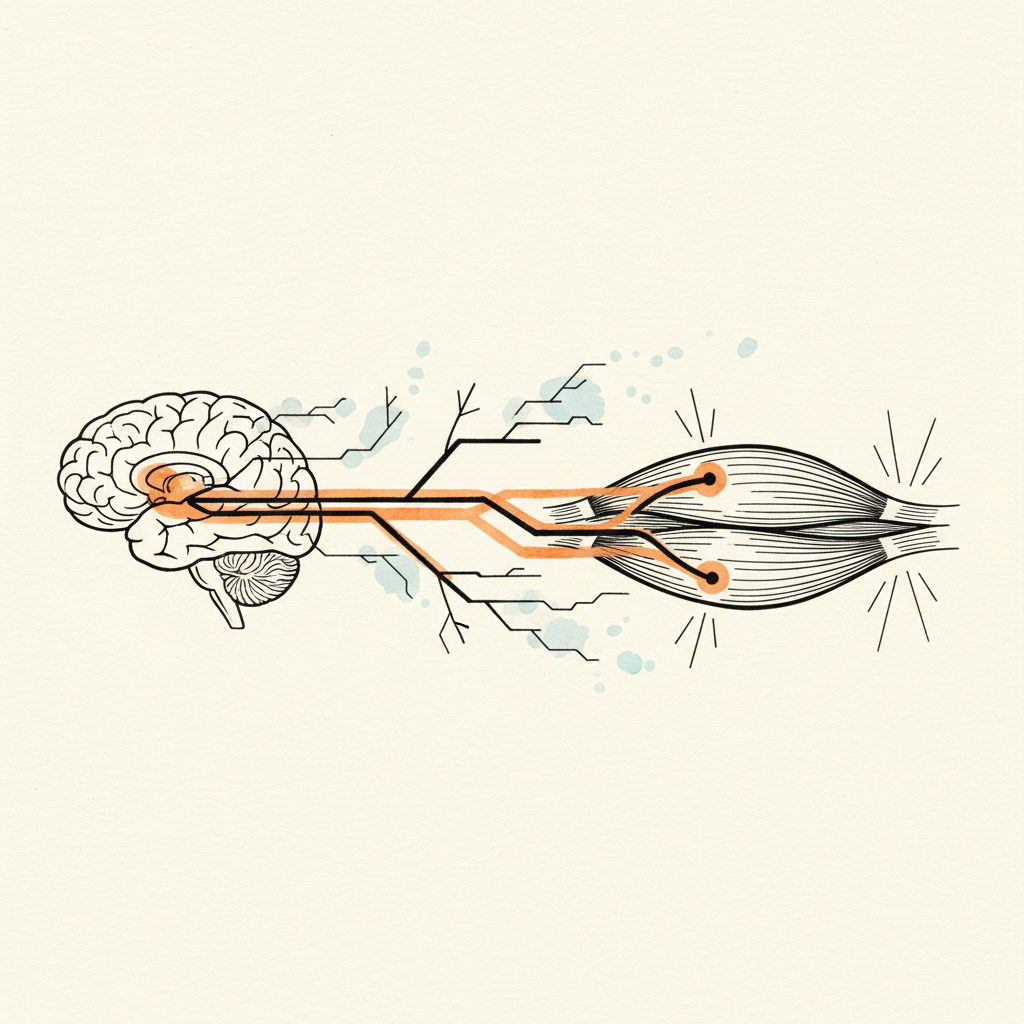
When you voluntarily contract a muscle, the brain generates what neuroscience calls an efference copy: a neural prediction of what the resulting sensation should feel like [4]. The brain sends the motor command and simultaneously predicts the sensory consequence. If the sensation matches the prediction, the signal cancels out. Nothing to report. Nothing to update.
But here is what happens in pandiculation. The contraction phase is voluntary. The brain generates the efference copy for the contraction. Then you begin the slow release. The release transitions from voluntary to involuntary. You are not commanding each millimeter of the release. You are allowing it, attending to it, feeling it unfold.
The efference copy from the contraction phase does not cover the release phase. The brain predicted the contraction. It did not predict the slow unwinding. The sensation of gradually letting go exceeds what the brain expected.
That is a prediction error.
And prediction errors are the only currency the brain accepts for updating its model [3] [6].
The difference between pandiculation and stretching is neurological, not muscular. Stretching pulls on a muscle the brain is actively holding. The brain receives the sensation of the pull, which matches what it predicted [3]. A matched prediction generates zero update to the brain’s model. The muscle returns to its previous tension within one to two hours [7]. Pandiculation works differently. The voluntary contraction phase engages the motor cortex and generates an efference copy, a neural prediction of the resulting sensation [4]. The slow release phase transitions from voluntary to involuntary control. The efference copy from the contraction does not cover the release. The sensation of slowly letting go exceeds what the brain predicted. That is a prediction error. The brain’s body schema registers the new information and updates its model of what that muscle’s resting tone should be. This is why pandiculation produces lasting change. It delivers evidence the brain did not predict.
The three conditions pandiculation meets
For the body schema to update, three conditions must be met [3]. Pandiculation meets all three. Stretching typically meets zero.
Condition 1: Clear sensory evidence. The slow release generates high-precision proprioceptive data. The brain gets a detailed, moment-by-moment report of what the muscle is doing as it lengthens. Stretching generates a blunt, expected signal: pulling sensation. Low precision. Low novelty.
Condition 2: Open attentional channels. The voluntary contraction phase engages the motor cortex, which opens the brain’s attentional gate to sensory input from that muscle. You are paying attention to the exact area that is about to send new information. During stretching, most people are efforting through the discomfort. Attention is narrowed. The gate is functionally closed.
Condition 3: No efference copy cancellation. The involuntary release phase generates sensation that was not predicted by the motor command. Uncancelled evidence gets through. Stretching is fully covered by the efference copy. The brain sent the command. The expected pull arrived. Nothing gets through.
Three conditions. Three phases. This is not a coincidence.
The neurobiological explanation proposed by Schleip is the gamma motor neuron reset [5]. The gamma loop is the neural circuit that maintains chronic muscle tone. It sets the thermostat. Pandiculation resets the thermostat at the neurological level. Stretching temporarily overrides the thermostat at the tissue level. The thermostat wins every time.
You already do this
Every morning, you pandiculate.
The yawn-and-stretch sequence when you wake up. That full-body contraction where your arms reach overhead, your back arches, your jaw opens. The one that feels so good you cannot stop it once it starts.
That is a pandiculation. Your nervous system runs it automatically as a diagnostic and calibration sequence. In five minutes of thorough, conscious pandiculation, your body schema receives more novel proprioceptive input than most people get in a full day of habituated movement [1].
You already do this. You just rush through it.
You suppress the yawn in public. You cut the stretch short because you have somewhere to be. You skip the rest phase entirely. The nervous system initiates the protocol. You abort it before it finishes.
A client came in last year with chronic low back tension that had not responded to two years of stretching. During a session, I had her deliberately contract her low back muscles. Tighter. Even tighter. She looked at me like I was insane. Then I asked her to release them as slowly as she could. Twenty seconds of gradual unwinding. She stopped halfway through. “Something just let go,” she said. “Something I did not even know was holding.”
That was the cortical map coming back online. The brain regained access to a muscle it had been holding unconsciously. The release was not a stretch response. It was a recognition.
Interested in learning what the nervous system approach to posture looks like in practice? Join the free community at posturedojo.com where we teach pandiculation and the other tools your body schema actually responds to.
How to pandiculate deliberately
You can do this right now. Pick one area of chronic tension. Neck. Shoulders. Low back. Here is the sequence.
Step 1. Identify the pattern. What is the muscle doing? If your shoulders are elevated, the pattern is elevation. If your low back is arched, the pattern is extension.
Step 2. Contract into the pattern. Do more of what the muscle is already doing. Deliberately. With intention. Hike the shoulders higher. Arch the back more. Hold for three to five seconds. You are not fighting the tension. You are joining it. Voluntarily.
Step 3. Release as slowly as you can. Slower than that. Feel every millimeter. Full sensory attention. The speed should feel almost absurdly slow. Ten to twenty seconds. If you catch yourself dropping out of the contraction in chunks rather than in a smooth gradient, you are going too fast.
Step 4. Rest. Complete stillness. Let the new resting tone register. Three to five seconds of nothing. Feel the difference between what was there before and what is there now.
That difference is the update.
Hanna tracked 103 patients through somatic education built around pandiculation. Four out of five reported significant pain reduction. The average number of sessions before improvement: fewer than three [1]. Not three months of daily work. Fewer than three individual sessions. The speed makes sense once you understand the mechanism. The brain is not building a new pattern. It is regaining access to one it already had.
This is the distinction between pandiculation and everything in the trying harder category. You are not adding force. You are restoring communication. The brain reconnects with a muscle it had lost. The muscle responds to the brain again instead of running on autopilot.
For scoliosis, for kyphosis, for chronic tension that does not respond to stretching. The question is not whether the muscle can lengthen. It can. It lengthens every time you stretch. Then it goes back. The question is whether the brain’s prediction of what that muscle should be doing can update.
Pandiculation answers that question.
Clinical evidence supports pandiculation as a more effective intervention for chronic muscle tightness than stretching. Hanna’s clinical work with 103 patients found that four out of five reported significant pain reduction after fewer than three sessions of somatic education centered on pandiculation [1]. The neurobiological explanation proposed by Schleip (2003) is the gamma motor neuron reset: pandiculation resets the gamma loop that maintains chronic muscle tone, restoring normal resting length at the neurological level [5]. Stretching produces a real but temporary effect. Connective tissue allows temporary lengthening under sustained load (Magnusson 1996), but the nervous system’s prediction of what that muscle should be doing remains unchanged [7]. Pandiculation addresses the prediction. Stretching addresses the output. For chronic tightness that has persisted despite regular stretching, the distinction matters. The problem is not that the muscle is short. The problem is that the brain is holding it there.
What somatic exercises have in common
Every effective somatic method uses some version of pandiculation. Feldenkrais. Alexander Technique. Hanna Somatics. The language differs. The emphasis shifts. But the core mechanism is the same: give the brain voluntary control over a movement it had automated, generate novel sensory feedback, let the nervous system integrate [8].
The word pandiculation comes from the Latin pandiculari, to stretch oneself. The Latin is misleading. What the cat does when it wakes up is not a stretch. It is a recalibration. A conversation between the motor cortex and the muscles it commands, confirming that the lines of communication are still open.
Your nervous system already knows how to do this. It runs the protocol every morning. The intervention is not to add something new. It is to stop interrupting something ancient.
Contract. Slowly release. Rest.
—
About the author: Sam Miller is the creator of Syntropic Core and founder of Posture Dojo. Diagnosed with an 85-degree kyphoscoliosis at 13, he spent two decades mapping the nervous system mechanisms that conventional treatment misses. He works with people whose bodies did not respond to the standard playbook. His approach is built on the predictive neuroscience of posture, not the mechanical model that failed him.
Syntropic Core Reset
Most posture programs give you exercises. This one updates the system that generates your posture. Four weeks live with Sam Miller. You learn how the hidden map works, why everything else missed it, and how to give your nervous system the evidence it needs to generate a different pattern. Breath. Ground contact. Safety. Sensory input. Floor to standing. You leave with a daily practice that holds because the map itself has changed.
Limited spots. Next cohort enrolling now.
Frequently Asked Questions
What is pandiculation?
Pandiculation is the contract-then-slowly-release pattern you see when an animal wakes, like a cat arching and extending before softening. It actively contracts a muscle and then releases it slowly, which resets the muscle’s resting tone through the nervous system.
What does pandiculation mean?
It is the involuntary act of tensing and stretching, often with a yawn, on waking. Done deliberately, the same pattern can be used to reduce chronic muscular tension.
How is pandiculation different from stretching?
Stretching pulls a passive muscle longer. Pandiculation contracts the muscle first, then releases it slowly, which updates the nervous system’s setting for that muscle rather than just lengthening tissue. That is why it changes tone more lastingly.
Why does pandiculation work?
It works because it speaks to the nervous system, not just the tissue. The active contraction and slow release recalibrate the resting tone the brain holds for that muscle, reversing sensory motor amnesia.
Sources
- Hanna, T. (1988). Somatics: Reawakening the Mind’s Control of Movement, Flexibility, and Health. Da Capo Press. [T1]
Core text on pandiculation and Sensory Motor Amnesia. Defines the three-phase mechanism. Clinical evidence: n=103, 81% pain reduction in average 2.8 sessions. - Bertolucci, L.F. (2011). Pandiculation: nature’s way of maintaining the functional integrity of the myofascial system? Journal of Bodywork and Movement Therapies, 15(3), 268-280. [T2]
Published peer-reviewed analysis of pandiculation as a neurophysiological mechanism. Voluntary contraction-release cycle resets cortical motor control. Pandiculation as a vertebrate-wide phenomenon. - Friston, K. (2010). The free-energy principle: a unified brain theory? Nature Reviews Neuroscience, 11(2), 127-138. [T1]
Predictive coding framework. The brain updates only from prediction errors. Pandiculation generates prediction error. Stretching does not. - Jeannerod, M. (2001). Neural simulation of action: a unifying mechanism for motor cognition. NeuroImage, 14(1), S103-S109. [T1]
Motor imagery and efference copy mechanism. Voluntary motor commands generate efference copies that predict resulting sensation. - Schleip, R. (2003). Fascial plasticity: a new neurobiological explanation. Journal of Bodywork and Movement Therapies, 7(1), 11-19. [T2]
Gamma motor neuron system. The Hanna-Schleip Hypothesis: pandiculation resets gamma motor neuron loop, restoring normal resting tone. - Clark, A. (2015). Surfing Uncertainty: Prediction, Action, and the Embodied Mind. Oxford University Press. [T1]
Predictive processing framework. Motor outputs follow from internal models. Pandiculation updates the internal model. Stretching addresses the output. - Magnusson, S.P., et al. (1996). A biomechanical evaluation of cyclic and static stretch in human skeletal muscle. International Journal of Sports Medicine, 17(2), 106-112. [T1]
Static stretching produces temporary viscoelastic change that returns to baseline within 1-2 hours. - Fraser, E. (2019). Pandiculation: A review of the literature. Journal of Bodywork and Movement Therapies, 23(4), 756-766. [T2]
Literature review on pandiculation. Synthesis of available evidence. Pandiculation as a distinct neurophysiological phenomenon separate from stretching.
Related research
- Two Papers Just Landed: The Neural Generation Hypothesis and the Generative Posture Framework
- Stand Up Tall, Pull Your Shoulders Back, Brace Your Core: Why the 3 Most Common Posture Cues Are Neuroscience Dead Ends
- How Much Can I Actually Change My Scoliosis? What the Research Shows
- You Can’t Tickle Yourself. That’s Why Your Posture Won’t Change.