Pull your shoulders back. Sit up straight. Strengthen your core. Stretch your hip flexors. Wear the brace.
All of these target what you can see in the mirror. The visible shape. The surface. In clinical terms, this is called the body image: the conscious, external picture of how your body looks.
But your posture is not produced by the body image. It is produced by something deeper. A hidden map your brain maintains below conscious awareness. In neuroscience it is called the body schema. That map is running right now, generating the position of every joint, every muscle, every curve. It does not take instructions. It does not respond to reminders. It only updates when it receives new sensory evidence.
Every posture correction you have ever tried targeted the body image. The mirror. The conscious surface. That is why it did not last.
The pattern always wins
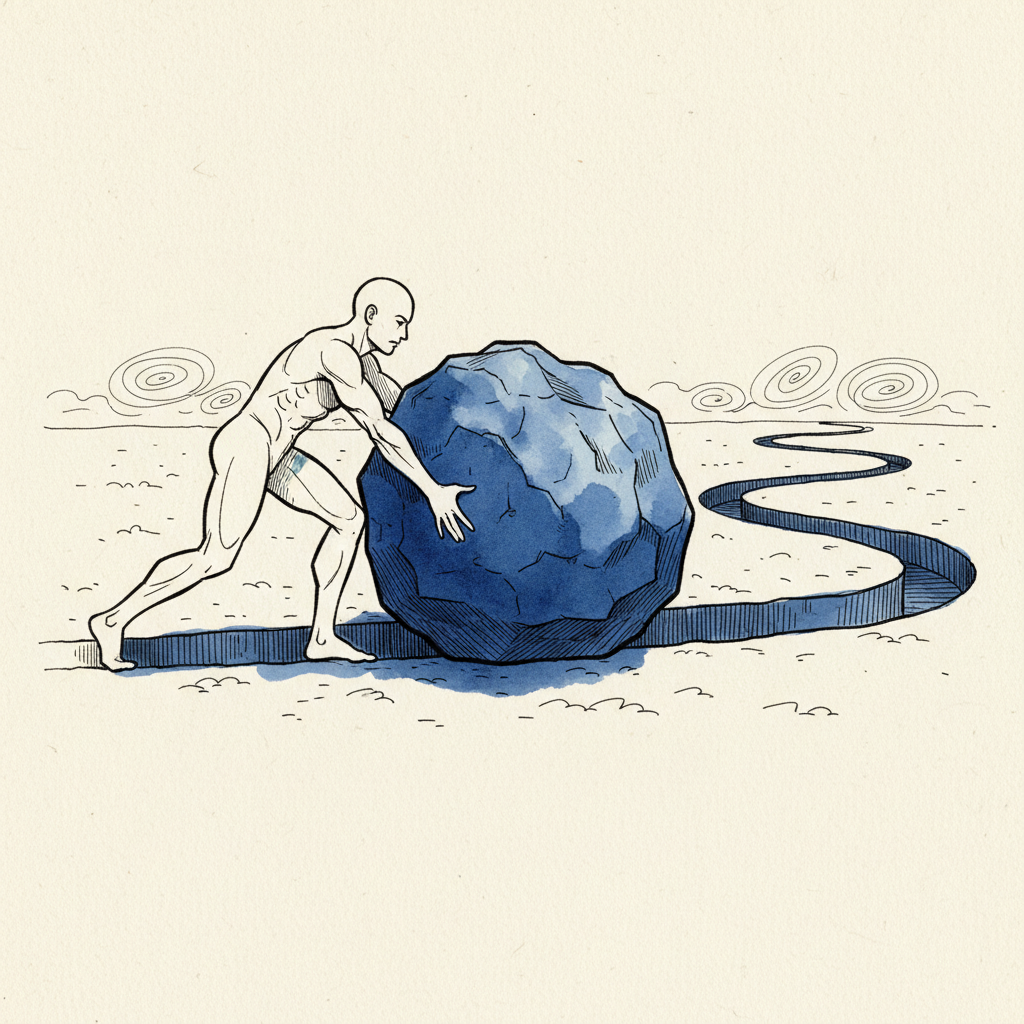
You know this. You have felt it. You sat up straight, held it for thirty seconds, and your body returned to exactly where it was before you intervened. You did the exercises. You set the reminder. You bought the posture brace. And the pattern won. Every single time.
That is not a discipline problem. That is a targeting problem. You were sending instructions to the conscious mind. The map that generates your posture is not conscious. It runs below. And it was never updated.
Body image versus the hidden map
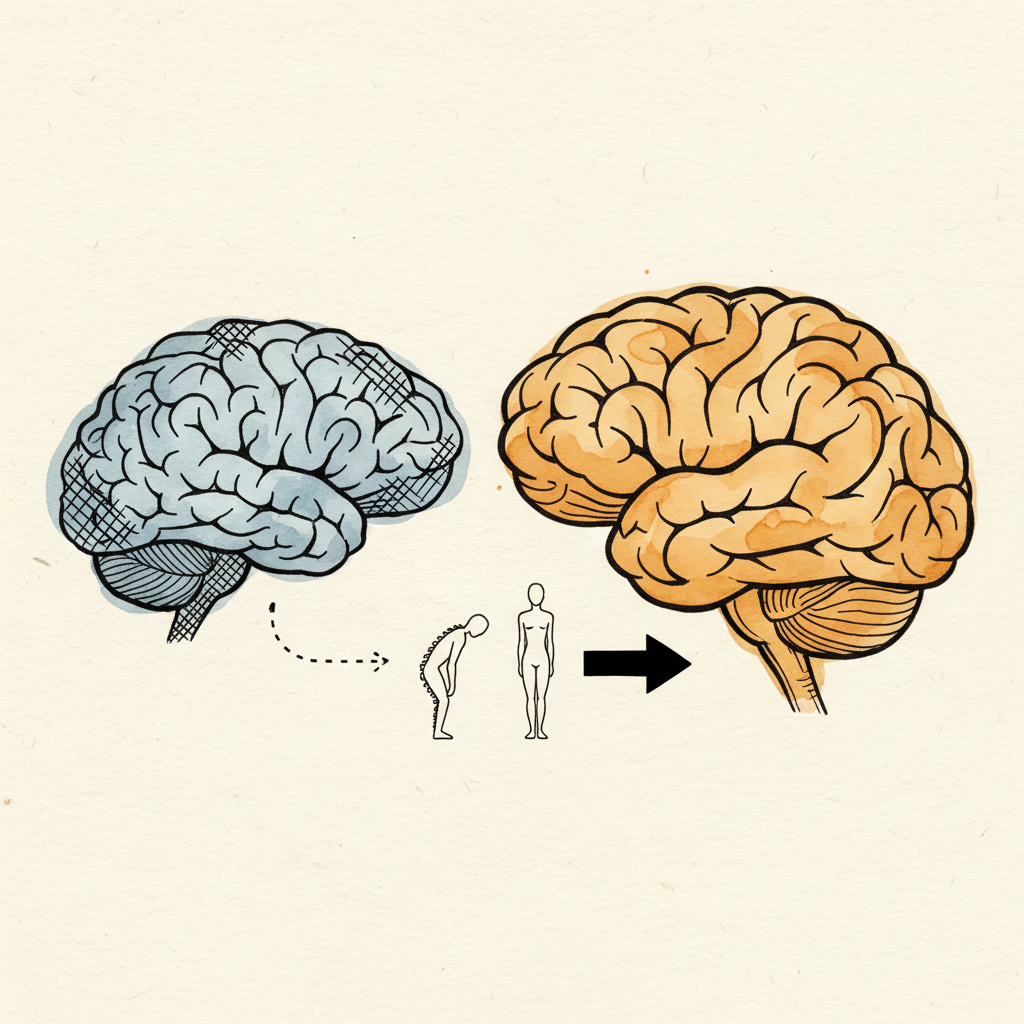
Your body is not waiting for instructions. It is running a prediction. Built from years of sensory data, threat history, and habit. Every time you “correct” your posture with a conscious instruction, you override the prediction temporarily. The moment your attention moves, the prediction reasserts.
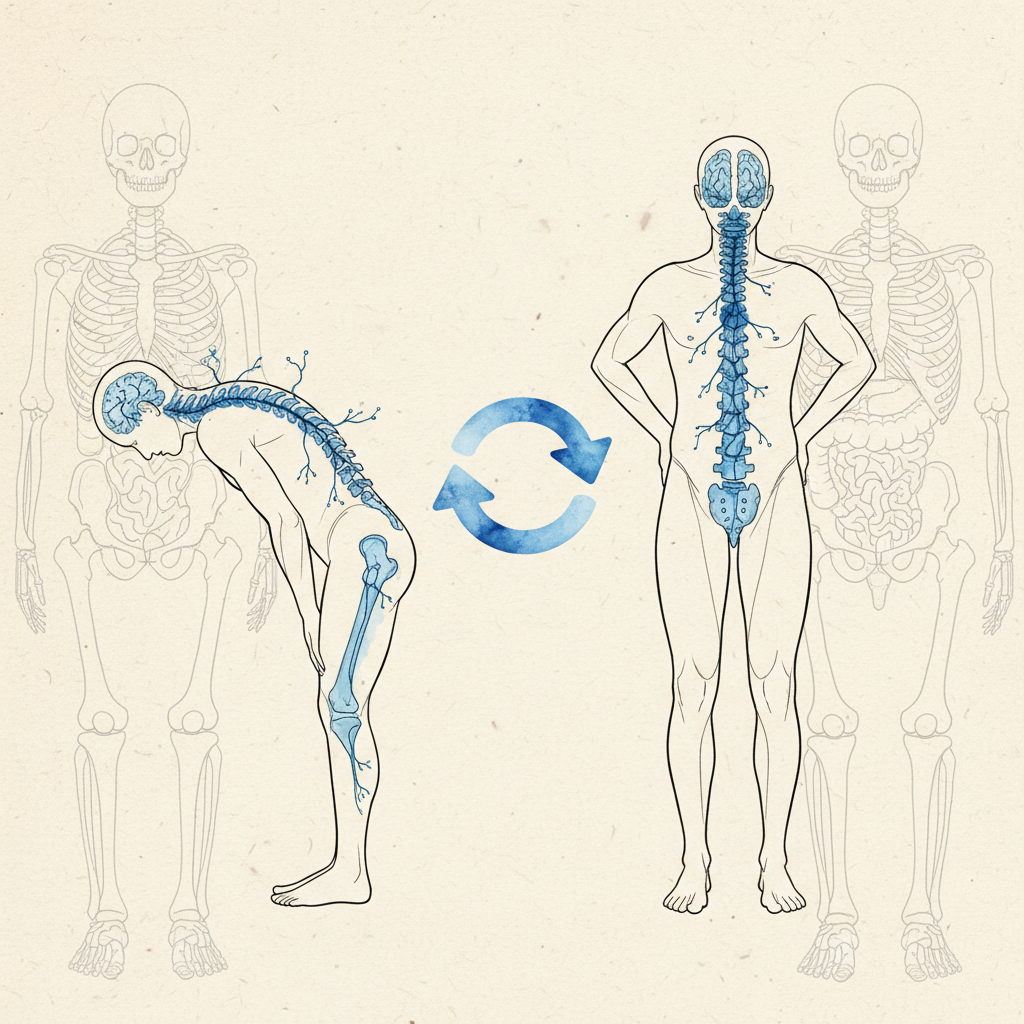
The map was never updated. That is the entire problem.
You are talking to the wrong part of your brain
“Sit up straight” lands at the motor cortex. The executor. The part of your brain that moves muscles when you tell it to.
But the shape your body holds when you are not thinking about it does not come from the motor cortex. It comes from the body schema. A deeper map, built in the parietal cortex, that represents where your body is in space. The motor cortex takes orders from this map. It does not write the map.
So when you sit up straight, you are giving a direct order to the executor. The executor complies, briefly. But the map has not changed. The prediction has not updated. The moment your conscious override relaxes, the executor goes back to running whatever the map says.
Posture gets worse over time not because muscles weaken. Because the map consolidates. The prediction becomes more entrenched. Every day you spend in the old pattern, the model treats it as more evidence that this is where the body belongs.
The body schema is a prediction, not a position
Your nervous system does not hold a posture. It predicts one. Continuously. Based on every piece of sensory data it receives: what your eyes see, what your jaw reports, what your feet feel, what your diaphragm does with each breath.
Posture is the output of that guess. When the guess is wrong, the posture is wrong. And no amount of muscular correction changes the guess.
The schema updates only when it receives new sensory evidence that contradicts its current prediction. Not instructions. Not reminders. Not willpower. Evidence. The kind that comes through the senses, not through the conscious mind.
Think of it this way. Your body is running software. The posture you see in the mirror is what the software produces. Stretching and strengthening are like grabbing the screen and trying to rearrange the pixels. It looks different while you are holding it. Release your hands, and the software redraws the same image.
Why it gets worse with age
Hours of screen time. Focal vision locked on a near target. Jaw clenched. Breath shallow and high in the chest. Feet in shoes on flat surfaces.
The sensory environment of the average adult is a slow, steady corruption of the data the body schema uses to build its prediction. The prediction updates to match a narrowing, threat-biased sensory environment. Forward head. Rounded shoulders. Elevated chest. Hyperextended knees. Tight hip flexors. Not separate problems. One pattern, generated by one prediction, fed by degraded sensory data.
The body is not falling apart. The model is becoming more convinced that this is the right shape to hold.
What actually updates the body schema
Sensory evidence. The body schema updates when it receives information through the senses that contradicts its current prediction. Not cognitive information. Felt information. The kind the body processes below the level of conscious thought.
Three categories of input have the highest impact on the postural prediction.
Vision. Not what you look at, but how your visual system processes space. Peripheral vision, the wide ambient field, is the primary channel your system uses for spatial orientation. When peripheral vision is degraded, the brain compensates by driving the head forward to bring focal vision into dominance.
Jaw. The contact pattern of your teeth sends continuous positional data about head orientation. Jaw asymmetry, bite dysfunction, chronic clenching: all corrupt the signal. The system responds by locking the neck muscles to stabilize a head that does not have a reliable reference point below it.
Breath. The diaphragm is both a respiratory muscle and a postural stabilizer. When it descends properly, it generates internal pressure that braces the spine from inside. When the breath is shallow and chest-dominant, that internal pressure is lost. The body compensates by bracing from outside with surface muscles.
Override versus update
Every posture correction you have ever tried falls into one of two categories.
Override: a conscious instruction to the motor cortex. Sit up. Pull shoulders back. Tuck chin. Engage core. These work for as long as you sustain attention. They do not change the prediction. They fight it.
Update: a sensory input that changes what the body schema believes is true. A shift in how you breathe. A change in visual field. A new relationship with ground contact. These do not require sustained attention. Once the schema updates, the new prediction runs automatically.
The reason your posture keeps going back is that every correction you have tried was an override, not an update. The body schema accepts sensory evidence, not instructions.
The simple test
If you have to remember to hold your posture, you are overriding. If your posture holds when you are not thinking about it, you have updated.
Jacob, one of our cohort participants in the UK, described what happens when the update starts landing: “I notice I’m going straight into that compensation. I’m like, oops, okay, that’s the map. So I’ll go back, organize my pressure, go super slow, and groove that new map.”
That is what it sounds like when someone stops fighting the pattern and starts updating the model. No forcing. No holding. Just new evidence, delivered to the right address.
Change the evidence. The map redraws itself.
Sam Miller is the founder of Posture Dojo. He was diagnosed with an 85-degree kyphoscoliosis at 13 and spent 20 years inside the mechanical model before discovering that posture is generated by the nervous system, not held by muscles.
Syntropic Core Reset
Most posture programs give you exercises. This one updates the system that generates your posture. Four weeks live with Sam Miller. You learn how the hidden map works, why everything else missed it, and how to give your nervous system the evidence it needs to generate a different pattern. Breath. Ground contact. Safety. Sensory input. Floor to standing. You leave with a daily practice that holds because the map itself has changed.
Limited spots. Next cohort enrolling now.
Details and enrollment →Related research
- Two Papers Just Landed: The Neural Generation Hypothesis and the Generative Posture Framework
- Stand Up Tall, Pull Your Shoulders Back, Brace Your Core: Why the 3 Most Common Posture Cues Are Neuroscience Dead Ends
- How Much Can I Actually Change My Scoliosis? What the Research Shows
- You Can’t Tickle Yourself. That’s Why Your Posture Won’t Change.