
Update, October 2026: Both papers have been revised since this post. The current versions are NGH 3.0 and GPF 2.5, and each now has eleven testable predictions. Read them free on Zenodo: NGH and GPF.
Two papers, one framework
In 2026 I published two research papers, now open-access preprints on Zenodo. This post is about what they say, why I wrote them, and what they change.
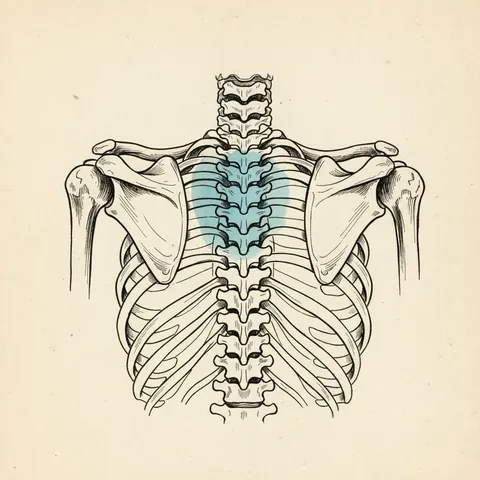
The first is the Neural Generation Hypothesis [1]. It proposes what holds part of a scoliosis curve in place: not the bone, and not a gene on its own, but the nervous system’s internal map of the body, working with degraded sensory input during the growth spurt.
The second is the Generative Posture Framework [2]. It names what drives posture everywhere else. Posture is not held. Posture is generated. The brain is making a best guess about how to organize your body given whatever sensory precision is currently available, and the shape you see in the mirror is that guess rendered as geometry.
NGH came first. Then, working through GPF, the broader framework sharpened what NGH was actually claiming. On the day GPF went live, I re-released NGH as an updated version with the new framing folded back in. Same thesis. More precise language. Tighter convergence with the evidence. The two papers are now a matched pair.
What follows is what each paper says, the fifteen-year question they both answer, and what the scoliosis research community asked for at its 2026 congress.
The curve has a generator. The generator has an address.
Why I stopped accepting “unknown cause”
I was diagnosed with scoliosis at 13. By 18 I was in a surgeon’s office asking for a fusion. He refused. He told me to live with it.
Being sent home is not something you forget.
So I lived with it until 33. At 33 my body collapsed. Fatigue, digestion, everything. A nervous system that had been white-knuckling the whole structure gave out. A David Goggins book pointed me at the hip flexor. The hip flexor pointed me at the diaphragm. The diaphragm pointed me at something I did not yet have a name for. I gained roughly two inches of height. I measured it on a doorframe. No imaging was taken, so nobody knows what changed in my spine, or whether it did.
In 2019 I founded Posture Dojo.
The one phrase that never fit was “unknown cause.” The one sentence that never fit was “you have a genetic predisposition.” Both sentences told me to stop looking. I had already tried every structural intervention I could find. Bracing, strengthening, stretching, mobilizing, adjusting, fusing as a last option. None of it explained why my body had organized itself this way in the first place. The genetics answer felt like a permission slip handed to doctors and parents to stop asking the harder question.
The Neural Generation Hypothesis is what emerged when I refused the permission slip.
The Neural Generation Hypothesis, in plain language
The core claim of NGH [1] is narrower than “scoliosis starts in the brain.”
It is that the part of the curve a person can actively correct is held by the brain’s map of the body, and that one way in is a body growing fast while the brain cannot feel it clearly. Growth and uneven loading still decide how large the curve gets.
One of the strongest gene signals for scoliosis sits near LBX1, a gene that in mice builds one of the two main classes of sensory relay neurons in the spinal cord, for touch and pain, some handling position signals. It does not build bone. Two other well-replicated genes, PAX1 and GPR126, shape the spine’s own cartilage and growth plates. So the genetics point to both the body’s sensing system and its structure. Whether LBX1 acts in scoliosis through sensing is the hypothesis, not yet shown. When body-position input is degraded, the body schema, the brain’s internal map of the body, works with bad data.
Here is the mechanism the paper proposes. During the growth spurt the spine drifts a tiny amount each month. With clear body sense, the nervous system notices and corrects it. With blurry body sense, the drift is too small to register, so nothing corrects it. Meanwhile the brain’s map keeps quietly updating to match the body it is in. Month by month, the curve becomes the map’s new “straight”, and the body is then held there. The map is not too slow. It updates toward the curve instead of back to straight.
Most scoliosis that appears in childhood or adolescence is labelled “idiopathic.” That word does not mean “no cause.” It means “no cause found.” NGH proposes a layer we were not looking at. The generator model sits alongside the structural one rather than replacing it. Diagnosis describes the shape. It does not describe the generator.
There is one animal study that most people miss. In 2013, Doménech and colleagues removed part of the body-sensing region of the brain in young rats [4]. No gene was edited. No bone was cut. Almost half of those rats developed a scoliotic curve, and none of the comparison rats did. It is one study from one group, it has not been repeated, and a brain lesion is not the same as blurry body sense. But it shows the arrow can run from brain to bone.
NGH assembles six lines of convergent empirical evidence and generates eleven testable predictions. It argues that the “idiopathic” label may mark a measurement gap rather than a mystery. The gene-vestibular convergence is part of the same story.
Why NGH forced a bigger frame
Once you see scoliosis as a body schema operating on degraded input, you cannot unsee it everywhere else.
Chronic pain stops looking like tissue damage and starts looking like precision weighting gone wrong. Kyphosis stops looking like weak rhomboids and starts looking like a protective prediction that has calcified into architecture. Post-concussive postural change stops looking like vestibular damage and starts looking like a sensory system that can no longer send clean prediction error upstream. Post-traumatic freezing stops looking like muscle tension and starts looking like an old protection model still being run by a body that never got the cancellation signal.
They all share the same architecture. I kept noticing. I kept writing. I kept stress-testing it inside the Syntropic Core Reset and the client sessions.
When the pattern held across six different postural conditions, it was no longer a theory about scoliosis. It was a theory about posture itself.
That is the Generative Posture Framework.
The Generative Posture Framework, in plain language
Posture is not held. Posture is generated.
That is the one sentence the entire paper turns on [2].
Your posture right now is the precision-weighted output of an active inference process. The brain is making a best guess about how to organize the body, given whatever sensory precision is currently available. Vision. Vestibular. Proprioception. Interoception. Stomatognathic input. When any of those channels is low-resolution, the prediction rests more heavily on what is left. When all of them are high-resolution, the prediction gets closer to the territory. The output is what you see in the mirror.
Posture is not held. Posture is generated. What holds you is the precision of what you can feel.
How posture is made, in one picture
The framework’s first figure shows the loop. Solid lines are shown by research, dashed lines apply established research to posture, and dotted lines are ideas not yet tested.
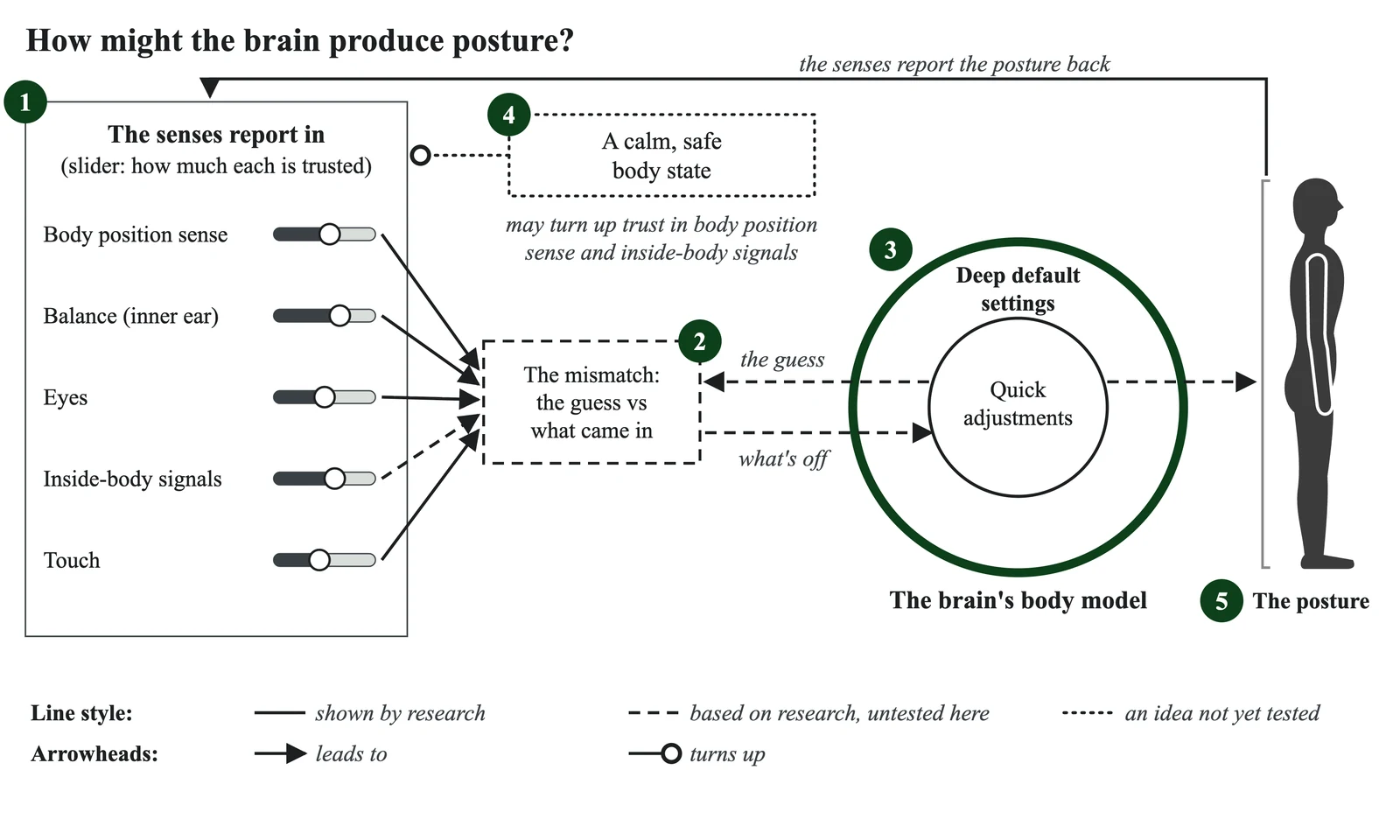
- The senses report in: body position sense, balance from the inner ear, the eyes, signals from inside the body, and touch. Each has a dial for how much the brain trusts it.
- The mismatch. The brain compares its guess with what came in.
- The brain’s body model has two layers: quick adjustments that act within a second, and deep default settings that change slowly. Together they make the next guess, and what is off feeds back in.
- A calm, safe body state is proposed to turn up trust in body position sense and inside-body signals. That part is untested.
- The posture is the output. The senses report it back, and the loop runs again.
Figure 1 of the Generative Posture Framework (Miller, 2026; version 2.5) shows posture as the output of a predictive loop. Sensory channels (proprioception, vestibular, vision, interoception, touch), each weighted by its estimated precision, are compared with the body schema’s prediction to produce a prediction error. The body schema has a fast loop for moment-to-moment control and a slow loop of priors, its deep default settings. Its output is the posture, whose sensory consequences return as input. A safety state is proposed, untested, to raise the precision of proprioceptive and interoceptive signals.
GPF then sets out what helps or blocks the main way those deep default settings change (route 1 in the second figure). It sorts the conditions into five prerequisites, one interference mechanism and two amplifiers.
The five prerequisites are a safe, low-threat body state, clear sensory signals, felt evidence (sensing the new position rather than being told it), a recovery window after practice, and attention to what you sense inside the body. When one is missing, the paper proposes, change is smaller or does not last. The interference mechanism is effort: the brain discounts the sensation it predicts from its own movement, so pushing yourself into a posture tells the body model less than you would expect. GPF proposes this is one reason “stand up tall” rarely sticks. The two amplifiers are co-regulation (being with another calm, regulated person, in person or by video) and, again, attention to inside-body sensation: some attention is needed for any update, and more of it is proposed to deepen it. Co-regulation helps but is not required.
How posture changes, or doesn’t
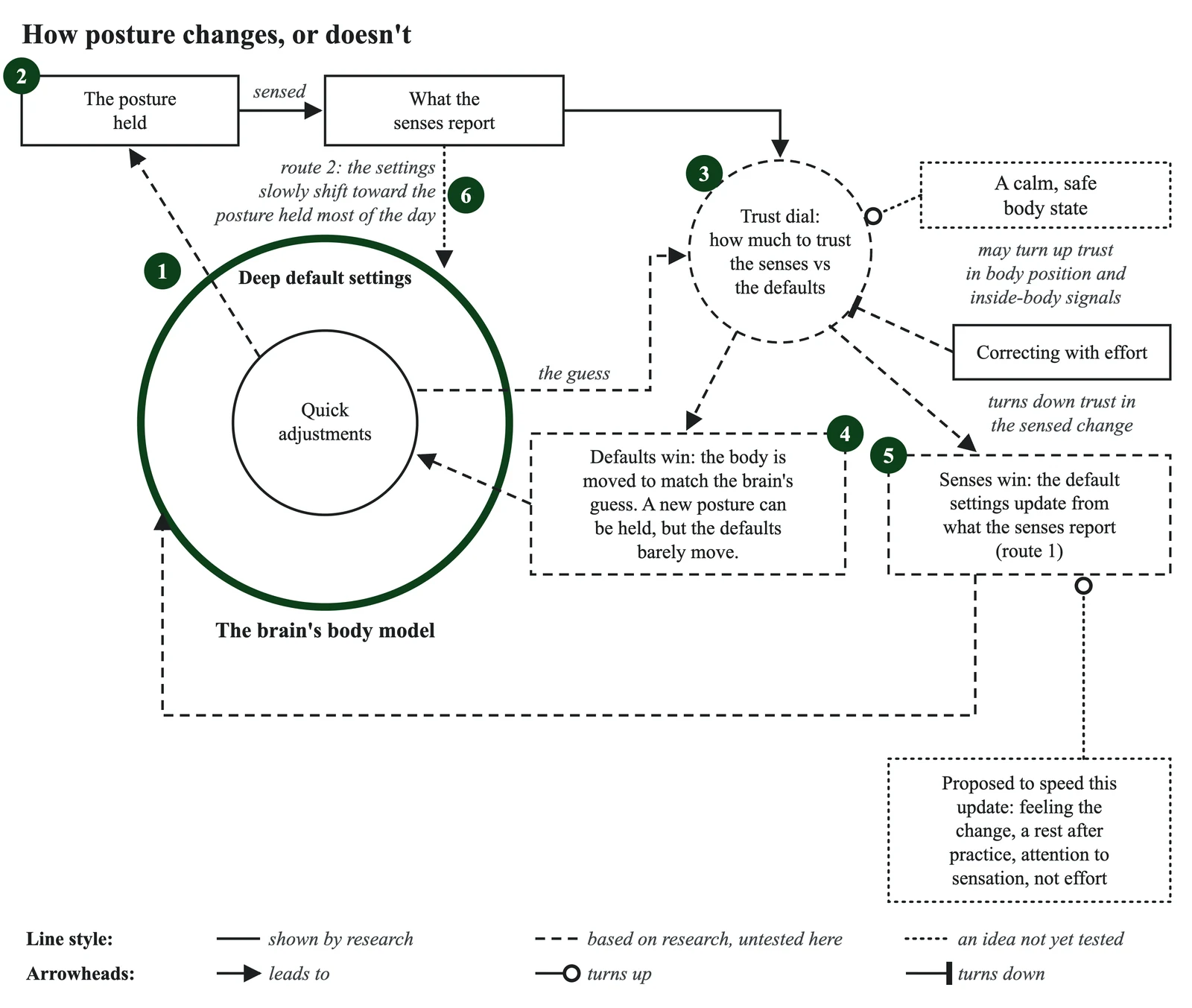
- The brain’s body model: quick adjustments inside, deep default settings around them.
- The posture you hold is sensed and reported back.
- A trust dial weighs the senses against the defaults. A calm, safe state is proposed to turn trust in body signals up. Correcting with effort turns down trust in the change you sense.
- If the defaults win, the body is moved to match the brain’s guess. You can hold a new posture this way, but the defaults barely move.
- If the senses win, the defaults update from what the senses report. This is route 1. Feeling the change, a rest after practice, and attention to sensation rather than effort are proposed to speed it.
- Route 2 runs either way: the settings slowly shift toward the posture held most of the day. If the framework is right, the posture you live in counts for every hour you hold it, so it can outweigh a few minutes of practice.
Figure 2 of the Generative Posture Framework (Miller, 2026; version 2.5) proposes two routes by which the body schema’s priors change. Route 1 is error-based update: when sensory precision outweighs the prior, the prediction error revises the prior; the rate is proposed to depend on five prerequisites (Safety State, Sensory Precision, Felt Evidence, Recovery Window, Interoceptive Attention), with effortful voluntary correction lowering sensory weight through efference copy. When the prior outweighs the senses, the body is moved toward the prior instead and the prior barely changes. Route 2 is use-dependent drift: the prior shifts toward the time-averaged sensed posture and is proposed not to need those conditions. The conditions are proposed and largely untested.
The NGH explainer walks through that paper’s two main figures the same way: The Neural Generation Hypothesis: What the Paper Says and Why It Matters.
The paper brings five bodies of work under one computational account. Wand’s Fit-for-Purpose model of chronic low back pain [5]. The RESOLVE graded sensorimotor retraining trial [6]. The SPINE CARE Egoscue trial [7]. Kontos’s post-concussion sensorimotor work. The predictive-processing pain literature. It also connects Porges’s polyvagal account [8], used as clinical description, with Friston’s active inference [3]. In GPF, felt safety is proposed to act as the gain control on the whole generative process, not as a feeling layered on top of posture.
Then GPF maps six postural conditions as instances of the same architecture. Adolescent idiopathic scoliosis. Kyphosis. Chronic pain. Post-traumatic freezing. Age-related postural collapse. Post-concussive postural change. One framework. Eleven testable predictions.
The curve has a generator. The generator has an address. So does the stoop, the flinch, the freeze, and the collapse.
What the scoliosis research community is asking
In May, at the SOSORT congress in Turin, an 89-study review of the neurophysiology of scoliosis (a conference abstract from the Milan group) concluded that AIS shows altered sensorimotor integration, and asked for a pre-specified hypothesis tested over time to work out what causes what [9].
A month before it was presented, I posted one publicly as a preprint: the Neural Generation Hypothesis, with written predictions that could prove it wrong. It has not been peer reviewed, and it is one of several candidate explanations.
Other groups at the same congress presented a review of neurophysiological mechanisms [10] and a trial of sensorimotor training [11]. That tells me the field is asking the same question. It is not confirmation of NGH, and those results are conference abstracts that will need reading in full once they are published.
What this changes inside Posture Dojo right now
This is not theory we are working toward. This is the working framework.
When a client lands in the Syntropic Core Reset with rounded shoulders, a locked diaphragm, and fifteen years of daily bracing, we do not start by correcting the shoulders. We start by restoring sensory precision. Jaw first, because jaw is Tier 1. Eyes next, because vision is Tier 1. Diaphragm next, because GPF proposes that organized pressure cycling, which the Dragon trains, produces trunk sensations the brain’s own motor command does not fully predict, so the signal is less muted. That is a proposal, not yet tested. In our experience, the shoulders reorganize downstream.
When a participant tells us they can finally feel the left side of their back for the first time in twenty years, we do not read it as a tissue change. We read it as a body schema update. In our experience, the change in posture follows the change in the map.
When someone asks me why they stood up tall yesterday and slumped again today, I stop explaining it as a willpower problem. It was never willpower. GPF proposes it is efference copy. The intention to stand tall generated the prediction that cancelled the signal. The map never got new information. The default returned. GPF names the proposed mechanism.
When a cohort member reports that the curve “feels smaller” after a breathwork ceremony, we do not dismiss it and we do not oversell it. We treat it as a precision report. The map has more information than it did an hour ago. What the spine will eventually do with that information is a separate question. But something in how they sense their body has changed.
The framework is how we teach, how we sequence, and how we talk. Now it has a public citation trail.
The curve has a generator. The generator has an address.
For fifteen years I was told that the explanation for my spine was either a gene I did not have or a label that meant nothing. I refused both and kept looking. The Neural Generation Hypothesis is what I found when I looked at what the body schema was doing during development. The Generative Posture Framework is what I found when I realized the same architecture runs every postural condition I had ever worked with.
Two papers. One body. One fifteen-year question. Now, finally, a paper trail.
If you are living with a spine someone told you to accept, a posture someone told you was genetic, or a pain someone told you was structural, the generator framework is where the next decade of this work begins. You can read both papers at the DOIs above. You can come train with us through the Syntropic Core Reset, linked below. Either way, the frame has changed.
The curve has a generator. The generator has an address.
Sam Miller is the creator of the Syntropic Core method and the founder of Posture Dojo. He writes about posture as a nervous system phenomenon at posturedojoresearch.com.
References
[1] Miller SA. The Neural Generation Hypothesis of Adolescent Idiopathic Scoliosis. Preprint, Zenodo. 2026. doi:10.5281/zenodo.19342098 (all versions; current is 3.0).
[2] Miller SA. The Generative Posture Framework. Preprint, Zenodo. 2026. doi:10.5281/zenodo.19580170 (all versions; current is 2.5).
[3] Friston K. The free-energy principle: a unified brain theory? Nat Rev Neurosci. 2010;11(2):127-138.
[4] Domenech J, Barrios C, Tormos JM, Pascual-Leone A. Somatosensory cortectomy induces motor cortical hyperexcitability and scoliosis: an experimental study in developing rats. Spine J. 2013;13(8):938-946.
[5] Wand BM, O’Connell NE, Di Pietro F, Bulsara M. Fit-for-Purpose model of chronic low back pain. 2023.
[6] Bagg MK, Wand BM, Cashin AG, et al. Graded sensorimotor retraining for chronic low back pain: the RESOLVE randomized clinical trial. JAMA. 2022;328(5):430-439.
[7] Choudhry NK, Fifer S, Fontanet CP, et al. Effect of a biopsychosocial intervention or postural therapy on disability and health care spending among patients with acute and subacute spine pain: the SPINE CARE randomized clinical trial. JAMA. 2022;328(23):2334-2344. doi:10.1001/jama.2022.22625.
[8] Porges SW. The Polyvagal Theory. New York: W.W. Norton; 2011.
[9] Cordani C, Zanotti FM, Malfitano C, Del Furia MJ, Leonelli B, Negrini A, Zaina F, Fregna G, Negrini S. Neurophysiological features of adolescent idiopathic scoliosis: a scoping review across central, peripheral, and sensorimotor domains. SOSORT 2026 Annual Meeting, Turin, abstract #206 (conference abstract, not peer reviewed).
[10] Huang Z, Wong A, Chan C. Systematic review of neurophysiological mechanisms in adolescent idiopathic scoliosis. SOSORT Congress abstract #168; Turin, Italy.
[11] Wang X, et al. Brain-science sensorimotor integration intervention for adolescent idiopathic scoliosis: a randomized controlled trial. SOSORT Congress abstract #99; Turin, Italy.
Common Questions About the Two Papers
What is the difference between the NGH and the GPF?
The Generative Posture Framework is the general model: how the brain may produce posture, and when that changes. The Neural Generation Hypothesis applies it to adolescent idiopathic scoliosis, proposing how part of a curve could come to be held during growth.
Are the two papers peer reviewed?
Not yet. Both are free preprints on Zenodo with permanent DOIs: the Neural Generation Hypothesis (version 3.0) and the Generative Posture Framework (version 2.5). Each sets out eleven testable predictions.
Why doesn’t standing up straight last?
The framework proposes two reasons. Correcting with effort makes the brain discount the sensation it predicts from its own movement, so the deep settings learn less. And those settings drift toward the posture you hold most of the day, so a few minutes of effort compete with many hours of habit. Both are proposals the paper sets out to test.
What does “posture is generated, not held” mean?
It means posture is treated as the output of the brain’s running prediction of the body, not as a position the muscles lock in place. The muscles still do the work. The framework is about what tells them where to go.
Comments
2 responses to “Two Papers, One Framework: The Neural Generation Hypothesis and the Generative Posture Framework”
[…] Two Papers Just Landed: The Neural Generation Hypothesis and the Generative Posture Framework […]
[…] Two Papers Just Landed: The Neural Generation Hypothesis and the Generative Posture Framework […]