
When was the last time you looked at the horizon?
Not a rhetorical question
I mean actually looked. Not glanced at your phone screen, not stared at a laptop, not focused on the face of the person across the table. When was the last time your eyes went wide and soft and took in the full field of space around you, from the ground to the sky to the edges of your peripheral vision?
If you cannot remember, that is the problem. Not your phone. Not your neck. Your eyes.
I spent years doing chin tucks. They did not fix it. And when I finally understood why, the entire model of forward head posture fell apart.
Two visual channels
Your visual system operates through two distinct channels.
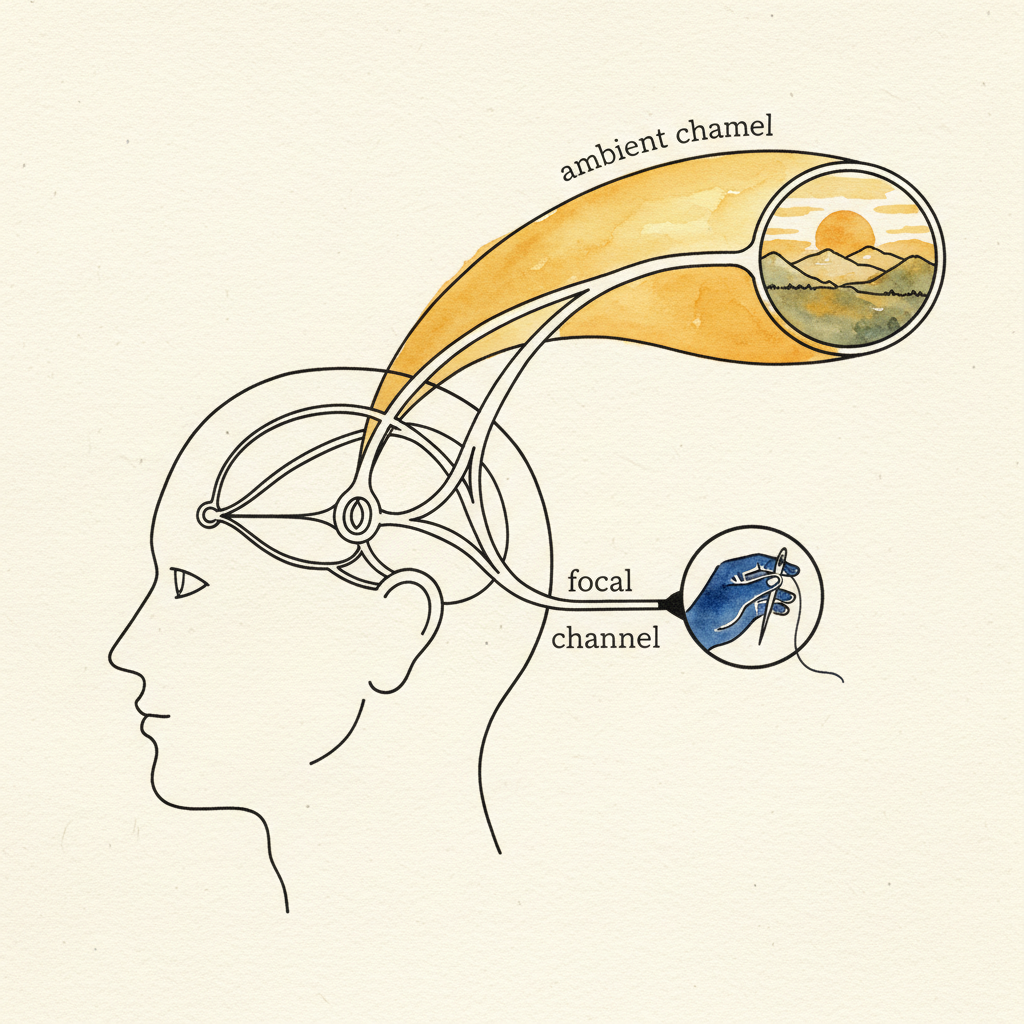
Peripheral vision. Also called ambient vision. Processed through the magnocellular pathway. This is the wide, spatial channel. It detects movement, orients you in space, and provides the primary postural stability reference for your nervous system. Research confirms that peripheral vision reduces postural sway more than central vision. When you are in a wide visual field, your brain knows where it is. The head can rest in a neutral position because the spatial reference is stable.
Focal vision. Also called central vision. Processed through the parvocellular pathway. The detail channel. Fine resolution for reading, targeting, close work. The channel that dominates during screen use.
Normal posture requires both channels operating in balance. Modern life shifts the balance almost entirely toward focal dominance. Screens. Phones. Close work. Hours in a narrow visual cone. The peripheral channel atrophies. The spatial reference degrades.
The head follows the eyes
When peripheral vision degrades, the nervous system loses its primary spatial reference. It no longer has a stable wide-field signal telling it where the body is in space. The response is predictable and involuntary: the head moves forward. The brain is pulling the eyes toward the target, toward focal dominance, toward the only visual channel that still provides reliable data.
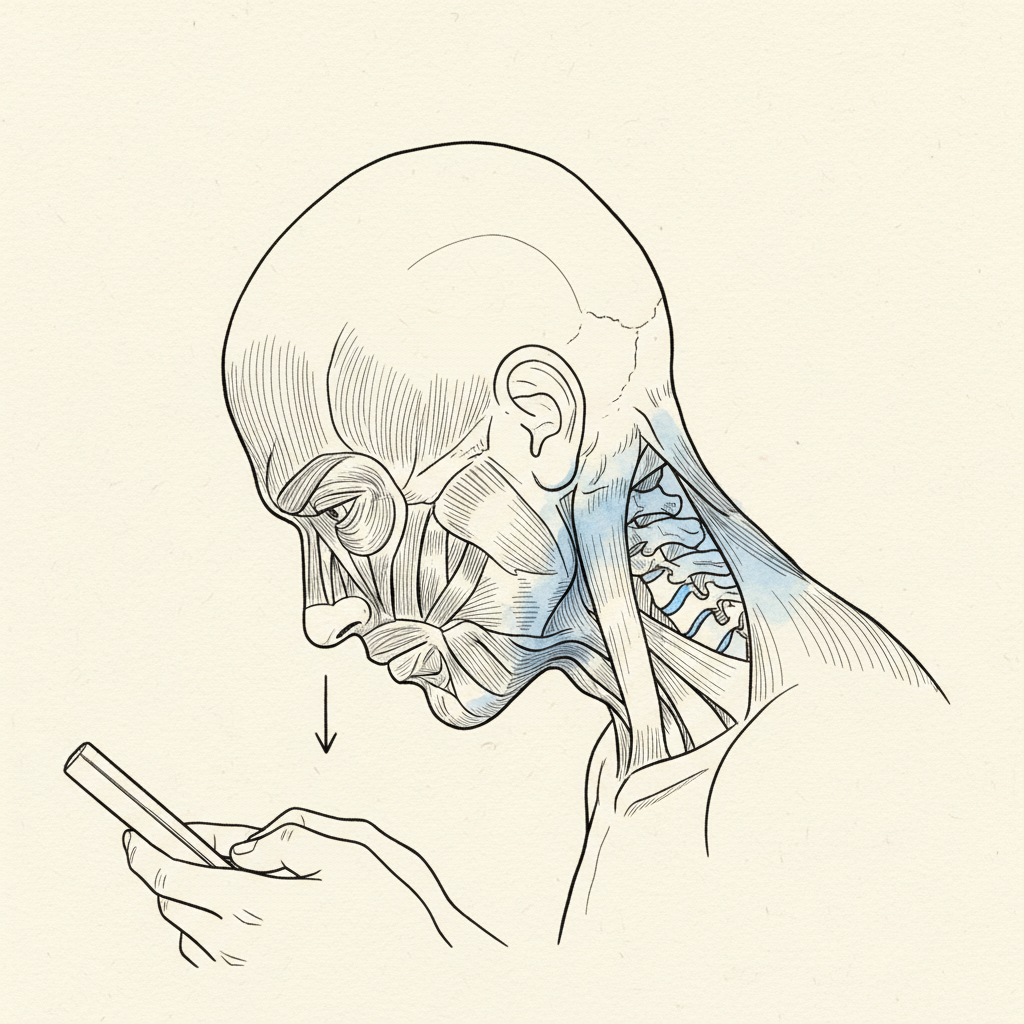
Think about what happens when you stare at a screen. Your visual field narrows. Your peripheral awareness drops. Your breath becomes shallow. Your jaw clenches. Your head drifts forward. Not separate problems. One coordinated response to a sensory environment that has collapsed from wide to narrow.
Now think about what happens when you step outside and look at the horizon. Your visual field widens. Your peripheral vision activates. Your breath deepens. Your jaw softens. Your head settles back.
No one told your head to move back. The visual input changed, and the prediction updated.
Why chin tucks and neck strengthening miss
The standard approach to forward head posture correction treats it as a mechanical problem. The head is forward. Strengthen one side, stretch the other, the head moves back into alignment.
This logic works if posture is mechanical.
Your head position is not determined by muscle balance. It is determined by a prediction. Your nervous system places your head where it believes it needs to be based on the sensory data it receives. The most dominant piece of that data is vision. Chin tucks fight the output without changing the input. The head returns to its forward position because the visual prediction has not been updated.
The mechanism
Vision is one of the highest-weighted inputs into the cerebellar postural model. The cerebellum integrates all sensory data and produces a prediction of where the body should be. Head position is the primary output of that prediction.
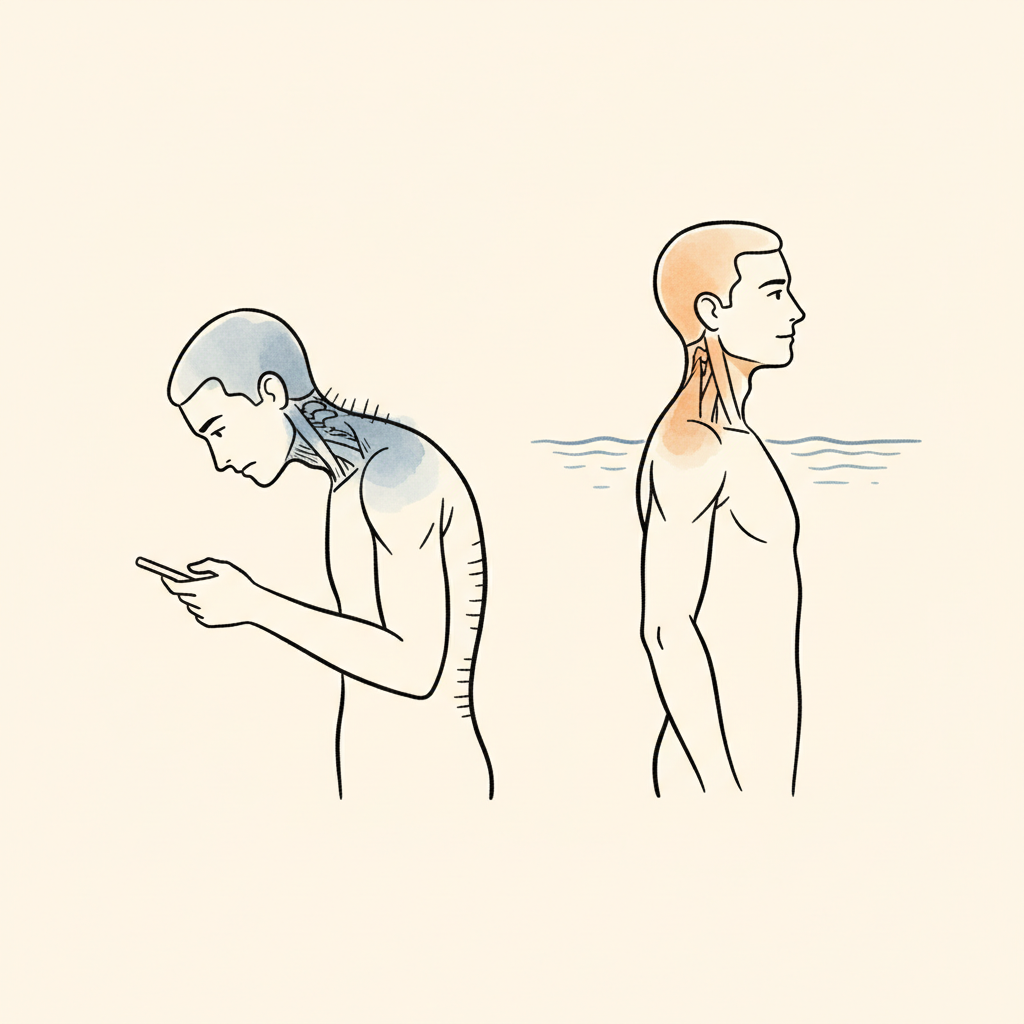
When the visual input is degraded, the cerebellar model adjusts. It places the head where it needs to be given the available data. If the dominant data is focal and near, the head goes forward. If the dominant data is peripheral and spatial, the head settles back. The neck muscles are executing an instruction from the model. They are not making independent decisions.
Research supports this. Moderate myopia without correction produces a 25% increase in postural instability. The compensatory response is cervical hypertonicity, particularly in the sternocleidomastoid and suboccipital muscles, to create a more stable platform for the eyes. The neck muscles are not tight because they are weak or overstretched. They are tight because the system is using them to stabilize a head that does not have a reliable visual reference.
The fix that actually works
If the problem is visual, the solution must include vision.
Restore peripheral visual engagement. Spend time in wide visual fields. Outside. Looking at distance. Allowing the eyes to soften from focal lock into peripheral awareness. Your visual system requires wide-field input to maintain the spatial reference that keeps your head positioned neutrally. This is sensory nutrition, not meditation.
Break the focal loop during screen work. Every twenty minutes, shift from focal to ambient vision. Do not just look away from the screen. Look through the space. Let the visual field widen. Let the eyes go soft. This reactivates the peripheral channel and gives the cerebellar model updated spatial data.
Address the upstream variables. If you have uncorrected refractive error, particularly myopia or astigmatism, the visual signal feeding your postural model is permanently degraded. A behavioral optometrist can assess how your visual system interacts with your postural system. Specialty prescriptions can alter the vergence demand on the eyes, effectively recalibrating the spatial reference the brain uses to organize posture.
The jaw connection
Vision is not the only upstream driver. The jaw is the second.
The contact pattern of your teeth sends continuous positional data to the trigeminal nerve, which has direct projections to the cervical motor neurons that control neck position. When jaw alignment is compromised, the system responds by hyperactivating the cervical stabilizers to forcibly stabilize the head. This chronic cervical tension does not resolve with stretching or manual therapy as long as the jaw signal remains corrupted.
Some people do everything right. The exercises, the ergonomics, the posture reminders. Their forward head posture does not change. The rate-limiting variable is upstream from the neck. It is in the jaw. Or the eyes. Or both.
The neck is not the problem. The neck is the messenger.
What changed for me
I did chin tucks for years. I strengthened my deep cervical flexors. I stretched my suboccipitals. My forward head posture persisted.
What changed it was not a neck exercise. It was a shift in how I used my eyes and how I breathed. When I learned to restore peripheral visual engagement, my head settled back without me thinking about it. When I addressed my breathing pattern and restored internal pressure through the diaphragm, the cervical bracing softened. The muscles that had been gripping for decades released. The inputs that were driving them to grip had changed.
The head goes where the eyes tell it to go. The eyes are responding to the visual environment you give them. Change the environment, the eyes respond, the head follows, the neck releases.
Your phone is not the cause of your tech neck. Your phone is the environment that collapsed your visual field. The collapsed visual field is the cause. And the fix starts with your eyes, not your neck.
Sam Miller is the founder of Posture Dojo and was diagnosed with an 85-degree kyphoscoliosis at 13. He spent two decades inside the mechanical model before discovering that posture is generated by the nervous system, not held by muscles.
Syntropic Core Reset
Most posture programs give you exercises. This one updates the system that generates your posture. Four weeks live with Sam Miller. You learn how the hidden map works, why everything else missed it, and how to give your nervous system the evidence it needs to generate a different pattern. Breath. Ground contact. Safety. Sensory input. Floor to standing. You leave with a daily practice that holds because the map itself has changed.
Limited spots. Next cohort enrolling now.
Related research
- TMJ and Posture: Why Your Jaw Is Running Your Neck
- Your Back Pain Is Not Caused by Your Posture (But They Share the Same Source)
- Two Papers Just Landed: The Neural Generation Hypothesis and the Generative Posture Framework
- Stand Up Tall, Pull Your Shoulders Back, Brace Your Core: Why the 3 Most Common Posture Cues Are Neuroscience Dead Ends
Comments
One response to “Tech Neck Is Not About Your Phone (It’s About Your Eyes)”
[…] The Complete Guide to Kyphosis | The TMJ-Posture Connection | Tech Neck Is an Eye Problem | The Kyphosis-Tinnitus […]