Someone told you to stand up straight. A parent. A teacher. A physical therapist. You pulled your shoulders back, lifted your chest, engaged your back muscles. For thirty seconds, you looked taller. Then your attention drifted and the curve returned.
You thought you failed. You did not fail. The instruction failed. “Stand up straight” is the single most counterproductive thing you can do for kyphosis. The harder you try, the worse it gets. Not because you lack discipline. Because of how your nervous system processes self-generated effort.
The efference copy problem
When you voluntarily contract a muscle, your motor cortex sends two signals simultaneously. One goes to the muscle. The other, called an efference copy, goes to the sensory cortex. The efference copy says: “I just generated this movement. Cancel the sensory feedback from it.”
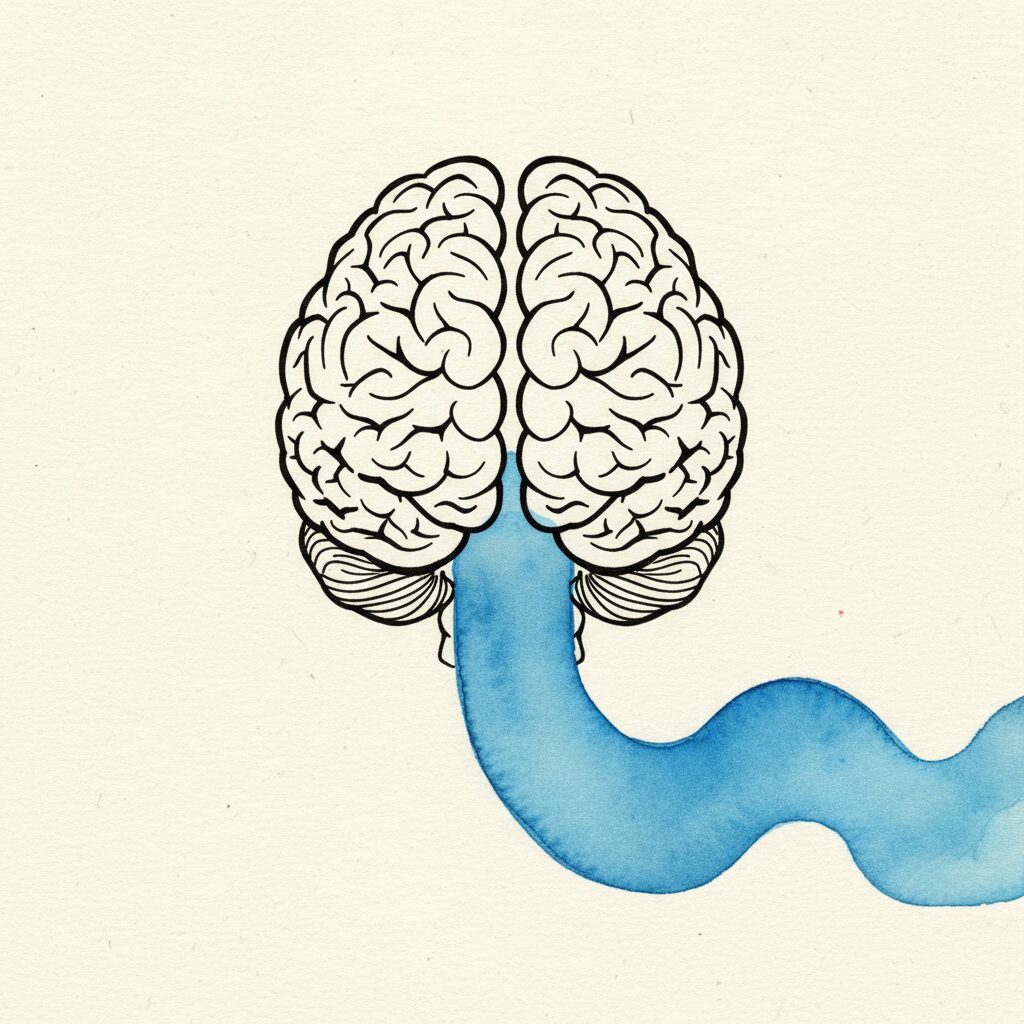
This is why you cannot tickle yourself. Your brain predicts the sensation before it arrives and suppresses it. The same mechanism operates in posture. When you deliberately pull yourself upright, the efference copy suppresses the proprioceptive feedback from that movement. You feel less, not more. The very act of trying to correct your posture reduces the sensory data your body schema needs to update its model.
Blakemore, Wolpert, and Frith (1998) demonstrated that self-produced sensory consequences are attenuated through efference copy mechanisms. When you generate a movement voluntarily, the predicted sensory outcome is subtracted from actual sensory input, resulting in diminished perception. This is the neural basis of why you cannot tickle yourself, and it applies directly to postural correction. Every deliberate attempt to “stand up straight” generates an efference copy that suppresses the proprioceptive signal from the corrected position. The body schema receives less data, not more. Fewer prediction errors reach the model. Fewer updates occur. Wolpert, Ghahramani, and Jordan (1995) formalized this as the forward model: the motor system predicts the sensory consequences of its own commands and cancels them. The implication for kyphosis is precise. Voluntary correction is the one strategy guaranteed to prevent the sensory update that would make the correction stick. The system needs prediction error to change. Effort eliminates prediction error.
Less effort, more information
Moshe Feldenkrais understood this fifty years before the neuroscience confirmed it. His first principle was not “try harder.” It was “reduce effort to increase sensitivity.”
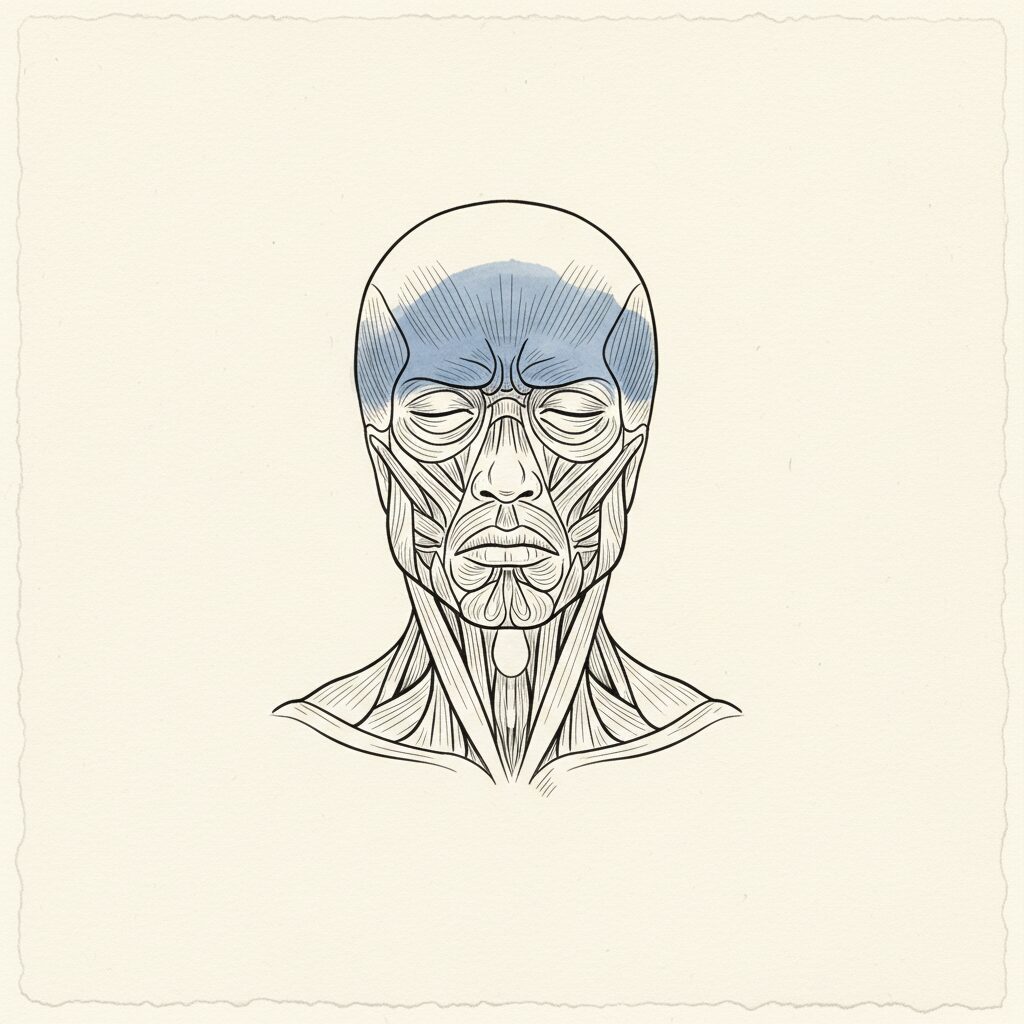
When effort drops, efference copy drops. When efference copy drops, sensory channels open. When sensory channels open, the body schema receives data it was not predicting. That data is prediction error. Prediction error is the only signal that updates the model.
This is not relaxation as passivity. This is relaxation as strategy. You reduce effort not because effort is bad, but because effort suppresses the information your system needs to reorganize.
Thomas Hanna called this sensory motor amnesia. The muscles are not weak. They are forgotten. The sensory cortex has lost its map of them. Trying harder to activate a forgotten muscle does not restore the map. It generates efference copies that further suppress the already diminished signal. The muscle gets louder. The sensation gets quieter. The gap between effort and awareness widens.
Why the curve always comes back
You pull yourself upright. The efference copy suppresses the feedback. Your body schema registers nothing new. No prediction error. No model update. The moment your conscious attention moves to something else, the prediction reasserts. The curve returns. You blame yourself.
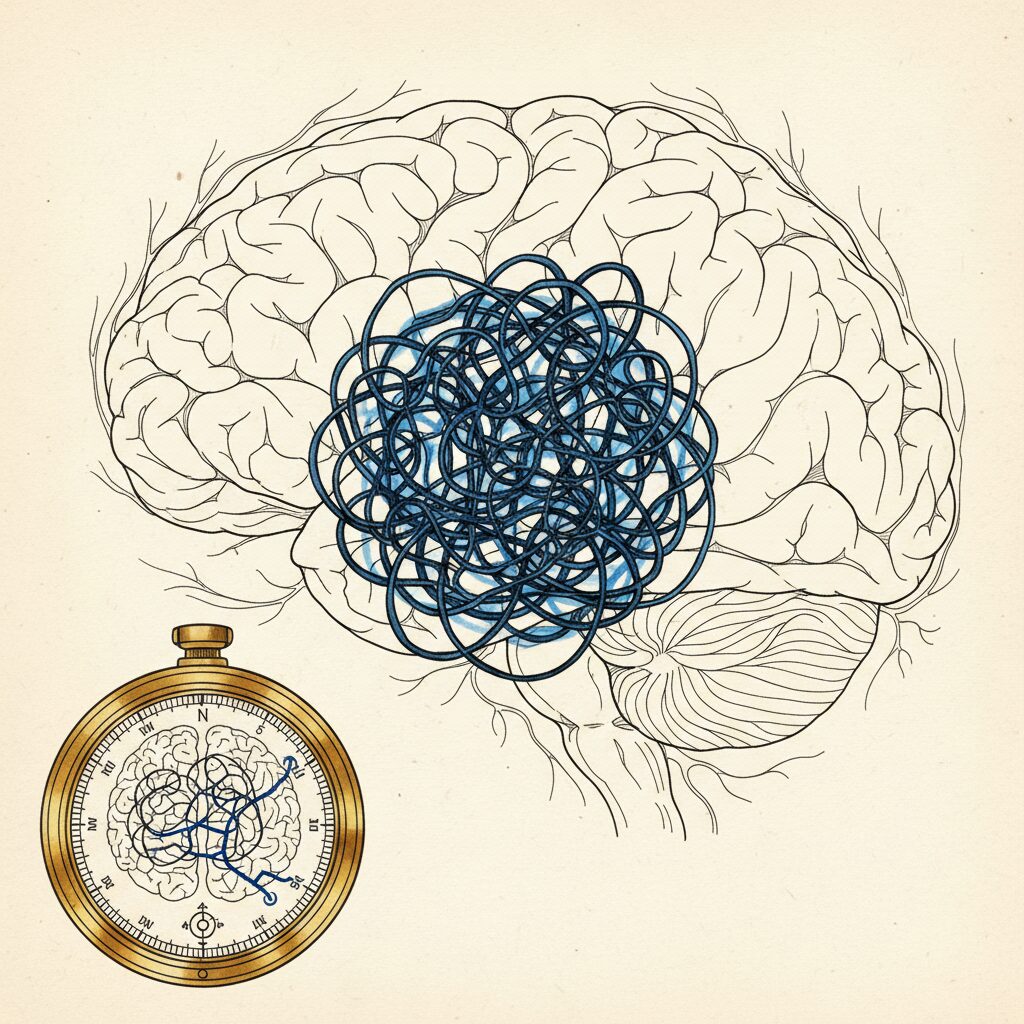
This is not a discipline problem. This is an architecture problem. Conscious correction operates at a level above where the postural prediction lives. It is like trying to change the foundation of a building by repainting the roof. The paint looks different for a moment. The foundation does not notice.
Hanna (1988) documented that chronic postural patterns become invisible to the person holding them, a condition he named sensory motor amnesia. The muscles are contracting but the sensory cortex no longer registers the contraction. Voluntary correction cannot restore what has been lost from awareness, because the act of voluntary correction generates the very suppression signal that maintains the amnesia. Feldenkrais (1972) demonstrated that reducing muscular effort below the threshold of habitual contraction allows novel sensory signals to reach the cortex. His method systematically lowers effort to a level where the Weber-Fechner law operates in the practitioner’s favor: smaller signals become perceptible against a quieter background. This is not a philosophical preference for gentleness. It is a neurological strategy for reopening sensory channels that efference copy has closed. The kyphotic curve persists because the system that generates it does not receive enough sensory contradiction to update. Effort increases the curve’s persistence. Reduced effort, paradoxically, is what allows the system to notice itself and change.
The paradox your nervous system already knows
Stop trying to stand up straight. The instruction is neurologically backwards. It generates the suppression that prevents the update that would make the change permanent.
Your nervous system does not need more effort. It needs more information. Information arrives through open sensory channels. Sensory channels open when effort decreases. The path to a different posture runs through less force, not more.
The curve is not a failure of effort. It is a failure of data. Give the system data it was not expecting, under conditions where it can actually receive it, and the prediction updates. Not for thirty seconds. Permanently.
—
Related: The Kyphosis Bracing Pattern | Why Awareness Changes Posture, Effort Doesn’t | Why Posture Corrections Don’t Last
—
Syntropic Core delivers organized internal pressure under conditions of low threat and present-without-demand attention. Sensory channels stay open instead of suppressed. The body schema receives data it was not predicting. The prediction updates. Not through effort. Through information. See how it works.
Sources
- Blakemore, S.J., Wolpert, D.M., & Frith, C.D. (1998). Central cancellation of self-produced tickle sensation. Nature Neuroscience, 1(7), 635-640. PMID: 10196573 [T1]
Self-produced sensory consequences are attenuated by efference copy. Voluntary postural correction suppresses the feedback it needs to stick. - Hanna, T. (1988). Somatics: Reawakening the Mind’s Control of Movement, Flexibility, and Health. Da Capo Press. ISBN: 978-0738209579 [T1]
Sensory motor amnesia: chronic patterns become invisible to the person holding them. Trying harder deepens the amnesia. - Wolpert, D.M., Ghahramani, Z., & Jordan, M.I. (1995). An internal model for sensorimotor integration. Science, 269(5232), 1880-1882. PMID: 7569931 [T1]
The motor system predicts and cancels the sensory consequences of its own commands. Effort eliminates the prediction error needed for update. - Feldenkrais, M. (1972). Awareness Through Movement: Health Exercises for Personal Growth. Harper & Row. ISBN: 978-0062503220 [T1]
Reduce effort to increase sensitivity. Lower the signal-to-noise floor so the nervous system can detect what it has been missing.
Related research
- Best Exercises for Kyphosis: What Actually Changes the Curve
- Cervical Kyphosis, Military Neck, and the Flat Neck Epidemic
- Your Kyphosis Is Not a Mistake Your Body Made
- Kyphosis and Ankylosing Spondylitis: What Surgery Can and Can’t Change
Comments
One response to “Why “Stand Up Straight” Makes Your Kyphosis Worse”
[…] stand up straight makes it worse […]