You found the exercises. Schroth. PSSE. Maybe a physiotherapist who specializes in scoliosis. You have been doing them for months, maybe years, and the curve has not changed. Or it changed a few degrees, then stalled. Or it changed on X-ray but your body still feels the same.
You are not doing it wrong. The exercises are not wrong either. They are the best available option within the muscular model of scoliosis, and the problem sits in that model itself, not in your execution.
What Schroth gets right
Schroth and physiotherapeutic scoliosis-specific exercises are the most evidence-based exercise approach to scoliosis management. The 2016 SOSORT guidelines recommend PSSE as part of conservative treatment during growth, and the research supports their role in slowing progression during adolescence [1]. If you are doing Schroth, you chose well. Better than generic “core strengthening.” Better than random yoga. Better than doing nothing.
But even the SOSORT guidelines acknowledge a ceiling: in adults, the evidence for curve reduction through exercise alone is limited. The exercises can stabilize, can slow, can improve function and reduce pain, and still the curve itself, the shape, tends to persist.
The question is why.
The muscular ceiling
Schroth exercises target the muscles around the curve. They strengthen the concavity, stretch the convexity, and train rotational breathing patterns to expand the collapsed side. All of this is logical, well-designed, and genuinely helpful.
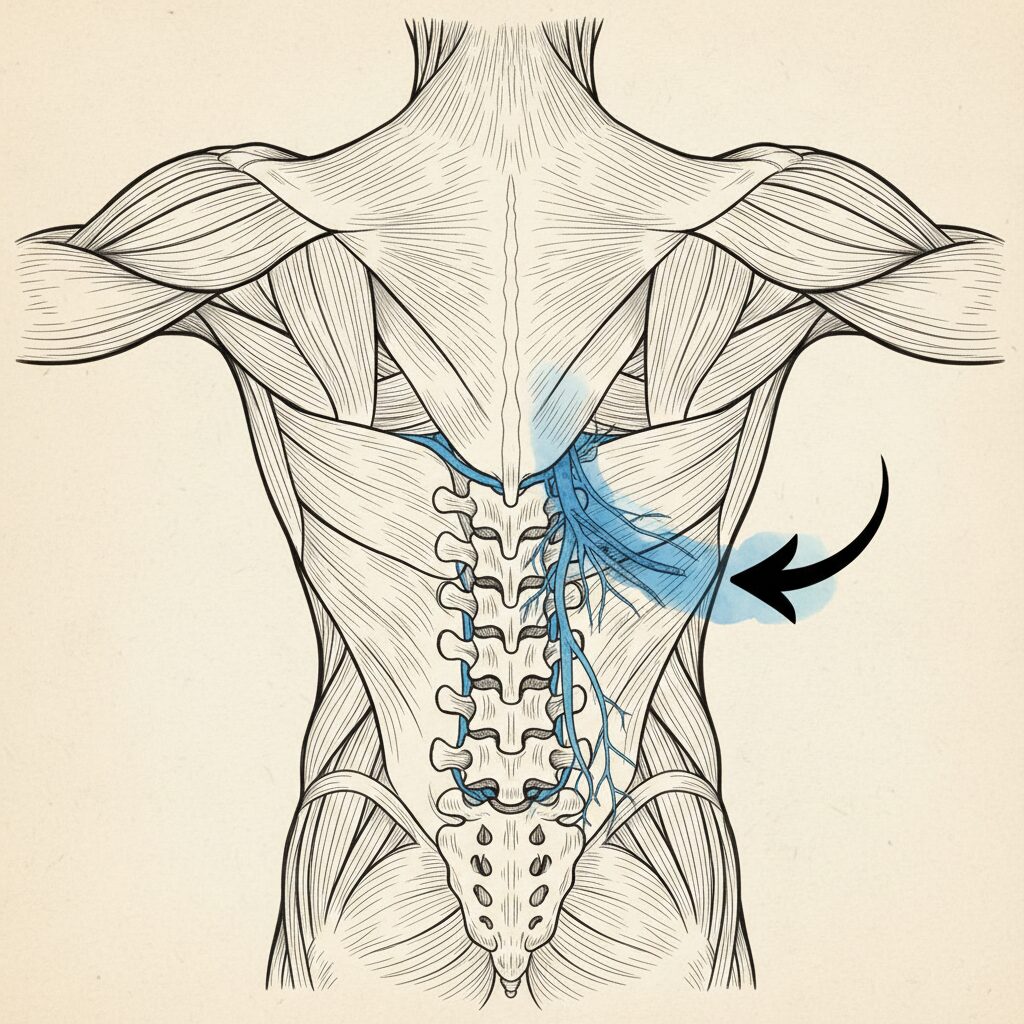
But the curve is not being generated by the muscles.
Scoliosis-specific exercises target the muscular layer surrounding the curve, but the curve itself is generated by the body schema, the nervous system’s internal model of the body in space. Burwell et al. (2009) demonstrated that adolescent idiopathic scoliosis involves neuromuscular, vestibular, and proprioceptive factors that extend well beyond simple muscular imbalance. The SOSORT guidelines (Negrini et al., 2018) recommend physiotherapeutic scoliosis-specific exercises but acknowledge limited evidence for curve reduction in adult populations. The muscular approach addresses the output layer of the curve without updating the predictive model that generates it. Exercises strengthen and stretch muscles around a shape that the nervous system is actively producing, and when the exercises stop, the shape returns, because the prediction that generates it was never revised.
The muscles are custodians of the curve, not its author. They hold the shape the nervous system dictates. Strengthening them changes who is holding the shape, never what shape is being held.
The curve is a prediction
Your nervous system runs a continuous prediction of your body in space, and this prediction, your body schema, determines the shape your spine takes. Not your muscles. Not your habits. Not your posture awareness. The prediction.
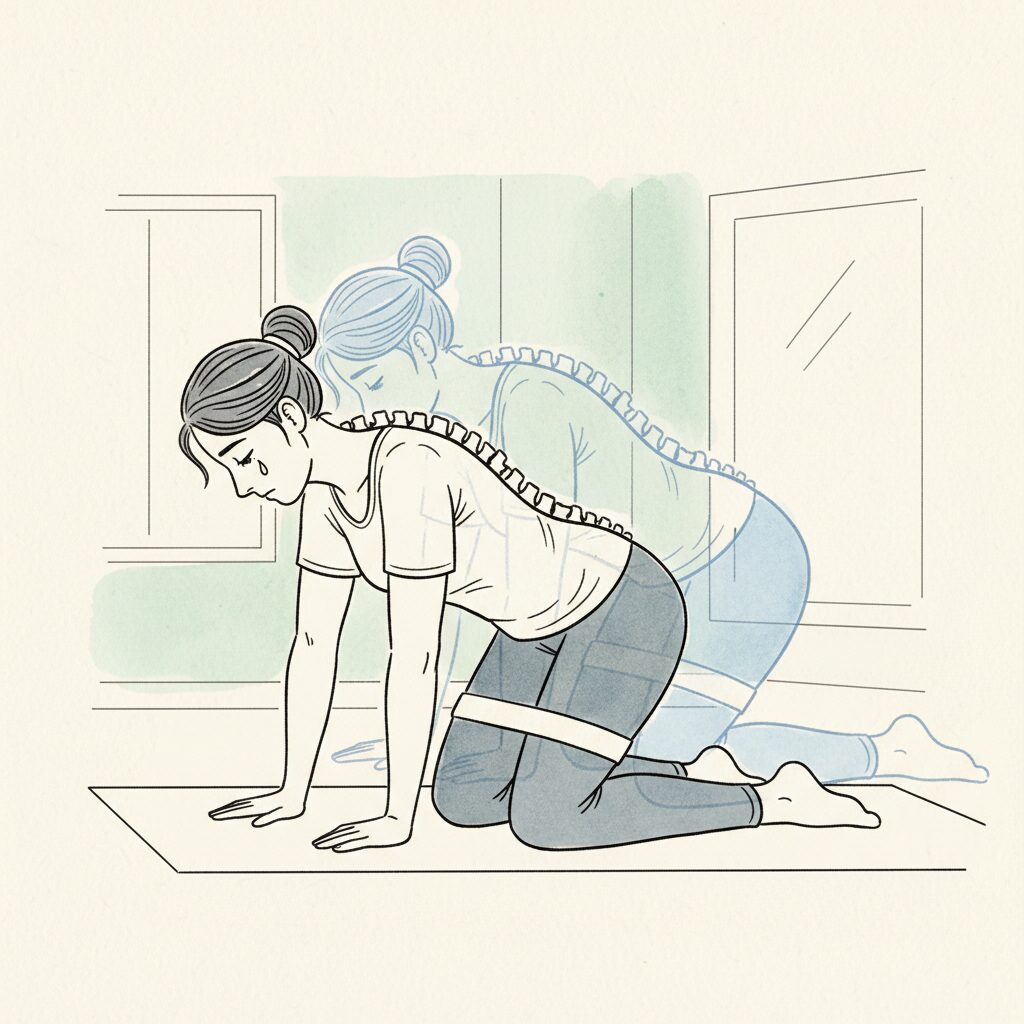
The curve in your spine is the shape that prediction generates, a postural output your nervous system is actively producing, right now, based on the sensory information it has received over your lifetime. No structural accident happened to you.
This is why the curve persists through every intervention that targets muscles. The muscles are downstream, receiving instructions from the body schema and executing them faithfully. You can override those instructions temporarily with effort, concentration, and Schroth breathing, but the moment you stop concentrating, the prediction reasserts itself. The curve returns. Not because you failed. Because the system that generates the curve was never updated.
What lives underneath the muscles
Below the muscular system is a hydraulic system. The diaphragm descends and pressurizes the abdominal cavity while the transversus abdominis and pelvic floor contain that pressure. Intra-abdominal pressure stiffens the lumbar spine from the inside, providing support that does not depend on muscular effort [3].
This pressure system is the spine’s primary stabilizer. The muscles are the backup.
Hodges et al. (2005) demonstrated that intra-abdominal pressure increases stiffness of the lumbar spine through a hydraulic mechanism independent of muscular contraction, a pressure-based stabilization that operates through the diaphragm, transversus abdominis, and pelvic floor functioning as a sealed pressurized canister. Kolar et al. (2012) showed that this diaphragmatic postural function is compromised in patients with chronic low back pain, and the dysfunction precedes the muscular compensation rather than following it. In scoliosis, exercises that strengthen muscles around the curve without restoring the pressure system underneath are reinforcing the backup stabilizer while ignoring the primary one. The muscular system was never designed to carry the full stabilization load. It fatigues. It tightens. It holds the curve in place because it has no other option.
In scoliosis, this pressure system is typically compromised. The diaphragm is not descending symmetrically, the canister is not pressurizing evenly, and the primary stabilizer is offline. So the muscles take over, gripping and bracing the spine in whatever shape the body schema predicts. The curve is that shape.
Schroth exercises strengthen the muscles that are already overworking, which makes the backup system more efficient without bringing the primary system back online. The pressure underneath stays quiet.
Why this matters for your exercise program
This is not an argument against Schroth. It is an argument for addressing what Schroth cannot reach.
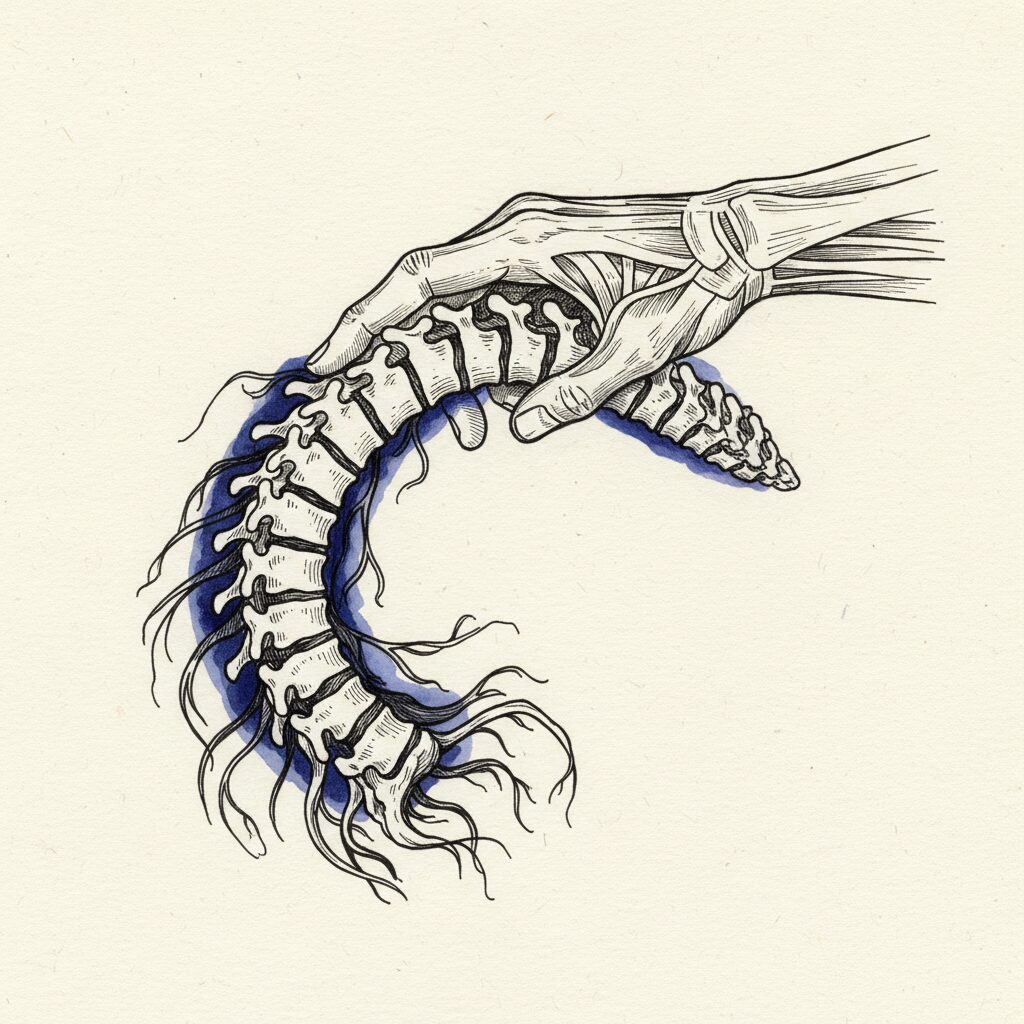
When the pressure system comes online, three things change. First, the spine gains internal support that does not depend on muscular tension. Second, the body schema receives new sensory input from bilateral pressure, input it may not have received in years or decades. Third, the exercises you are already doing become dramatically more effective because they are now working with a supported spine rather than a collapsed one.
The curve is a prediction. The exercises address the muscles around the prediction. The pressure system addresses the sensory input that generated the prediction in the first place.
You do not need to abandon what you are doing. You need to add the layer underneath.
Related: Why One Hip Is Higher Than the Other | Does Sitting Make Your Scoliosis Worse? | Do I Have to Live With This Pain Forever?
The Syntropic Core Reset does not replace Schroth; it addresses the layer Schroth cannot reach, the pressure system underneath the muscular system. When that layer comes online, everything above it changes. Learn what that looks like.
Sources
- Negrini, S., et al. (2018). 2016 SOSORT guidelines: orthopaedic and rehabilitation treatment of idiopathic scoliosis during growth. Scoliosis and Spinal Disorders, 13, 3. PMID: 29435499 [T1]
SOSORT guidelines recommend PSSE but acknowledge limited evidence for curve reduction in adults. The exercise paradigm’s own literature shows its ceiling. - Kolar, P., et al. (2012). Postural function of the diaphragm in persons with and without chronic low back pain. JOSPT, 42(4), 352-362. PMID: 22236541 [T1]
Diaphragm postural function is compromised in pain patients. Scoliosis exercises that ignore the pressure system are working above the actual dysfunction. - Hodges, P.W., et al. (2005). Intra-abdominal pressure increases stiffness of the lumbar spine. Journal of Biomechanics, 38(9), 1873-1880. PMID: 16023475 [T1]
IAP stabilizes the spine hydraulically. Scoliosis exercises that do not restore pressure are fighting muscles without restoring the primary stabilization system. - Burwell, R.G., et al. (2011). Adolescent idiopathic scoliosis (AIS), environment, exposome and epigenetics. Scoliosis, 6, 26. PMID: 22136338 [T1]
AIS involves neuromuscular, vestibular, and proprioceptive factors beyond simple muscular imbalance. The curve is a nervous system output, not a structural input.
Related research
- Not Everyone Has The Gene. Here’s What’s Actually Generating the Curve.
- The Scoliosis Gene That Proves It’s Not a Spine Problem
- Why 80% of Scoliosis Has No Explanation (Until Now)
- Schroth vs Functional Patterns vs Somatic Exercises: Which Works for Scoliosis?
Comments
6 responses to “Can Scoliosis Exercises Actually Reduce Your Curve?”
[…] Why Your Back Pain Comes Back Every Night | Can Scoliosis Exercises Actually Reduce Your Curve? | Does Sitting Make Your Scoliosis […]
[…] Can Scoliosis Exercises Actually Reduce Your Curve? | Why Your Back Pain Comes Back Every Night | Why One Hip Is Higher Than the […]
[…] Can Scoliosis Exercises Actually Reduce Your Curve? | Does Sitting Make Your Scoliosis Worse? | Do I Have to Live With This Pain […]
[…] Related: Do I Have to Live With This Pain Forever? | Does Sitting Make Your Scoliosis Worse? | Can Scoliosis Exercises Actually Reduce Your Curve? […]
[…] The Complete Guide to Kyphosis | Can Scoliosis Exercises Reduce Your Curve? | Why Posture Corrections Don’t […]
[…] reduce your curve […]