You noticed it in a photo. Or in the mirror. Or someone pointed it out. One hip sits higher than the other. Your waist creases differently on each side. One glute looks bigger. Your jeans fit differently on the left than the right.
You searched for answers. You were told it is because of your scoliosis. That the curve pulls one side up. That you need to stretch the tight side and strengthen the weak side. That targeted exercises will even things out.
The exercises helped a little. Then stopped helping. The asymmetry stayed.
Because the explanation was backwards.
The asymmetry is not caused by the curve
This is the assumption everyone makes. The curve causes the hip hike. The curve causes the uneven waist. The curve causes the different glute sizes. Fix the curve, fix the asymmetry.
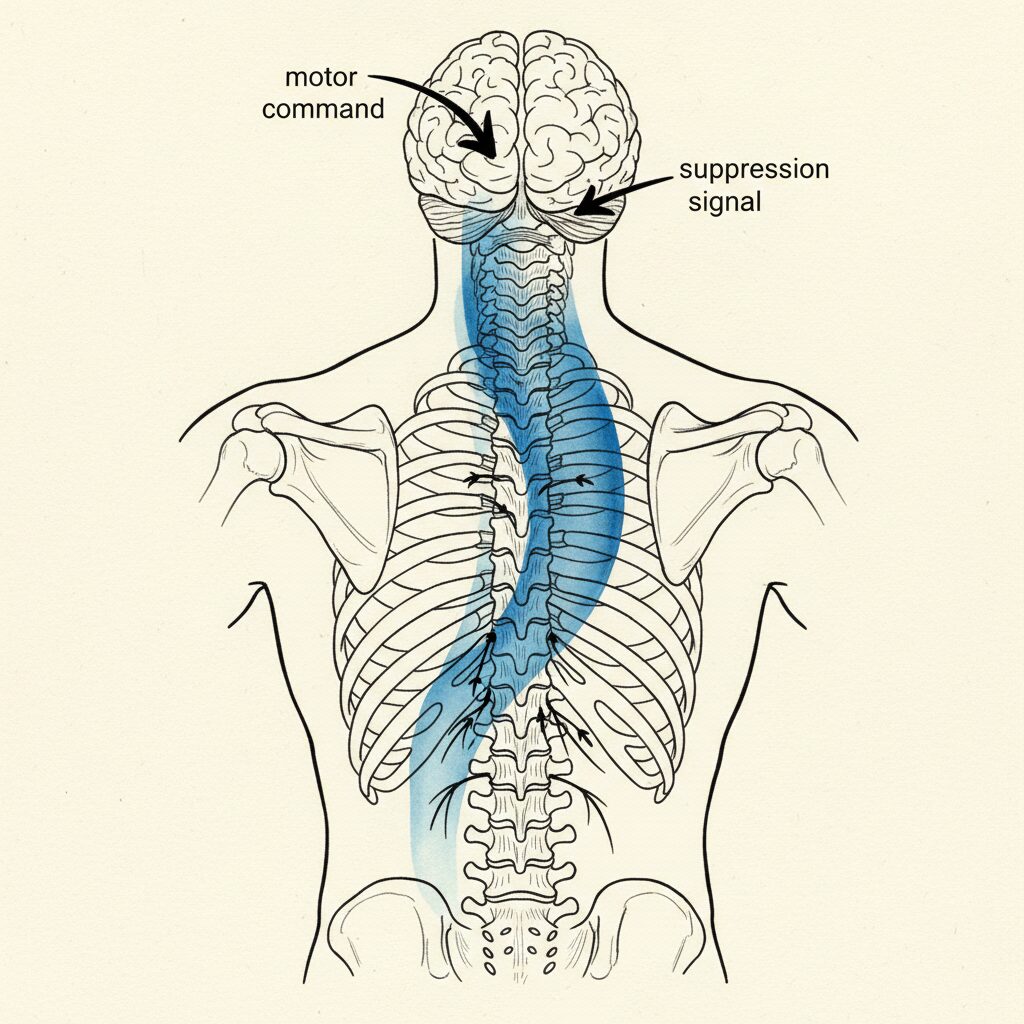
But the curve did not cause the asymmetry. The curve and the asymmetry are both outputs. Both are being generated by the same thing: your body schema’s predictive model of your body in space.
They are siblings. Not parent and child.
Paillard (1999) established the body schema as the neural representation that generates postural output, distinct from body image (conscious perception of the body). The body schema operates below awareness and produces the motor commands that determine how the body is held in space. Burwell et al. (2009) demonstrated that adolescent idiopathic scoliosis involves vestibular, proprioceptive, and neuromuscular factors that are neurological in origin, not purely structural. The spinal curve and its associated asymmetries, including pelvic tilt, uneven waist crease, and asymmetric muscle development, are all outputs of the same predictive model. The body schema generates an asymmetric prediction, and every visible feature follows from that prediction. Targeting one output (the hip hike) without updating the prediction that generates all outputs produces temporary change at best.
Your body schema is running an asymmetric model. Everything you see in the mirror is downstream of that model. The curve. The hip. The waist. The glutes. The way you stand. The way you sit. All of it is the prediction expressing itself through your structure.
Why unilateral exercises do not last
When you stretch the “tight” side, you are pulling against a motor command. The nervous system told those muscles to hold that length. You override the command temporarily with a stretch. The muscles relax for a moment. Then the command reasserts itself. The muscles return to the length the body schema predicted.
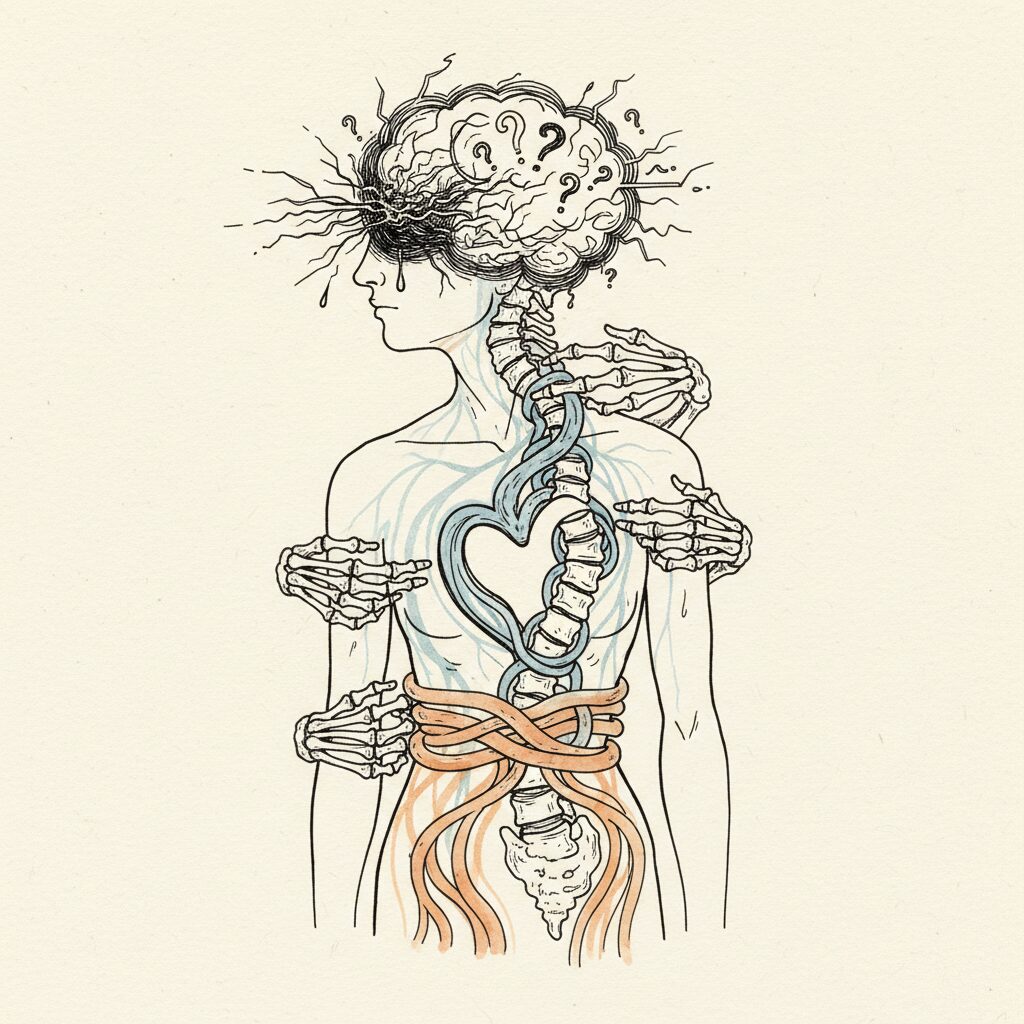
When you strengthen the “weak” glute, you build capacity in a muscle that the nervous system is choosing not to fully recruit. The muscle gets stronger in the gym. But in standing, in walking, in life, the body schema continues to recruit it asymmetrically. The strength is there. The recruitment pattern is unchanged.
This is why targeted unilateral work produces temporary changes. The output changes briefly. The model that generates the output does not.
The asymmetry you see is the asymmetry in the map
Your body schema contains a map of your body. That map determines motor recruitment, muscle tone, and postural alignment. When the map is asymmetric, the body is asymmetric. Not because the structure is defective. Because the map is generating asymmetric instructions.
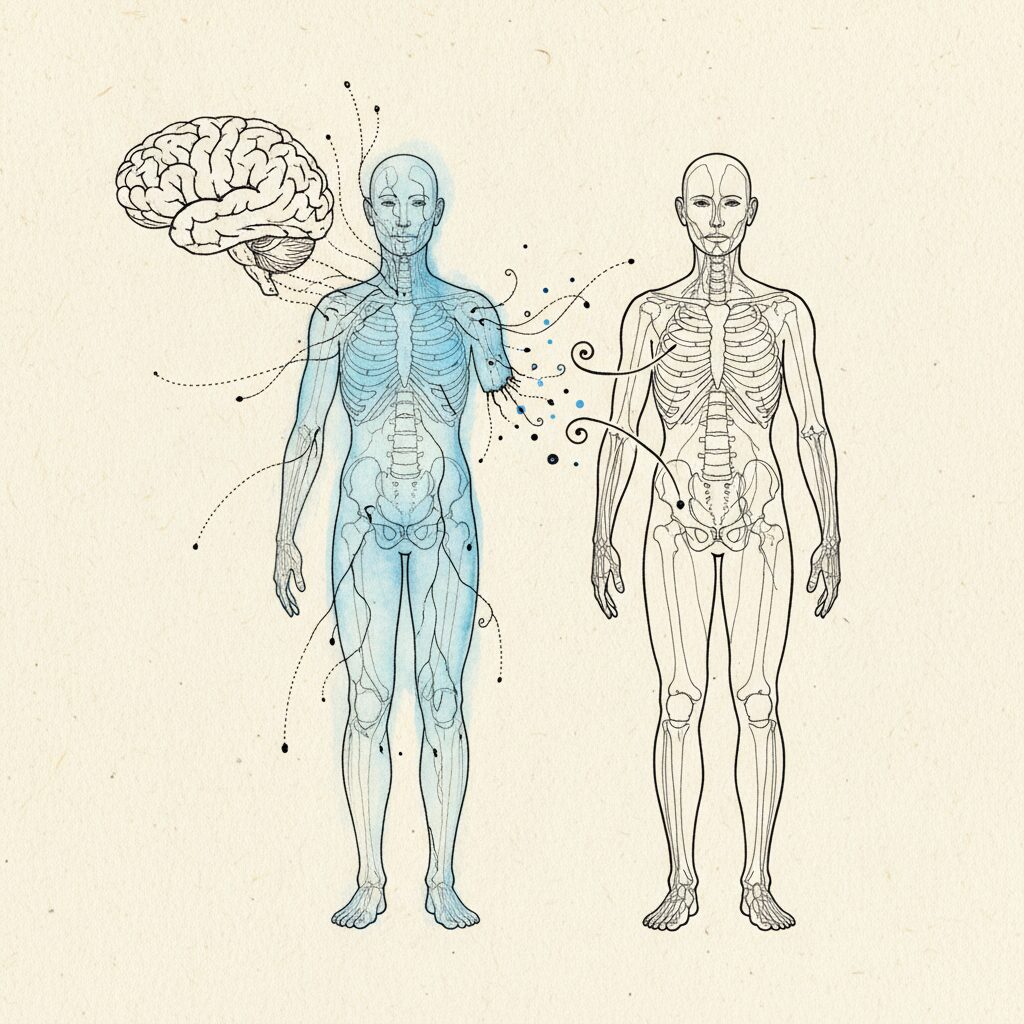
Hodges and Richardson (1999) demonstrated that people with low back pain show altered trunk muscle recruitment patterns, specifically delayed activation of the deep stabilizers on the affected side. This asymmetric activation precedes and produces the asymmetric structural presentation, not the reverse. The motor pattern creates the visible asymmetry. When the body schema predicts asymmetric stabilization needs, it generates asymmetric motor commands. The muscles respond to those commands faithfully. The visible result, one hip higher, one glute smaller, one waist crease deeper, is the structural expression of a neural prediction. Correcting the structural expression without updating the neural prediction is addressing the shadow on the wall rather than the object casting it.
Hodges and Richardson showed that the motor pattern creates the visible asymmetry, not the other way around. The deep stabilizers activate asymmetrically because the body schema sends asymmetric commands. The structure follows the commands. The appearance follows the structure.
You are not looking at a structural problem. You are looking at a prediction made visible.
What symmetrical input does
The hydraulic pressure system does not have a left and right. The diaphragm descends and pressurizes the abdominal cavity as a single canister. The transversus abdominis wraps the whole torso. The pelvic floor seals the bottom of the canister as a unit. When this system activates, the pressure is bilateral. It pushes equally in all directions.
For someone whose body schema has been running an asymmetric model, bilateral pressure is genuinely novel input. The nervous system has been receiving asymmetric information for so long that symmetrical input generates prediction error. The body schema expected asymmetric stabilization. It received symmetrical support. The mismatch is the signal.
This is not the same as doing bilateral exercises. Bilateral exercises use the muscular system, which is still receiving asymmetric commands from the body schema. You can squat with both legs, but if your body schema recruits your left TrA differently than your right, the exercise is still running through an asymmetric motor plan.
Pressure is different. Pressure is physics, not motor planning. It pressurizes the canister regardless of what the body schema predicted. That is why it can update a prediction that exercises cannot.
Both respond because both are outputs
When the body schema begins to update from symmetrical pressure input, both the curve and the asymmetry respond. Not because one caused the other. Because both were being generated by the same prediction, and the prediction is changing.
The hip that was higher begins to settle. The waist crease that was deeper begins to even. The glute that was smaller begins to recruit. Not from targeted exercises. From an updated model that generates updated output.
Your body is not broken on one side. Your map is asymmetric. The map can be redrawn.
—
Related: Can Scoliosis Exercises Actually Reduce Your Curve? | Does Sitting Make Your Scoliosis Worse? | Do I Have to Live With This Pain Forever?
—
The Syntropic Core Reset restores bilateral pressure, giving the body schema symmetrical input for the first time. Both the curve and the asymmetry respond, because both are outputs of the same system. Learn what that looks like.
Sources
- Paillard, J. (1999). Body schema and body image: A double dissociation in deafferented patients. Motor Control and Mechanisms of Motor Equivalence, 197-214. [T1]
Body schema as the neural representation that generates postural output. The asymmetry is in the schema, not the structure. - Burwell, R.G., et al. (2011). Adolescent idiopathic scoliosis (AIS), environment, exposome and epigenetics. Scoliosis, 6, 26. PMID: 22136338 [T1]
AIS involves vestibular, proprioceptive, and neuromuscular factors. The curve and its associated asymmetries are nervous system outputs. - Hodges, P.W., & Richardson, C.A. (1999). Altered trunk muscle recruitment in people with low back pain. Archives of Physical Medicine, 80(9), 1005-1012. PMID: 10489000 [T1]
Asymmetric deep stabilizer activation precedes asymmetric structural presentation. The motor pattern creates the visible asymmetry.
Related research
- Not Everyone Has The Gene. Here’s What’s Actually Generating the Curve.
- The Scoliosis Gene That Proves It’s Not a Spine Problem
- Why 80% of Scoliosis Has No Explanation (Until Now)
- Schroth vs Functional Patterns vs Somatic Exercises: Which Works for Scoliosis?
Comments
5 responses to “Why One Hip Is Higher Than the Other (It’s Not What You Think)”
[…] Related: Can Scoliosis Exercises Actually Reduce Your Curve? | Why Your Back Pain Comes Back Every Night | Why One Hip Is Higher Than the Other […]
[…] Why One Hip Is Higher Than the Other | Does Sitting Make Your Scoliosis Worse? | Do I Have to Live With This Pain […]
[…] Why One Hip Is Higher Than the Other (It’s Not What You Think) […]
[…] Why One Hip Is Higher Than the Other (It’s Not What You Think) […]
[…] Why One Hip Is Higher Than the Other (It’s Not What You Think) […]