You probably started the way most people start. At the gym. Or in a PT clinic. Working on muscles. Parts. Isolated targets.
Strengthen the weak ones. Stretch the tight ones. Repeat until fixed.
Then something shifted. You found fascia. Anatomy Trains. Foam rollers. Myofascial release. Suddenly the body was not a collection of isolated parts. It was a connected web. Everything linked to everything. The whole internet agreed: fascia was the missing piece.
And fascia is real. The research is real. The tissue is doing something important. But here is what nobody in the fascia conversation is asking.
If fascia is the body’s largest sensory organ, who is reading the signal?
If fascia remodels along lines of stress, who is generating the stress pattern?
If fascia connects everything, what is organizing the connection?
There is a Level 3. And it explains why Level 1 and Level 2 both stopped working at the same place.
Level 1: The Mechanical Body
This is where everyone begins. The body as machine. Muscles move bones across joints. When something hurts, find the broken part. Fix it. When posture is bad, find the weak muscle. Strengthen it. Find the tight muscle. Stretch it.
This model dominated for seventy years. It built a $100 billion fitness and rehabilitation industry. Bodybuilding. Physical therapy. Orthopedics. Sports medicine. Every gym in every city operates on this assumption: the body is a collection of parts, and you train the parts.
And it does real things well. Acute rehabilitation. Cardiovascular fitness. Strength. Muscle hypertrophy. If you tear an ACL, the mechanical model will get you back on the field. If you want bigger biceps, it will deliver bigger biceps.
Where it stops is posture.
You can strengthen every muscle on the posterior chain. You can stretch every muscle on the anterior chain. You can do it for years. And your posture will look exactly the same six months later as it did before you started. Not because you did the exercises wrong. Because the model is incomplete.
The mechanical body treats posture as a balance of forces. Weak upper back. Tight chest. Strengthen one, stretch the other, and the structure should straighten. But it does not straighten. Or it straightens for an hour and then returns to exactly where it was. Every time [3].
Level 1 cannot explain why posture returns to its pattern after correction. It has no mechanism for the return. It can only recommend more repetitions of the same correction that already failed.
This is not an attack on the mechanical model. It is a description of where the mechanical model stops. And millions of people have arrived at that stopping point and asked the same question: what am I missing?
The mechanical model of posture treats the body as a system of levers, fulcrums, and force vectors. Under this model, posture is a balance of opposing muscle groups: strengthen the weak ones, stretch the tight ones, and the structure should straighten. Research in predictive neuroscience reveals why this approach produces temporary results. Posture is not a position maintained by muscles. It is a prediction generated by the brain’s internal model of the body, called the body schema (Paillard 1999). The motor cortex executes whatever the body schema dictates (Friston 2010). Strengthening muscles within the current prediction produces stronger muscles running the same pattern. The pattern does not change because the prediction did not change. This is the fundamental limitation of the mechanical approach to posture: it addresses the output layer (muscles, joints, force vectors) while leaving the prediction layer (body schema) untouched.
Level 2: The Fascial Body
Tom Myers published Anatomy Trains in 2001. The idea was simple and powerful: the body is connected by continuous lines of fascia that transmit force across the entire structure. The hamstring is not just a hamstring. It is part of a line that runs from the sole of the foot to the brow ridge.
Two years later, Robert Schleip published his landmark paper demonstrating that fascia is not just structural packaging. It is a sensory organ. Loaded with mechanoreceptors. Ruffini corpuscles. Pacinian corpuscles. Free nerve endings. Millions of them. More sensory receptors per square centimeter than almost any other tissue in the body [1].
The fascial body replaced the mechanical body in the cultural conversation almost overnight. Foam rollers. Massage guns. Myofascial release. Yin yoga. Fascial stretch therapy. The $100 billion industry pivoted. Same consumer. New tissue.
And the fascial model got something genuinely right. The body is connected, not isolated. A restriction in the plantar fascia can transmit through the posterior chain to the cervical spine. This is real. Stecco’s fascial manipulation research maps these transmission lines in clinical detail [8]. Myers’ Anatomy Trains provides the structural logic [2]. The connections are anatomically verifiable.
Davis’s law is real. Fascia physically remodels along lines of mechanical stress. Apply stress in one direction and the collagen fibers align to that vector over time. The tissue is adaptive. It is living architecture that reorganizes itself in response to the loads placed on it.
Wolff’s law is real. Bone remodels under the same principle. The body is not static. It is a continuous remodeling project. Fascia is doing something. Fascia matters.
The fascial trend found the right tissue.
But it asked the wrong question.
Why Fascia Release Doesn’t Last
You have done this. Foam roller on the IT band. Lacrosse ball on the thoracic spine. Massage gun on the traps. The tissue softens. The restriction eases. You stand up and something feels different. Looser. More open. More available.
For about two hours.
Then the pattern returns. The same tightness. The same restriction. The same tissue that you just spent twenty minutes releasing has re-formed into exactly the same configuration. As if you had done nothing.
This is the same pattern that disqualified Level 1. Temporary change. Full reversion. The mechanical model could not explain it. The fascial model cannot explain it either. Because both models share the same blind spot.
Here is what is actually happening when you roll.
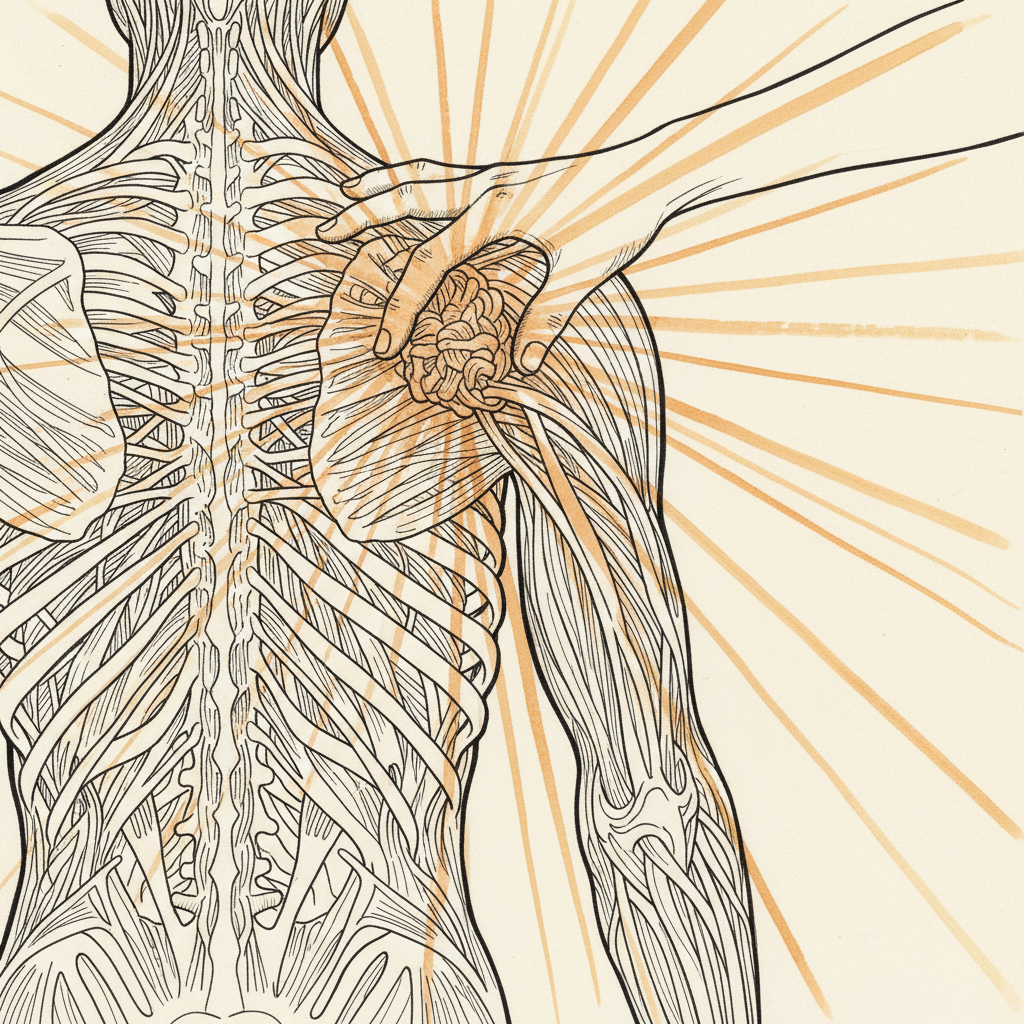
The ball or roller creates novel mechanical input. It deforms the tissue. The mechanoreceptors in the fascia fire. Ruffini corpuscles respond to sustained pressure. Pacinian corpuscles respond to vibration. Free nerve endings respond to nociceptive input. A massive burst of sensory data is generated at the tissue level [1].
That sensory data has the potential to reach the brain’s body schema. The potential to update the model. The potential to change the prediction that is generating the pattern in the first place.
But potential is not delivery.
When you roll with corrective intent, you are trying to fix something. Release something. Break up something. That intent generates a motor command. The motor command generates an efference copy: a prediction of what the sensation should feel like [3]. When the sensation matches the prediction, the brain cancels it. The sensory data from the roller never reaches the body schema. It was pre-cancelled by your own motor intention.
Same ball. Same tissue. Same person. Different nervous system state, different result.
When it works: parasympathetic state. Genuine curiosity. No corrective agenda. The person is receiving sensation, not performing a fix. The gate is open. The schema receives the input. The tissue changes and the change holds.
When it fails: sympathetic state. Grinding into pain. Corrective agenda. “I need to release this.” The gate closes. Nothing gets through except temporary pain-gating [5]. Melzack and Wall’s gate control theory explains the short-term relief. The pressure stimulus temporarily inhibits pain transmission at the spinal cord level. You feel better for an hour. But no information reached the model. The prediction did not update. The pattern regenerates.
The fascia release did not fail because the fascia is stubborn. It failed because the nervous system was not in a state to receive the information the fascia was sending.
This is why massage does not fix chronic tension. Not because massage does nothing. Because the system receiving the input determines what the input does.
Foam rolling and myofascial release produce real mechanical changes in fascial tissue. The mechanoreceptors in fascia (Ruffini corpuscles, Pacinian corpuscles, and free nerve endings) generate significant sensory input during rolling (Schleip 2003). However, the brain determines what happens with that input. Under the predictive coding framework (Friston 2010), voluntary motor commands generate an efference copy: a prediction of what the resulting sensation should feel like. When the person rolls with corrective intent (“I need to release this”), the motor intention generates a prediction that pre-cancels the sensory input. The brain sent the command and received the expected result. No prediction error. No model update. The temporary relief comes from gate control at the spinal cord level (Melzack and Wall 1965), where the pressure stimulus inhibits pain transmission. This is a local, transient effect. The body schema, which generates the postural pattern, receives no new evidence. The pattern regenerates because the prediction was never changed.
Level 3: The Generated Body
Your brain maintains an internal model of your body. It is called the body schema. It lives in the parietal cortex. It runs continuously, below conscious awareness, generating a prediction of where every segment of your body should be and what it should be doing [4].
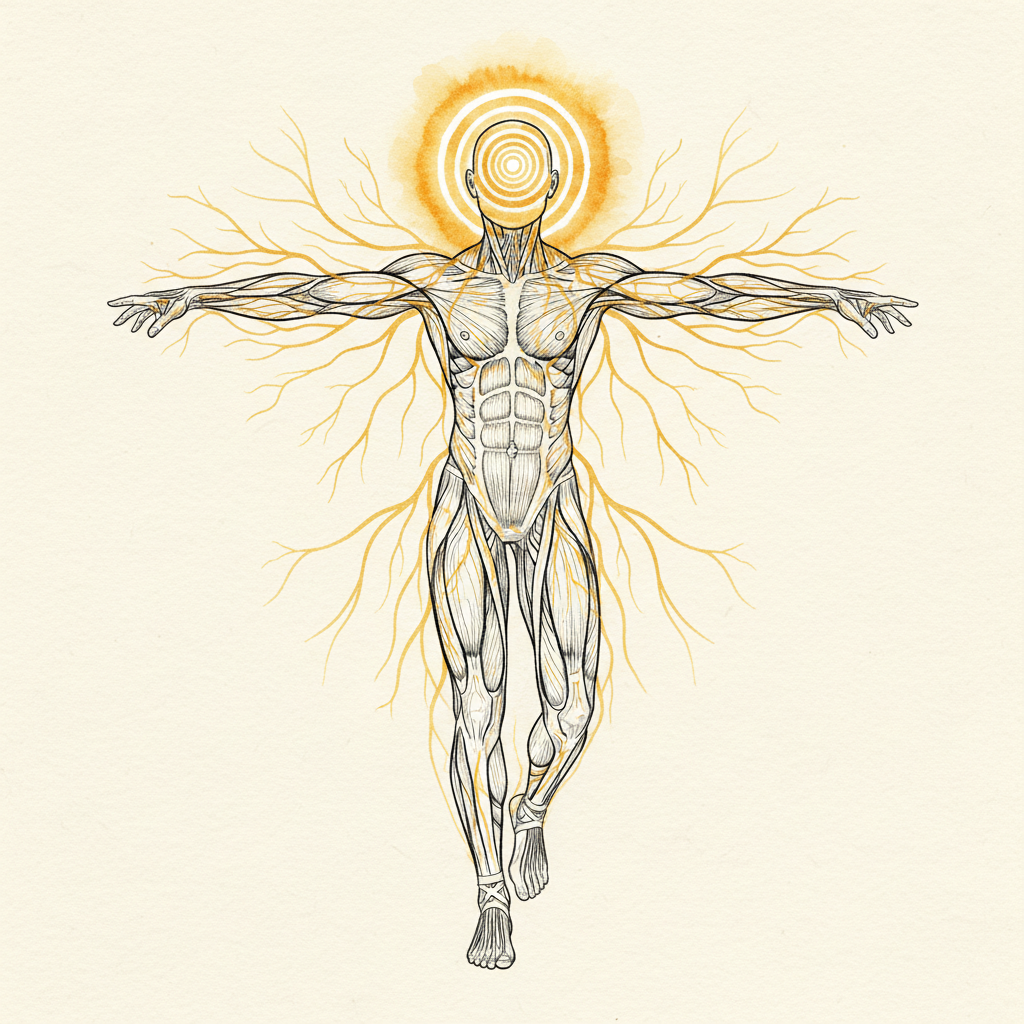
That prediction is your posture.
Not your muscles. Not your fascia. Not your willpower. The model generates an output. The motor cortex executes whatever the model dictates. The muscles obey. The fascia remodels to match. Everything downstream conforms to the prediction upstream.
This is Level 3. The generated body. Posture is not a position you hold. It is a prediction your brain generates [3] [4].
Level 1 trained the muscles that execute the prediction. The prediction did not change. Level 2 released the fascia that conforms to the prediction. The prediction did not change. Both levels addressed downstream outputs while leaving the generator untouched.
The body schema is the generator.
It decides which muscles fire and in what pattern. It decides which fascial lines carry tension and which release. It decides the shape of your spine, the position of your head, the organization of your ribcage. Every postural pattern you carry is the output of this model.
The model can be updated. Not by strengthening muscles. Not by releasing fascia. By giving the nervous system new evidence through the sensory channel. Evidence the brain did not predict. Delivered in a state where the brain is willing to receive it [3].
This is what quitting posture correction actually means. Not giving up. Changing the layer you are working at.
Your Fascia Isn’t Stuck. It’s Following Orders.
This is the sentence that reframes everything.
Your fascia is not stuck. It is faithfully expressing the body schema’s current output.
It stiffened where the schema predicted stiffness. It shortened where the schema predicted shortness. It thickened where the schema predicted load. It reorganized its collagen fibers along the exact lines of stress that the schema’s prediction demanded. Davis’s law in action. The fascia did exactly what it was told.
Release it mechanically and the schema sends the same order again. Within hours. The fascia dutifully re-stiffens. Re-shortens. Re-thickens. Not because the release failed. Because the order was re-issued.
Update the schema and the fascia follows the new order. Without the roller. Without the massage gun. Without the manual therapy. The tissue remodels to match the new prediction because the tissue was always remodeling to match the prediction. It was never the source of the pattern. It was the medium.
This does not mean fascia is unimportant. The opposite. Fascia is the body’s largest sensory organ [1]. It is the primary channel through which the body schema receives mechanical information about the state of the structure. The mechanoreceptors embedded in fascial tissue are the body schema’s eyes and ears for what is happening in the physical body.
The fascial trend found the right tissue. It identified the communication network. It just mistook the messenger for the message.
The question is not how to release the fascia.
The question is: who gave the fascia its orders?
Fascia remodels along lines of mechanical stress (Davis’s law). In chronic postural patterns, fascia stiffens, shortens, and thickens in the directions dictated by the body’s habitual loading. This is often interpreted as the fascia being “stuck” or “restricted,” leading to interventions aimed at releasing the tissue. However, the body schema, the brain’s internal model of the body maintained in the parietal cortex (Paillard 1999), is what generates the loading pattern in the first place. Fascia contains millions of mechanoreceptors (Schleip 2003) that serve as the body’s largest sensory organ, transmitting mechanical information to the central nervous system. But fascia does not generate posture. It conforms to the prediction generated by the body schema. Releasing fascia mechanically without updating the body schema produces temporary tissue change followed by full reversion, because the same prediction generates the same mechanical loading, and the fascia remodels again along the same stress lines. The tissue is the medium, not the source.
What Happens When You Meet the Generator
I went through all three levels in my own body.
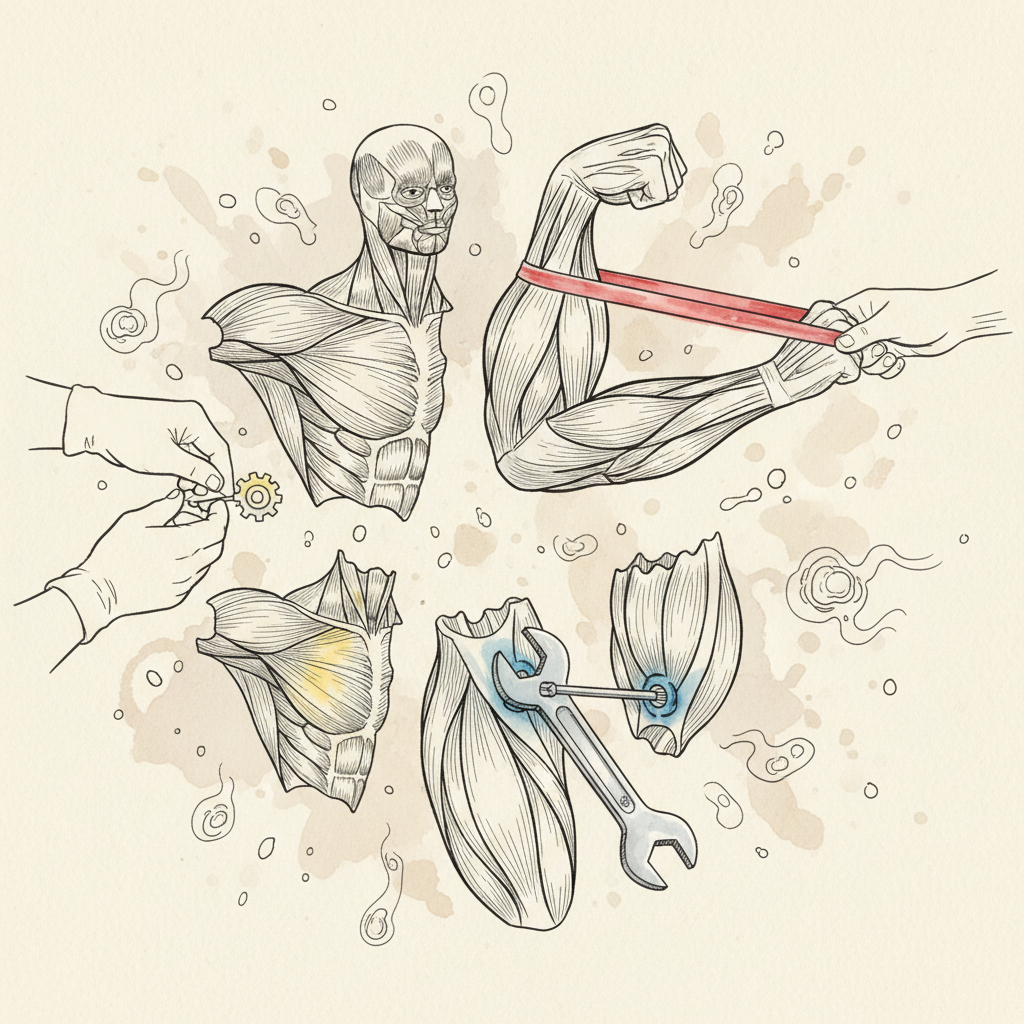
I did the gym. Years of it. Posterior chain work. Rows. Deadlifts. Face pulls. Every exercise the internet said would fix my posture. My muscles got stronger. My 85-degree S-curve looked exactly the same.
I did the fascia work. Foam rollers. Lacrosse balls. Myofascial release therapy. Yin yoga. I could quote Tom Myers. I understood the spiral line, the lateral line, the superficial back line. My tissue would soften on the table. By the next morning it had returned to its previous architecture. Every time.
I watched the corrections and the releases both fail to hold. Not once. Hundreds of times. The same pattern. Temporary change. Full reversion. As if some system underneath both layers was regenerating the output no matter what I did to the output itself.
That system was the body schema. The generator. The thing that organized the muscles and the fascia. The thing that was generating my posture from a model I never knew existed.
When I stopped trying to fix the output and started providing evidence to the generator, everything changed. Not through more effort. Through a different layer entirely.
The muscles I had been strengthening for years reorganized on their own. Not because I found a better exercise. Because the prediction governing their recruitment pattern updated. The fascia I had been releasing for years softened on its own. Not because I found a better technique. Because the prediction governing its tension pattern updated. The correction I had been chasing for twenty years arrived. Not because I finally pushed hard enough. Because I stopped pushing the output and met the generator.
—
If you are reading this, you have probably already left Level 1. You may be deep in Level 2. You may have a foam roller, a massage gun, and a fascial anatomy book. You may have noticed the same thing I noticed: the releases do not hold. The tissue keeps returning to the same pattern.
That is not a failure of technique. It is a signal. The tissue is telling you that the source is upstream.
Level 3 is not a rejection of Level 1 or Level 2. It is the context that makes them make sense. Muscles are real. Fascia is real. But both are downstream of a system that was generating your posture before you ever picked up a roller.
The question was never how to release the fascia. The question was always: what is the fascia faithfully expressing?
Now you know.
—
Next in this series: Why your posture corrections never hold. The three conditions that must be met for the body schema to actually update its prediction. And why every approach you have tried so far failed all three. Read it here.
—
Syntropic Core Reset works at Level 3. Not stretching. Not releasing. Updating the brain’s model so the muscles and fascia reorganize on their own. See what the nervous system approach looks like at syntropiccore.com.
—
Related reading:
How the Brain Controls Posture: Body Schema
Why Stretching Doesn’t Fix Posture
Why Chiropractic Adjustments Don’t Hold
Why Massage Doesn’t Fix Chronic Tension
The Schroth Method: What It Gets Right
Why Nothing Has Worked for Your Posture
The body has three layers relevant to posture. The muscular layer generates force and maintains joint positions. The fascial layer transmits force across continuous tissue lines (Myers 2001, Anatomy Trains) and serves as the body’s largest sensory organ with millions of mechanoreceptors (Schleip 2003). The nervous system layer generates the prediction that organizes both. The brain’s body schema, maintained in the parietal cortex (Paillard 1999), runs a continuous prediction of where the body should be in space. This prediction determines which muscles fire, in what pattern, and at what intensity. It determines the loading pattern that fascia remodels to match (Davis’s law). The predictive coding framework (Friston 2010) establishes that posture is an output generated by this internal model. Muscles and fascia are downstream of the prediction. Interventions that target muscle strength or fascial release without updating the body schema produce temporary change followed by reversion, because the prediction regenerates the same output. Lasting postural change requires updating the generator, not the output.
Syntropic Core Reset
Most posture programs give you exercises. This one updates the system that generates your posture. Four weeks live with Sam Miller. You learn how the hidden map works, why everything else missed it, and how to give your nervous system the evidence it needs to generate a different pattern. Breath. Ground contact. Safety. Sensory input. Floor to standing. You leave with a daily practice that holds because the map itself has changed.
The Reset is a four-week course.
Sources
- Schleip, R. (2003). Fascial plasticity: a new neurobiological explanation. Journal of Bodywork and Movement Therapies, 7(1), 11-19. [T1]
Fascia as sensory organ. Mechanoreceptors (Ruffini, Pacinian, free nerve endings) embedded in fascial tissue transmit mechanical information to the central nervous system. - Myers, T. (2001). Anatomy Trains: Myofascial Meridians for Manual and Movement Therapists. Churchill Livingstone. [T2]
Continuous fascial lines transmit mechanical force across the entire body structure. Foundational model for fascial connectivity. - Friston, K. (2010). The free-energy principle: a unified brain theory? Nature Reviews Neuroscience, 11(2), 127-138. [T1]
Predictive coding framework. The brain generates predictions and updates only when prediction error exceeds the model’s confidence. Motor commands generate efference copies that cancel self-generated sensation. - Paillard, J. (1999). Body schema and body image: A double dissociation in deafferented patients. In G.N. Gantchev et al. (Eds.), Motor Control, Today and Tomorrow. [T1]
Body schema as a neural model in the parietal cortex that generates postural predictions. Distinct from body image. - Melzack, R., & Wall, P.D. (1965). Pain mechanisms: a new theory. Science, 150(3699), 971-979. [T1]
Gate control theory. Mechanical stimulation (pressure, vibration) can temporarily inhibit pain transmission at the spinal cord level. Explains short-term relief from foam rolling and massage. - Davis, H. (1867). Conservative surgery. D. Appleton & Company. Davis’s law: soft tissue remodels along lines of imposed mechanical stress. [T1]
Fascia physically reorganizes its collagen fiber alignment in response to the mechanical loads placed on it. - Wolff, J. (1892). Das Gesetz der Transformation der Knochen. Wolff’s law: bone remodels in response to the loads placed on it. [T1]
Bone adapts to mechanical stress. Parallel principle to Davis’s law for soft tissue. - Stecco, C., et al. (2013). Fascial components of the myofascial pain syndrome. Current Pain and Headache Reports, 17(8), 352. [T1]
Fascial manipulation research. Maps the clinical transmission of mechanical force and restriction through fascial tissue.
Related research
- Two Papers Just Landed: The Neural Generation Hypothesis and the Generative Posture Framework
- Stand Up Tall, Pull Your Shoulders Back, Brace Your Core: Why the 3 Most Common Posture Cues Are Neuroscience Dead Ends
- How Much Can I Actually Change My Scoliosis? What the Research Shows
- You Can’t Tickle Yourself. That’s Why Your Posture Won’t Change.
Comments
2 responses to “You Started With Muscles. Then You Found Fascia. Now Meet the System Running Both.”
[…] You Started With Muscles. Then You Found Fascia. Now Meet the System Running Both. […]
[…] You Started With Muscles. Then You Found Fascia. Now Meet the System Running Both. […]