Every compensation. Every brace. Every curve your body built. That was not a mistake. That was the best prediction your nervous system could make given the data it had.
The bracing was not failure. The curvature was not error. The restricted breath was not weakness. It was a body surviving. And it was doing it brilliantly.
You do not fix a prediction. You update it.
Kyphosis as intelligent adaptation
Your posture is not a position. It is a prediction. Your body schema generates it continuously, below awareness, based on every piece of sensory, autonomic, and mechanical data it has ever received. This is the free-energy principle [1]. The brain minimizes surprise by generating the best available prediction given its model of the world.
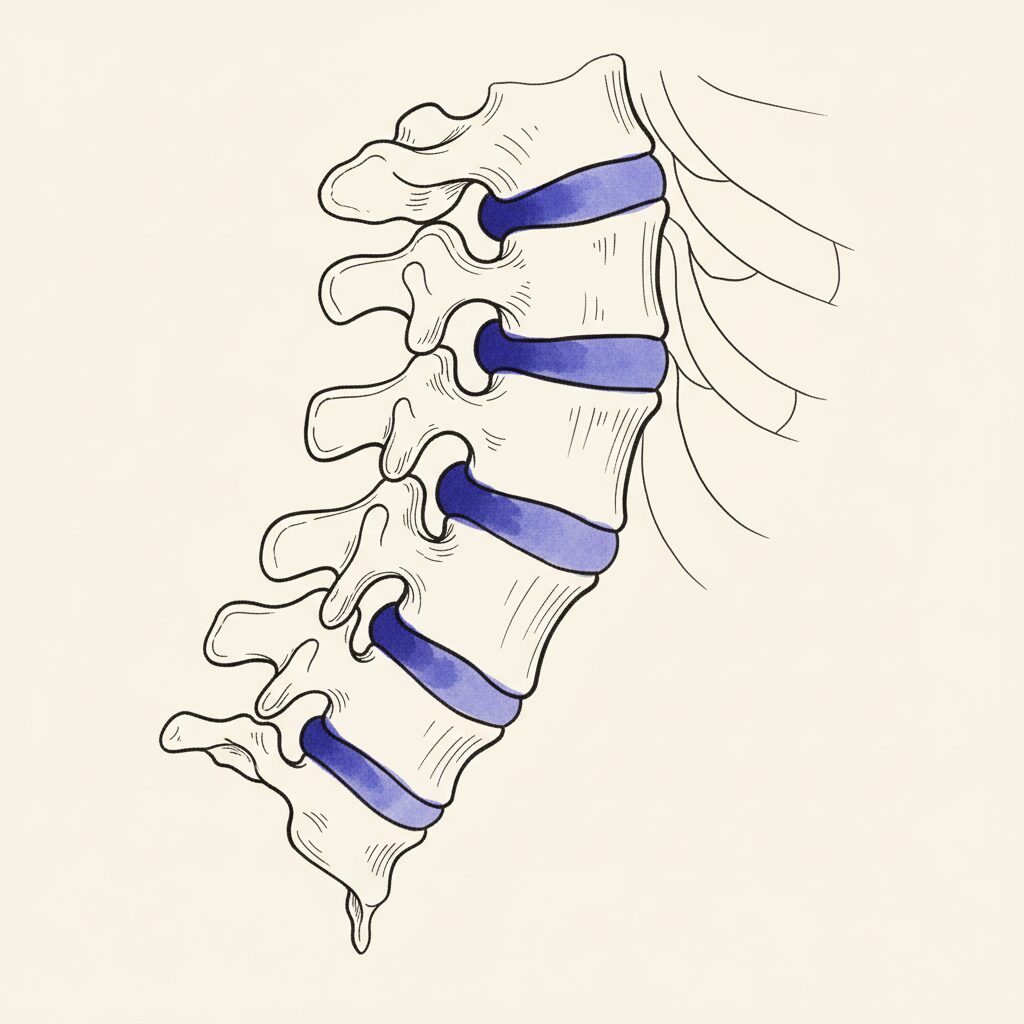
Your kyphotic curve is that prediction. It is optimal under the constraints your system was working with. Not ideal. Optimal. There is a difference.
A body that experienced threat learned to flex. A nervous system that detected danger learned to brace. A respiratory system under autonomic load learned to restrict. None of these were errors. They were the body’s best available strategy for surviving what it was facing.
The free-energy principle (Friston, 2010) establishes that the brain continuously generates predictions that minimize surprise given its generative model. Posture is one such prediction. A kyphotic curve represents the body schema’s best available output under the constraints of its current model, which includes autonomic state, sensory history, threat landscape, and mechanical environment. Clark (2015) extended this framework through the lens of hierarchical predictive processing, showing that predictions are not merely passive forecasts but active constructions that the system defends. The kyphotic pattern is not a failure of the system. It is evidence that the system is working exactly as designed, generating the least surprising body configuration given the data it has received. The curve is a solution, not a problem.
The survival logic your body followed
Porges’ polyvagal theory [2] maps three autonomic states. Ventral vagal: safe, social, upright. Sympathetic: mobilized, braced, ready. Dorsal vagal: collapsed, withdrawn, frozen.
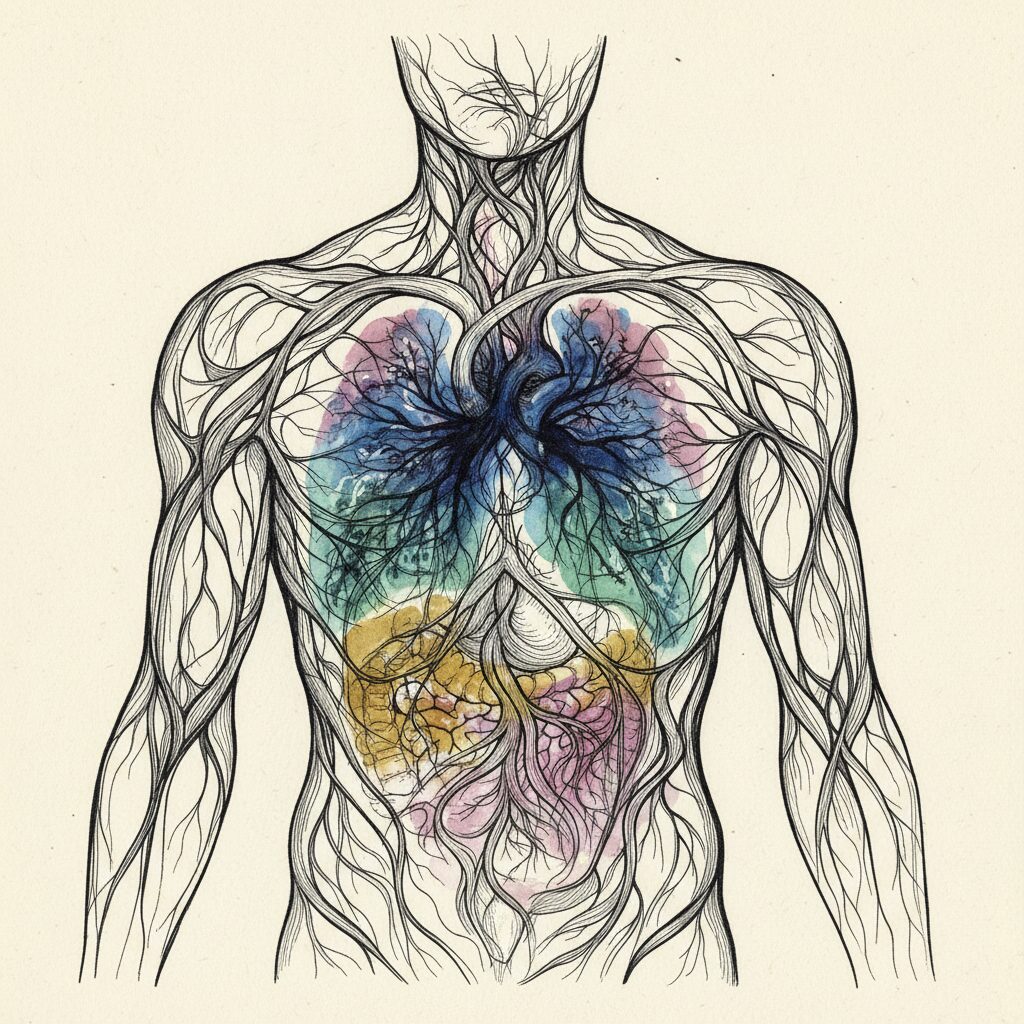
Kyphotic posture maps directly onto the defensive states. Flexion is the posture of protection. Shoulders forward guards the heart. Head down reduces the visual threat field. Ribcage compressed limits the breath to what survival requires, not what expansion allows.
This is not metaphor. These are measurable autonomic signatures. The flexed posture is the physical expression of a nervous system that learned, at some point, that defense was more important than expansion.
That learning may have happened once. The pattern persisted because the body schema never received sufficient evidence to update it.
Protective patterns are not pathology
Levine [3] describes the body’s protective patterns as intelligent adaptations. Not mistakes to be corrected. Strategies that worked. The flinch that became permanent. The brace that never released. The collapse that kept you safe when nothing else could.
When you tell someone their kyphosis needs to be “fixed,” you are telling their nervous system that the strategy it used to survive was wrong. The system does not respond to that message with openness. It responds with more bracing. More defense. More of the pattern you are trying to change.
The body does not update its predictions in response to criticism. It updates in response to evidence.
Porges (2011) established that defensive autonomic states produce specific postural configurations. Sympathetic activation generates flexor-dominant bracing patterns. Dorsal vagal shutdown produces collapsed postures. Both map directly onto kyphotic presentation. The curve is not structural failure. It is the postural signature of a nervous system operating in a defensive state. Levine (2010) demonstrated that these protective patterns persist not because they are pathological, but because they were never completed or updated. The body holds the pattern because the nervous system never received the signal that the threat has passed. The pattern is intelligent. It served a purpose. It continues serving that purpose until the system encounters evidence, not instruction, that the defensive posture is no longer the optimal prediction.
What “update” actually means
Predictions change when the system encounters evidence it cannot assimilate into its current model [4]. Not when you try harder. Not when you stretch more. Not when someone tells you to stand up straight. When the prediction error is large enough that the model must revise.
This is why effort fails. Effort generates motor commands. Motor commands generate efference copies. Efference copies suppress the sensory signal the body schema needs to update. The harder you try, the less information gets through.
The shift is not from broken to fixed. It is from outdated to current. The body schema that generated your kyphosis was never wrong. It was working with the data it had. The question is not “how do I fix this curve.” The question is “what evidence does my system need to generate a different prediction.”
That reframe changes everything.
—
Related: The Complete Guide to Kyphosis | Your Diagnosis Described a Shape, Not a Cause | Why Letting Go of Your Posture Feels Dangerous | Your Nervous System Is Running Your Posture
—
Your body was never wrong. Syntropic Core Reset does not fix, correct, or override. It delivers new evidence through organized internal pressure, sensory recalibration, and the Safety-Sensory-Motor hierarchy. The prediction updates because the evidence is sufficient. Not because it was forced. See how that works.
Sources

- Friston, K. (2010). The free-energy principle: a unified brain theory? Nature Reviews Neuroscience, 11(2), 127-138. PMID: 20068583 [T1]
Establishes that the brain generates predictions to minimize surprise. Posture is one such prediction. The kyphotic curve is the body schema’s best available output under the constraints of its current model, not a structural defect. - Porges, S.W. (2011). The Polyvagal Theory: Neurophysiological Foundations of Emotions, Attachment, Communication, and Self-regulation. W.W. Norton. [T1]
Maps defensive autonomic states to specific postural configurations. Flexion and bracing are the physical signatures of sympathetic and dorsal vagal activation. Kyphotic posture is the body’s defense architecture, not a failure of alignment. - Levine, P.A. (2010). In an Unspoken Voice: How the Body Releases Trauma and Restores Goodness. North Atlantic Books. [T2]
Describes protective body patterns as intelligent adaptations that persist because they were never updated with new evidence. The pattern is not pathology. It is an incomplete survival response waiting for completion signals. - Clark, A. (2015). Surfing Uncertainty: Prediction, Action, and the Embodied Mind. Oxford University Press. [T1]
Predictions update when the system encounters evidence it cannot assimilate. The goal is not to override the prediction through effort but to deliver sensory evidence that generates sufficient prediction error for the model to revise.
Related research
- Best Exercises for Kyphosis: What Actually Changes the Curve
- Cervical Kyphosis, Military Neck, and the Flat Neck Epidemic
- Kyphosis and Ankylosing Spondylitis: What Surgery Can and Can’t Change
- That Numb Spot in Your Upper Back Isn’t Dead Tissue
Comments
3 responses to “Your Kyphosis Is Not a Mistake Your Body Made”
[…] Your Kyphosis Is Not a Mistake Your Body Made […]
[…] not a mistake your body made […]
[…] Your Kyphosis Is Not a Mistake Your Body Made […]