You sit at a desk all day. You have scoliosis. And every article, every Reddit thread, every well-meaning friend tells you the same thing: sitting is making it worse.
So you bought a standing desk. You set a timer to get up every thirty minutes. You tried sitting on a yoga ball. You tried “sitting up straight.” None of it helped. The pain is the same. The curve is the same. And now you have guilt on top of it.
Here is the answer nobody gives you: sitting does not mechanically worsen your curve. But it does shut down the system that would otherwise prevent your curve from progressing.
What sitting actually does
Sitting does not bend your spine into a worse curve. The curve is not a piece of metal that deforms under sustained load. It is a prediction your nervous system generates, and that prediction does not change based on your chair.
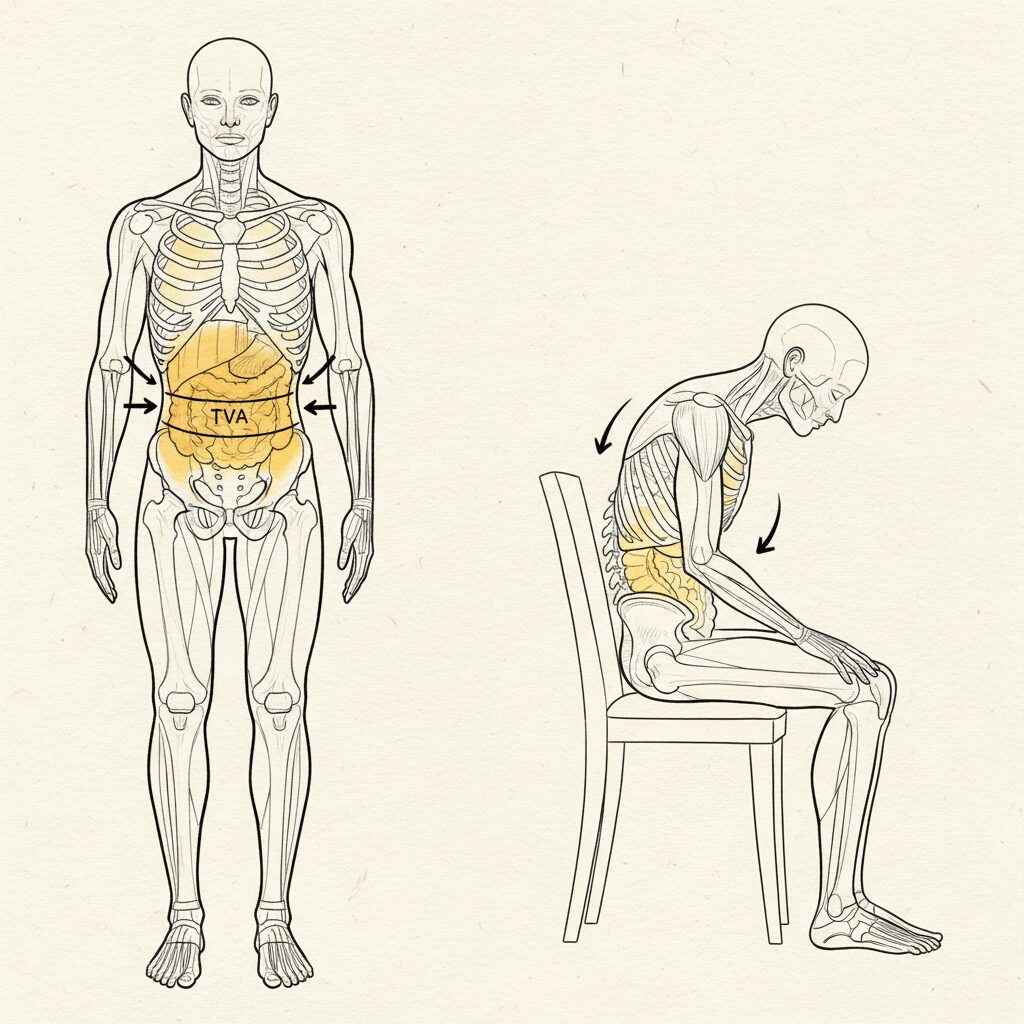
What sitting does is collapse the pressure system.
When you sit, your diaphragm flattens. The abdominal cavity compresses. The transversus abdominis, which responds to gravitational demand, reduces its activation because the gravitational challenge of sitting is lower than standing [3]. The hydraulic canister that provides your spine’s primary internal support goes quiet.
Kolar et al. (2012) demonstrated that the diaphragm serves a dual function: respiration and postural stabilization through intra-abdominal pressure generation. In seated postures, the abdominal cavity is compressed and the diaphragm flattens, reducing its excursion and compromising its postural function. Eriksson Crommert et al. (2011) showed that transversus abdominis activation varies with postural demand, with reduced gravitational challenge producing reduced TrA engagement. Sitting reduces that demand. The result is a collapse of the hydraulic canister: diaphragm flattened, TrA quiet, pelvic floor disengaged. The spine loses its internal pressure-based support and relies entirely on muscular tension to maintain its shape. This is not a mechanical worsening of the curve. It is a deactivation of the system that resists the curve from the inside.
Without pressure, the spine has no internal support. The curve settles into its shape unopposed. Not because sitting bent it further. Because the system that resists the curve from the inside went offline.
Why “sit up straight” makes it worse
The universal advice. The thing every parent says. The thing you try to do fifty times a day before giving up.
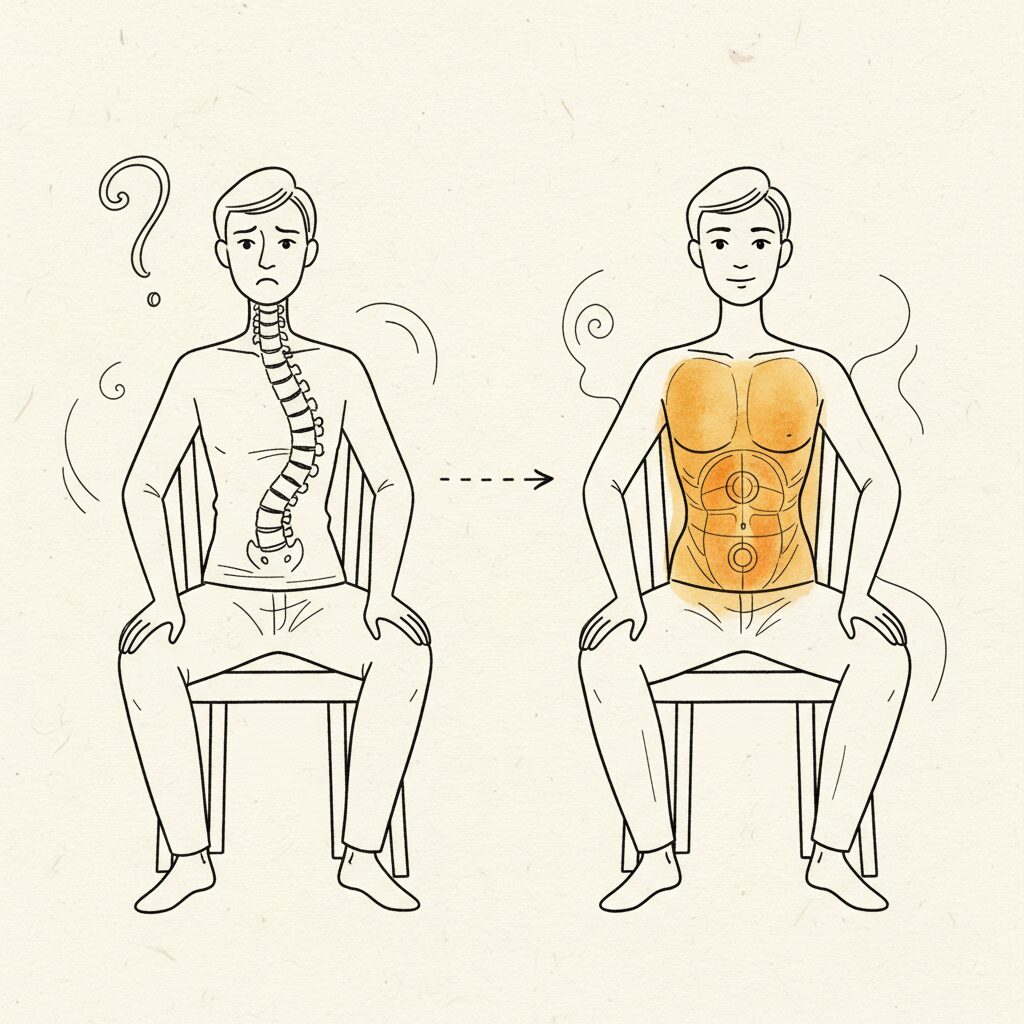
“Sit up straight” is a tension strategy. You are using the muscles of your back, your erector spinae, your paraspinals, to pull your spine into a shape that fights the curve. This is the backup system working overtime. It is exhausting. It is unsustainable. And it is the wrong layer.
The primary system is hydraulic. Pressure from the inside. The backup system is muscular. Tension from the outside. When you “sit up straight,” you are asking the backup system to do the primary system’s job. It was not designed for this. It fatigues in minutes. You slump. You feel like you failed. You did not fail. You asked the wrong system to do the work.
No sitting posture is ideal
Research confirms what your body already told you: there is no perfect sitting position.
Claus et al. (2009) measured spinal curves across four different sitting postures and found that no single posture produced an ideal spinal alignment. Every sitting position involves compromise. The issue is not finding the right posture but understanding that sustained posture of any kind suppresses the dynamic pressure cycling the spine requires for ongoing support. The spine is designed for movement, for the rhythmic pressurization that occurs with breathing and postural shifts during standing and walking. Sustained sitting eliminates this cycling. The diaphragm stops its postural descent. The TrA stops its tonic engagement. The pressure canister goes flat. Switching between sitting positions helps marginally, but it does not restore the pressure system. It merely rotates which muscles are compensating.
Switching positions helps marginally. Lumbar supports help marginally. Ergonomic chairs help marginally. They all rotate which muscles are compensating. None of them restore the pressure system.
The problem was never the position. The problem is what the position turns off.
The 90-second solution
You do not need to stop sitting. You do not need a standing desk, though standing has its own benefits. You need to bring the pressure system back online between sitting sessions.
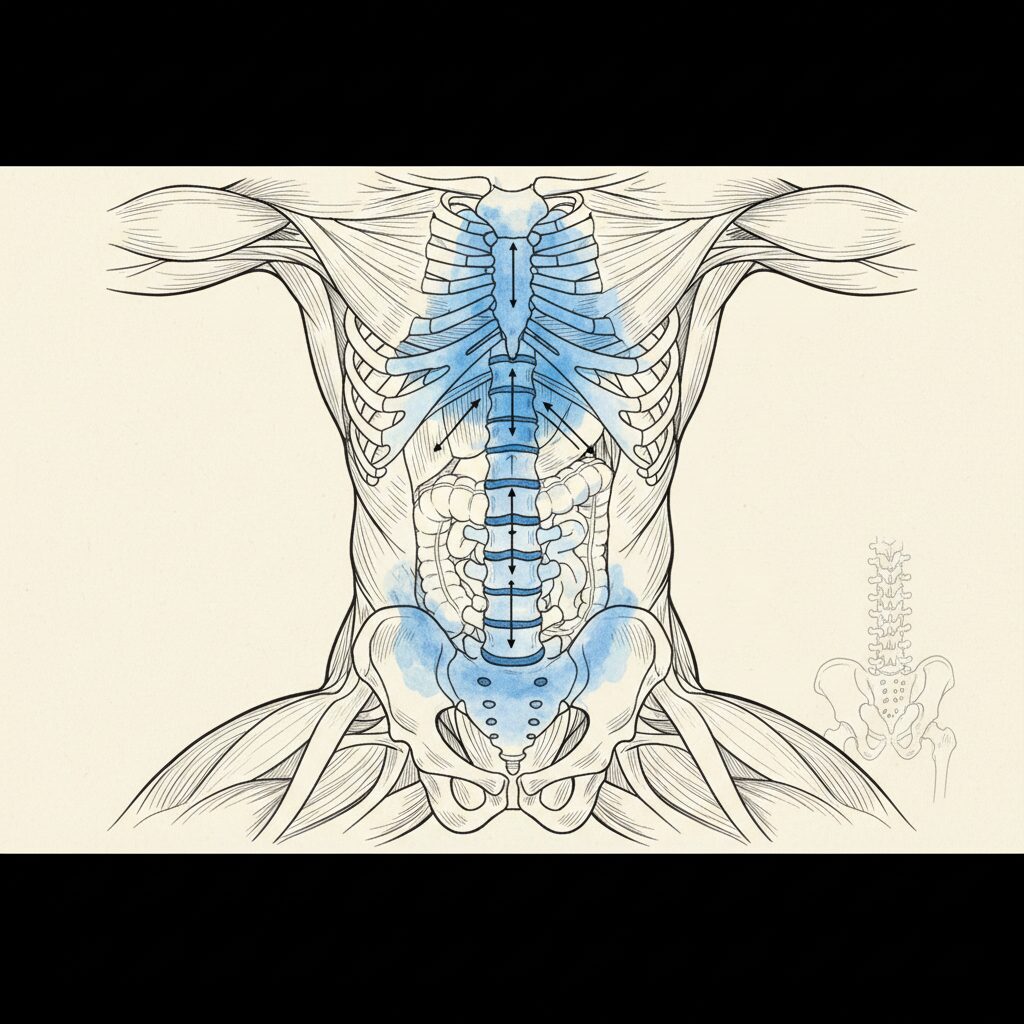
When the diaphragm regains its dome and descends with postural intent, the canister repressurizes. The TrA re-engages. The pelvic floor participates. The spine gains internal support that does not depend on muscular effort. The curve is resisted from the inside, not fought from the outside.
This takes ninety seconds. Not an hour of exercises. Not a yoga class. A reset that restores the primary system so that when you sit back down, the pressure is present underneath the posture.
The goal is not to sit perfectly. The goal is to maintain the pressure system that supports your spine regardless of position. Sitting is not the enemy. A collapsed pressure system is the enemy. And that system can be restored in the time it takes to refill your water glass.
—
Related: Can Scoliosis Exercises Actually Reduce Your Curve? | Why Your Back Pain Comes Back Every Night | Why One Hip Is Higher Than the Other
—
A 90-second Syntropic Core Reset between sitting sessions restores diaphragm dome, re-engages the deep stabilizers, and brings the pressure canister back online. Not by changing your chair. By changing what is happening inside your torso. Learn what that looks like.
Sources
- Kolar, P., et al. (2012). Postural function of the diaphragm in persons with and without chronic low back pain. JOSPT, 42(4), 352-362. PMID: 22236541 [T1]
Seated posture compresses the abdominal cavity and flattens the diaphragm, reducing its postural function and IAP generation. - Claus, A.P., et al. (2009). Is ‘ideal’ sitting posture real? Measurement of spinal curves in four sitting postures. Manual Therapy, 14(4), 404-408. PMID: 18793867 [T1]
No single sitting posture is ideal. The issue is sustained posture of any kind, which suppresses the dynamic pressure cycling the spine needs. - Eriksson Crommert, A., et al. (2011). Activation of transversus abdominis varies with postural demand in standing. Gait & Posture, 33(3), 473-477. PMID: 21269831 [T1]
TrA responds to gravitational demand. Sitting reduces gravitational challenge, reducing TrA activation and therefore reducing pressure generation.
Related research
- Not Everyone Has The Gene. Here’s What’s Actually Generating the Curve.
- The Scoliosis Gene That Proves It’s Not a Spine Problem
- Why 80% of Scoliosis Has No Explanation (Until Now)
- Schroth vs Functional Patterns vs Somatic Exercises: Which Works for Scoliosis?
Comments
4 responses to “Does Sitting Make Your Scoliosis Worse?”
[…] Do I Have to Live With This Pain Forever? | Does Sitting Make Your Scoliosis Worse? | Can Scoliosis Exercises Actually Reduce Your […]
[…] Why One Hip Is Higher Than the Other | Does Sitting Make Your Scoliosis Worse? | Do I Have to Live With This Pain […]
[…] Can Scoliosis Exercises Actually Reduce Your Curve? | Does Sitting Make Your Scoliosis Worse? | Do I Have to Live With This Pain […]
[…] Related: Why Your Back Pain Comes Back Every Night | Can Scoliosis Exercises Actually Reduce Your Curve? | Does Sitting Make Your Scoliosis Worse? […]