You have tried everything.
Physical therapy. Chiropractic. Massage. Yoga. Pilates. Injections. Maybe surgery. You bought the standing desk, the ergonomic chair, the special pillow. You did the stretches your physiotherapist gave you. You did them again when they stopped working. You tried a different physiotherapist. A different approach. A different set of stretches.
And the pain is still there.
You are not weak. You are not lazy. You did not fail. Every treatment you tried was reasonable given what you were told. The problem is not your effort. The problem is what you were told.
What every treatment had in common
Physical therapy targeted your muscles. Chiropractic targeted your joints. Massage targeted your soft tissue. Yoga targeted your flexibility. Surgery targeted your discs, your vertebrae, your nerves.
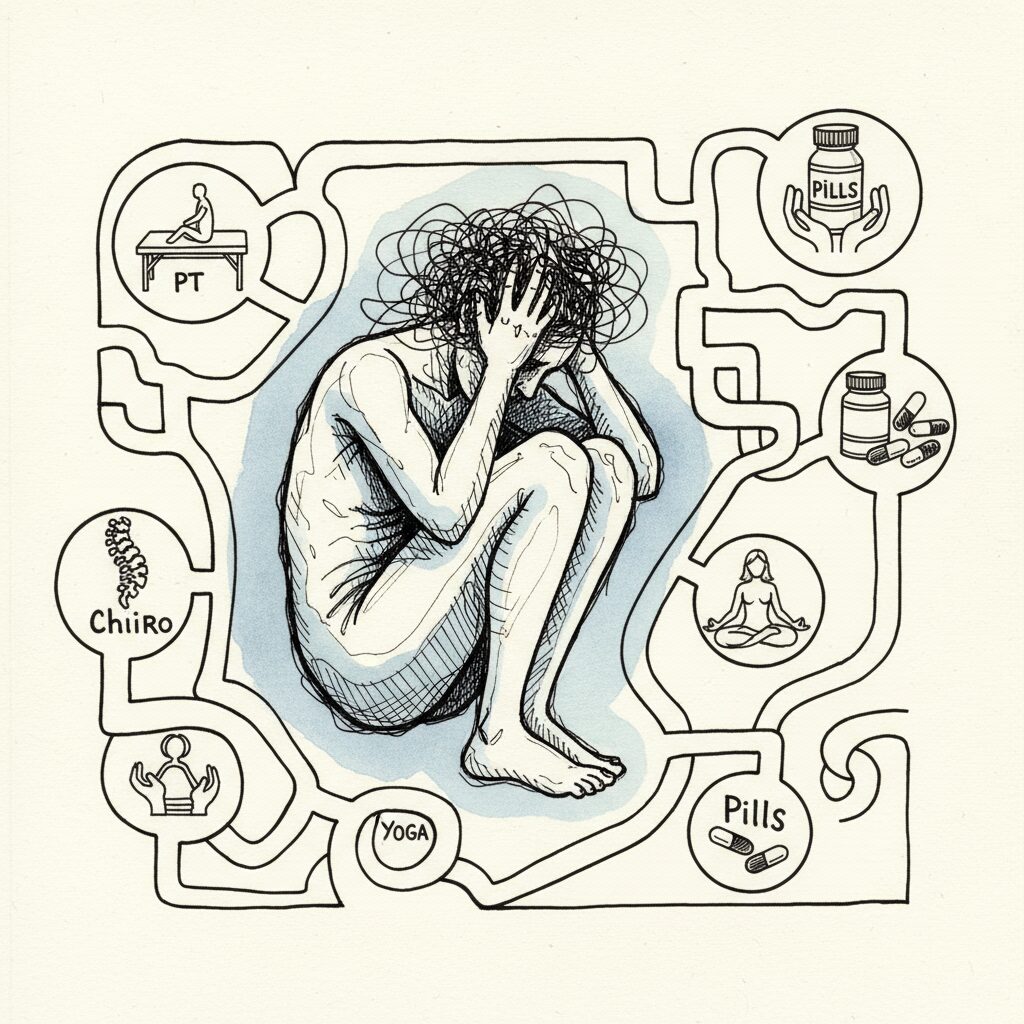
Every treatment targeted your structure.
And every treatment assumed that if the structure was corrected, the pain would resolve. Align the spine. Loosen the muscles. Decompress the nerve. Release the fascia. The logic is clean. The anatomy is sound. And for acute injuries, it works.
But your pain is not acute. Your pain has been here for months, years, maybe decades. And the reason it persists is not that your structure is still broken. It is that your nervous system is still generating the same pattern.
Pain is a prediction
This is the hardest thing to accept. Not because it is complicated. Because it changes everything you were told.
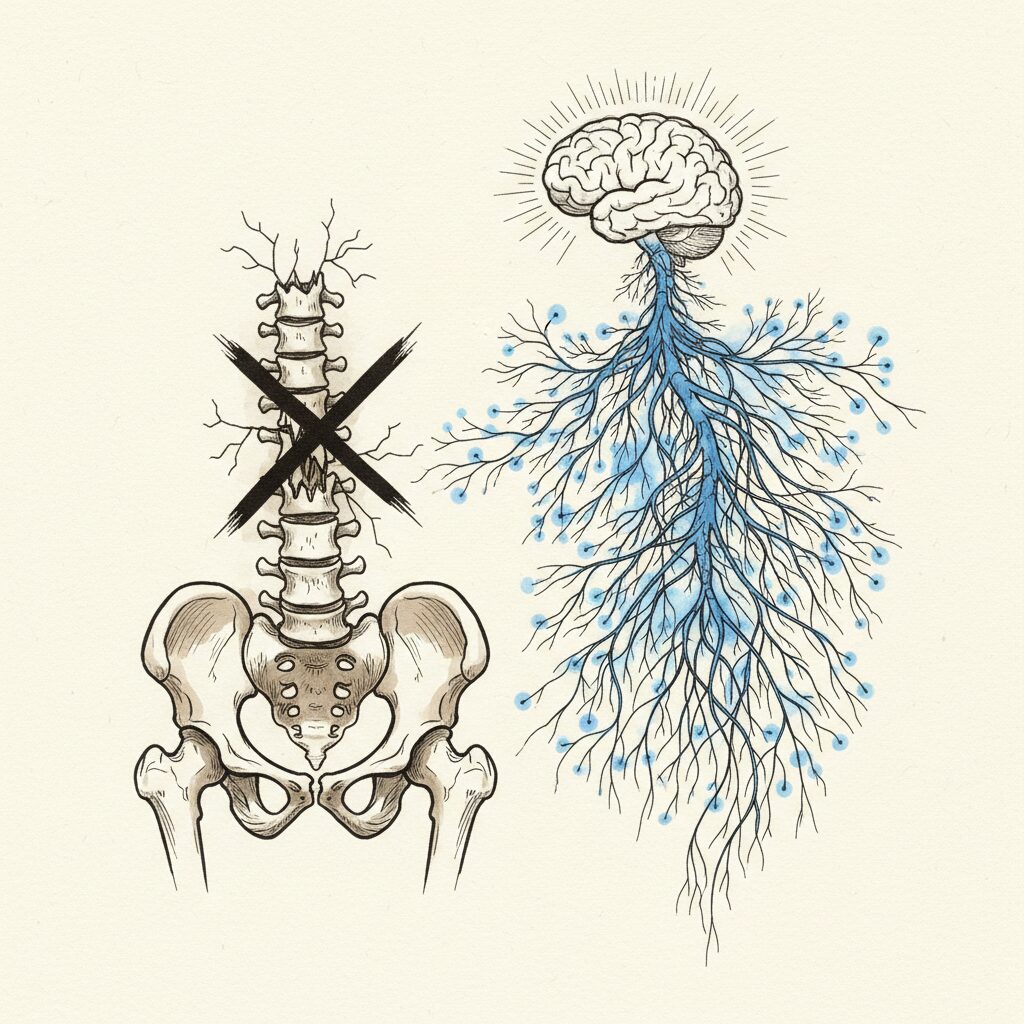
Pain is not a report from damaged tissue. Pain is a prediction your nervous system generates based on the evidence it has received. When the evidence says “this area is under threat,” the nervous system produces pain as a protective output. The pain is real. The tissue damage may or may not be.
Moseley and Flor (2012) demonstrated that chronic pain involves cortical reorganization: the body schema’s representation of the painful area physically changes in the somatosensory cortex. The pain is no longer generated by tissue damage but by a cortical prediction that has become self-sustaining. Moseley and Hodges (2006) showed that motor strategy rigidity persists even after pain resolves, meaning the protective pattern continues generating its output even when the original threat is gone. Vlaeyen and Linton (2000) established that fear-avoidance behavior prevents the prediction error that would resolve the protective pattern: the person avoids the movement that would generate contradictory evidence, so the prediction never updates. The pain persists not because the body is still damaged, but because the nervous system never received the evidence it needed to revise its prediction.
Your nervous system learned to produce this pain pattern. It learned it from real injury, from sustained stress, from years of compensatory movement, from the words your doctors used to describe your body. The learning was legitimate. The pattern was protective.
But the pattern outlasted the threat. And now it runs on its own.
Why the pattern persists
Your nervous system does not update its predictions randomly. It updates them when it receives sensory evidence that contradicts the current prediction. This is called prediction error. It is the only currency the body schema accepts for revision.
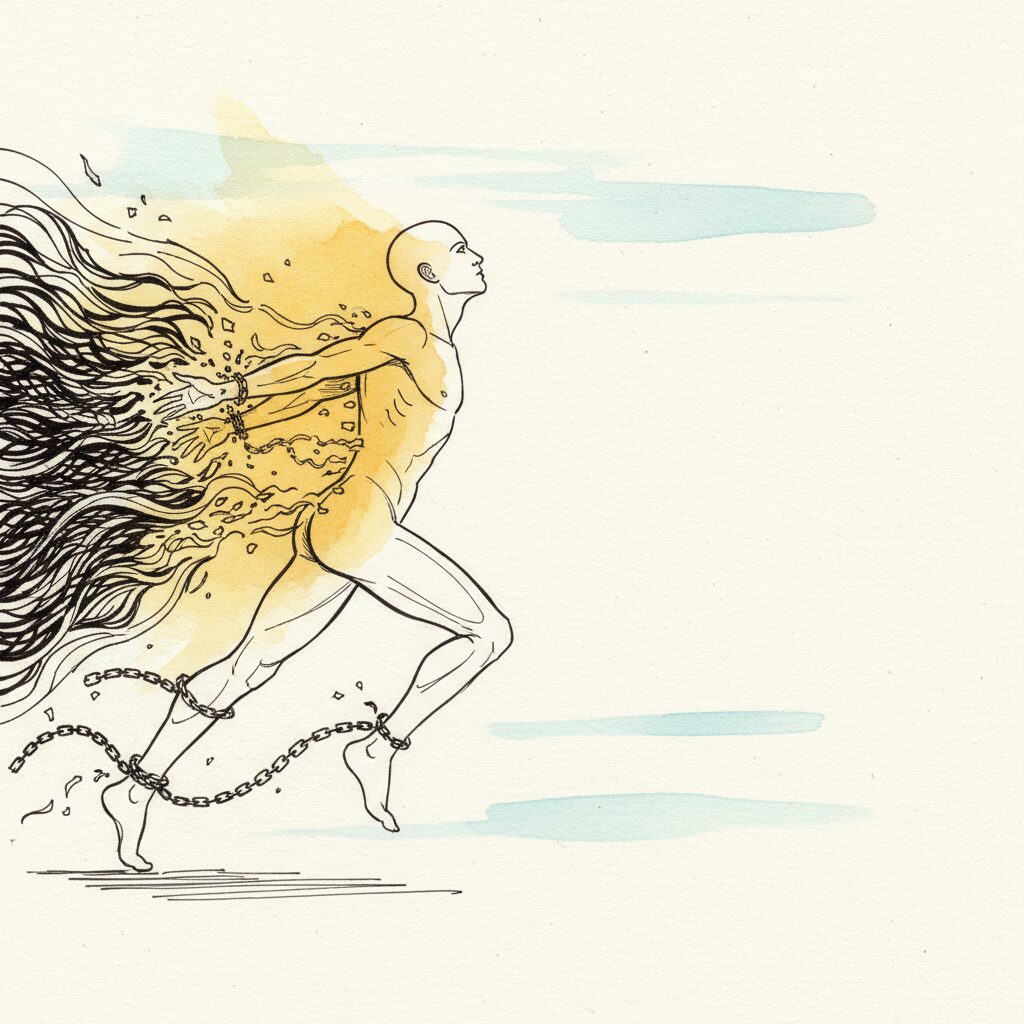
Every treatment you tried either confirmed the prediction or avoided the territory where the prediction lives.
Stretching confirmed it: the muscles resisted because the nervous system told them to resist, and the stretch felt like the body confirming its own limitation. Strengthening confirmed it: the exercises worked the backup system harder without addressing why the primary system went offline. Avoidance confirmed it: every movement you stopped doing was one less opportunity for your nervous system to receive contradictory evidence.
The fear-avoidance cycle is the cruelest part. You avoid the movement because it hurts. But the avoidance is what prevents the update. The prediction never encounters evidence that would change it. The pain stays because the pattern is never challenged.
The body schema can be updated
This is the part that matters. The part that changes things.
The cortical representation of your painful area has changed. Moseley and Flor showed this. The map is different. But maps can be redrawn. Cortical reorganization goes both ways. The same plasticity that created the pain pattern can undo it.
But the update requires something specific. Not effort. Not discipline. Not stretching harder or strengthening more. It requires new sensory evidence that the nervous system did not predict.
The body schema updates through prediction error: the mismatch between expected and actual sensory input. Hodges et al. (2005) demonstrated that intra-abdominal pressure provides hydraulic spinal stabilization independent of muscular effort. When this pressure system is restored in someone whose nervous system has been relying entirely on muscular guarding, the body schema encounters a stabilization input it was not predicting. The stabilization is present, but the muscles did not produce it. This mismatch generates prediction error. Moseley and Hodges (2006) showed that rigid motor strategies prevent normalization, meaning that the system needs a genuinely novel input to break the pattern. Pressure-based stabilization provides that novelty: it is not a correction, not a stretch, not a conscious effort. It is hydraulic support arriving through a channel the pain prediction did not account for.
What “felt in the first session” means
When pressure returns to a system that has been running on muscular tension for years, something happens that you cannot fake. The muscles that have been gripping for months or years encounter a stabilization force underneath them that was not there a moment ago. The nervous system registers this. Not as a stretch. Not as a correction. As evidence.
The evidence says: the spine is supported. The hydraulic system is online. The muscles can stand down.
This is not a cure. It is a crack in the pattern. The first moment when your nervous system encounters its own body differently than it predicted. The first prediction error in what may have been years of confirmation.
That crack is where the update begins.
You do not have to live with this pain forever. Not because your body will be fixed. Because your nervous system can learn a different prediction. It learned the current one. It can learn a new one. But only if it receives evidence it was not expecting.
—
Related: Why Your Back Pain Comes Back Every Night | Can Scoliosis Exercises Actually Reduce Your Curve? | Does Sitting Make Your Scoliosis Worse?
—
The Syntropic Core Reset provides sensory evidence your body schema needs to update. Not correction. Not stretching. Evidence that surprises the system. People feel the shift in the first session. Learn what that looks like.
Sources
- Moseley, G.L., & Hodges, P.W. (2006). Reduced variability of postural strategy prevents normalization of motor changes induced by back pain. Behavioral Neuroscience, 120(2), 474-476. PMID: 16719709 [T1]
Motor strategy rigidity persists after pain resolves. The pain may be gone but the pattern that generates it remains because the system never returned to its primary strategy. - Moseley, G.L., & Flor, H. (2012). Targeting cortical representations in the treatment of chronic pain. Neurorehabilitation and Neural Repair, 26(6), 646-652. PMID: 22331213 [T1]
Chronic pain involves cortical reorganization. The body schema’s representation of the painful area has changed. Treatment must update the representation, not just the tissue. - Hodges, P.W., et al. (2005). Intra-abdominal pressure increases stiffness of the lumbar spine. Journal of Biomechanics, 38(9), 1873-1880. PMID: 16023475 [T1]
IAP provides hydraulic stabilization. When this system is restored, the muscular guarding that generates pain becomes unnecessary. - Vlaeyen, J.W., & Linton, S.J. (2000). Fear-avoidance and its consequences in chronic musculoskeletal pain: a state of the art. Pain, 85(3), 317-332. PMID: 10781906 [T1]
Fear-avoidance prevents the prediction error needed to update the pain pattern. The avoidance behavior protects the prediction that generates the pain.
Related research
- What It Actually Means to Complete the Trauma Cycle
- Your Body Doesn’t Need to Be Fixed. It Needs to Be Heard.
- The Exercise Your Therapist Should Have Given You After EMDR
- Your Body Never Finished Running: Why Trauma Lives in Your Posture
Comments
4 responses to “Do I Have to Live With This Pain Forever?”
[…] Related: Why One Hip Is Higher Than the Other | Does Sitting Make Your Scoliosis Worse? | Do I Have to Live With This Pain Forever? […]
[…] Related: Can Scoliosis Exercises Actually Reduce Your Curve? | Does Sitting Make Your Scoliosis Worse? | Do I Have to Live With This Pain Forever? […]
[…] Do I Have to Live With This Pain Forever? | Does Sitting Make Your Scoliosis Worse? | Can Scoliosis Exercises Actually Reduce Your […]
[…] live with this pain forever […]