You bought the brace. You wore it for two weeks. Maybe three. Your shoulders felt pulled back. Your spine felt straighter. And then you stopped wearing it because it was uncomfortable, or because you forgot, or because the moment you took it off your posture went right back to where it started.
You are not the problem. The brace is the problem. Not because it is poorly designed. Because it is designed around a premise that does not work.
One thing to be clear about. This article is about posture correctors, the straps and shirts sold for slouching. A scoliosis brace prescribed for a growing child is a different tool, with a large trial behind it (Weinstein et al., 2013). If you or your child has one, keep wearing it and keep the check-ups.
The posture corrector is the tension strategy made wearable. And it will fail for the same reason your muscles fail: external support cannot replace internal pressure.
What the brace is actually doing
A posture corrector works by pulling. Elastic straps across the upper back retract the shoulders. A rigid panel along the spine holds it in extension. The device applies external tension to hold the skeleton in a position the body cannot hold on its own.
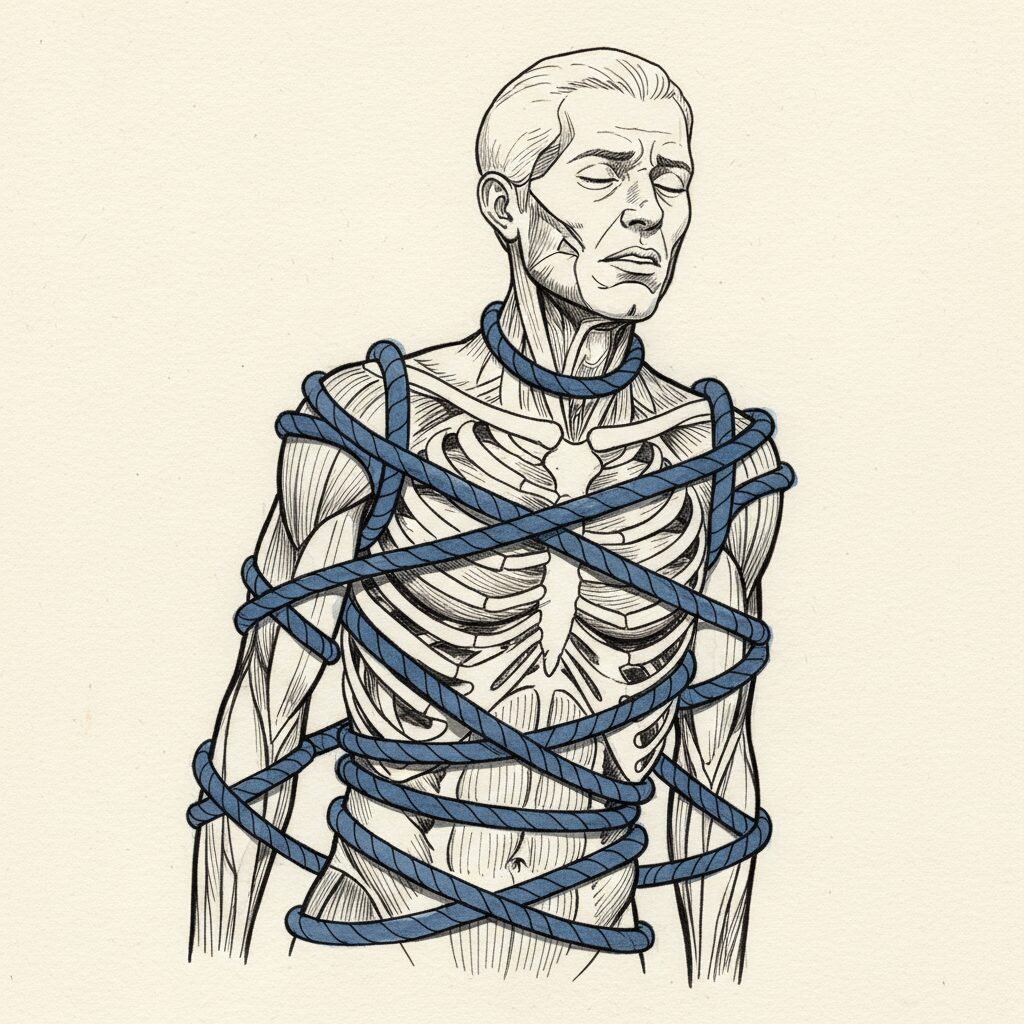
This is the same thing your upper traps, erector spinae, and rhomboids are already doing. Gripping the skeleton into position from the outside. The brace is not correcting your posture. It is doing your compensation for you.
And while it does, the system that actually generates postural support, the deep stabilization system driven by intra-abdominal pressure, falls further offline. In my view, the deep system gets less to do. The diaphragm, the transversus abdominis and the pelvic floor are not needed, not challenged, not practised.
You are not building better posture. You are outsourcing it.
Perceived stability is not stability
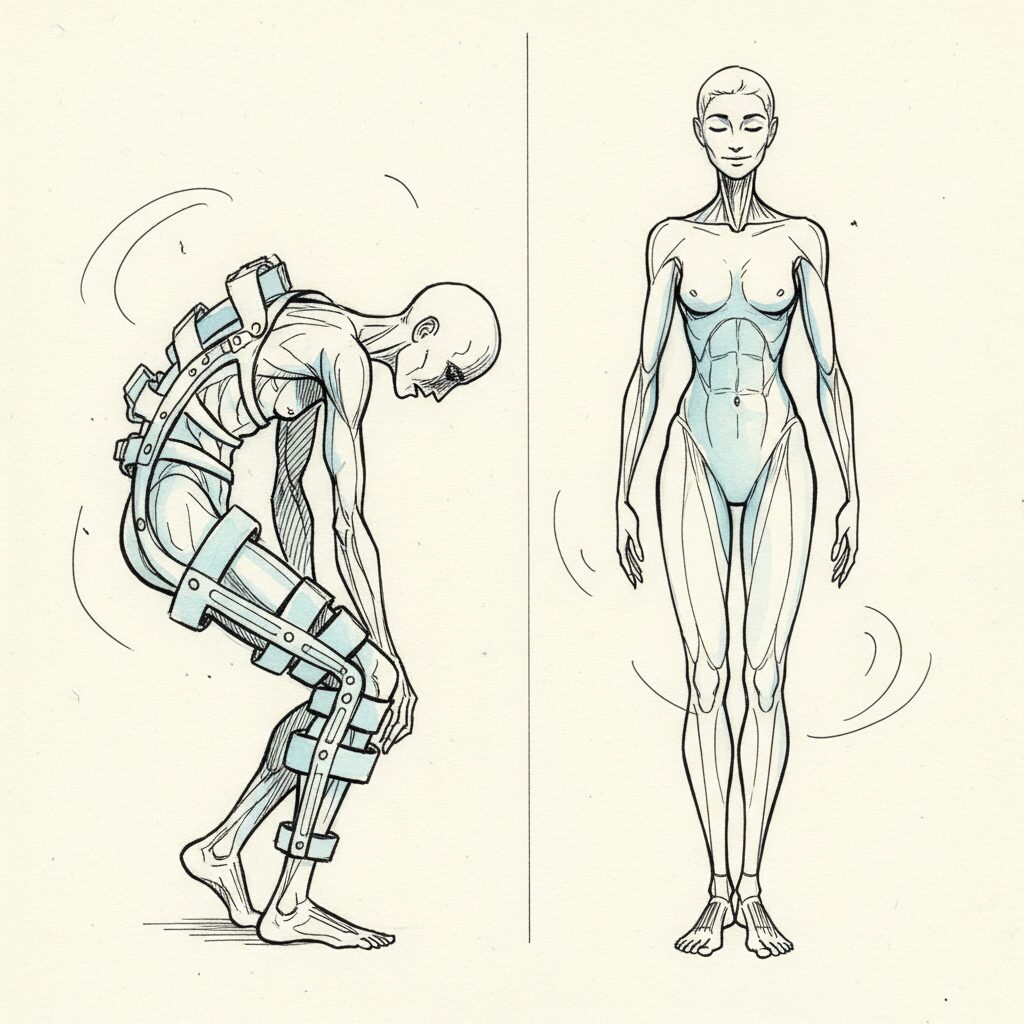
Veltzke et al. (2026) studied weightlifting belts, the closest clinical analog to posture corrector braces, and found a striking dissociation: the belts increased perceived stability without increasing measured stability. Subjects felt more supported. Their measured balance was no steadier. The sensation of support and actual support are different things. A posture corrector produces the feeling of being held upright. It does not produce the biomechanical conditions that generate upright posture. This finding explains why brace users report immediate comfort but no lasting change: the device creates a sensory illusion of stability while the structural deficit continues.
This is the core trap. The brace feels like it is working. You stand straighter. Your shoulders sit further back. The mirror shows improvement. But the feeling is coming from the device, not from you. The moment the device comes off, the feeling leaves with it.
Hodges et al. (2005) showed, in three people, that raising intra-abdominal pressure with no abdominal or back muscle activity made the lower spine 8 to 31 percent stiffer [3]. This is internal support. Hydraulic. Automatic. The brace provides none of it.
The feedback problem nobody talks about
There is something worse than a brace that does not help. A brace that actively blocks the update your body needs.
Kilteni and colleagues (2020) showed that the brain turns down sensation from movements it makes itself, using a copy of its own motor command. A device holding you in place does not do that. What it does is take away the need to find the position yourself. My reading is that this is the real cost: the body schema gets no practice. It is handed a position instead of discovering one.
Your body learns posture through sensation. Through the continuous stream of proprioceptive data flowing from every joint, every muscle spindle, every fascial receptor. This data tells the body schema where you are. The schema generates motor output based on what it receives.
The brace interrupts this loop. It holds you in a position without allowing you to feel your way into it. The nervous system receives a diminished signal. The body schema does not update. And when the brace comes off, the schema generates the same output it was generating before, because it never received the information it needed to change.
Why the brace market keeps growing
The posture corrector market is enormous because the promise is irresistible. Wear this and your posture improves. No effort. No time. No learning curve.
It sells because it matches the model most people carry: posture is a structural problem. The structure is in the wrong position. Force it into the right position and the problem is solved.
This model is wrong. Posture is not a position. It is a prediction. Your nervous system generates your posture based on its model of your body in gravity. Change the model and the posture changes. Change the position without changing the model and nothing changes.
The brace changes the position. It never touches the model.
What actually works
Your posture corrector already exists. It is inside you. It is called the diaphragm.
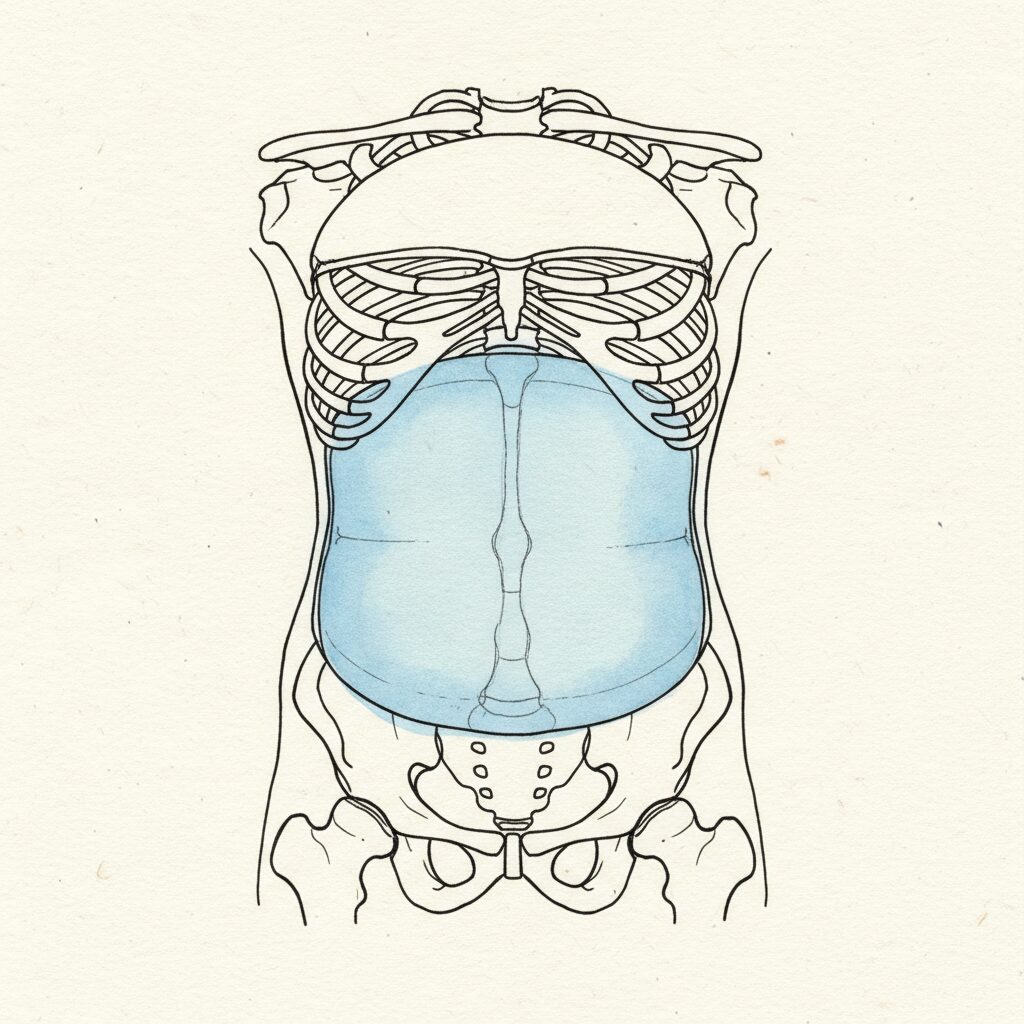
When the diaphragm recovers its dome shape and generates rhythmic intra-abdominal pressure, the spine receives hydraulic support from within. The deep stabilizers fire. The transversus abdominis engages. The pelvic floor contributes its share of the pressure canister.
This is not external tension pulling you into position. This is internal pressure pushing you into alignment. The difference is everything.
External support creates dependency. Internal pressure creates capacity. One requires a device. The other requires a system that is already there, waiting to come back online.
The brace you need is not in a box on Amazon. It is between your ribs and your pelvis. It is just turned off.
—
Related: Why Stretching Doesn’t Fix Posture | The Collapse That Fixes Your Posture | Why Your Body Holds Tension
—
Syntropic Core Resets restore the internal pressure system that makes posture correctors unnecessary. Not by pulling you into position from the outside, but by reactivating the diaphragm and deep stabilizers that generate support from within. See how it works.
Sources
- Kilteni, K., Engeler, P., & Ehrsson, H.H. (2020). Efference copy is necessary for the attenuation of self-generated touch. iScience, 23(2), 100843. PMID: 32058957 [T1]
Sensory attenuation of self-generated touch depends on an efference copy of the motor command. Passive or externally produced touch is not attenuated. - Veltzke, F., Qiu, F., Bey, M.E., & Legerlotz, K. (2026). A weight lifting belt increases squat performance and subjectively perceived but not objectively measured postural stability. Journal of Strength and Conditioning Research, 40(8), 944-952. PMID: 41860443 [T1]
External support devices increase subjective stability without increasing objective stability. The sensation of support is not actual support. - Hodges, P.W., et al. (2005). Intra-abdominal pressure increases stiffness of the lumbar spine. Journal of Biomechanics, 38(9), 1873-1880. PMID: 16023475 [T1]
IAP provides real internal stabilization (8-31% of spinal stiffness). External braces bypass this system entirely and may suppress it further. - Weinstein, S.L., Dolan, L.A., Wright, J.G., & Dobbs, M.B. (2013). Effects of bracing in adolescents with idiopathic scoliosis. New England Journal of Medicine, 369(16), 1512-1521. PMID: 24047455 [T1]
Randomized and preference cohorts. Bracing significantly decreased the progression of high-risk curves to the surgical threshold.
Related Reading
Posture correctors are one piece of a wider pattern. See why nothing you’ve tried has fixed your posture for how this fits alongside stretching, yoga, massage, core exercises, and chiropractic.
Comments
3 responses to “Why Posture Correctors Don’t Work (The Real Reason)”
[…] Why Posture Correctors Don’t Work (The Real Reason) […]
[…] The brace holds your shoulders back while you wear it. The moment it comes off, so does the correction, because a brace is an external scaffold, not an update to the internal one. Your nervous system was never asked to change anything. It just waited. Why Posture Correctors Don’t Work (The Real Reason) […]
[…] Why Posture Correctors Don’t Work (The Real Reason) […]