Your physical therapist told you to strengthen your core. Your trainer gave you planks. Your Pilates instructor added crunches and oblique twists. You did them all, consistently, for weeks or months. And somehow you feel worse.
Not a little worse. The kind of worse that makes you question everything. Because you did what you were told. You put in the work. And the pain increased.
You are not imagining it. And you are not doing something wrong. You are strengthening the wrong layer.
Two systems, one name
When someone says “core,” they mean one thing. But the body has two entirely different stabilization systems, and they operate on different principles.
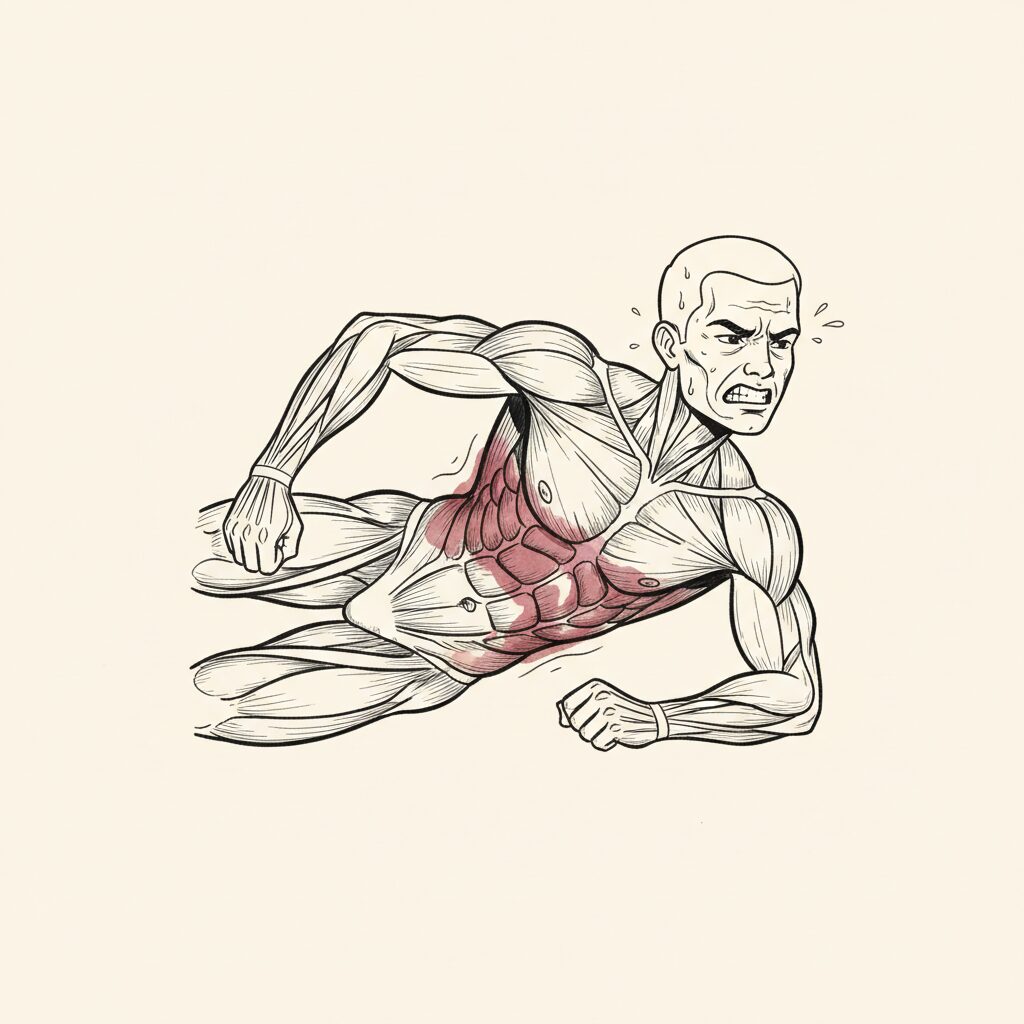
The first is the global muscle system. Rectus abdominis. External obliques. These are the muscles you can see, the muscles that burn during a plank, the muscles that show up in a mirror when body fat drops low enough. They generate force. They create movement. They brace the trunk by gripping it from the outside.
The second is the deep stabilization system. Transversus abdominis. Diaphragm. Multifidus. Pelvic floor. These muscles do not generate movement. They generate pressure. They create a hydraulic cylinder inside the trunk that supports the spine from within. You cannot see them. You cannot feel them burn. And critically, you cannot activate them by trying.
When your therapist said “strengthen your core,” they meant the first system. Planks, crunches, dead bugs, bird dogs. All of these load the global muscles. All of them bypass the deep system.
For someone with scoliosis whose deep system is already offline, this is not neutral. It is counterproductive.
Hodges and Richardson (1999) demonstrated that individuals with low back pain show delayed or absent activation of the transversus abdominis and multifidus during limb movements, with compensatory overactivation of superficial global muscles. Eriksson Crommert et al. (2011) showed that the transversus abdominis is the only trunk muscle whose activation co-varies with vertical center-of-mass position regardless of load direction: it responds to gravitational demand, not voluntary instruction. These findings explain why conventional core exercises fail to restore deep stabilization. Planks and crunches load the rectus and obliques through voluntary contraction. The deep system does not respond to voluntary contraction. It responds to conditions: postural demand, gravitational orientation, pressure requirements. Strengthening the global system without restoring the deep system increases the dominance of the backup over the primary.
What happens when you strengthen the backup
In a scoliotic spine, the global muscles are already working overtime. They are compensating for a deep stabilization system that is not generating adequate pressure. The rectus abdominis is bracing the front. The obliques are bracing the sides. The erector spinae are bracing the back. All of this tension is holding the spine in position because the hydraulic system that would do it from within has gone quiet.
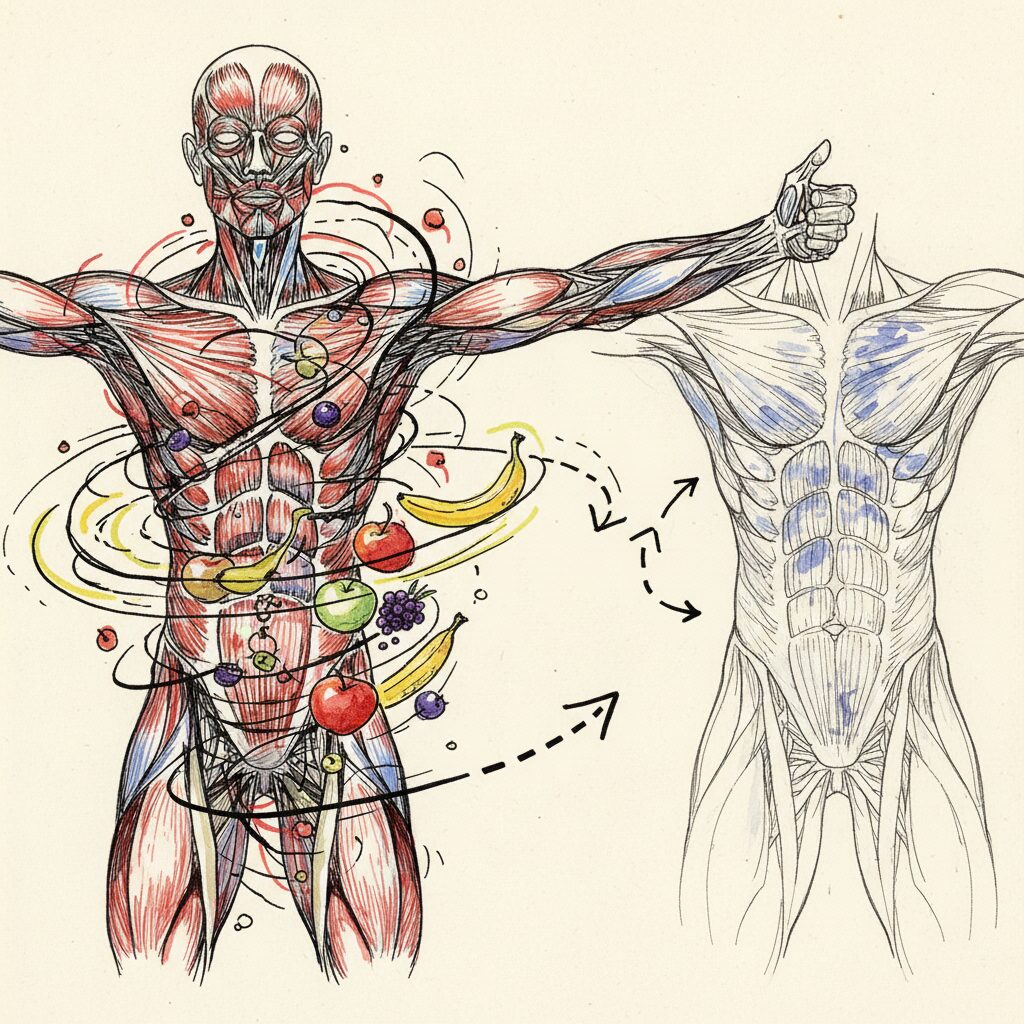
Now add planks. Add crunches. Add weighted rotational exercises. You are making these compensating muscles stronger. You are making the backup louder. You are increasing the grip on a spine that is already over-gripped.
For someone with scoliosis, this means more compression through the concavity of the curve. More rigidity through the compensatory pattern. More tension where the system is already tense. The curve does not improve. The pain increases. Because you have reinforced the very strategy that is maintaining the problem.
The feedback problem
There is a second mechanism that makes conventional core work harmful for scoliosis, and it is more insidious than the first.
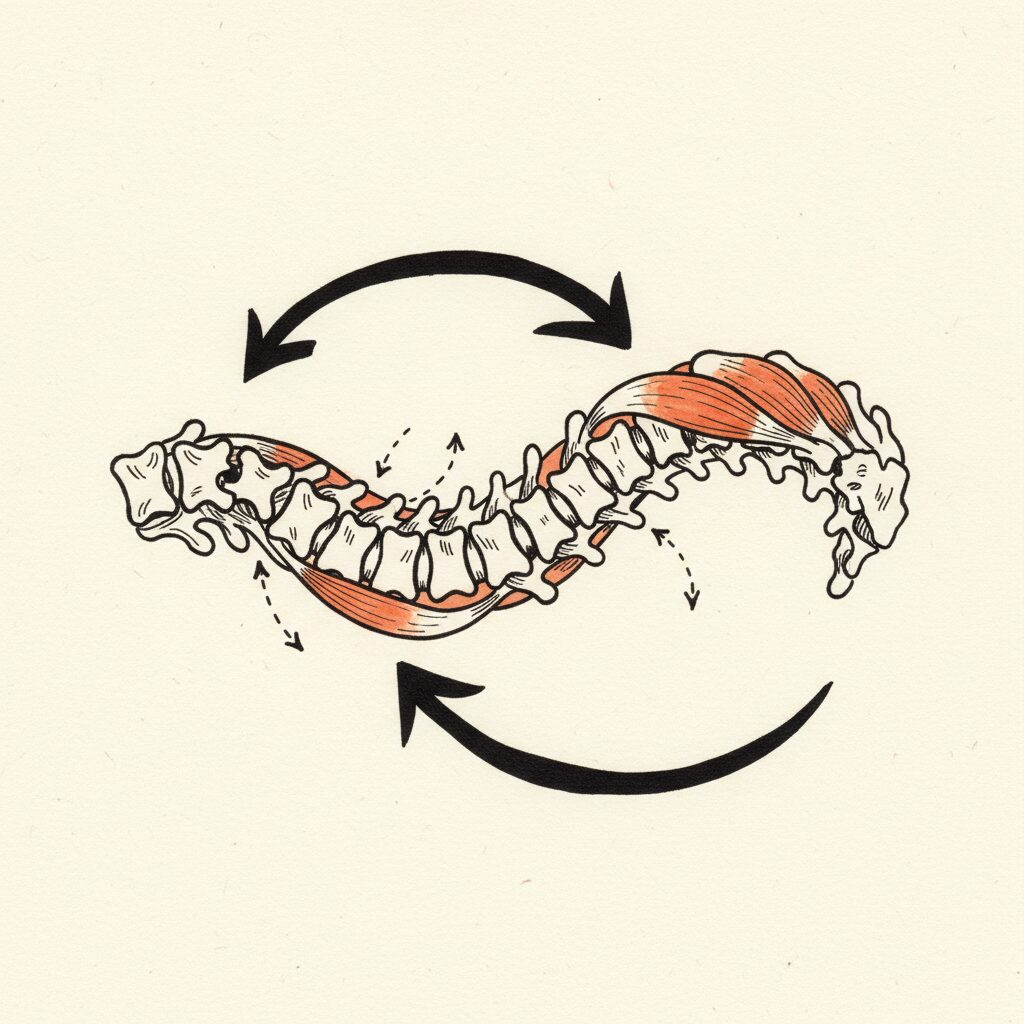
Kilteni and Ehrsson (2020) demonstrated that self-generated movements produce efference copies that suppress incoming proprioceptive feedback. When you voluntarily brace your core, the brain predicts the sensory consequences of that bracing and attenuates the proprioceptive signals arriving from the trunk. The result is a reduction in the sensory data the body schema needs to update its model of spinal position. For someone with scoliosis, whose body schema already carries a distorted map of the spine, voluntary bracing further reduces the information available for reorganization. The harder you brace, the less your nervous system receives the feedback it needs to change. Core strengthening does not just fail to fix the pattern. It actively suppresses the sensory channel that would allow the pattern to update.
Every time you hold a plank, you are generating efference copies. Your brain predicts what the position should feel like. It dampens the incoming proprioceptive signal. You feel the burn. You feel the effort. But the subtle information your nervous system needs to detect where the spine actually is, how the curve is loading, what the pressure canister is doing, all of that gets turned down.
You cannot reorganize what you cannot feel. And bracing makes you feel less.
Not anti-exercise. Anti-wrong-layer.
This is not an argument against movement. It is not an argument against strength. It is an argument against sequence.
Core exercises become useful when they are layered on top of a functional pressure system. When the deep stabilizers are online. When the diaphragm is generating pressure. When the transversus abdominis is firing anticipatorily. When the hydraulic system is doing its job.
Then the global muscles have something to build on. The rectus has a pressurized canister behind it. The obliques have a stable base to work from. The erectors have hydraulic support to complement, not replace.
But if you add global strength before the deep system is restored, you are building a house on a foundation that is not there. More floors. Same crack. The building does not get more stable. It gets more loaded on the same failure point.
What the deep system responds to
You cannot plank your way into deep stabilization. You cannot crunch your way into diaphragm function. The deep system does not respond to instructions. It responds to conditions.
Ground contact. Reduced gravitational demand. Exhale emphasis. Absence of voluntary effort. Safety state.
These are not exercises. They are environments. When the nervous system detects these conditions, the deep stabilizers come online. The diaphragm recovers its dome. The transversus abdominis begins firing in response to gravity. The pelvic floor engages. Pressure returns.
Not because you told the muscles to fire. Because you created the conditions where they fire on their own.
Then, and only then, does core strengthening serve the spine instead of compressing it.
—
Related: Why Stretching Never Fixes Chronic Tightness | Scoliosis Pain: The Curve Is Not the Cause | The Collapse That Fixes Your Posture
—
Syntropic Core Resets activate the deep stabilization system through conditions, not instructions. By restoring the diaphragm, transversus abdominis, and pelvic floor first, the pressure system comes online and conventional core exercises become safe and effective instead of counterproductive. See how it works.
Sources
- Hodges, P.W., & Richardson, C.A. (1999). Altered trunk muscle recruitment in people with low back pain with upper limb movement at different speeds. Archives of Physical Medicine and Rehabilitation, 80(9), 1005-1012. PMID: 10489000 [T1]
Core exercises typically activate global muscles (rectus, obliques) while the deep stabilizers (TrA, multifidus) remain delayed or absent. - Kolar, P., et al. (2012). Postural function of the diaphragm in persons with and without chronic low back pain. JOSPT, 42(4), 352-362. PMID: 22236541 [T1]
Planks and crunches increase intra-abdominal pressure acutely but through bracing, not through diaphragmatic postural function. This flattens the diaphragm further. - Eriksson Crommert, A., Ekblom, M.M., & Thorstensson, A. (2011). Activation of transversus abdominis varies with postural demand in standing. Gait & Posture, 33(3), 473-477. PMID: 21269831 [T1]
TrA responds to gravity, not to instructions. You cannot voluntarily activate the deep stabilization system through conventional core exercises. - Kilteni, K., & Ehrsson, H.H. (2020). Efference copy is necessary for the attenuation of self-generated touch. iScience, 23(2), 100843. PMID: 32058957 [T1]
Voluntary core bracing generates efference copies that suppress proprioceptive feedback, further disconnecting the body schema from accurate sensory input.
Related research
- Not Everyone Has The Gene. Here’s What’s Actually Generating the Curve.
- The Scoliosis Gene That Proves It’s Not a Spine Problem
- Why 80% of Scoliosis Has No Explanation (Until Now)
- Schroth vs Functional Patterns vs Somatic Exercises: Which Works for Scoliosis?
Comments
One response to “Why Core Strengthening Can Make Scoliosis Pain Worse”
[…] Why Core Strengthening Can Make Scoliosis Pain Worse […]