You did the exercises. You felt taller walking out. Your shoulders were back. Your spine felt longer. Something shifted.
Next morning, the curve is back.
This is not a compliance problem. You did the work. The work produced a temporary result. The result did not persist. The question is why.
Override is not update
The exercise changed the output. It placed your body in a new position through conscious effort. Your muscles held the correction while your attention held the instruction.
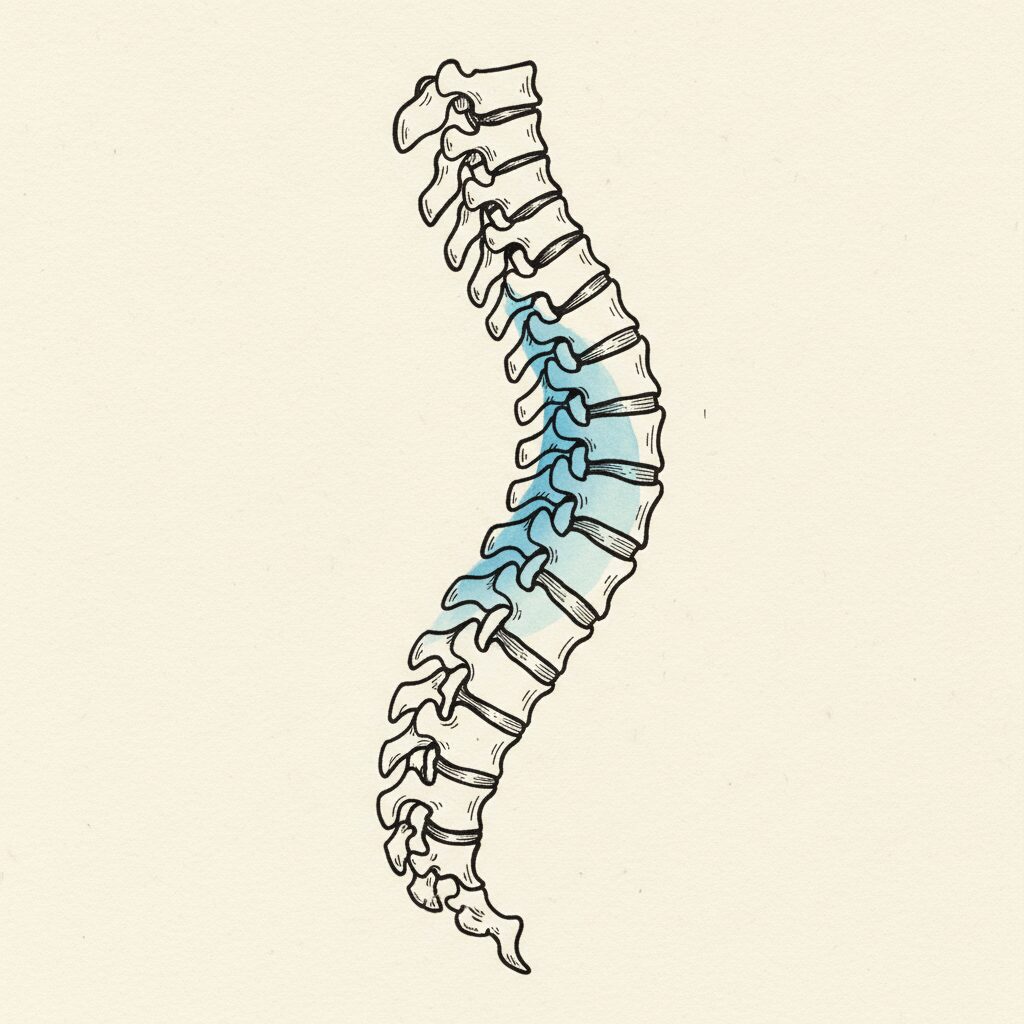
But the body schema, the brain’s predictive model of your body in space, was never updated. The model still predicts the old curve. It still selects motor strategies consistent with that prediction. Your conscious effort overrode the model temporarily. The moment that effort lapsed, the model reasserted itself.
Sleep did not undo your progress. Distraction did not undo your progress. The prediction that was never revised simply resumed generating its output.
The persistence question
Two people do the same PT exercises. Same clinic. Same therapist. Same protocol. One person’s posture changes and stays changed. The other’s reverts overnight.
The variable is not the exercise. It is whether the nervous system encountered genuinely novel information during the exercise.
Tsao and Hodges (2008) demonstrated that motor control training can produce persistent improvements in postural strategies, but only when the training updates the underlying motor strategy itself, not merely the muscular output. When the motor strategy updates, the change persists beyond the training session. When only the output changes, it reverts. Latash (2012) reframed motor redundancy as motor abundance: the nervous system has many possible solutions for any given posture and selects among them based on its current prediction. Strengthening one solution does not change the selection criteria. Clark (2015) described this through predictive processing: the brain continuously generates predictions about body state and selects actions consistent with those predictions. A temporary override through conscious effort does not revise the prediction. The prediction reasserts itself the moment conscious control lapses, during sleep, distraction, or fatigue.
What your nervous system needed and did not get
The body schema updates from one thing. Prediction error. The mismatch between what the brain expected to feel and what it actually felt.

Most PT exercises produce sensory feedback the model already predicts. You stretch what the model expects to be tight. You strengthen what the model expects to be weak. The model receives confirmation. No mismatch. No error signal. No revision.
The exercise can be perfect. The form can be flawless. If the sensory feedback matches what the model already predicted, the model holds. You did the work. The model did not receive new information.
The conditions for lasting change
The nervous system does not update under demand. It updates under specific conditions.
First, autonomic safety. A nervous system in sympathetic activation narrows its sensory channels. It prioritizes threat detection over proprioceptive detail. The information that would generate prediction error cannot arrive through a narrowed channel.
Second, genuinely novel sensory input. Not harder input. Not more input. Input the model did not predict. Information that cannot be assimilated into the current schema without revising the schema.
Clark (2015) described the brain as a prediction machine that updates its models only when prediction error, the mismatch between expected and actual sensory input, exceeds the model’s capacity to explain it away. Latash (2012) showed that the nervous system selects motor strategies from an abundant set based on current predictions, not based on which muscles are strongest. Changing the selection requires changing the prediction, not the strength. Tsao and Hodges (2008) found that motor control training produced lasting changes only when it altered the motor strategy itself, suggesting that the training generated sufficient prediction error to revise the underlying model. Together, these findings indicate that lasting postural change requires conditions that deliver information the body schema cannot assimilate into its current prediction: autonomic safety to keep sensory channels open, and organized sensory input that generates genuine mismatch.
Your PT session was not wrong. It was incomplete.
The exercises were not the problem. The sequence was. Strengthening and stretching address the output layer. They assume the model is correct and the muscles are not cooperating. But the muscles are cooperating. They are executing exactly what the model predicts.
The model needs to be updated before the exercises can produce a different result. That update requires a different kind of input, delivered under different conditions, in a specific order.
—
Related: Why Posture Corrections Don’t Last | Why Awareness Changes Posture and Effort Doesn’t | The Kyphosis Bracing Pattern
—
Syntropic Core Reset creates the conditions for genuine prediction error. Autonomic safety opens sensory channels. Organized internal pressure delivers information the schema cannot assimilate into its current prediction. That mismatch drives lasting update. The exercise that follows operates on a different system. Learn what that looks like.
Sources
- Latash, M.L. (2012). The bliss (not the problem) of motor abundance (not redundancy). Experimental Brain Research, 217(1), 1-5. PMID: 22246105 [T1]
Motor abundance: the nervous system has many possible solutions for any posture. It selects the one consistent with its current prediction, not the one with the most strength. - Tsao, H., & Hodges, P.W. (2008). Persistence of improvements in postural strategies following motor control training in people with recurrent low back pain. Journal of Electromyography and Kinesiology, 18(4), 559-567. PMID: 17336546 [T1]
Motor control training can produce lasting changes when it updates the motor strategy, not just the output. Key evidence that the variable is schema update, not muscular change. - Clark, A. (2015). Surfing Uncertainty: Prediction, Action, and the Embodied Mind. Oxford University Press. [T1]
Predictions regenerate outputs continuously. A temporary override through conscious effort does not change the prediction. The model reasserts itself the moment conscious control lapses.
Related research
- Best Exercises for Kyphosis: What Actually Changes the Curve
- Cervical Kyphosis, Military Neck, and the Flat Neck Epidemic
- Your Kyphosis Is Not a Mistake Your Body Made
- Kyphosis and Ankylosing Spondylitis: What Surgery Can and Can’t Change
Comments
2 responses to “Why Your Kyphosis Comes Back After Every PT Session”
[…] Why Your Kyphosis Comes Back After Every PT Session […]
[…] comes back after PT […]