You are more water than structure
You already know you are mostly water. Here is the part the anatomy books got wrong for a hundred years. A large share of that water does not live inside your cells. It lives in the spaces between them, in a connected fluid network that runs through every tissue in your body.
For a century the textbooks drew those spaces as dense, solid connective tissue. They were wrong, and the correction changes how you should think about movement, breathing, and why a stiff body loosens when you finally move it.
This article explains what the interstitium is, why recent research calls it a possible third circulatory system, how your heartbeat and breath pump it, and what that means for anyone whose body feels stuck, dry, or stiff.
The 150-word answer
The interstitium is the continuous, fluid-filled space that sits between your cells and wraps every nerve and blood vessel. In 2018 a team led by pathologist Neil Theise imaged living tissue and found that layers long classified as dense connective tissue are actually open spaces flooded with fluid, held apart by a collagen lattice [1]. Standard microscope slides had hidden this because slide preparation drains the fluid and collapses the space flat. The interstitium holds roughly a fifth of the water in your body. In 2021 the same group showed these spaces are continuous across organ boundaries, one body-wide network [2]. In 2024, a study found interstitial fluid flow rises and falls with heartbeat and breathing, becoming pulsatile during heavy breathing [3]. The practical meaning is direct. You are a hydraulic system. Your pulse and your breath are the pump, and movement is what keeps the fluid moving.
What the interstitium actually is
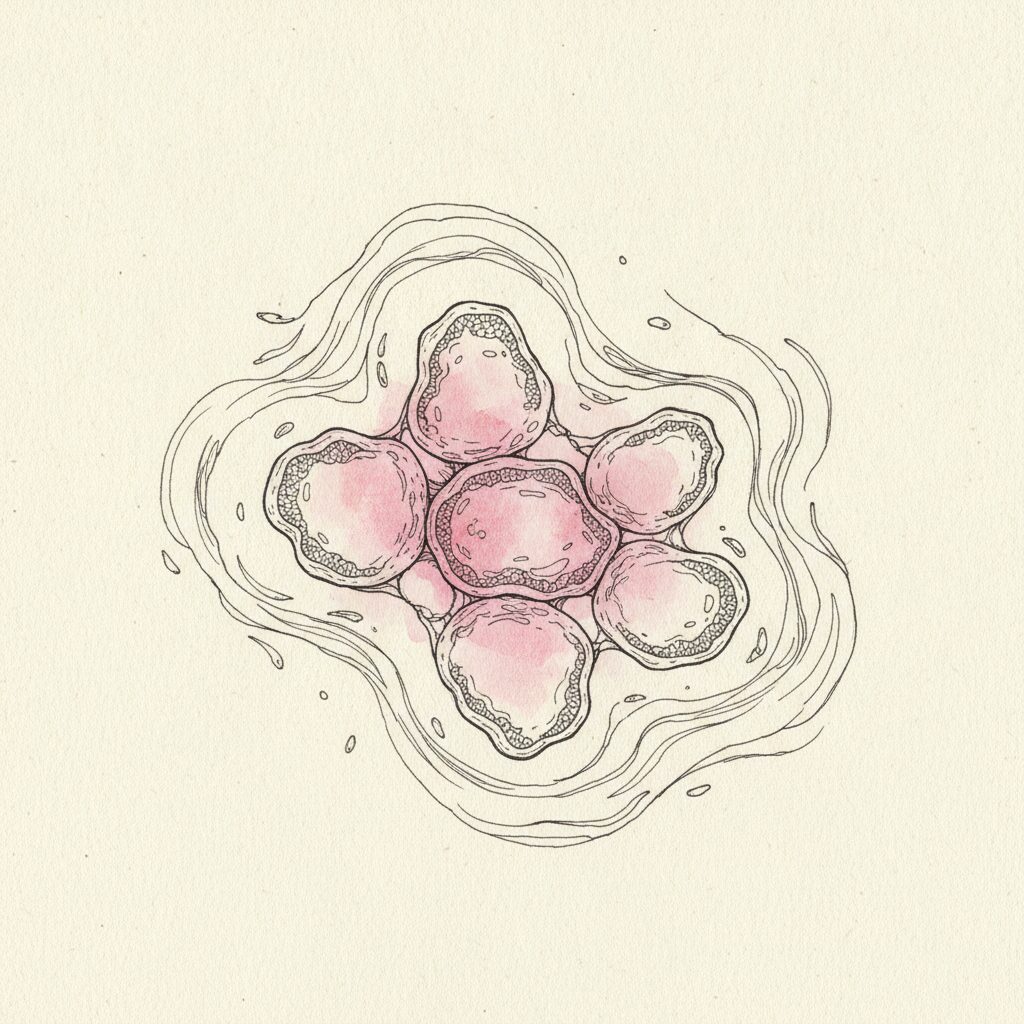
The interstitium is not an organ you were taught to name. It is the fluid space between everything else. Between muscle fibers, around organs, along the sheaths of your nerves and the outer walls of your blood vessels, there is an open lattice of collagen and elastin, and that lattice is flooded with interstitial fluid.
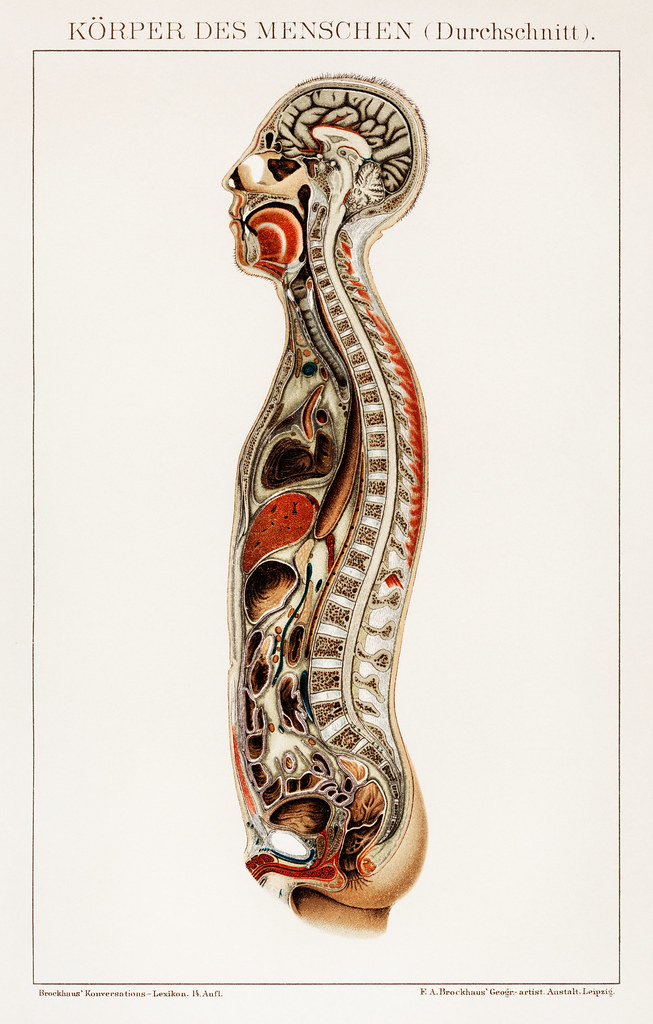
“Korpers Des Menschen (1898), an antique lithograph of an anatomy chart of a human body showcasing its internal system. Digitally enhanced from our own original plate.” by Free Public Domain Illustrations by rawpixel is licensed under CC BY 2.0.
In 2018, Benias, Wells, Theise and colleagues used a new imaging method on living tissue and showed that structures long classified as dense connective tissue are in fact open, fluid-filled spaces supported by thick collagen bundles [1]. The reason it was missed for over a century is almost funny. To make a microscope slide, you fix and dehydrate the tissue. That process drains the water and collapses the open space flat, so a wet, living, open network looks like solid packing under the lens. Image it alive, and the fluid space appears.
By their estimate, this space contributes to roughly twenty percent of the total water volume in the body. That makes it one of the largest fluid compartments you have.
Why researchers call it a third circulatory system
The 2018 paper left one big question open. Are these fluid spaces sealed inside each organ, or are they connected into a single system?
In 2021, Cenaj, Wells, Theise and colleagues answered it [2]. They tracked non-biological particles, including tattoo pigment and colloidal silver, and mapped the fluid pathways. The interstitial spaces turned out to be continuous within and between organs, connected through the fibrous sheaths of nerves and the outer coats of blood vessels that pass through organs and the spaces between them. Their conclusion was that there is a body-wide network of fluid-filled interstitial spaces, with significant implications for signaling, cell movement, and the spread of disease.
This is why the interstitium is now sometimes described as a third circulatory system, alongside your blood and your lymph. It is not a metaphor. It is a connected fluid compartment that reaches everywhere.
Your heartbeat and breath are the pump
If you carry a body-wide fluid network, something has to move the fluid. That is the question a 2024 study set out to answer [3].
The researchers watched interstitial fluid flowing in the outer layer of blood vessels, into the heart and lungs. This was not blood, and it was not lymph. It was interstitial flow. And they found the flow rate rose and fell with two things: the heart rate and the breath. When breathing got heavier, the flow became pulsatile, moving in waves. Each expansion and contraction of the heart or the lungs pushed the fluid forward and back.
One honest caveat. This 2024 study was done in an animal model, not in people, and the full human map is still being drawn. But the anatomy is shared and the direction is clear. The fluid between your cells is not still, and what moves it is you. Your pulse is a stroke of the pump. Your breath is a stroke of the pump. You have been running this system your entire life without knowing it.
This is what it means to say the body is hydraulic. Not as a figure of speech. The fluid is real, the connected space is real, and the pump is your own heartbeat and your own breath.
Why stillness stiffens you and movement loosens you
Now hold two facts together, because this is the part that matters for your body.
First, interstitial flow is driven by movement, pulse, and breath [3]. Second, the fluid itself is not plain water. It is thick with hyaluronan, a large molecule that sets the fluid’s viscosity and its capacity to hold water [5]. When tissue stops sliding and moving, hyaluronan thickens, flow drops, and the tissue starts to densify and stick.
Put those together and stillness is not neutral. When you sit braced and shallow for hours, you are under-circulating your largest fluid compartment. The pump is idling. The fluid is thickening. The tissue is congealing. This is a large part of why a sedentary body feels dry and stiff, and why the first few minutes of movement feel restricted before things loosen. You are literally getting the fluid moving again.
And interstitial flow is not only transport. It is a signal. Fibroblasts and other cells feel the flow as a mechanical force and remodel the tissue in response to it [4]. Fluid moving through the lattice tells the cells how to build the lattice. Move well, and you are not just hydrating the tissue. You are instructing it.
What this means for your body
This reframes why movement matters, and it is not the reason most people were given.
Movement is not only about muscles getting stronger or joints staying mobile. It is about keeping your largest fluid system in motion. Full breathing, where the belly, the back, and the ribs all move, is a direct lever on the pump the 2024 research describes. This is why a single organized breath can change how your whole body feels in about ten seconds. You are not stretching a muscle. You are moving fluid through a connected system that reaches everywhere.
If your body feels chronically stiff, dry, or stuck, the missing input is often not more stretching or more strength. It is circulation of the fluid you already carry, driven by breath and by varied, unhurried movement. Breathing is the one part of this system you can consciously reach, which is why it is the fastest way in.
Where posture fits
The fluid system does not float free of your structure. It lives inside your fascia and your frame, and it is shaped by how you hold and move them. Fascia is the tissue that holds the fluid space open, and a braced, guarded body compresses and dries it. This is one of the reasons chronic tension is self-reinforcing. Guarding reduces movement, reduced movement slows the fluid, slowed fluid stiffens the tissue, and stiff tissue invites more guarding.
The way out is not force. It is restoring easy, full breathing and unhurried movement so the pump comes back online. Release comes from moving fluid, not from fighting the tissue. If your posture keeps snapping back no matter how hard you work at it, the fluid layer is one of the inputs that most programs never address.
Start with the breath
The simplest entry to this whole system is the breath, because it is the one pump stroke you can run on purpose.
The Syntropic Core Reset teaches breathing and movement that put this hydraulic system to work, restoring fluid movement through the body rather than forcing the structure into shape. Start with the free Syntropic Core Reset to feel what an organized breath does to a stiff body. If you are working through scoliosis, kyphosis, or chronic pain and want a practitioner who understands the nervous system and the fluid body rather than only the bones, browse the practitioner directory to find one near you.
You are a hydraulic being. Your pulse and your breath are the pump. Movement is what keeps the water moving.
FAQ
What is the interstitium in simple terms?
The interstitium is the fluid-filled space between your cells, wrapping every nerve and blood vessel. Research in 2018 showed it is an open, water-filled network held apart by collagen, not the solid tissue it was long thought to be. It holds roughly a fifth of your body water [1].
Is the interstitium really a new organ?
The 2018 researchers proposed it could be considered an organ because of its size and its role as a continuous fluid compartment [1]. That label is a framing rather than a settled classification, but the underlying finding, a large body-wide fluid space, is well supported.
How does breathing affect interstitial fluid?
A 2024 study found interstitial fluid flow rises and falls with heartbeat and breathing, becoming pulsatile during heavier breathing [3]. In effect, your breath and pulse pump the fluid. The study was done in an animal model, so the human picture is still being confirmed, but the mechanism is clear.
Why does my body feel stiff when I sit still for a long time?
When you stop moving, interstitial flow slows and the hyaluronan in the fluid thickens, so the tissue densifies and feels stiff [5]. Movement and breathing restart the flow, which is why the first few minutes of moving feel restricted and then loosen.
Is this the same as fascia?
They are closely related. Fascia is the connective-tissue architecture, and the interstitium is the fluid-filled space within and around it. The collagen lattice of the fascia holds the fluid space open, and the fluid keeps the fascia supple.
Sources
- Benias PC, Wells RG, Sackey-Aboagye B, et al. Structure and Distribution of an Unrecognized Interstitium in Human Tissues. Sci Rep. 2018;8:4947. PMID 29588511.
- Cenaj O, Allison DHR, Imam R, Wells RG, Theise ND, et al. Evidence for continuity of interstitial spaces across tissue and organ boundaries in humans. Commun Biol. 2021;4:436. PMID 33790388.
- Li H, Li B, Luo W, et al. Regulation of interstitial fluid flow in adventitia along vasculature by heartbeat and respiration. iScience. 2024;27(4):109407. PMID 38532885.
- Swartz MA, Fleury ME. Interstitial flow and its effects in soft tissues. Annu Rev Biomed Eng. 2007;9:229-256.
- Cowman MK, Schmidt TA, Raghavan P, et al. Viscoelastic properties of hyaluronan in physiological conditions. F1000Res. 2015;4:622. PMID 26594344.
Comments
One response to “The Interstitium: Why Your Body Is Hydraulic and Movement Is the Pump”
[…] The Interstitium: Why Your Body Is Hydraulic and Movement Is the Pump […]