Every word you have heard about your posture is still inside you. Not as a memory. As an instruction.
For the mechanism and research behind this idea, see Your Words Are Programming Your Posture (The Science).
The doctor said “progressive.” Your nervous system heard “defend.” The physical therapist said “strengthen your core.” Your nervous system heard “you are weak.” The internet said “irreversible.” Your nervous system heard “stop trying.”
You think these words described your body. They did not. They entered it. They became inputs to the system that generates your posture. And that system is still running them right now.
This is not about positive thinking. This is not about affirmations or reframing your mindset. This is about a mechanism, one that shows up in how you feel and how you move. Language can become tension, guarding, and the way you carry yourself. Not the shape of your bones. The way you live in them.
Nobody told me that the words I was hearing about my body were becoming part of the body I was hearing about. The diagnosis didn’t just describe my posture. It entered my nervous system and became one of the inputs generating it.
That realization did not change what my spine looked like on the X-ray. It changed what my nervous system was doing with the X-ray.
Where the Cage Comes From
You did not build it. That is the first thing. Your nervous system did what nervous systems do with a threat. Nobody chose this. Including you.
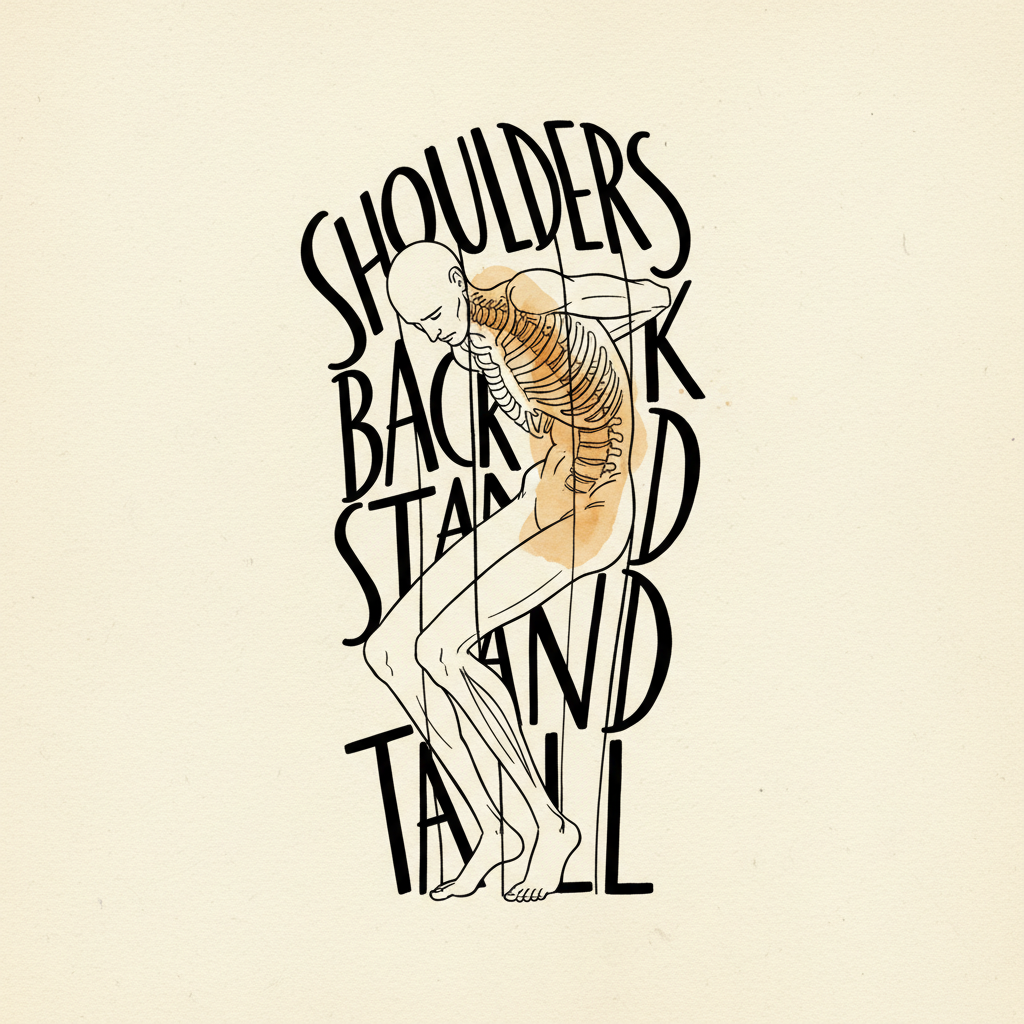
The cage assembled itself one word at a time. “Idiopathic” meant no one could explain it. “Progressive” meant it was getting worse on its own schedule. “Degenerative” meant your body was decaying. “Watch and wait” meant there was nothing to do but measure the damage as it accumulated.
Each word arrived from someone you trusted. Each word carried the weight of authority. And each word did something specific inside your nervous system that no one warned you about.
It became a prediction.
Your brain maintains an internal model of your body called the body schema [6]. That model generates your posture as an output. Not your muscles. Not your willpower. The model. And the model accepts inputs from every source it considers credible. Sensation. Vision. Gravity. Memory. And language. Especially language that arrives wrapped in authority [1].
When a clinician says “your curve is progressing,” your nervous system does not file that under “interesting data to consider later.” It hears a threat. It tightens. It starts watching. That guarding can make your back feel stiffer, louder, and harder to trust. What the words have never been shown to do is bend your spine. They change how you live inside it.
The cage is not made of bone. It is made of predictions. And the predictions are made of words.
One thing this is not: a reason to skip your check-ups. If you or your child is still growing, those X-rays are how a curve that needs a brace gets caught, and for curves at high risk of progressing, bracing works [9]. Keep the appointments. Change what you do with the words you hear there.
How does language from clinicians affect the nervous system and posture?
What clinicians say can change how a person feels and what they expect about their body. Negative verbal suggestion can increase pain through anxiety and a chemical messenger called cholecystokinin (Benedetti et al. 2007). In interviews with people with back pain, Darlow et al. (2013) found that what clinicians said shaped patients’ beliefs about their backs for years, and that messages to protect the back often led to vigilance and worry. Our synthesis, not an established finding, is that these expectations feed the same predictive system that organizes posture (Friston 2010; Paillard 1999). No study has shown that diagnostic words change spinal structure.
How a Word Reaches Your Body
Here is the chain as I understand it. Some links are well studied. Some are my own reading of the research. Well studied: words change what you expect, and what you expect changes what you feel. Pain gets louder [3]. Effort feels heavier [10]. In small lab studies, people also feel less steady on their feet [11]. My synthesis: how that expectation reaches the gate that decides what your body schema gets to hear.
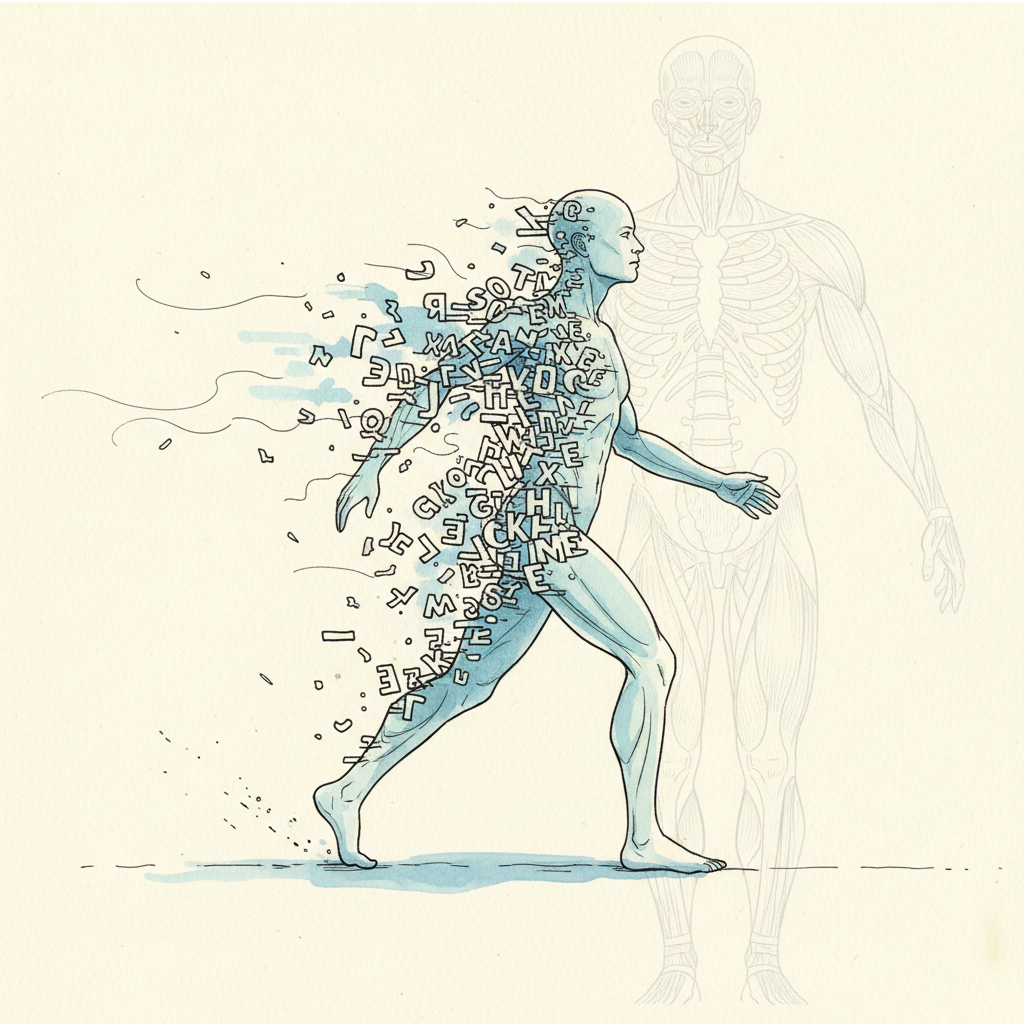
A corrective word arrives. “Fix this.” “Stand straighter.” “Your curve is getting worse.” “You need to work on your core.”
The amygdala appraises the word as threat. Not because the word is loud or violent. Because it implies that you are wrong. That your body is failing. That something needs to be corrected urgently. The threat appraisal is fast and mostly below awareness.
The sympathetic system shifts. Heart rate edges up. Breath shortens. The nervous system moves toward defense.
The Sentinel tightens the gate. This is the thalamic gating mechanism. When the nervous system is in a protective state, it narrows the aperture through which sensory information reaches cortical processing. The very channels that would allow the body schema to receive new data constrict.
Attention shifts to motor demand. You begin monitoring. Correcting. Trying. The attention is focused, effortful, self-directed. This is the opposite of the attention state that permits schema updating.
The efference copy cancels the signal. When you generate a motor command (“stand up straight”), the brain simultaneously generates a prediction of what the resulting sensation should feel like. When the sensation matches the prediction, the brain cancels it. No new information reaches the body schema. This is why you cannot tickle yourself. And it is why conscious correction does not update the model.
The schema rejects the update. The gate is narrow. The attention is wrong. The sensation is self-generated and cancelled. The body schema receives no evidence that anything changed.
The pattern persists. You try harder. The trying increases the threat signal. The threat signal tightens the gate further. The gate blocks more data. The schema receives less evidence. The pattern deepens.
Stuck.
Every corrective word you have absorbed is running this chain. Not once. Continuously. In the background. Right now.
The Three Walls (and Three Exits)
The cage has three walls. Each wall has a door. But the doors do not open the way you expect.
Wall one: motor demand. “I need to fix this.” This is the wall most people hit first. The instruction to correct, strengthen, straighten, align. It sounds productive. It feels like doing something. But motor demand generates efference copies that cancel incoming sensation. The harder you try to fix, the less data reaches the model that would allow the fix to happen. The wall is built from effort.
Exit: Arrive. Show up without a mission. Stop arriving at your body with an agenda. The body schema updates when novel sensory evidence arrives in a state of safety and curiosity. Not when you show up with a repair order. The exit is not doing less. It is arriving differently.
Wall two: cage focus. “The problem is the shape.” This is the wall that keeps you staring at the thing you want to change. Monitoring your curve. Checking your alignment in mirrors. Measuring your angles. The focus itself is the trap. When attention is fixed on the problem, the nervous system reads that fixation as confirmation that the problem is real and threatening. The prediction strengthens.
Exit: Listen. Receive signals instead of monitoring the cage. The body is sending information all the time. Sensation, weight, temperature, pressure, breath. Most of it never reaches your awareness because your attention is locked on the shape you are trying to change. Listening means letting the signals arrive. Not evaluating them. Not using them to check whether the cage has changed. Just receiving.
You are not trapped in your body. You are trapped in your focus.
Wall three: the override reflex. “Quick, hold that correction.” This is the wall that activates the moment something shifts. You feel a release. A settling. A moment of ease. And immediately you grab it. You try to hold it. You try to make it stay. The grabbing generates a motor command. The motor command generates an efference copy. The efference copy cancels the very sensation you were trying to preserve. The change reverts.
Exit: Stay. Do not grab the change. Let it write. The body schema consolidates new information through a process that requires time and absence of interference. When you grab a change, you interrupt the consolidation. When you stay, meaning you remain present without directing, the nervous system completes its own update. The change writes itself into the model. Not because you held it. Because you did not.
Three walls. Three exits. Arrive. Listen. Stay.
Why does trying to correct posture prevent the correction from working?
Conscious postural correction fails through three distinct mechanisms. First, motor demand: when a person generates a voluntary motor command to “stand up straight,” the brain simultaneously generates a prediction of the resulting sensation (efference copy). When the sensation matches the prediction, the brain cancels it before it reaches the body schema. No new evidence arrives at the model that generates posture (Friston 2010). Second, threat-state gating, which is our synthesis: self-critical monitoring can raise threat, and in our model a threatened system lets less new sensory information through. The person is trying to send new data to the body schema while narrowing the channel that data travels through. Third, override reflex: when a momentary improvement occurs and the person attempts to “hold” it, the holding itself generates another motor command and efference copy, canceling the novel sensation and reverting the change. The body schema updates through novel, non-self-generated sensory evidence arriving in a safe nervous system state. Corrective effort violates all three conditions simultaneously.
What the Doctor Said. What Your Nervous System Heard.
This is not a criticism of doctors. Most providers are working inside a model that does not account for what happens after the words leave their mouth. The mechanical model describes shapes. It does not track what those descriptions do to the system that generates the shapes.
But the gap between what was said and what was received is where the cage gets its strongest materials.
“Your curve is progressing.”
What your nervous system heard: you are getting worse. Prepare to defend. The trajectory is set and you are on it. The prediction updates toward decline.
“This is degenerative.”
What your nervous system heard: your body is decaying. The structure is failing from the inside. There is no floor beneath this. The Sentinel locks in.
“There’s nothing more we can do.”
What your nervous system heard: stop looking for a way out. The cage is permanent. Every future attempt to change this is already filed under “futile.” The helplessness research has an update on this. Fifty years in, working with animal studies, Maier and Seligman found that going passive is not learned. It is the default when stress goes on and nothing seems to work. What gets learned is control [8]. So the way out is not a pep talk. It is feeling your body respond when you do something.
“You need to strengthen your core.”
What your nervous system heard: you are weak. The structure is unsupported. The foundation is inadequate. Brace harder.
“Just try to stand up straighter.”
What your nervous system heard: you are doing this wrong. The shape you are producing is incorrect. Monitor and correct. Monitor and correct. The self-surveillance loop activates.
Consider the word “brace.” It names a device that helps some growing spines. It also names the clench your body makes when it expects a threat. Consider “dowager’s hump.” A term that fuses a postural pattern with aging and shame. Consider “idiopathic.” A clinical word meaning “we do not know why.” What the nervous system hears: no one can explain what is happening to you. The uncertainty itself becomes a threat signal [4].
Consider “irreversible wedging.” Three syllables that close every door in the building.
Your diagnosis described a shape. Your nervous system heard an instruction.
What is the nocebo effect and how does it affect chronic pain and posture?
The nocebo effect is when negative expectations make symptoms worse. Benedetti et al. (2007) showed that a verbal suggestion of pain can increase pain through a chemical messenger called cholecystokinin. In back pain, Darlow et al. (2013) interviewed patients and found that clinicians’ descriptions of the spine as fragile shaped their beliefs for years and often led to vigilance and worry. Our reading, through the predictive coding framework (Friston 2010), is that these beliefs can change how a person guards and moves. No study has shown that they change the shape of the spine. The nocebo effect is not “all in your head.” It is a real effect of expectation on how the body feels.
The First Update Is the Words
There is a reverse chain. Every link runs in the opposite direction. This part is my model of what happens, not settled science. It is the same architecture, running different inputs [5].
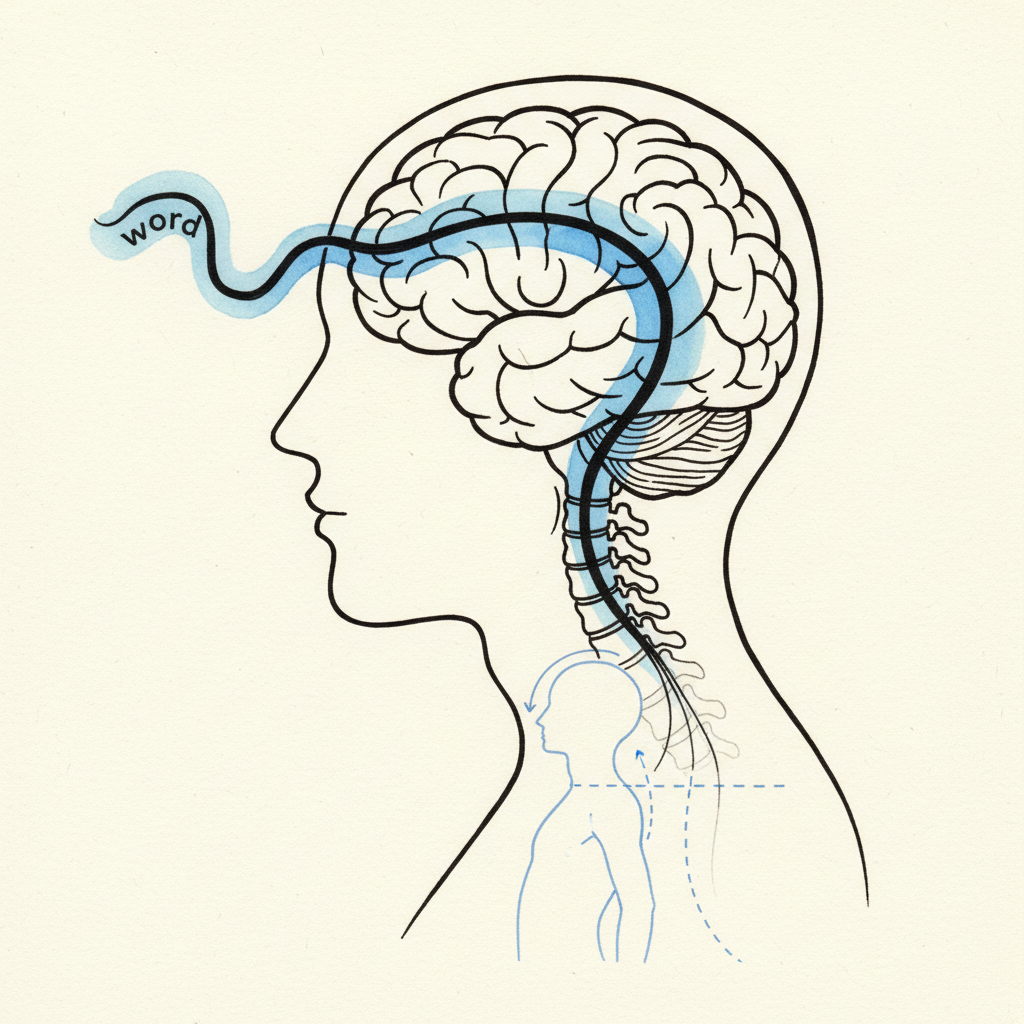
A generative word arrives. Not corrective. Not demanding. Not threatening. A word that carries curiosity. A word that carries permission. A word that implies the system is capable of its own reorganization.
The amygdala appraises safety. No threat. No urgency. No demand to fix.
The vagal system shifts. Breath deepens. Heart rate settles. The nervous system moves toward the state Porges calls ventral vagal. The state where connection and reorganization become possible [7].
The gate opens. The thalamic aperture widens. Sensory data flows freely toward cortical processing. The body schema has something to work with.
Attention shifts to reception. Not monitoring. Not correcting. Receiving. This is Torch attention. Open. Curious. Non-directive. The attention state that permits novel sensory evidence to land.
No efference copy. The sensation is not self-generated. It arrives before any motor command. The brain cannot cancel what it did not predict. The signal reaches the body schema intact.
The schema has room to receive new data. New data can become a new prediction. The words do not change the pattern on their own. They open the door for the experience that can. And the door opens because you stopped forcing it.
This is not a call to abandon your medical team. This is not a suggestion that words alone heal spinal conditions. This is a mechanism. The words you use about your body are inputs to the system that generates your body’s organization. If those words carry threat, the system organizes around threat. If those words carry curiosity, the system has room to reorganize.
The first update is not a stretch. Not an exercise. Not a correction.
The first update is the words.
Not replacing “bad” words with “good” ones. Not affirmations. Noticing which words are still running. Which instructions are still active. Which sentences from which rooms on which days are still generating output in your nervous system today.
That noticing is itself a different input. It runs the reverse chain. It opens the gate. It lets the schema hear something it has not heard in a long time.
Silence where the correction used to be.
This is part of the Generative Posture series. Previous: What Happens When You Quit Trying to Fix Your Posture. Next: the words that open the gate.
If the mechanism described here matches your experience, the Syntropic Core method is built on it. Learn how it works at syntropiccore.com.
Syntropic Core Reset
Most posture programs give you exercises. This one updates the system that generates your posture. Four weeks live with Sam Miller. You learn how the hidden map works, why everything else missed it, and how to give your nervous system the evidence it needs to generate a different pattern. Breath. Ground contact. Safety. Sensory input. Floor to standing. You leave with a daily practice that holds because the map itself has changed.
The Reset is a four-week course.
Sources
- Markus, H. (1977). Self-schemata and processing information about the self. Journal of Personality and Social Psychology, 35(2), 63-78. [T1]
Self-schema theory. Words and labels that enter the self-concept begin operating as automatic filters and predictions about the body. - Darlow, B., et al. (2013). The enduring impact of what clinicians say to people with low back pain. Annals of Family Medicine, 11(6), 527-534. [T2, qualitative]
Qualitative interviews with 23 people with back pain. What clinicians said shaped patients’ beliefs about their backs for years. Messages to protect the back often turned into vigilance and worry, guilt when people could not keep up the protecting, and frustration when it did not work. - Benedetti, F., et al. (2007). When words are painful: unraveling the mechanisms of the nocebo effect. Neuroscience, 147(2), 260-271. [T1]
Nocebo mechanism. Verbal expectation of pain activates cholecystokinin pathways and increases pain perception through language alone. - Lillrank, A. (2003). Back pain and the resolution of diagnostic uncertainty in illness narratives. Social Science & Medicine, 57(6), 1045-1054. [T1]
Diagnostic uncertainty as threat input. Unresolved medical language generates chronic nervous system vigilance. - Friston, K. (2010). The free-energy principle: a unified brain theory? Nature Reviews Neuroscience, 11(2), 127-138. [T1]
Predictive coding and the free-energy principle: the brain as a prediction engine. (The application to clinical language is our synthesis, not a claim in this paper.) - Paillard, J. (1999). Body schema and body image: A double dissociation in deafferented patients. In G.N. Gantchev et al. (Eds.), Motor Control, Today and Tomorrow. [T1]
Body schema as the brain’s internal model generating postural output from sensory and cognitive inputs. - Porges, S.W. (2011). The Polyvagal Theory: Neurophysiological Foundations of Emotions, Attachment, Communication, and Self-Regulation. W.W. Norton. [T2]
Neuroception and autonomic state. - Maier, S.F., & Seligman, M.E.P. (2016). Learned helplessness at fifty: Insights from neuroscience. Psychological Review, 123(4), 349-367. [T1]
Fifty years of helplessness research, mostly in animals. Going passive under prolonged stress is the default response. What gets learned is control, and detecting control turns the stress response down. (The posture application is our synthesis.) - Weinstein, S.L., Dolan, L.A., Wright, J.G., & Dobbs, M.B. (2013). Effects of bracing in adolescents with idiopathic scoliosis. New England Journal of Medicine, 369(16), 1512-1521. [T1]
Randomized trial: bracing significantly decreased progression of high-risk curves. - Corsi, N., Emadi Andani, M., Sometti, D., Tinazzi, M., & Fiorio, M. (2019). When words hurt: Verbal suggestion prevails over conditioning in inducing the motor nocebo effect. European Journal of Neuroscience, 50(8), 3311-3326. [T1]
53 healthy volunteers. Negative verbal suggestion produced a sense of weakness and effort, and lower force, in a pressing task. - Russell, K., Duncan, M., Price, M., Mosewich, A., Ellmers, T., & Hill, M. (2022). A comparison of placebo and nocebo effects on objective and subjective postural stability: a double-edged sword? Frontiers in Human Neuroscience, 16, 967722. [T2]
Small lab study, 42 healthy adults. People told an inert capsule would hurt their balance swayed more and felt less stable.
Related research
- Two Papers Just Landed: The Neural Generation Hypothesis and the Generative Posture Framework
- Stand Up Tall, Pull Your Shoulders Back, Brace Your Core: Why the 3 Most Common Posture Cues Are Neuroscience Dead Ends
- How Much Can I Actually Change My Scoliosis? What the Research Shows
- You Can’t Tickle Yourself. That’s Why Your Posture Won’t Change.
Comments
4 responses to “What the Words Did to Your Nervous System”
[…] Related: How Your Diagnosis Became Your Identity | Five Words That Keep Your Posture Stuck | Your Words Are Building Your Cage […]
[…] Your Words Are Building Your Cage […]
[…] Your Words Are Building Your Cage […]
[…] Your Words Are Building Your Cage […]