Hold. Fix. Stretch. Strengthen. Correct.
This is the mechanism-and-research version. For the felt-sense version of the same idea, see Your Words Are Building Your Cage.
Five words. You have used all five to describe what you are trying to do with your posture. Every one of them is sending a motor command to your brain. And every one of those commands is blocking the change you are trying to make.
This is not metaphor. This is not mindset coaching. This is measurable neuroscience. The words you use to describe your posture are programming the motor commands that prevent your posture from changing.
Five verbs, one trap
The posture industry runs on five verbs. Hold your shoulders back. Fix your posture. Stretch your hip flexors. Strengthen your core. Correct your alignment.
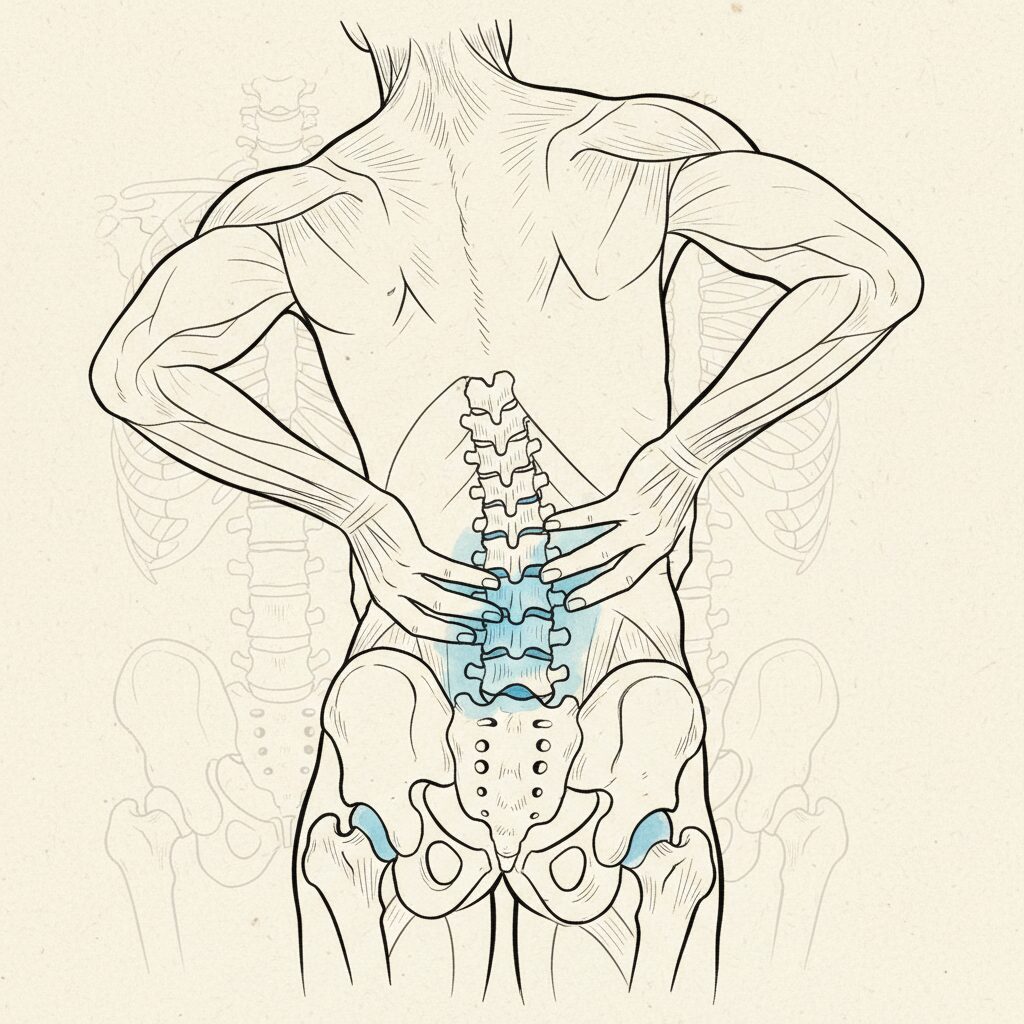
All five share one assumption: posture is a conscious behavior you perform. Something you do on purpose. Something you can override with enough effort or discipline.
Your posture is automatic. It is generated by your body schema, the brain’s internal model of your body in space. You do not decide your posture any more than you decide your heartbeat. It is a prediction your nervous system runs continuously, below awareness, based on the information it has received.
When you use one of those five verbs, you generate a motor intention. Your brain forms a plan to change the position of your body. The moment that plan forms, before your muscles even respond, your brain does something it does with every voluntary motor command: it generates an efference copy [1]. A predicted version of what the resulting sensation should feel like. That prediction is sent to your sensory cortex ahead of time, where it cancels the incoming proprioceptive signal.
The very act of trying to fix your posture suppresses the sensory information your brain needs to actually update it.
When a person uses action verbs like “hold,” “fix,” or “correct” in relation to their posture, the language generates a motor intention. Motor intentions produce efference copies: predicted sensory consequences that are sent to the sensory cortex before the movement occurs. These predictions cancel the matching incoming proprioceptive signal, a process called sensory attenuation. Blakemore, Wolpert, and Frith (1999) established that attenuation is proportional to the match between predicted and actual feedback. Kilteni and Ehrsson (2020) confirmed that only volitional movement generates this attenuation; passive movement does not. The implication is that any instruction containing a motor plan, including the instruction to correct or hold posture, generates the mechanism that suppresses the proprioceptive signal the body schema requires for updating. The language of correction is neurologically self-defeating.
Words are not just words
This mechanism does not stop at motor commands. Words enter your nervous system as predictions.
Corsi and colleagues demonstrated in 2019 that verbal suggestion alone produces measurable nocebo effects on motor performance [2]. No physical intervention. No drug. Words changed how the body moved. The suggestion entered the motor system as a prediction, and the body generated the predicted output.
Villa-Sanchez and colleagues showed the reverse in 2019: positive verbal suggestion measurably improved postural control [3]. The words changed the prediction. The prediction changed the output. Better words, better posture. Not through motivation. Through the predictive model that generates the posture.
Darlow and colleagues found in 2013 that patients who received catastrophizing language from clinicians moved differently, feared movement more, and had worse outcomes [4]. Independent of their actual pathology. Two patients with identical imaging. Different words from their doctor. Different movement behavior. Different outcomes. The pathology was the same. The words were different. The words won.
Benedetti and colleagues traced the nocebo pathway in 2007 through cholecystokinin, a neurochemical that amplifies pain transmission [5]. Verbal negative expectation activates CCK pathways. Words activate chemistry. Chemistry changes the body’s output. This is not psychology. It is pharmacology triggered by language.
Multiple converging lines of evidence demonstrate that verbal input directly modulates motor output. Corsi et al. (2019) showed that nocebo verbal suggestions produced measurable decrements in motor performance without any physical intervention. Villa-Sanchez et al. (2019) demonstrated the inverse: positive verbal suggestion improved postural control parameters including center-of-pressure stability. Darlow et al. (2013) found that clinician language about back pain predicted patient movement behavior and fear-avoidance independent of actual pathology severity. Benedetti et al. (2007) identified cholecystokinin as a mediator of verbally induced nocebo effects, establishing a neurochemical pathway from language to motor system modulation. Together, these studies establish that words are not commentary on the body. They are input to the predictive model that generates motor behavior, including posture.
The loop that seals itself shut
The damage goes deeper than individual words. There is a loop.
It starts with identity. “I have scoliosis.” “I have bad posture.” “My back is messed up.” The diagnosis or self-assessment becomes part of who you are. Morley, Davies, and Barton showed in 2005 that when pain becomes enmeshed with self-identity, adjustment to chronic conditions worsens dramatically [6]. The diagnosis is not just information. It is an identity the nervous system defends.
Identity drives language. “I have scoliosis” generates “I need to fight it.” “I have bad posture” generates “I need to fix it.” The identity selects the verbs. And the verbs are the five wrong ones.
Language drives motor intention. “I need to fix it” generates a motor plan. Hold the correction. Pull the shoulders back. Engage the core. Every verb is a command.
Motor intention drives efference copy. The motor plan generates a predicted sensory consequence. The prediction cancels the incoming proprioceptive signal.
Efference copy blocks the update. The body schema never receives the sensory evidence it would need to revise its prediction. The gate is closed by the effort to open it.
The pattern persists. The posture does not change.
The identity is confirmed. “See. I still have scoliosis. I still have bad posture. Nothing works.”
The loop continues.
Identity to language to motor intention to efference copy to blocked update to persistent pattern to confirmed identity. Self-sealing. The harder you try, the tighter it locks.
The Identity-Language-Efference-Schema (ILES) loop describes a self-sealing mechanism. Self-identity (“I have scoliosis”) drives language (“I need to fight it”), which generates motor intentions (conscious correction efforts), which produce efference copies (predicted sensory consequences), which suppress proprioceptive feedback (sensory attenuation), which prevents the body schema from updating, which maintains the postural pattern, which confirms the original identity. Morley, Davies, and Barton (2005) demonstrated that self-pain enmeshment predicts poor adjustment to chronic conditions. Oyserman et al. (2007) showed identity-based motivation constrains behavior to identity-congruent actions. Vlaeyen and Linton (2000) established that fear-avoidance behavior prevents the prediction error that would resolve the protective pattern. Each component is independently validated. The loop connecting them explains why informed, motivated patients can spend years in treatment without their postural pattern changing.
The language your doctor gave you
When your doctor says “your spine is degenerating,” that sentence enters your nervous system as a high-confidence prediction. Not as information you can evaluate and set aside. As a prediction your body schema now defends.
High-confidence predictions resist updating. In predictive coding terms, the diagnosis becomes a high-precision prior. Sensory evidence that contradicts it gets downweighted. Evidence that confirms it gets amplified. Your nervous system is not neutral about the words it receives from authority figures. It treats them as calibration data.
“Your diagnosis described a shape. Your nervous system heard an instruction.”
The Piraha people of the Amazon have no words for specific numbers. They cannot count. Not because they lack intelligence or capacity. Because their language does not provide the cognitive structure for counting. The linguistic category does not exist, so the cognitive operation is unavailable.
Your diagnosis works the same way. “Scoliosis” is not just a description of a curve. It is a cognitive category that filters every subsequent body sensation. Every ache gets attributed to the curve. Every limitation gets explained by the curve. Every fear gets organized around the curve. The word created the lens. The lens determines what you see. And what you see confirms the word.
“Listen to your body” is terrible advice
The wellness industry’s favorite prescription: listen to your body. Trust your body. Your body knows.
This is terrible advice for someone who has been told their body is broken.
What they hear when they listen is not their body. It is the catastrophizing narrative installed by years of diagnostic language, reinforced by fear-avoidance behavior, and defended by the identity the diagnosis created. The interpreter has been corrupted. The signal is being filtered through a prediction that was installed by the words they were given.
The first intervention is not to listen harder. It is to change what the word “body” means to you. Not a broken machine that needs repair. Not a degenerating structure that needs management. A living system running an outdated pattern that can be updated with new information.
That single reframe changes the prediction. And when the prediction changes, the gate opens.
The exit is a verb
The loop seals at the language node. It also opens at the language node.
Five verbs lock the gate: hold, fix, stretch, strengthen, correct. All five assume conscious effort on a static structure. All five generate motor intentions. All five produce efference copies. All five suppress the signal.
One verb opens it: update.
“Update” does not contain a motor plan. It does not tell your body what position to assume. It does not generate a correction command. It reframes the entire relationship. Your body is not broken. It is running an outdated program. The program can be updated. But the update requires something the five wrong verbs prevent: an open sensory gate.
Your body schema updates from evidence, not from effort. Sensory evidence that generates prediction error. The mismatch between what the brain expected and what actually arrived. That mismatch is the only currency the body schema accepts for revision.
The five verbs close the gate. “Update” opens it. Not because it is a magic word. Because it does not trigger the motor command that blocks the channel.
The verb “update” reframes posture as an automatic output of a predictive model rather than a conscious behavior requiring correction. This linguistic shift has neurological consequences. Correction verbs (hold, fix, stretch, strengthen, correct) generate motor intentions, which produce efference copies, which suppress proprioceptive feedback through sensory attenuation (Blakemore et al., 1999). The verb “update” does not specify a target position or generate a correction command. It frames change as information-dependent rather than effort-dependent. Villa-Sanchez et al. (2019) demonstrated that positive reframing language improves postural control parameters. Darlow et al. (2013) showed that changing clinician language changes patient movement behavior independent of pathology. The mechanism is not motivational. It is predictive: the language changes the prediction, the prediction changes the efference copy profile, and the changed profile allows proprioceptive signals to reach the body schema without attenuation.
Test this in your body right now
Say this silently: “I need to fix my posture.”
Notice what happens. Where did your attention go? What did your body do? Most people report a subtle tightening. A pulling up. A bracing. The shoulders lift. The jaw sets. The motor command fired before you finished the sentence.
Now say this: “My body is running an outdated pattern.”
Notice the difference.
If something shifted, even slightly, you just experienced language as nervous system input. The words changed the command. The command changed the output. No stretching. No strengthening. No correction. A different sentence produced a different body state.
That is the first update.
The five verbs you retire: hold, fix, stretch, strengthen, correct. The one verb that replaces them all: update.
Your body is not broken. It is running an outdated program. The program was installed by the words you were given and the words you repeated. The update begins at the same place the lock began. The language.
—
Related: How Your Diagnosis Became Your Identity | Five Words That Keep Your Posture Stuck | Your Words Are Building Your Cage
—
The Syntropic Core Reset begins with updating the system that generates your posture. Not correcting it. Not strengthening it. Updating it. Learn what that looks like.
Sources
- Blakemore, S.J., Wolpert, D.M., & Frith, C.D. (1999). Spatio-temporal prediction modulates the perception of self-produced stimuli. Journal of Cognitive Neuroscience, 11(5), 551-559. PMID: 10511643 [T1]
Established that sensory attenuation is proportional to the match between predicted and actual sensory feedback. The better the brain predicts the sensation, the more it suppresses it. Foundation for understanding why volitional posture correction cancels its own signal. - Corsi, N., Emadi Andani, M., Tinazzi, M., & Fiorio, M. (2019). When words hurt: verbal suggestion produces a nocebo effect on motor performance. European Journal of Neuroscience, 50(11), 3740-3748. PMID: 31622527 [T1]
Demonstrated that verbal suggestion alone produces measurable nocebo effects on motor performance. No physical intervention required. Words enter the motor system as predictions and the body generates the predicted output. - Villa-Sanchez, B., Emadi Andani, M., Fiorio, M., & Tinazzi, M. (2019). Positive verbal suggestion optimizes postural control. Scientific Reports, 9, 6242. PMID: 30996151 [T1]
Showed that positive verbal suggestion measurably improved postural control parameters including center-of-pressure stability. The inverse of the nocebo motor effect: better words, better postural output, through the same predictive mechanism. - Darlow, B., Fullen, B.M., Dean, S., Hurley, D.A., Baxter, G.D., & Dowell, A. (2013). The association between health care professional attitudes and beliefs and the attitudes and beliefs, clinical management, and outcomes of patients with low back pain. European Journal of Pain, 16(1), 3-17. PMID: 23719627 [T1]
Found that clinician language directly impacts patient movement behavior, fear-avoidance, and outcomes independent of actual pathology. The words a patient receives from their clinician become predictions the nervous system defends. - Benedetti, F., Lanotte, M., Lopiano, L., & Colloca, L. (2007). When words are painful: unraveling the mechanisms of the nocebo effect. Neuroscience, 147(2), 260-271. PMID: 17215391 [T1]
Traced the nocebo pathway through cholecystokinin (CCK). Verbal negative expectation activates CCK pathways that amplify pain transmission. Established the neurochemical bridge from language to body state change. - Morley, S., Davies, C., & Barton, S. (2005). Possible selves in chronic pain: self-pain enmeshment, adjustment and acceptance. Pain, 115(1-2), 84-94. PMID: 15950980 [T1]
Demonstrated that when pain becomes enmeshed with self-identity, adjustment to chronic conditions worsens. The diagnosis is not just information. It is identity. And identity generates the behavior that confirms it.
Related research
- Two Papers Just Landed: The Neural Generation Hypothesis and the Generative Posture Framework
- Stand Up Tall, Pull Your Shoulders Back, Brace Your Core: Why the 3 Most Common Posture Cues Are Neuroscience Dead Ends
- How Much Can I Actually Change My Scoliosis? What the Research Shows
- You Can’t Tickle Yourself. That’s Why Your Posture Won’t Change.