Posture does not cause back pain.
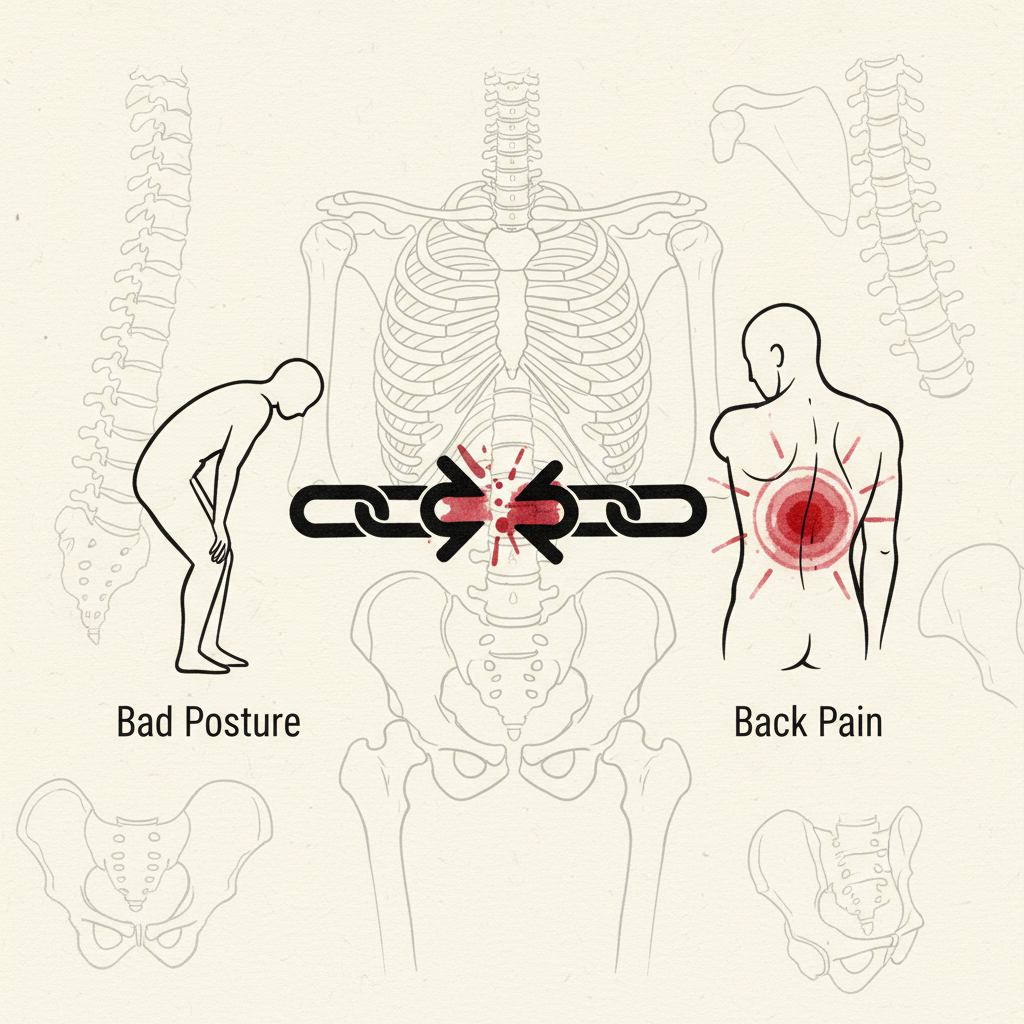
That might be the most liberating sentence in this entire library. Read it again. Let it land. Because if you have been working on your posture specifically to fix your back pain, you have been solving the wrong equation. The relationship between these two things is not what anyone told you it was.
They share a source. They are not cause and effect.
What the research actually says
Multiple large-scale studies have failed to establish a consistent causal relationship between posture and back pain. People with “perfect” posture get back pain. People with significant postural deviations live pain-free. The correlation between spinal alignment and pain intensity is weak to nonexistent in the research literature.
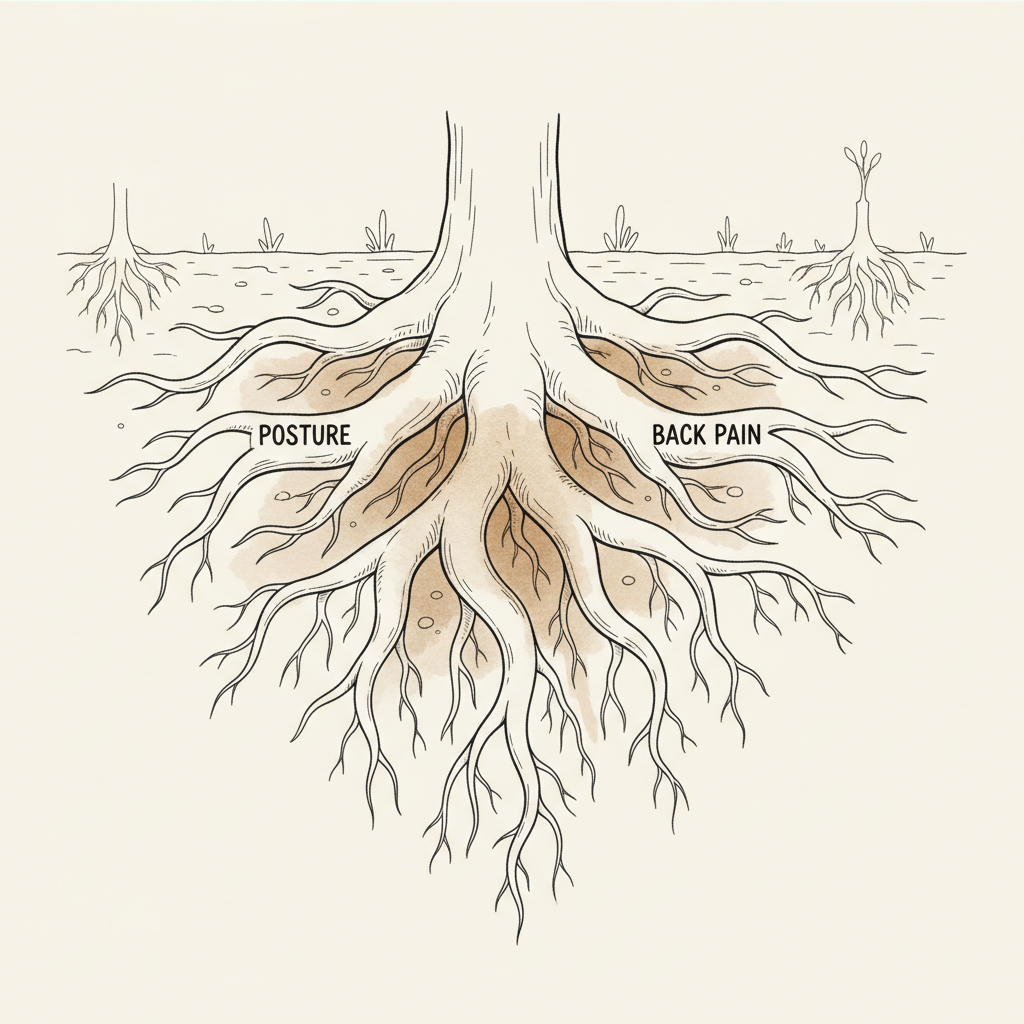
Posture does not cause pain. Something deeper causes both.
Both are outputs
Pain is not an input. It is an output. Your nervous system generates pain as a protective response based on its assessment of threat. Not tissue damage alone. Threat. The brain’s prediction of whether the body is in danger.
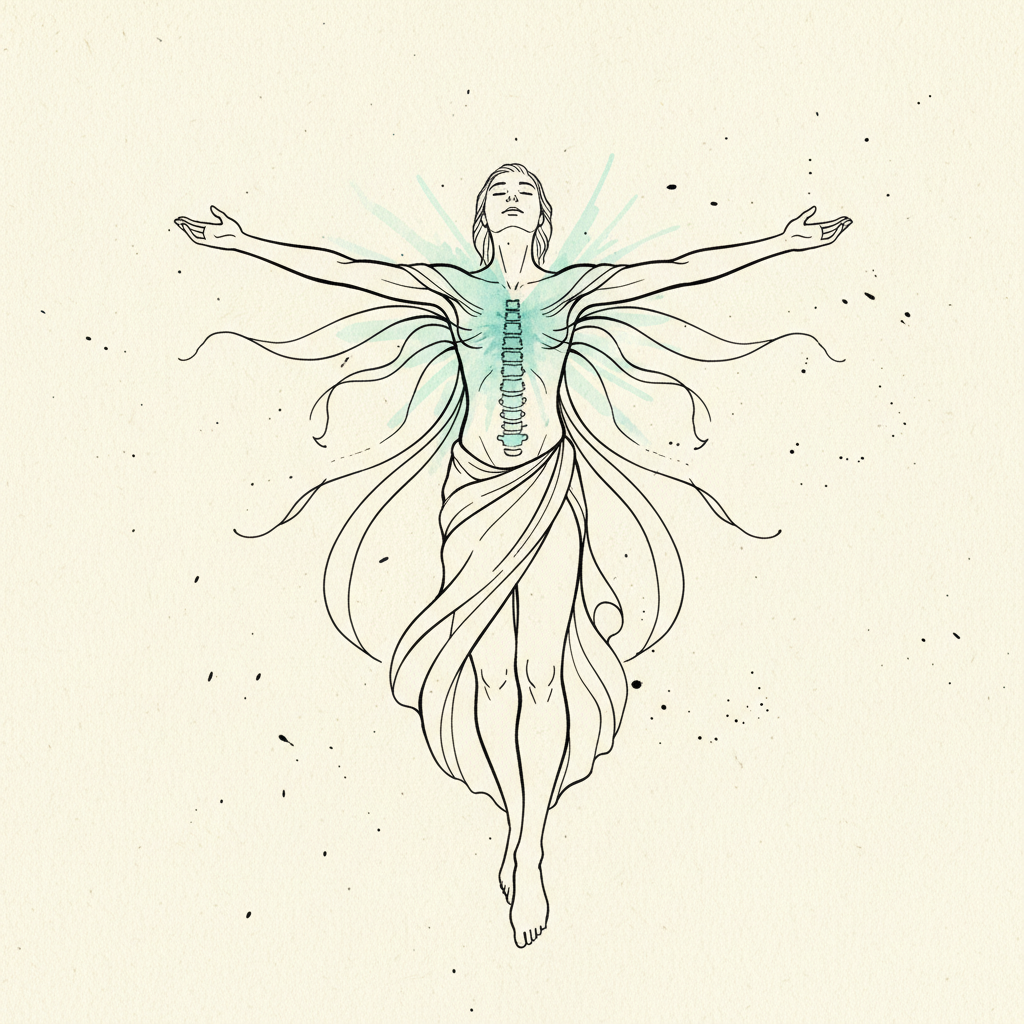
Posture is also an output. Your nervous system generates the shape your body holds based on the same assessment. When the system reads threat, it braces. The posterior chain locks. The muscles grip. The body rigidifies.
Pain and posture are both downstream of the same upstream variable: the nervous system’s threat assessment. When that assessment reads danger, it produces two simultaneous outputs. A bracing pattern you call poor posture. A protective signal you call pain. They are siblings. Not parent and child.
Why fixing posture does not fix pain
If you correct the postural output through exercises and alignment work but do not address the threat assessment, the pain persists. You changed one output without changing the input. The brain is still reading threat.
It explains why pain sometimes resolves without any postural change. When the threat assessment shifts through stress reduction, improved sleep, social safety, or meaningful occupation, pain can decrease even if the structural posture has not changed. The input shifted. The output followed.
It explains why people with severe structural deviations can be pain-free. A significant curve does not guarantee pain. A perfectly aligned spine does not guarantee freedom from it. The structure is not the determinant. The nervous system’s assessment of that structure is.
What actually drives back pain
The emerging consensus in pain science points to several converging factors. None of them are purely structural.
Nervous system sensitization. Under chronic stress or after injury, the pain threshold lowers. Signals that would normally register as benign get processed as threatening. Central sensitization. A nervous system state, not a tissue state. The tissue may be completely healed while the system continues to generate pain from normal signals.
Lost internal pressure. When the diaphragm fails to generate organized intra-abdominal pressure, the spine loses its internal hydraulic support. The surface muscles compensate by bracing. This chronic bracing creates local ischemia, reduced blood flow, and metabolic waste accumulation in the tissues. The muscles are not injured. They are starved.
Cortical smudging. Under chronic pain, the body map for the affected region loses resolution. The brain cannot feel the detail of the area. It responds conservatively: more protection, more bracing, more pain. The map degradation and the pain amplify each other. You cannot correct what you cannot feel. And the inability to feel becomes, itself, a pain driver.
Threat history. The nervous system does not forget. Previous injuries, surgical procedures, prolonged stress, and unresolved trauma all accumulate in the threat prediction. A back that was injured ten years ago may have fully healed tissue but an active threat memory that continues to generate protective responses.
Claire’s question
I have a client, Claire, who is nine sessions into this work. She has dramatically increased her body awareness over five months. She can map her ribs bone by bone. She feels left-right differences in her ankles. She knows when her pressure leaks and when it holds.
But the pain has not decreased proportionally. And she is starting to wonder: when does the pain go away?
Here is what I told her. The map got detailed enough to actually see what was always there. The pain is not new. The awareness of it is. The map lights up before the territory changes. That is how this works.
The awareness-pain paradox is real. You start doing this work, you feel more, and some of what you feel is uncomfortable. The thalamic gate opened and sensory data is flowing again. Your body map is sharpening. And a sharp map registers everything, including the patterns that need to change.
The pain resolves when the system no longer needs to produce it. When the threat assessment shifts. When the internal pressure comes back online and the surface muscles can stop gripping. When the body schema updates and the bracing pattern loses its rationale.
Addressing the source
If pain and posture share a source, the intervention should target the source.
Reduce the threat level through organized breathing, which shifts autonomic state. Restore sensory resolution through body awareness practices that reverse cortical smudging. Rebuild internal pressure through diaphragmatic work that gives the spine hydraulic support.
When the assessment shifts from threat to safety, both outputs change. The bracing releases. The pain resolves. The prediction was updated.
Kyle, one of our cohort participants with a disc herniation and chronic back pain, described what happened after his first session: “The bracing I was doing with low back pain was slightly less.”
Slightly less. Honest. Subtle. And precisely what the early stages of this process look like. Not dramatic relief. A fractional reduction in the system’s need to protect. The bracing eases because the threat level dropped a degree. Then another. Then another.
The question that changes everything
If you have back pain, the question is not “how do I fix my posture to stop my pain?”
The question is: what is my nervous system responding to, and how do I change the signal?
Change the signal. The pain changes. The posture changes. You addressed the one thing that was generating both.
Sam Miller is the founder of Posture Dojo. He lived with chronic pain and an 85-degree scoliosis curve for most of his adult life. The pain resolved when he stopped treating it as a tissue problem and started treating it as a prediction.
Syntropic Core Reset
Most posture programs give you exercises. This one updates the system that generates your posture. Four weeks live with Sam Miller. You learn how the hidden map works, why everything else missed it, and how to give your nervous system the evidence it needs to generate a different pattern. Breath. Ground contact. Safety. Sensory input. Floor to standing. You leave with a daily practice that holds because the map itself has changed.
The Reset is a four-week course.
Details and enrollment →Related research
- TMJ and Posture: Why Your Jaw Is Running Your Neck
- Tech Neck Is Not About Your Phone (It’s About Your Eyes)
- Two Papers Just Landed: The Neural Generation Hypothesis and the Generative Posture Framework
- Stand Up Tall, Pull Your Shoulders Back, Brace Your Core: Why the 3 Most Common Posture Cues Are Neuroscience Dead Ends
Comments
2 responses to “Your Back Pain Is Not Caused by Your Posture (But They Share the Same Source)”
[…] Your Back Pain Is Not Caused by Your Posture (But They Share the Same Source) […]
[…] Your Back Pain Is Not Caused by Your Posture (But They Share the Same Source) […]