Everyone who learns their posture can change asks the same question first.
How much?
The internet gives you two answers. Fitness influencers promise transformation in six weeks. Orthopedic surgeons say nothing short of surgery moves the needle. Both are wrong. And both are wrong for the same reason: they are looking at the spine instead of the system that shapes it.
The real answer is in the research. It is specific. It is measurable. It is radiographically verified. And it reveals something far more interesting than a number.
It reveals a mechanism. One that every successful study shares. One that none of them named.
The number matters. But what matters more is what it tells you about how change actually happens.
Randomized controlled trials consistently demonstrate that targeted exercise interventions can produce measurable Cobb angle changes in scoliosis. The SEAS method (Monticone et al. 2014, n=110) achieved a 5.3-degree improvement over 12 months. Schroth physiotherapy (Schreiber et al. 2016, n=50) produced a 3.5-degree between-group difference in 6 months, confirmed by Fan et al. (2023) meta-analysis showing a pooled 3.2-degree change across 6 RCTs. Katzman et al. (2017, n=99) demonstrated 3.0 degrees of kyphosis reduction in adults over 60. The minimum clinically important difference (MCID) for Cobb angle measurement is 5 degrees. These results indicate that exercise-based interventions produce real, radiographically verified spinal changes, though the mechanisms through which these changes occur vary by method and point to nervous system-level adaptation rather than structural bone remodeling.
Schroth 3D: Breath and Exercise Together (Otman et al. 2005)
Fifty adolescent scoliosis patients. Average starting Cobb angle: 26.1 degrees. After one year of Schroth 3-dimensional exercise therapy: 17.85 degrees. A reduction of more than 8 degrees.
The treatment was intensive. Five days a week, four hours a day for the first six weeks. Then a home program. What makes this study remarkable is not just the size of the change. It is what the patients were doing: rotational angular breathing. Directed pressure into the concavity of the curve. Sensory feedback through the ribs. The spine was not being pushed. It was being re-informed.
8.25 degrees. From breath and exercise. Not surgery. Not bracing. Breath and movement, organized in the direction the generator needed to hear.
Spinal Extension Exercises: Stopping Kyphosis in Your 50s (Ball et al. 2009)
This study asked a different question. Not “can you reverse a curve?” but “can you stop one from getting worse?”
Women between 50 and 59 years old. The researchers measured kyphosis progression with age and found the sharpest increase happens in the fifth and sixth decades. Then they put one group on spinal extension exercises three times a week for a year.
The result was unambiguous. Women who did the exercises prevented kyphosis progression entirely. Women who did not got measurably worse. The difference was highly significant (p=.0001).
This matters because it answers the question people over 40 are afraid to ask: is it too late? No. The tissue responds. The generator responds. Even in a population where the medical model says “this is just aging,” targeted input changed the trajectory.
The exercises were simple spinal extensions. Load through the extensor chain. Awareness of position under gravity. The same input channels that every other successful study in this table targeted.
The Numbers: What the RCTs Actually Show
Before interpretation. Before theory. The data.
Six studies. Five methods. Three continents. All measuring radiographic spinal change from exercise-based interventions.
| Method | Cobb Angle Change | Timeframe | Study | Population |
|---|---|---|---|---|
| SEAS active self-correction | -5.3 degrees (vs +1.7 control) | 12 months | Monticone 2014, n=110 | AIS |
| Schroth physiotherapy | -3.5 degrees between-group | 6 months | Schreiber 2016, n=50 | AIS |
| Schroth (pooled meta-analysis) | -3.2 degrees | 3-12 months | Ceballos-Laita 2023, 6 RCTs | AIS |
| Kyphosis exercise (older adults) | -3.0 degrees | 6 months | Katzman 2017, n=99 | Adults 60+ |
| Schroth + Sensory Integration | Greater than Schroth alone | 12 weeks | 2025 trial, n=62 | AIS |
| Yoga (non-randomized) | -9.2 degrees lumbar | 6+ months | Fishman 2021, n=56 | AIS, mean age 14 |
| Schroth 3D exercise | -8.25 degrees (26.1 to 17.85) | 1 year | Otman et al. 2005, n=50 | AIS (avg age 15) |
| Spinal extension exercises | Prevented kyphosis progression (p=.0001) | 1 year | Ball et al. 2009 | Women 50-59 |
A note on the Fishman yoga data: this was a non-randomized trial in adolescents, not a randomized controlled trial, and the comparison group was made up of the patients who reported not doing the poses. The 9.2-degree change is pattern-consistent with the other findings, but the evidence is weaker. It belongs in the conversation. It does not carry the same weight as the controlled studies above it.
The minimum clinically important difference (MCID) for Cobb angle measurement is 5 degrees. Only the SEAS trial crossed that threshold in a controlled setting.
So the honest answer: 3 to 5 degrees in 6 to 12 months. Real. Radiographically verified. Not a miracle. Not nothing.
These are not opinions. These are X-rays.
What Each Study Actually Did
The numbers are interesting. The methods are more interesting. Because when you look at what each research group actually asked their participants to do, a pattern emerges that none of them explicitly named.
SEAS: The Body Learns to Correct Itself
SEAS stands for Scientific Exercises Approach to Scoliosis. The word that matters is “self-correction.”
In the Monticone 2014 trial, participants learned to find and hold a corrected spinal position using internal sensory feedback. No brace. No hands-on correction during the exercise. No external force pushing the spine into alignment. The patient’s own proprioceptive system did the work (Monticone et al. 2014, European Spine Journal).
The participant felt where their spine was. Learned where it could be. And practiced holding the new position until the nervous system recognized it as home.
5.3 degrees of improvement. 12 months. From the inside out.
The mechanism at work: proprioceptive retraining. The nervous system learned a new prediction about where the spine should be. The correction came from updated sensory data, not external force.
Schroth: Breathing Into the Curve
Schroth physiotherapy uses a technique called rotational angular breathing. The patient breathes into the concavity of the curve. Directing breath, and therefore intra-abdominal pressure, into the collapsed region of the torso.
This is not stretching. It is directed pressure combined with sensory attention. You send organized force into a specific region while paying attention to the expansion. Two inputs delivered simultaneously: mechanical and sensory.
Schreiber 2016 documented a 3.5-degree between-group difference in 6 months (PLoS One). Ceballos-Laita 2023 pooled six randomized trials covering 144 adolescents and found a mean Cobb change of 3.18 degrees (European Journal of Physical and Rehabilitation Medicine). The authors are careful to note that this did not exceed the minimum clinically important difference.
The mechanism at work: directed pressure plus sensory feedback. The patient sends organized intra-abdominal pressure to a specific region while attending to the expansion. The generator receives new data through two channels at once.
Katzman: Load Plus Awareness in Older Adults
The Katzman 2017 trial targeted hyperkyphosis in adults over 60. Targeted spine strengthening combined with posture training. But the detail that matters is this: participants did not just do exercises. They learned to feel their position in space while under load (Katzman et al. 2017, Osteoporosis International).
Not just strengthening. Awareness training under gravitational load. The nervous system received new data about where the spine is while real-world forces were acting on it.
3.0 degrees of kyphosis reduction. 6 months. In adults who were told their curves were age-related and permanent.
The mechanism at work: gravitational loading combined with body awareness. The generator received new data about spinal position under real-world forces.
Schroth Plus Sensory Integration: Upgrading the Input Channel
A 2025 trial added explicit sensory integration training to standard Schroth exercises. The results exceeded Schroth alone in just 12 weeks.
Think about what that means. They did not change the exercises. They upgraded the sensory system that detects the need for correction. Better inputs. Better output.
The mechanism at work: upstream sensory precision. Instead of training just the correction, they trained the system that detects when correction is needed. The resolution of the input channel went up. The output improved accordingly.
Fishman Yoga: Sustained Loading With Breath
Fishman’s yoga protocol used specific asymmetric poses held for extended duration. Not flow. Not sequence. Sustained, asymmetric loading with breath awareness (Fishman 2021, Global Advances in Health and Medicine).
The 9.2-degree lumbar change is the largest number in this dataset. It is also the weakest evidence: the study was non-randomized, the comparison group was the patients who did not do the poses, and fewer than half of those enrolled returned a follow-up X-ray. But the pattern is consistent with everything else on this list.
The mechanism at work: sustained positional data combined with autonomic support. Long holds give the nervous system time to integrate a new position. Breath keeps the system in a regulatory state that allows the body schema to update.
The Pattern Nobody Named
Five methods. Five different research groups. Five different countries.
Zero of them told the spine what to do. All of them told the nervous system something new.
A cross-study analysis of exercise interventions that produce radiographic spinal change reveals a shared mechanism: all successful methods update sensory inputs to the postural control system rather than directly manipulating the spine. SEAS uses proprioceptive retraining (Monticone et al. 2014). Schroth uses directed intra-abdominal pressure with sensory feedback (Schreiber et al. 2016, Fan et al. 2023). Katzman’s kyphosis protocol combines gravitational loading with body awareness (Katzman et al. 2017). A 2025 trial showed that adding sensory integration training to Schroth improved outcomes, suggesting upstream sensory precision matters. Fishman’s yoga uses sustained asymmetric loading with breath awareness (Fishman 2021). This convergence suggests that spinal curve changes from exercise are mediated through nervous system updating, consistent with the Neural Generation Hypothesis which proposes that posture is generated by the body schema as a predictive model.
The mechanical model says: push the spine, brace the spine, strengthen the muscles around the spine. Address the output directly.
None of these successful interventions did that.
SEAS updated proprioceptive prediction. Schroth updated pressure distribution and sensory feedback. Katzman updated gravitational awareness under load. The Schroth plus Sensory Integration trial updated the precision of the sensory channels themselves. Fishman updated sustained positional data with autonomic support.
Every one of them changed the inputs to the system that generates posture. Not the posture itself. Not the spine. The generator.
They did not move the spine. They updated the model that moves the spine.
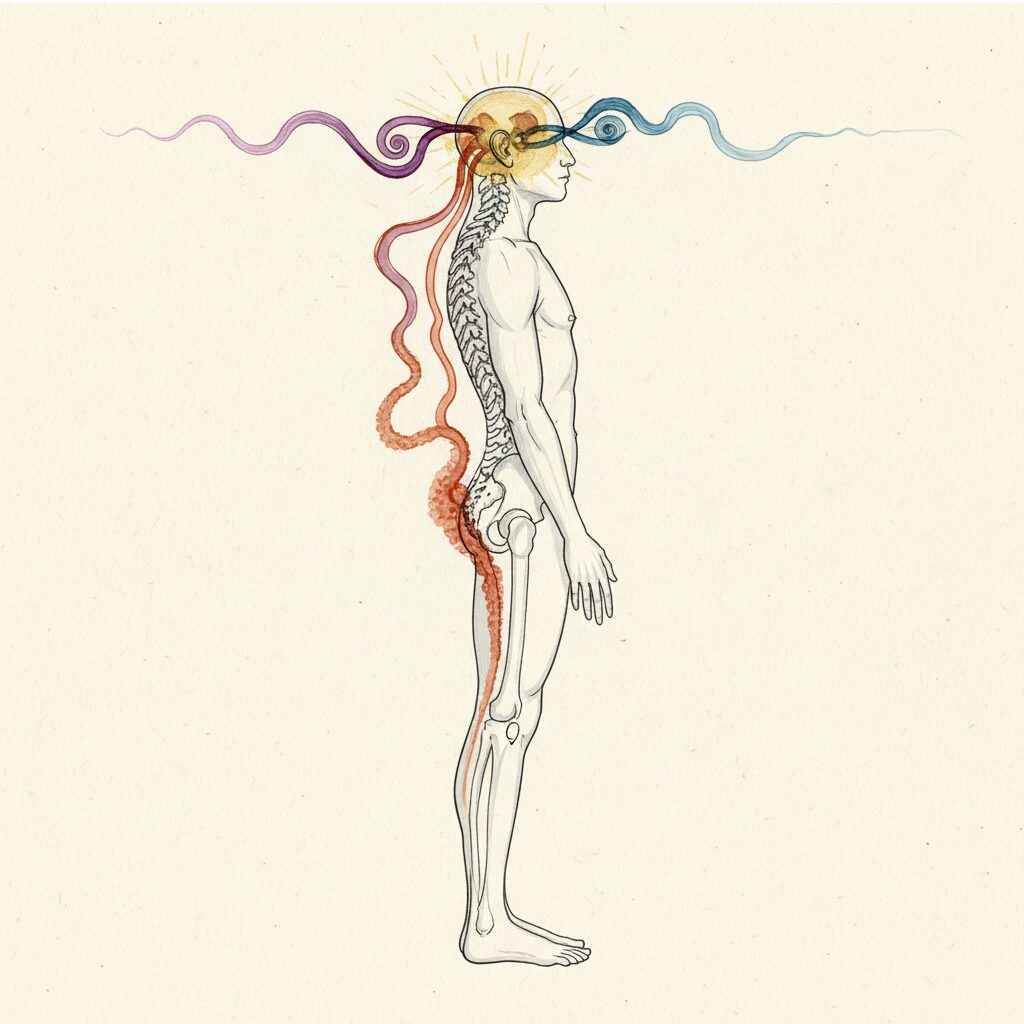
I want to be clear about something. I did not see this pattern first. The researchers saw it in their own data. Each group published in their own silo. Each group described their own mechanism. The problem is that nobody stood back and asked: why do all of these work the same way?
When you read the Monticone paper, it describes proprioceptive retraining. When you read Schreiber, it describes sensory feedback through directed breathing. When you read Katzman, it describes awareness under load. Each one identified the input channel they were targeting. None of them had a framework that unified all five.
That framework now exists. We published it as the Neural Generation Hypothesis. And it did not exist when any of these trials were designed. We are not claiming these researchers were wrong. We are saying they were all right, and the reason they were all right is the same reason.
The Three Clocks: Why Changes Happen at Different Speeds
The degree changes documented in these trials are real. But understanding what kind of change you are looking at matters as much as the number itself.
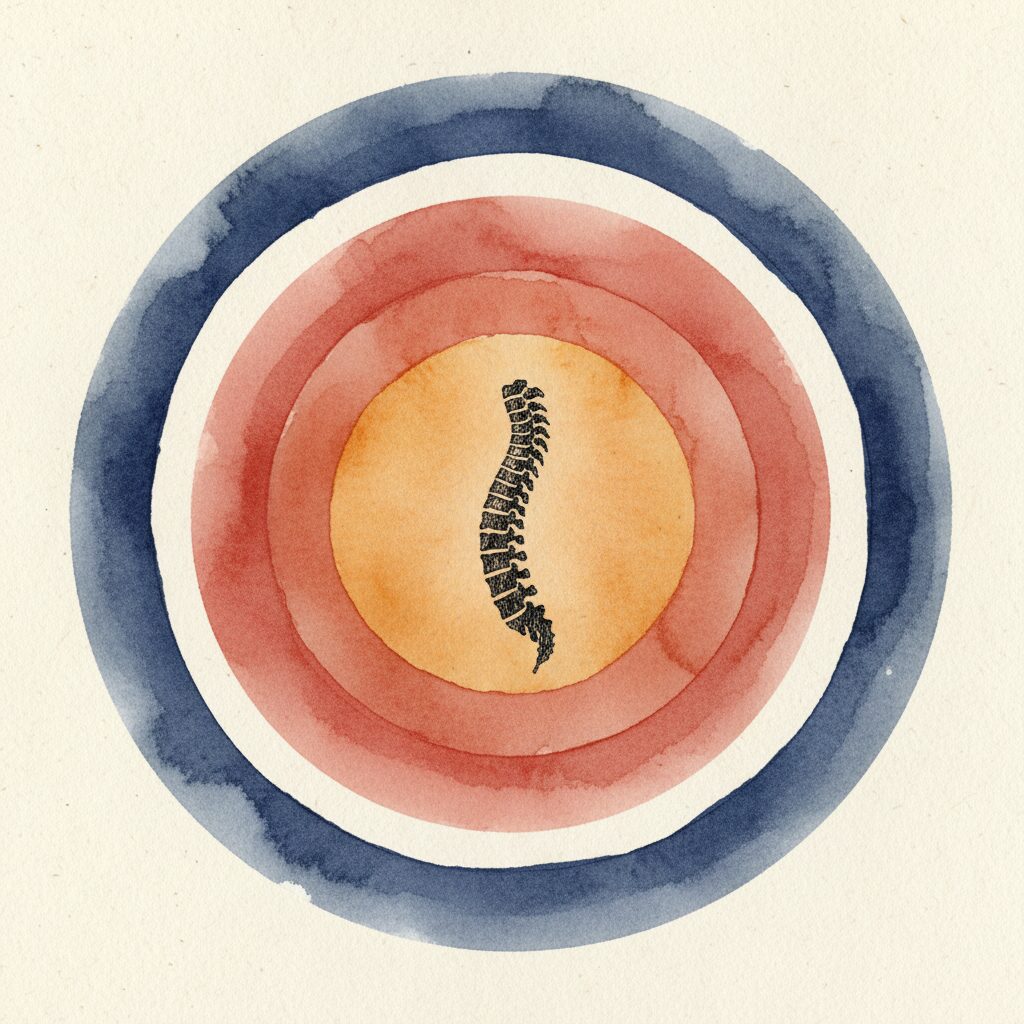
Your body operates on three timescales when it comes to structural change. Understanding which clock is ticking tells you what kind of change is realistic and how long it takes to hold.
Clock 1: Schema (Seconds to Weeks)
The body schema updates its prediction. Musculature reorganizes around the new prediction. Standing posture measurably changes.
This is what most 3 to 12 month exercise RCTs are actually measuring. The change is real. Radiographically verified. But it is a new instruction set, not yet a new structure.
Think of it as changing the thermostat. The temperature shifts quickly. The house has not been insulated yet.
Clock 2: Soft Tissue (Weeks to Months)
Fascia, disc hydration, muscle fiber architecture, connective tissue. All of these reorganize under sustained new loading. But slowly.
How fast this happens is far less settled than it is usually presented. Measured by radiocarbon dating, the collagen core of adult tendon is essentially not renewed once height growth finishes (Heinemeier et al. 2013, FASEB Journal), and the collagen of the intervertebral disc has a half-life measured in decades rather than months (Sivan et al. 2008, Journal of Biological Chemistry). What does change over weeks to months is muscle, fluid, and the non-collagen part of the matrix. Treat 12 to 18 months as our working estimate for soft tissue settling around a new pattern, not as a measured figure. We previously cited a 100-day collagen half-life on this page. That was wrong, and the paper cited for it found close to the opposite.
This clock stabilizes Clock 1 changes. Without it, the schema update is real but fragile.
What happens after supervised practice stops has not been tested for Schroth. The one trial here that followed patients after the program ended found the opposite of fading: Monticone 2014 reported the change held for at least a year. A separate randomized trial found that supervised Schroth in the clinic improved Cobb angle while the same exercises given as an unsupervised home program did not (Kuru et al. 2016, Clinical Rehabilitation), so supervision appears to matter while the work is happening. Whether gains fade afterwards is an open question that nobody has answered.
Our own reading, and this is a hypothesis rather than a finding, is that a fade would be Clock 1 running without Clock 2: the schema updates, but the tissue never gets enough sustained loading cycles to remodel around the new prediction. Nobody has tested that.
This is why daily practice matters more than intensity. Clock 2 needs consistency, not heroics.
Clock 3: Bone (Months to Years)
Wolff’s Law. Trabecular bone reorganizes along new lines of mechanical stress. This is documented in the adolescent growth window. But here is the honest framing that matters.
Zero imaging studies have demonstrated trabecular reorganization from exercise therapy in adults.
No one can claim this layer yet. Not us. Not Schroth. Not anyone. Anyone who tells you exercise changes bone structure in adults is ahead of the evidence. The mechanism exists. Astronauts lose and regain bone density, confirming that bone responds to loading. But nobody has shown it in a postural context in adults.
What we can say: a pattern that stays unchanged for a decade deepens into tissue and bone. A pattern that shifts and holds for 12 to 18 months gets consolidated by Clock 2. The force redistribution begins working in your favor on Clock 3’s timeline. Even a 3-degree shift changes the lateral force differential on the concave versus convex side by roughly 15 to 20 percent at peak loads. Over years, that is the difference between progressive degeneration and equilibrium.
Why Even Small Changes Compound
Three to five degrees does not sound like much. Until you understand what it means over time.
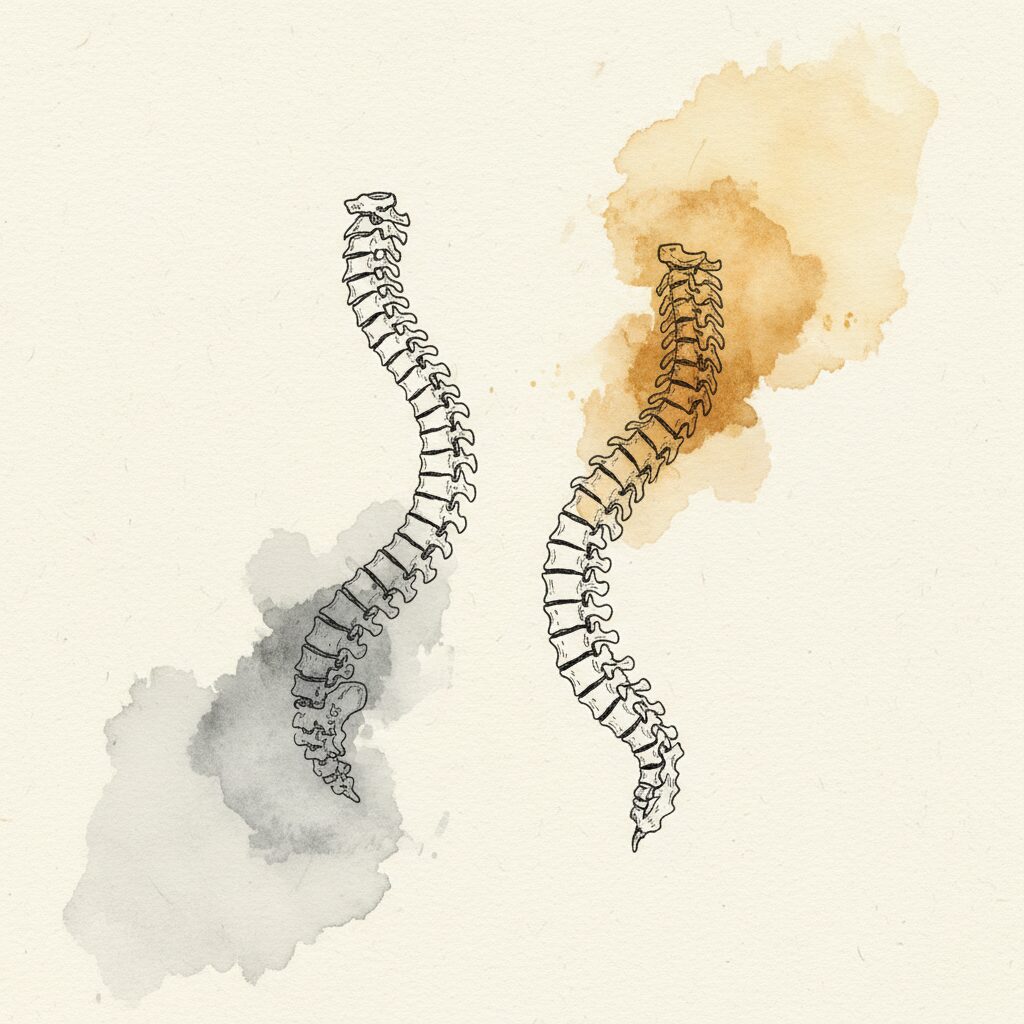
A 3-degree shift in a thoracic curve changes the force distribution across your spine by 15 to 20 percent at peak loads. The concave side, which was being compressed more every year, starts to decompress. The convex side, which was being stretched and weakened, starts to stabilize.
That is not a one-time event. That is a new direction. And direction compounds.
Every year you stay in the old pattern, the forces deepen it. The tissue remodels around compression. The discs thin asymmetrically. The facet joints wear unevenly. The pattern becomes more expensive to maintain and harder to change. This is not catastrophizing. This is physics.
Every year you practice in the new pattern, the forces work in your favor. The tissue remodels around the updated prediction. The load distributes more evenly. The system that was spending energy on protection can spend it on function instead.
The sooner you act, the less there is to undo.
And here is what the research does not measure but every practitioner sees: even when the curve does not change on an X-ray, the person changes. Pain decreases. Breathing deepens. Movement becomes easier. The nervous system stops generating a threat response around the spine. That alone changes a life.
The alternative is not “staying the same.” The alternative is regression. Curves progress. Compensation patterns deepen. Pain that was manageable becomes chronic. The body does not hold still. It is always moving in a direction.
The question is not whether you can afford to do this work. The question is whether you can afford not to.
Whether the curve changes three degrees or zero degrees, the awareness you build prevents the complications that come from living inside a pattern you cannot feel. That awareness is the floor. Everything else is upside.
This Is How We All Move Forward
Five research groups on three continents identified the same mechanism independently. That is not a coincidence. That is a signal.
The frameworks we are publishing in our research papers did not exist when these trials were designed. The Neural Generation Hypothesis. The Generative Posture Framework. These are new lenses for reading data that was already there. We hope they push everyone forward.
This is not competition. Every method that updates the generator is on the same team. Schroth practitioners. SEAS therapists. Yoga teachers who hold the pose long enough for the nervous system to listen. All of them are doing the right thing. The question now is: what happens when we do it together, in sequence, with the full input stack?
3 to 5 degrees in 6 to 12 months. That is what the evidence shows from targeting one or two inputs at a time. What it does not show yet is what happens when you address all five simultaneously, in the right order, with daily practice sustained through Clock 2. That is the experiment we are running. And we are publishing the frameworks openly so everyone can run it.
Your spine is not the problem. It is the printout. The research agrees. The exciting part is what comes next.
Ready to Address All Five Input Channels?
The Syntropic Core Foundations program sequences all five research-validated input channels in the order your nervous system needs them. Seven sessions. Daily practice. One system built from the pattern the research reveals.
Join the Foundations Waitlist at syntropiccore.com
Not sure if your posture is generated? Start here: Why Your Posture Is Generated, Not Held
Still working with the mechanical model? Read this first: The Mechanical Model Is the Problem
References
- Monticone M, et al. Active self-correction and task-oriented exercises reduce spinal deformity and improve quality of life in subjects with mild adolescent idiopathic scoliosis. European Spine Journal. 2014;23(6):1204-1214.
- Schreiber S, et al. Schroth physiotherapeutic scoliosis-specific exercises added to the standard of care lead to better Cobb angle outcomes. PLoS One. 2016;11(12):e0168746.
- Ceballos-Laita L, et al. The effectiveness of Schroth method in Cobb angle, quality of life and trunk rotation angle in adolescent idiopathic scoliosis: a systematic review and meta-analysis. European Journal of Physical and Rehabilitation Medicine. 2023;59(2):228-236. PMID 36692412.
- Katzman WB, et al. Targeted spine strengthening exercise and posture training program to reduce hyperkyphosis in older adults. Osteoporosis International. 2017;28(10):2831-2841.
- Fishman LM, Groessl EJ, Sherman KJ. Serial case reporting yoga for idiopathic and degenerative scoliosis. Global Advances in Health and Medicine. 2014;3(5):16-21. PMID 25568820.
- Fishman LM. Isometric yoga-like maneuvers improve adolescent idiopathic scoliosis: a nonrandomized control trial. Global Advances in Health and Medicine. 2021;10:2164956120988259. PMID 33717658.
- Kuru T, et al. The efficacy of three-dimensional Schroth exercises in adolescent idiopathic scoliosis: a randomised controlled clinical trial. Clinical Rehabilitation. 2016;30(2):181-190. PMID 25780260.
- Sivan SS, et al. Collagen turnover in normal and degenerate human intervertebral discs as determined by the racemization of aspartic acid. Journal of Biological Chemistry. 2008;283(14):8796-8801. PMID 18250164.
- Heinemeier KM, et al. Lack of tissue renewal in human adult Achilles tendon is revealed by nuclear bomb 14C. FASEB Journal. 2013;27(5):2074-2079.
- Otman S, Kose N, Yakut Y. The efficacy of Schroth’s 3-dimensional exercise therapy in the treatment of adolescent idiopathic scoliosis in Turkey. Saudi Med J. 2005;26(9):1429-1435.
- Ball JM, Cagle P, Johnson BE, Lucasey C, Lukert BP. Spinal extension exercises prevent natural progression of kyphosis. Osteoporos Int. 2009;20(3):481-489.
Sam Miller. Eight years of neurosomatic practice working with the body schema in scoliosis, kyphosis, and chronic postural conditions. Founder of Posture Dojo and creator of Syntropic Core.
Related research
- Two Papers Just Landed: The Neural Generation Hypothesis and the Generative Posture Framework
- Stand Up Tall, Pull Your Shoulders Back, Brace Your Core: Why the 3 Most Common Posture Cues Are Neuroscience Dead Ends
- You Can’t Tickle Yourself. That’s Why Your Posture Won’t Change.
- The Five Diaphragms You Didn’t Know You Had
Comments
3 responses to “How Much Can I Actually Change My Scoliosis? What the Research Shows”
[…] How Much Can I Actually Change My Scoliosis? What the Research Shows […]
[…] How Much Can I Actually Change My Scoliosis? What the Research Shows […]
[…] How Much Can I Actually Change My Scoliosis? What the Research Shows […]