
Monday you felt amazing. You walked out of the chiropractor’s office standing taller, breathing easier, pain gone. By Wednesday it was creeping back. By Friday you were booking next week’s appointment.
This has happened to you six times. Or sixty.
And every time, the same thought: maybe this one will hold. Maybe I need to go more often. Maybe I need a different chiropractor.
Here is what nobody in that office has explained to you. The adjustment is real. What it changed is real. And the reason it did not last has nothing to do with the skill of the person who delivered it.
The model with no explanation
The standard chiropractic model tells you your spine went “out of alignment.” The adjustment puts it “back in.” When it goes out again, you come back.
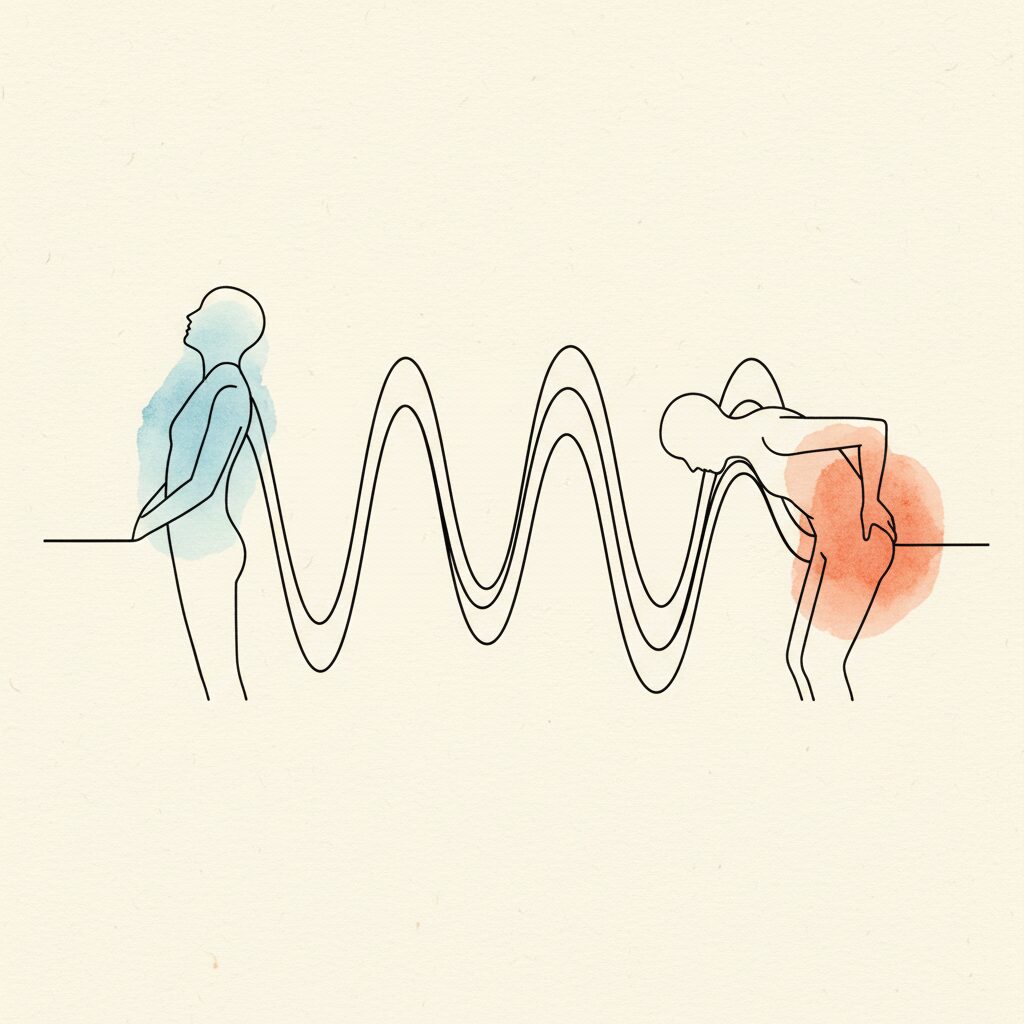
This frames your body as a building with crooked beams. The chiropractor straightens the beam. The beam goes crooked again. You return for another straightening.
Notice what is missing from this story. There is no explanation for WHY the pattern returns. The model describes what happens. It does not explain the mechanism. A beam does not go crooked on its own. Something is generating the pattern. And that something was not on the table during your adjustment.
What the adjustment actually delivers
A chiropractic adjustment produces genuine neurological input. This is not controversial and it is not trivial.
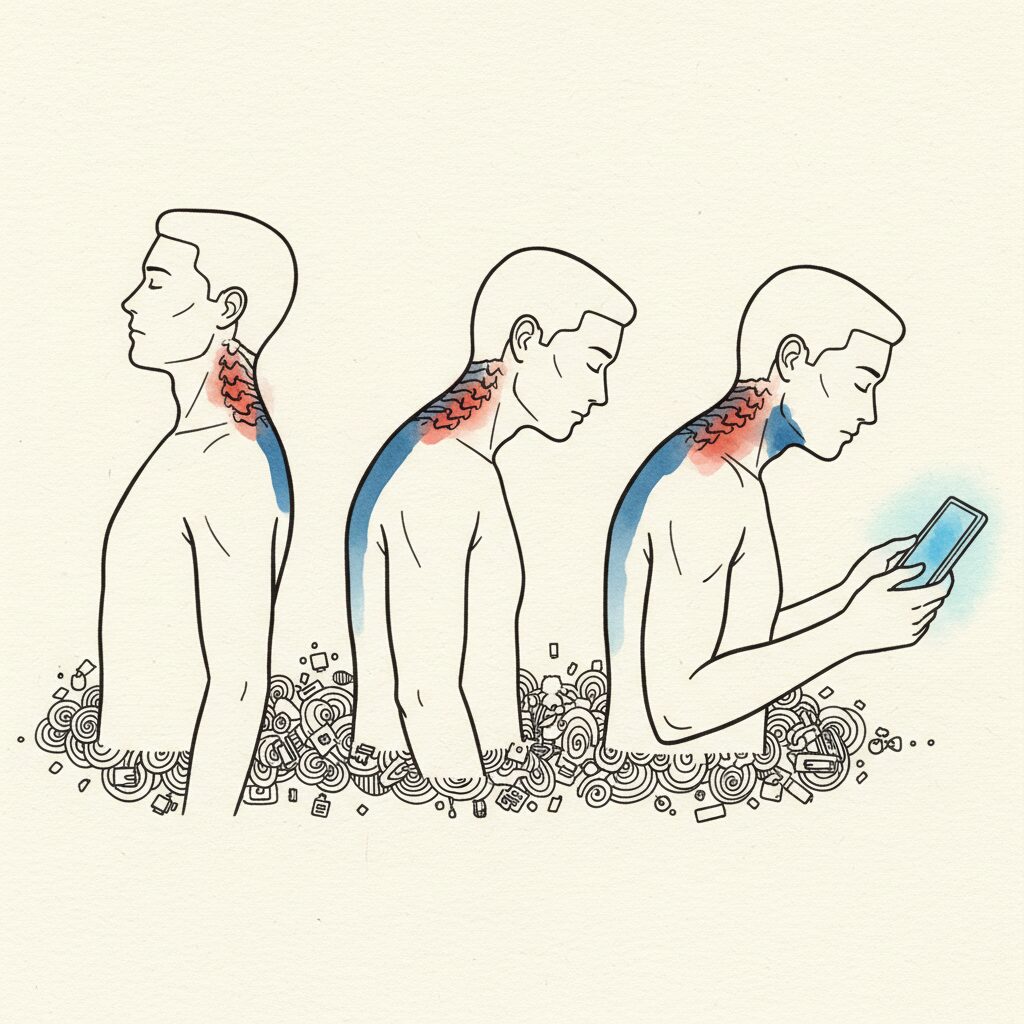
When a high-velocity thrust is applied to a spinal segment, the joint capsule is mobilized, mechanoreceptors in the surrounding tissue fire a burst of novel sensory information, and the pain gate temporarily closes. You feel different. You stand up taller. The relief is not imagined.
Here is the critical detail that changes the entire picture. The adjustment is passive. You did not produce the movement. Your motor cortex did not issue a command. And that matters enormously.
Kilteni and Ehrsson (2020) demonstrated that efference copies, the brain’s predicted version of self-generated sensation, are produced only by volitional movement. Passive movement generates no efference copy. This means the sensory signal from a passive event arrives at the body schema unattenuated: full strength, full precision. When a chiropractor manipulates your spine, you did not generate a motor command for that movement. No efference copy was produced. The proprioceptive signal from the manipulation reaches your body schema without the cancellation that would occur if you had produced the same movement yourself. This is why adjustments feel so vivid. The signal gets through in a way that your own corrections never do.
Kilteni and Ehrsson demonstrated in 2020 that efference copies are generated only by volitional movement [1]. Passive movement produces no efference copy. No cancellation. The signal arrives at full strength.
This is why the adjustment feels so vivid. Your own attempts to correct your posture generate motor commands that suppress the very feedback you need. The chiropractor’s hands bypass that suppression entirely. The signal gets through.
Tseng and colleagues confirmed in 2007 that sensory prediction errors drive cerebellar adaptation [2]. The adjustment creates a genuine prediction error. Your brain predicted one position. The manipulation delivered another. The mismatch registers. Your cerebellum responds.
The adjustment works. That is not the problem.
The problem is the competition
Your body schema is a prediction system. It has been running the current postural prediction for thousands of hours. Every minute you sit at your desk. Every hour you drive. Every night you sleep in the same position. Thousands of repetitions of the same sensory input, consolidating the same prediction.
In the language of how the brain updates, this is a high-confidence prior. A deeply consolidated prediction that the brain treats as reliable.
The chiropractic adjustment is a single prediction error competing against that consolidated prediction.
Shadmehr, Smith, and Krakauer (2010) established that the brain updates its motor predictions through the accumulation of prediction errors over time, not through single corrective events. A single sensory prediction error creates a transient perturbation in the forward model, but the brain’s confidence in its existing prediction (the prior) determines how much weight the new evidence receives. A deeply consolidated prior, one that has been reinforced by thousands of hours of consistent sensory input, assigns low precision to a single contradictory event. The prediction error is registered but does not outweigh the accumulated evidence supporting the current model. This is why a single manipulation can produce a temporary change in posture without altering the underlying prediction that generates the posture.
Shadmehr, Smith, and Krakauer showed in 2010 that motor predictions update through the accumulation of prediction errors, not single events [3]. Your brain weighs the new evidence against the old. A single manipulation registers. But it does not outweigh thousands of hours of consolidated input.
The prior wins. Not because the adjustment failed. Because a single event cannot overwrite a deeply consolidated prediction.
Your chiropractor gave you one rep. Your pattern has 200,000.
The motor cortex problem
There is a deeper layer. Tsao, Galea, and Hodges demonstrated in 2008 that chronic low back pain patients have reorganized motor cortex maps [4]. The area of the motor cortex that controls the deep trunk muscles has shifted, smeared, lost its precision.
A single spinal manipulation does not remap motor cortex. It cannot. Cortical reorganization requires repeated evidence delivery over time, with consolidation windows between sessions. The adjustment opens a window. The motor cortex map does not change during one window.
This is not a limitation of chiropractic. It is a limitation of any single-event intervention applied to a pattern that has been consolidating for years. The body schema does not update from one conversation. It updates from a pattern of evidence that the brain can no longer explain away with the old prediction.
Your chiropractor cleared the cache
Think of your posture pattern as a website. Your body schema is the server. The code that generates the page lives on the server.
The chiropractic adjustment cleared your browser cache. The page loaded fresh. For fourteen hours, everything looked different. Cleaner. More open. The pain was gone. The stiffness was gone.
But the server was untouched. The same code was still running. And when the cache refilled, the same page rendered.
The adjustment reached the browser. It never reached the server.
Your body schema is the server. Until the code that generates the pattern is updated, the pattern will regenerate after every cache-clear. Not because the chiropractor failed. Because cache-clearing is not code-editing.
The window most people waste
Here is what the adjustment does give you. A window.
For a brief period after a manipulation, the prior has been disrupted. The prediction is slightly less confident. The system is momentarily more receptive to new sensory evidence. This is real. This is valuable.
Most people waste this window. They walk out of the office, sit in the car, drive home, sit on the couch, and re-deliver the exact same sensory input that built the pattern in the first place. The window closes. The prior reconsolidates. The pattern returns.
Tseng et al. (2007) demonstrated that sensory prediction errors are the primary driver of cerebellar adaptation. When the cerebellum detects a mismatch between predicted and actual sensory input, it enters a state of heightened plasticity, temporarily increasing the weight assigned to new sensory evidence. This creates a window during which the motor system is more responsive to novel input. The window is time-limited: without reinforcing evidence, the cerebellar model reverts to its prior state. Blakemore, Wolpert, and Frith (1999) showed that sensory attenuation is proportional to prediction confidence. When prediction confidence is temporarily reduced, as occurs immediately following a manipulation that generates unexpected sensory input, incoming signals receive higher weighting. This is the neurological basis for the post-adjustment window: a brief period of reduced prior confidence during which the system is more receptive to evidence that would normally be dismissed.
The adjustment is not the treatment. The adjustment is the opening. What you do inside that opening determines whether anything changes permanently.
What adjustments actually need
I am not anti-chiropractic. I have received hundreds of adjustments. Some of my most important early breakthroughs in understanding my own body happened on a chiropractic table. The adjustment gave me the first sensory evidence that my body could exist in a different configuration. That mattered.
What I did not understand for years was why it never lasted. I thought I needed more adjustments. More frequently. A better chiropractor. What I actually needed was a system that could use the window the adjustment created.
The adjustment delivers one prediction error. Trying harder to hold the new position generates efference copies that suppress the signal. Going back for more adjustments delivers more single events that each compete against the same consolidated prior.
What changes the prior is not one event. It is a pattern of evidence, delivered through channels that do not generate efference copies, repeated enough times that the brain’s confidence in its old prediction erodes. The adjustment opens the door. Something else has to walk through it.
Mood before shape
If you have had an adjustment in the last week, you might still feel a trace of the change it made.
Most people cannot tell what is different. They check the shape. Is my shoulder still lower? Is my head still back? Did the correction hold? And the answer is usually no, the shape returned.
But there was something else. Before the shape changed, something shifted that was harder to name. A slight ease. A settling. A moment where your body felt less like a project and more like a place you could be.
That came first. Before the structural change. And it disappeared first, too. Most people do not notice it going because they were never taught to notice it arriving.
The sequence matters. The nervous system settles before the structure follows. The interoceptive shift, the felt sense of ease, arrives before the proprioceptive shift, the change in shape. When you track the wrong signal, you miss the real one.
Your body does not update from being rearranged. It updates from receiving evidence that a different organization is possible. The adjustment delivered that evidence. Briefly. Through one channel. Once.
The question is not whether the adjustment worked. It did. The question is what happens in the 23 hours and 55 minutes after it.
—
The Posture Dojo is a free community where we explore what the body actually does with new information, and why most of it gets thrown away. No corrections. No exercises. A different operating system for your body. Join the conversation here.
Sources
- Kilteni, K., & Ehrsson, H.H. (2020). Efference copy is necessary for the attenuation of self-generated touch. iScience, 23(2), 100843. PMID: 32058957 [T1]
Demonstrated that efference copies are generated only by volitional movement and are necessary for sensory attenuation. Passive movement produces no attenuation. The adjustment delivers signal at full strength because it bypasses the efference copy mechanism. - Tseng, Y.W., et al. (2007). Sensory prediction errors drive cerebellum-dependent adaptation of reaching. Journal of Neurophysiology, 98(1), 54-62. PMID: 17507504 [T1]
Confirmed that sensory prediction errors are the primary driver of cerebellar adaptation. The mismatch between predicted and actual sensory input is the currency the motor system uses to update its model. - Shadmehr, R., Smith, M.A., & Krakauer, J.W. (2010). Error correction, sensory prediction, and adaptation in motor control. Annual Review of Neuroscience, 33, 89-108. PMID: 20367317 [T1]
Established that motor predictions update through accumulated prediction errors over time, not through single corrective events. A consolidated prior resists updating from a single contradictory input. - Tsao, H., Galea, M.P., & Hodges, P.W. (2008). Reorganization of the motor cortex is associated with postural control deficits in recurrent low back pain. Brain, 131(Pt 8), 2161-2171. PMID: 18669505 [T1]
Demonstrated motor cortex reorganization in chronic LBP patients. The cortical map controlling deep trunk muscles shifts and smears. A single manipulation cannot remap motor cortex. Repeated evidence delivery with consolidation windows is required. - Blakemore, S.J., Wolpert, D.M., & Frith, C.D. (1999). Spatio-temporal prediction modulates perception of self-produced stimuli. Journal of Cognitive Neuroscience, 11(5), 551-559. PMID: 10511643 [T1]
Established that sensory attenuation is proportional to prediction confidence. When prior confidence is reduced, as occurs after unexpected sensory input from a manipulation, incoming signals receive higher weighting. This is the neurological basis for the post-adjustment window.
Related research
- Why Awareness Changes Your Posture (And Effort Doesn’t)
- Two Papers Just Landed: The Neural Generation Hypothesis and the Generative Posture Framework
- Stand Up Tall, Pull Your Shoulders Back, Brace Your Core: Why the 3 Most Common Posture Cues Are Neuroscience Dead Ends
- Stop Fighting Your Pain. Start Reading It.
Comments
One response to “Why Chiropractic Adjustments Don’t Last (The Real Reason)”
[…] chiropractic adjustments don’t last […]