You have been told your kyphosis is either structural or postural. One means it is fixed in the bone. The other means you are just slouching. One is permanent. The other is your fault.
Both frames are wrong. Not because they are inaccurate descriptions of tissue. Because they ask the wrong question. The useful question is not “what type do I have?” The useful question is: what data is my nervous system using to generate this curve?
The structural-vs-postural binary assumes the spine is a thing you have. It is not. Your spine is a thing your nervous system is generating. Right now. Every second. Based on a predictive model that updates, or fails to update, depending on the information it receives.
Scheuermann’s is real. The binary is still false.
Scheuermann’s disease produces vertebral wedging. You can see it on X-ray. The anterior height of three or more consecutive vertebrae is reduced by at least five degrees each. That is structural in the tissue sense. Nobody is denying the wedging.
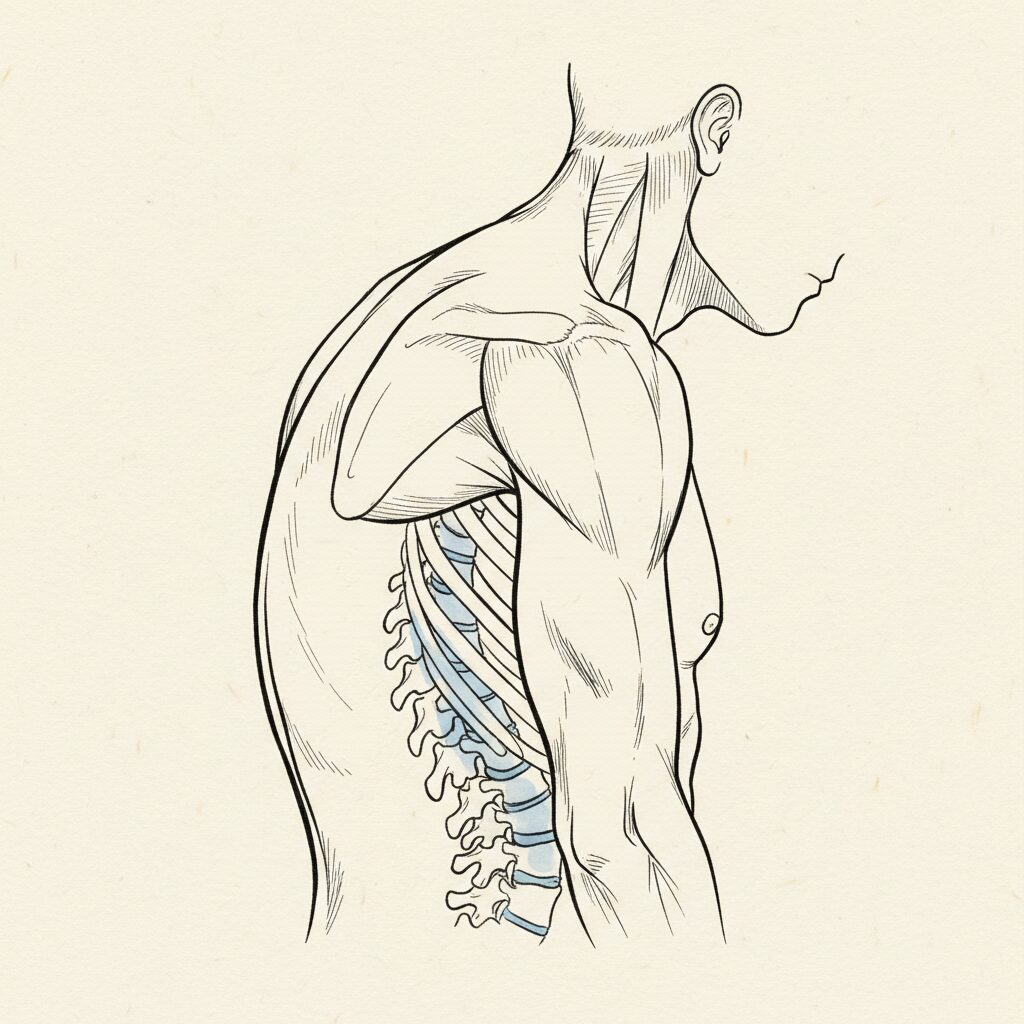
But the wedging is not generating your posture. Your nervous system is generating your posture. The wedging is one input among many. Your body schema takes that input, combines it with proprioceptive data, vestibular signals, visual field orientation, threat level, breathing pattern, and a lifetime of motor habits. Then it generates the curve you are living in.
Friston’s (2010) free-energy principle establishes that the brain operates as a prediction machine, continuously generating motor outputs that minimize surprise between expected and actual sensory states. Posture is not held. It is predicted. The nervous system generates a postural configuration based on its best model of the body in space, then compares sensory feedback against that prediction. In kyphosis, the curve is the prediction, maintained because the body schema’s model has not received sufficient prediction error to update. Paillard’s (1999) double dissociation work demonstrated that the body schema operates below conscious awareness, maintaining a spatial model of the body that directly governs motor output. Patients with intact body image but damaged body schema could describe their posture but could not organize movement. This separation proves that conscious understanding of your curve, knowing it is “structural” or “postural,” has no direct access to the system generating it. Lowe (1990) documented that Scheuermann’s disease produces measurable vertebral wedging, but the compensatory patterns above and below the apex, the cervical hyperextension, the lumbar flattening, the rib cage rigidity, are all generated by the nervous system in response to the wedging. The bone change is one variable. The body schema’s response to that variable generates everything you actually experience as “your kyphosis.”
The question that changes everything
Stop asking whether your kyphosis is structural or postural. Start asking: what is my body schema using to generate this prediction?
The body schema is not choosing your curve randomly. It is solving a problem. It is organizing you around the best data it has. If that data includes a threat signal, the prediction tilts toward extension and bracing. If that data includes reduced proprioception from the thoracic spine, the prediction fills in the gaps with its best guess, which is usually yesterday’s posture.
The curve persists not because bone is in the way. The curve persists because the prediction has not been interrupted.
Why the binary keeps you stuck
“Structural” tells you nothing can change. So you stop trying. You manage. You accommodate. You buy a better chair. The prediction never receives new data. The curve deepens.
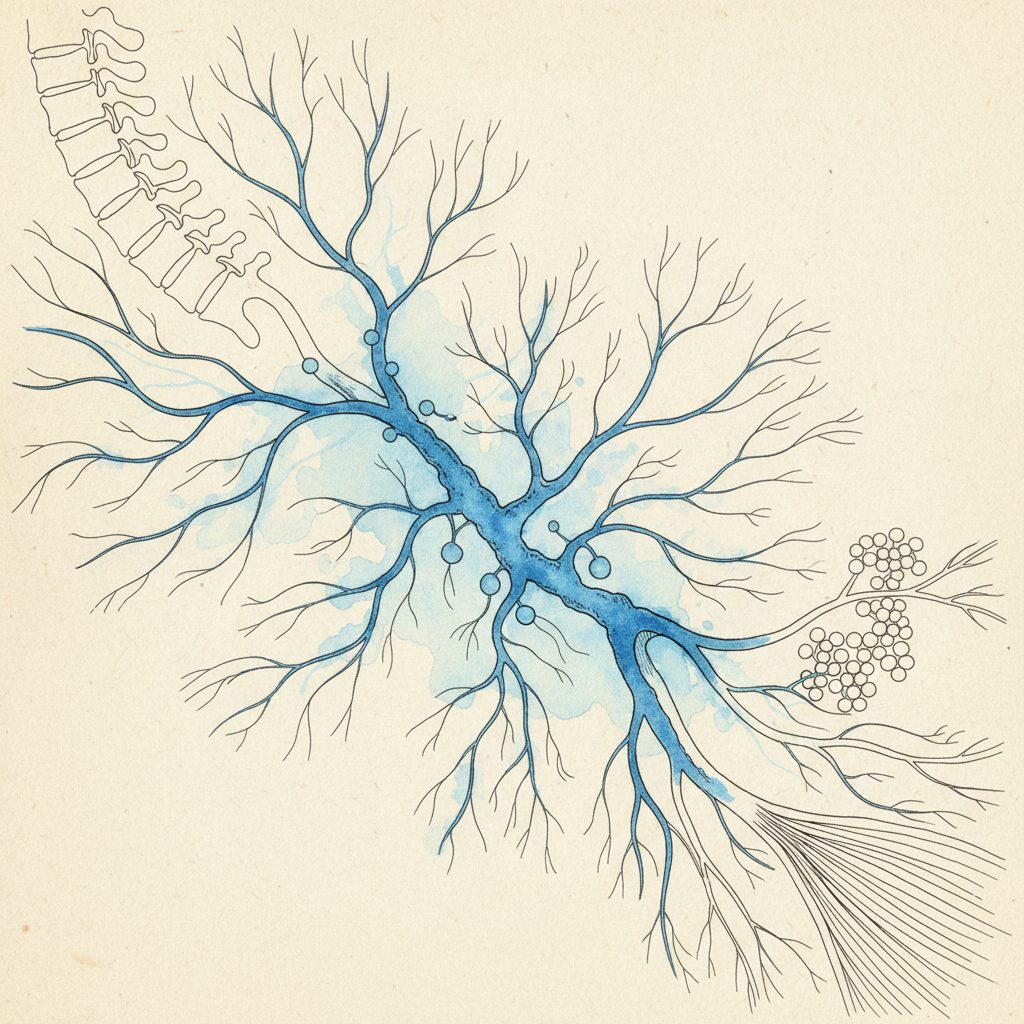
“Postural” tells you it is a discipline problem. So you try harder. You pull your shoulders back. You activate your rhomboids. You generate efference copies that suppress the very proprioceptive feedback your body schema needs to update. The prediction never receives new data. The curve deepens.
Both answers lead to the same place. Both answers prevent the one thing that would actually change the output: a prediction error delivered to the body schema under conditions where it can integrate.
Clark (2015) describes the brain as a “prediction machine” that generates experience and action through hierarchical Bayesian inference. Conscious correction, the deliberate attempt to stand straighter, operates at the highest level of the hierarchy. But postural generation happens at lower levels, in body schema circuits that do not take instructions from conscious intention. The correction is a top-down override that lasts only as long as attention sustains it. The moment attention shifts, the deeper prediction reasserts. This is not willpower failure. It is architectural. The prediction lives below the level where “stand up straight” operates. To change the prediction, you need to deliver new sensory evidence at the level where the prediction is generated: proprioceptive, interoceptive, and vestibular channels that feed directly into the body schema’s model.
The curve is an output. Treat the input.
Your kyphosis, whether it involves vertebral wedging or not, is the output of a predictive system. The system is generating this curve because its model says this is the best configuration given current data.
Change the data. Change the output.
Not by forcing a new shape. By delivering information the body schema was not expecting. Pressure where there has been absence. Sensation where there has been numbness. Safety where there has been threat. That is prediction error. And prediction error is the only language the body schema speaks.
—
Related: Kyphosis: The Complete Guide | The Kyphosis Bracing Pattern | Your Diagnosis Is Not the Cause
—
Syntropic Core works at the prediction layer. It asks what evidence the body schema needs to generate a different prediction, then delivers it through organized internal pressure, sensory recalibration, and the Safety-Sensory-Motor hierarchy. Not correction. Update. See how it works.
Sources
- Friston, K. (2010). The free-energy principle: a unified brain theory? Nature Reviews Neuroscience, 11(2), 127-138. PMID: 20068583 [T1]
The brain minimizes prediction error through action and perception. Posture is a prediction, not a position. - Paillard, J. (1999). Body schema and body image: a double dissociation in deafferented patients. In G.N. Gantchev, S. Mori, & J. Massion (Eds.), Motor Control, Today and Tomorrow. Academic Publishing House. [T1]
Body schema and body image are dissociable. Conscious knowledge of posture does not govern the system generating it. - Lowe, T.G. (1990). Scheuermann disease. Journal of Bone and Joint Surgery, 72(6), 940-945. PMID: 2195036 [T1]
Vertebral wedging is measurable. But the compensatory patterns surrounding it are generated by the nervous system, not the bone. - Clark, A. (2015). Surfing Uncertainty: Prediction, Action, and the Embodied Mind. Oxford University Press. ISBN: 978-0190217013 [T1]
The brain is a prediction machine. Conscious correction operates above the level where postural predictions are generated.
Related research
- Best Exercises for Kyphosis: What Actually Changes the Curve
- Cervical Kyphosis, Military Neck, and the Flat Neck Epidemic
- Your Kyphosis Is Not a Mistake Your Body Made
- Kyphosis and Ankylosing Spondylitis: What Surgery Can and Can’t Change
Related Reading
- Best Exercises for Kyphosis
- Why “Standing Up Straight” Makes Kyphosis Worse
- Kyphosis as a Nervous System Bracing Pattern
Comments
3 responses to “Is Your Kyphosis Structural or Postural? Why That’s the Wrong Question”
[…] Is Your Kyphosis Structural or Postural? Why That’s the Wrong Question […]
[…] Is Your Kyphosis Structural or Postural? […]
[…] Is Your Kyphosis Structural or Postural? Why That’s the Wrong Question […]