You are about to lie on the floor and move like a three-month-old. And it is going to do more for your posture than the last five years of corrective exercise combined.
I know how it sounds. Ridiculous. Reductive. Like some influencer selling you a gimmick wrapped in science language. But this is Dynamic Neuromuscular Stabilization (DNS), developed by the Prague School of Rehabilitation under Pavel Kolar. It is the most rigorously studied developmental movement approach in clinical rehabilitation. And the reason it works on adults is the reason most posture programs fail: it addresses the operating system, not the applications running on top of it.
DNS positions are the developmental positions infants move through on the way to standing. DNS uses them with adults because each one is the configuration where a specific stabilization pattern first came online: the diaphragm, the deep core, the joints under load. Here is what each one calibrates, and the order to take them in.
The Original Boot Sequence
Every human who has ever lived went through the same developmental movement sequence. Supine. Prone on elbows. Rolling. Quadruped. Kneeling. Half-kneeling. Standing. Every one. Regardless of culture, era, geography, or genetics.
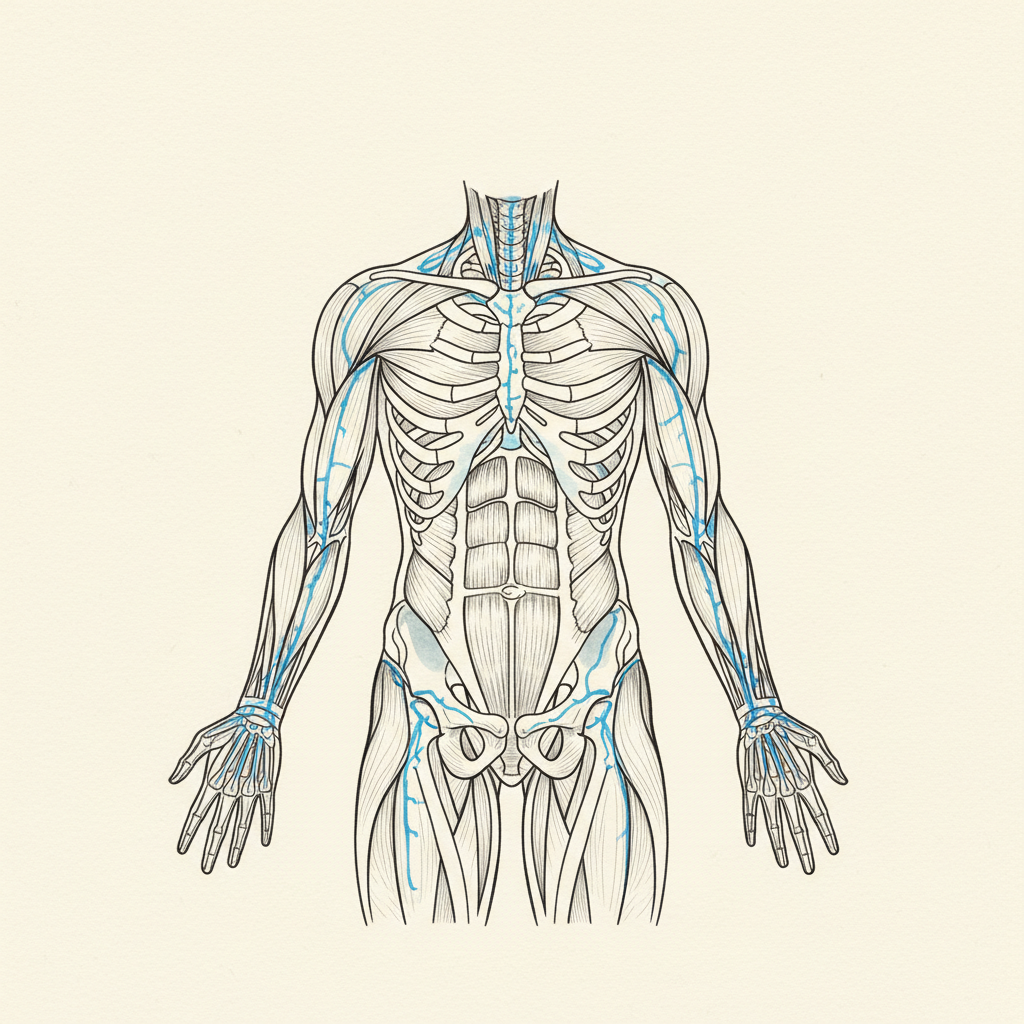
Hardwired.
Each position activates specific stabilization patterns. The diaphragm learns to descend. Deep core musculature learns to co-activate. Joints learn their load-bearing relationships. The body schema builds its first spatial map. Every position is a calibration step in a sequence the nervous system has been running since before recorded history.
DNS uses these developmental positions in adults because they are the original software installation. Not arbitrary. The specific configurations in which the system first learned to stabilize the spine, organize internal pressure, and coordinate movement. Return to them, and the system has an opportunity to reinstall patterns that may have been overwritten by decades of chairs, shoes, screens, and compensatory use.
Not Baby-Specific. Nervous System-Specific.
Common objection: adults are not babies. Different proportions, different loads, different demands.
Correct. But the positions are not about being a baby. They are about the configurations in which specific stabilization software came online for the first time.
The three-month supine position is when the diaphragm first achieves its dual role: respiratory pump AND postural stabilizer. Intra-abdominal pressure comes online. For the first time in development, the spine has internal hydraulic support.
If your adult body has lost that internal pressure system, if your diaphragm has been pulled up into chest-dominant breathing or locked into a bracing pattern, then you are running without software that was installed at three months of age. The supine position gives the system a chance to re-access it. You are returning to the specific configuration where the pattern was established.
Yola, a 67-year-old participant with a severe S-curve, described what happened when she found this position: “When I hold the pressure, even if I breathe out, if I hold it up, my upper body somehow aligns. It was fantastic feeling. I didn’t have to stay straight or feel the twist. I didn’t have to do any work. It just worked.”
She did not force her spine straight. She gave the system the conditions it needed, and it organized itself.
DNS Developmental Positions: What Each One Calibrates
Three-month supine. On your back, knees bent, feet in air. Diaphragm in optimal position. Gravity assists instead of resisting the pressure system. Deep stabilizers activate without competing against gravity. The canister learns to seal. The diaphragm descends against the pelvic floor’s response. If this does not work, nothing built on top of it will work either.
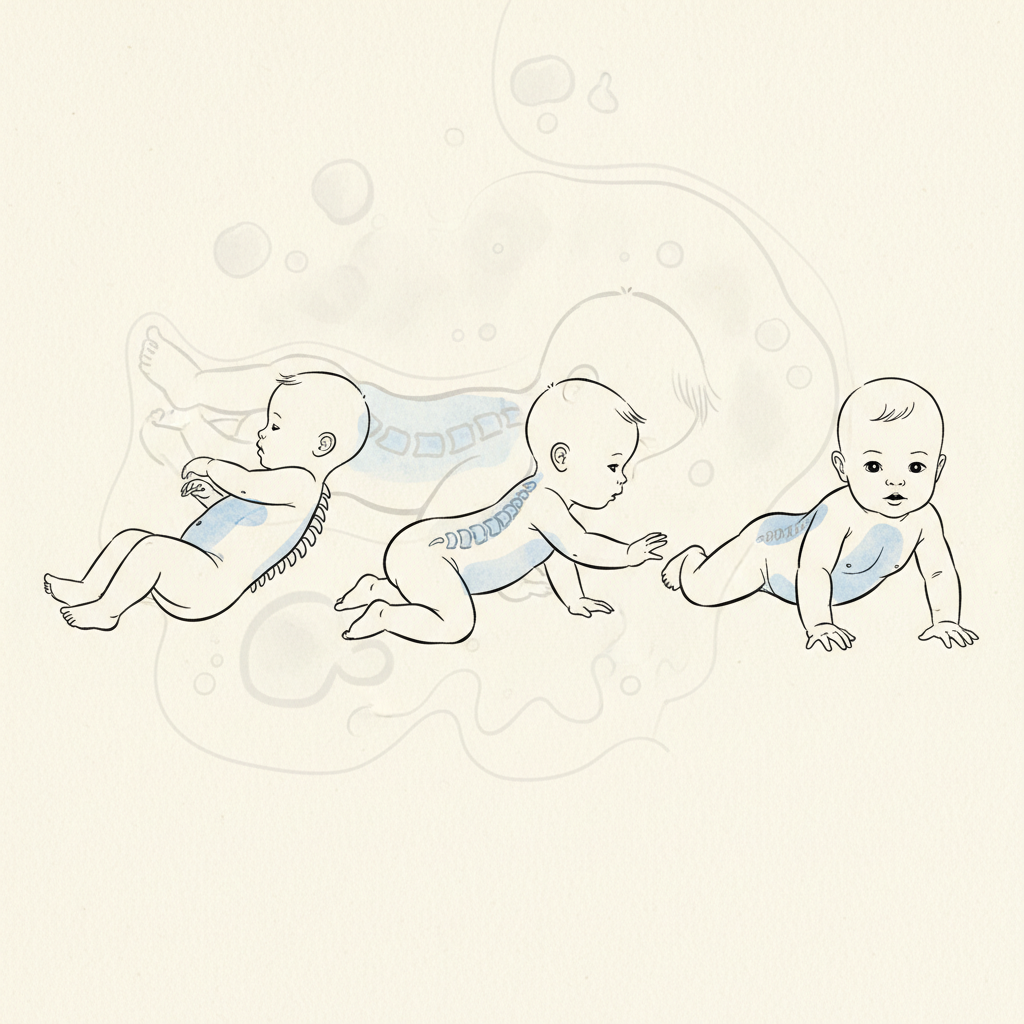
Three-month prone. Face down, supported on forearms. The cervical spine learns its relationship with the shoulder girdle. Deep neck flexors engage. Thoracic extensors activate. Scapulae stabilize against the rib cage. Head control integrates with spinal extension.
Rolling patterns. The transition between supine and prone. Where the spiral fascial lines first activate. Oblique slings learn to coordinate. Rotation enters a system that has only known linear movement. For scoliosis, particularly powerful: organized rotation versus the disorganized rotation the curve imposes.
Quadruped. The first position where the spine must stabilize against gravity without the floor’s support. The canister must hold while limbs move. Reveals deficits immediately. Spine sags: pressure system inadequate. Pelvis shifts: hip stabilizers not integrated. Diagnostic as much as therapeutic.
Kneeling and half-kneeling. Vertical positions below standing. Reduce gravitational demand while requiring vertical stabilization. Half-kneeling introduces asymmetry, where most compensatory patterns become visible and addressable.
PRI and DNS: Shared Ground, Different Angles
If you have explored posture correction beyond the mainstream, you may have found the Postural Restoration Institute. PRI and DNS share philosophical territory but approach from different directions.
PRI focuses on inherent human asymmetry. Right diaphragm dominance, the liver’s mass, the heart’s leftward position. The body is not symmetrical, and correction must account for this.
DNS focuses on developmental patterning and ideal stabilization. Less concerned with inherent asymmetry, more concerned with the quality of the stabilization pattern itself. Is this the pattern the system would have chosen in an ideal developmental environment?
Both recognize that posture is neurologically generated. Both use positions and breathing as primary tools. Both understand the diaphragm is central. Where they differ is emphasis. PRI: asymmetry management. DNS: developmental re-patterning. For scoliosis, both perspectives are valuable. Developmental patterns provide the foundation. Asymmetry management addresses the reality of a body that has been adapting to a non-ideal structure for decades.
Your posture has a pattern. Most people never get shown what it is.
Two minutes. A few honest questions. Find out where to start, and why.
Why Planks Miss the Point
Planks. Crunches. Dead bugs. Bird dogs. Standard core stability exercises. Not wrong. They build abdominal capacity. But they assume the stabilization pattern is already correct and just needs to be stronger.
DNS says the pattern itself may be wrong.
The sequence in which muscles activate. The relationship between diaphragm and pelvic floor. The timing of deep stabilizers relative to surface muscles. All of it may be organized incorrectly. Strengthening an incorrect pattern reinforces it.
Hardware upgrades running the same buggy code versus a software reinstallation.
Pattern first. Strength second. Most programs reverse this. Strength gets layered on top of compensatory patterns. The patterns get stronger. The compensations get more entrenched. The person works harder while the underlying organization never changes.
How to Start
Follow the developmental progression. Start at the bottom. Do not skip levels.
Supine first. Establish diaphragmatic breathing with organized internal pressure. Feet in the air, knees bent. Feel the canister seal. Feel the spine supported by internal pressure, not surface gripping. If the diaphragm will not descend, if the abdominal wall cannot hold, stay here. This is the foundation.
Prone next. Forearms down. Head neutral. Deep neck flexors engaged. Scapulae stable. Maintain the pressure system from supine in this new position. If pressure collapses, go back.
Then rolling. Slow, controlled transitions. Let the spiral lines activate. No momentum. Let rotation emerge from the pressure system. Jerky or uncontrolled: the system is not ready. More time below.
Then quadruped, kneeling, half-kneeling. Each position adds gravitational demand. Each tests whether the pattern from the position below survives the increase in load.
Wes, a participant with congenital limb difference and CPTSD, described the progression: “My understanding is getting much better. My knowledge is kind of piling up. It’s starting to notice it in my walk, in my gait. My ability to sense is getting stronger.”
Sensing. That is the real output. Not strength. Sensing.
Calibration, Not Exercise
Every piece of technology has a reset function. A way to return to factory settings when accumulated errors become too many to troubleshoot individually. The developmental sequence is the human body’s calibration mode.
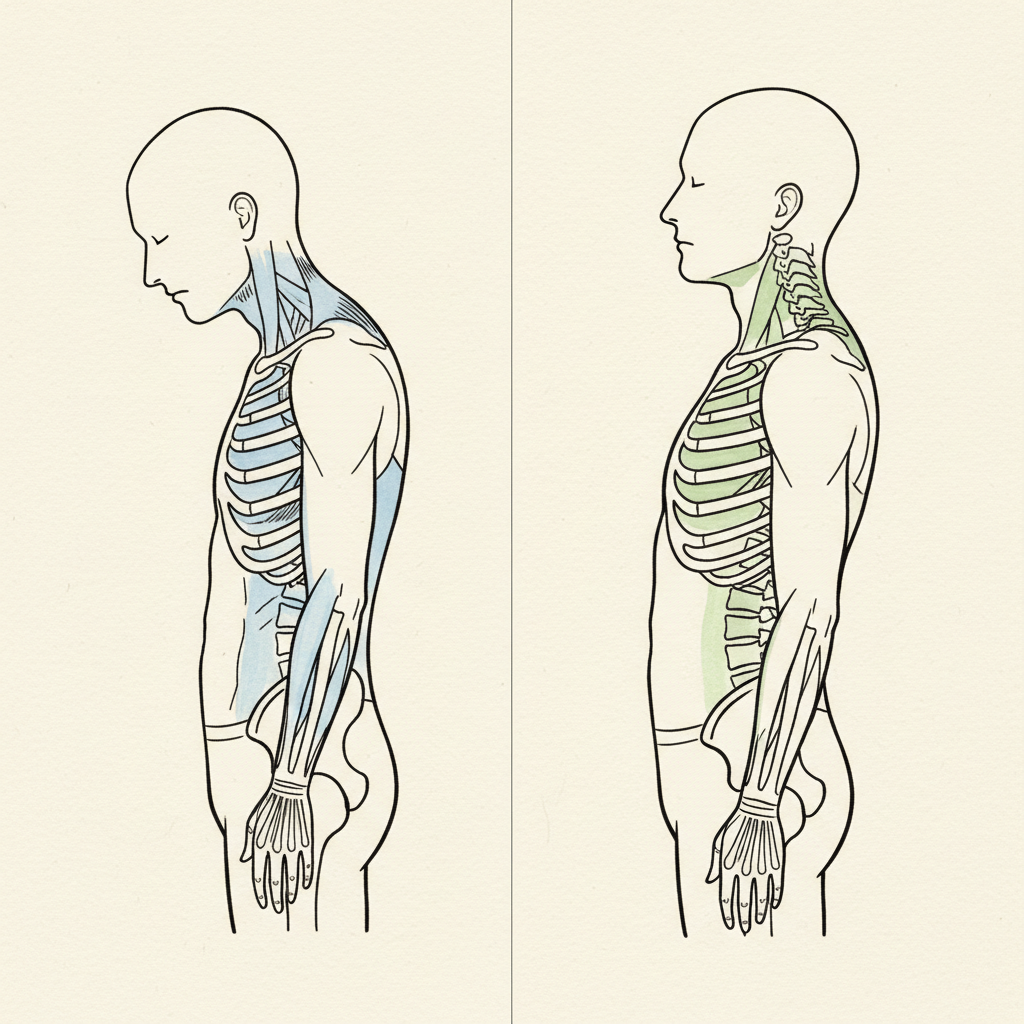
When you lie in the three-month supine position and let the diaphragm descend, you are not exercising. You are calibrating. Giving the system the specific sensory context in which the pressure system was originally installed. The system recognizes the context. The pattern re-emerges. The conditions for its emergence were recreated.
DNS positions often produce changes that feel disproportionate to the effort. Ten minutes on the floor, moving slowly, breathing deliberately. You stand up feeling different. You did not build muscle in ten minutes. The system updated a pattern that had been running incorrectly for years. The update propagates. Standing feels different because the stabilization underneath standing has changed.
You went through this sequence once already. The patterns are in the system. Installed during the first year of your life. Overwritten, not deleted. The original code is still there, underneath the compensatory layers.
These are not baby exercises. They are the most sophisticated movement patterns you will ever do. Because they address the level of organization that generates every other movement you have.
Frequently Asked Questions
What are the DNS developmental positions, in order?
Supine, prone on elbows, rolling, quadruped, kneeling, half-kneeling, standing. Infants move through the same sequence, most of it in the first year of life. Work through them in the same order as an adult. Start at the bottom and do not skip levels. Each position tests whether the pattern from the one below survives more load.
Why use baby positions with adults?
The positions are not about being a baby. They are the configurations in which specific stabilization patterns came online for the first time. Three-month supine is where the diaphragm first takes on both jobs, breathing and postural support. If your adult body has lost that internal pressure system, the same position gives the nervous system a chance to re-access it.
Which DNS position should an adult start with?
Three-month supine. On your back, knees bent, feet in the air. Establish diaphragmatic breathing with organized internal pressure, and feel the spine supported from inside, not by surface gripping. If the diaphragm will not descend or the abdominal wall cannot hold, stay here. If this does not work, nothing built on top of it will work either.
Sam Miller is the founder of Posture Dojo. He lives inside an 85-degree kyphoscoliosis and has for thirty years. He writes from the inside of that experience.
Syntropic Core Reset
Most posture programs give you exercises. This one updates the system that generates your posture. Four weeks live with Sam Miller. You learn how the hidden map works, why everything else missed it, and how to give your nervous system the evidence it needs to generate a different pattern. Breath. Ground contact. Safety. Sensory input. Floor to standing. You leave with a daily practice that holds because the map itself has changed.
The Reset is a four-week course.
Related research
- The Best Posture Programs in 2026 (And Why Most Share the Same Blind Spot)
- The Schroth Method: What It Gets Right and Where It Stops
- Two Papers Just Landed: The Neural Generation Hypothesis and the Generative Posture Framework
- Stand Up Tall, Pull Your Shoulders Back, Brace Your Core: Why the 3 Most Common Posture Cues Are Neuroscience Dead Ends
Related: Conservative Spine Care: how to find and choose a practitioner
Comments
2 responses to “DNS Exercises for Adults: Why Baby Positions Fix Grown-Up Posture”
[…] DNS exercises […]
[…] DNS Exercises and Developmental Positions […]