I spent years thinking my anxiety lived in my head. Therapy. Journaling. Meditation. Breathing apps. I did all of it. None of it touched the thing that actually happened when anxiety arrived: my rib cage locked.
This is the general posture-anxiety piece, written from personal experience. The scoliosis-specific version is at Scoliosis and Anxiety. The vagus-nerve mechanism is at The Vagus Nerve and Posture.
Not my thoughts. My ribs. A physical cinching around the lower thorax, like someone had tightened a belt two notches. The breath moved up into my chest. My shoulders rounded inward. My jaw clamped shut. And then, only then, did the racing thoughts begin.
I had the sequence backward for a decade.
They Share a Generator
Posture does not cause anxiety. Anxiety does not cause bad posture. They are co-expressions of a single upstream event: the nervous system’s threat assessment.
When that system reads danger, it produces two outputs simultaneously. One is psychological: hypervigilance, racing thoughts, the sense that something is wrong. The other is physical: posterior chain bracing, shallow breathing, forward head, clenched jaw. These are not two separate problems. They are one event, experienced from the inside as anxiety and visible from the outside as posture collapse.
The sympathetic branch handles this. Fight, flight, freeze. When the dial shifts toward sympathetic dominance, the body does something specific. The back extensors fire. The hip flexors shorten. The breath moves into the chest. The visual field narrows. The head drives forward.
Clinicians call the postural version “systemic extension.” It looks exactly like what most people call bad posture. It is not a posture problem. It is a threat state wearing a body.
Why Scoliosis Makes It Worse
Research consistently shows higher rates of anxiety and depression in scoliosis populations. The conventional explanation is psychosocial: people with visible curves feel self-conscious. True, but incomplete.
The deeper mechanism is hardware.
A rotated rib cage compromises the diaphragm. A compromised diaphragm reduces respiratory efficiency. Reduced respiratory efficiency lowers vagal tone. Lowered vagal tone means the parasympathetic system cannot adequately brake the sympathetic response. The nervous system runs closer to its threat threshold at baseline. The cause is physiological, not psychological. The breathing apparatus is physically restricted.
One of our participants, Kami, described noticing her diaphragm holding throughout the day: “I’d bring awareness there and it just wasn’t moving. How interesting. And then allowing it to move was less force. Not more.”
Less force. That is the whole principle in seven words. The system was not weak. It was locked.
The Loop
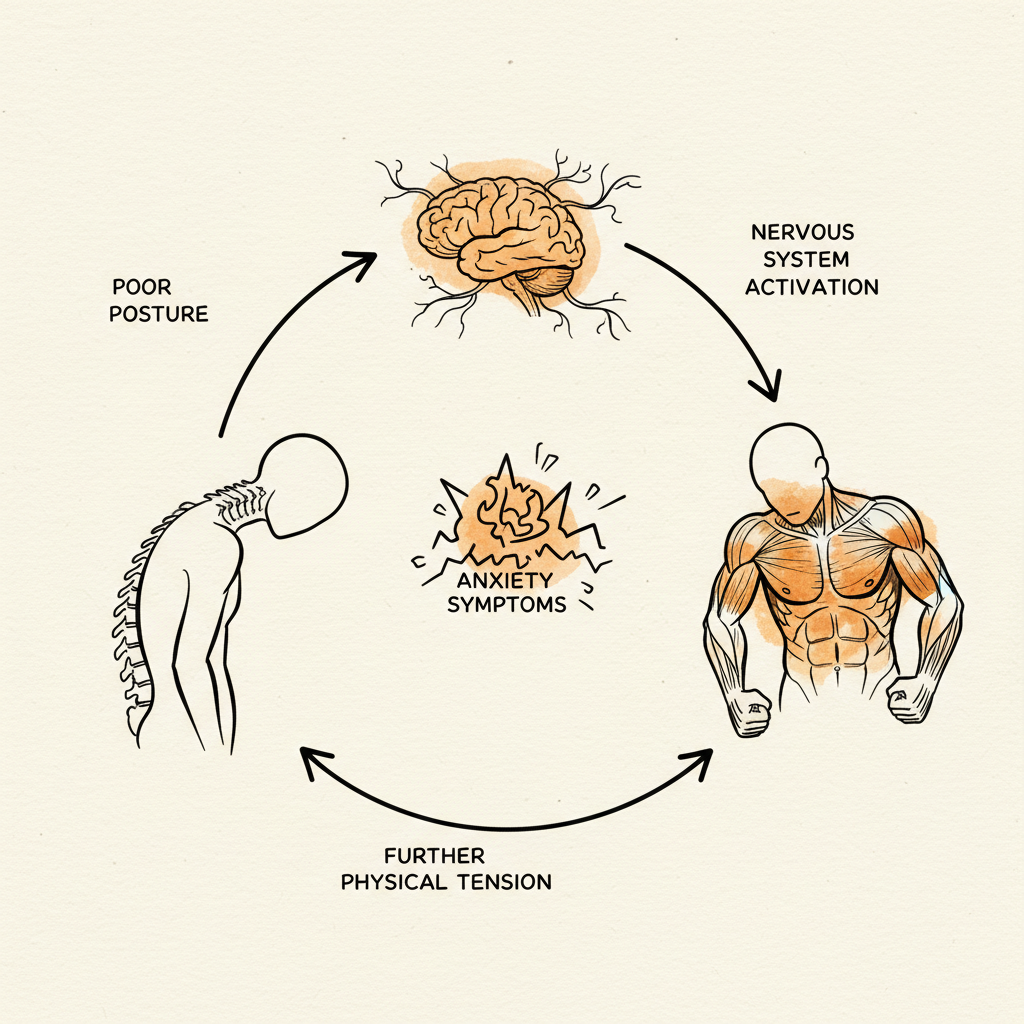
Sympathetic activation produces the bracing pattern. The bracing pattern compresses the diaphragm. The compressed diaphragm reduces vagal tone. Reduced vagal tone sustains sympathetic dominance. Which produces more bracing.
Round and round.
The anxious mind and the braced body feed each other. Neither is the cause. Both are passengers in a self-reinforcing loop driven by the autonomic system’s threat assessment. Treating anxiety as purely psychological and posture as purely physical both produce incomplete results. The anxiolytic takes the edge off the feeling but does not release the bracing. The posture exercise changes the position for ten minutes but does not shift the state. Both treat one output while the generator hums underneath.
What the Research Shows
Nair and colleagues found upright posture improved mood and reduced fatigue in mild-to-moderate depression. Wilkes showed that slumped posture increased negative affect compared to upright sitting. Michalak demonstrated that experimentally inducing upright posture improved recall of positive memories in depressed individuals.
But these studies share a blind spot. They treat posture as a position to adopt rather than a prediction to update. They show that changing the position changes the state temporarily. They do not explain why the position returns the moment the experiment ends.
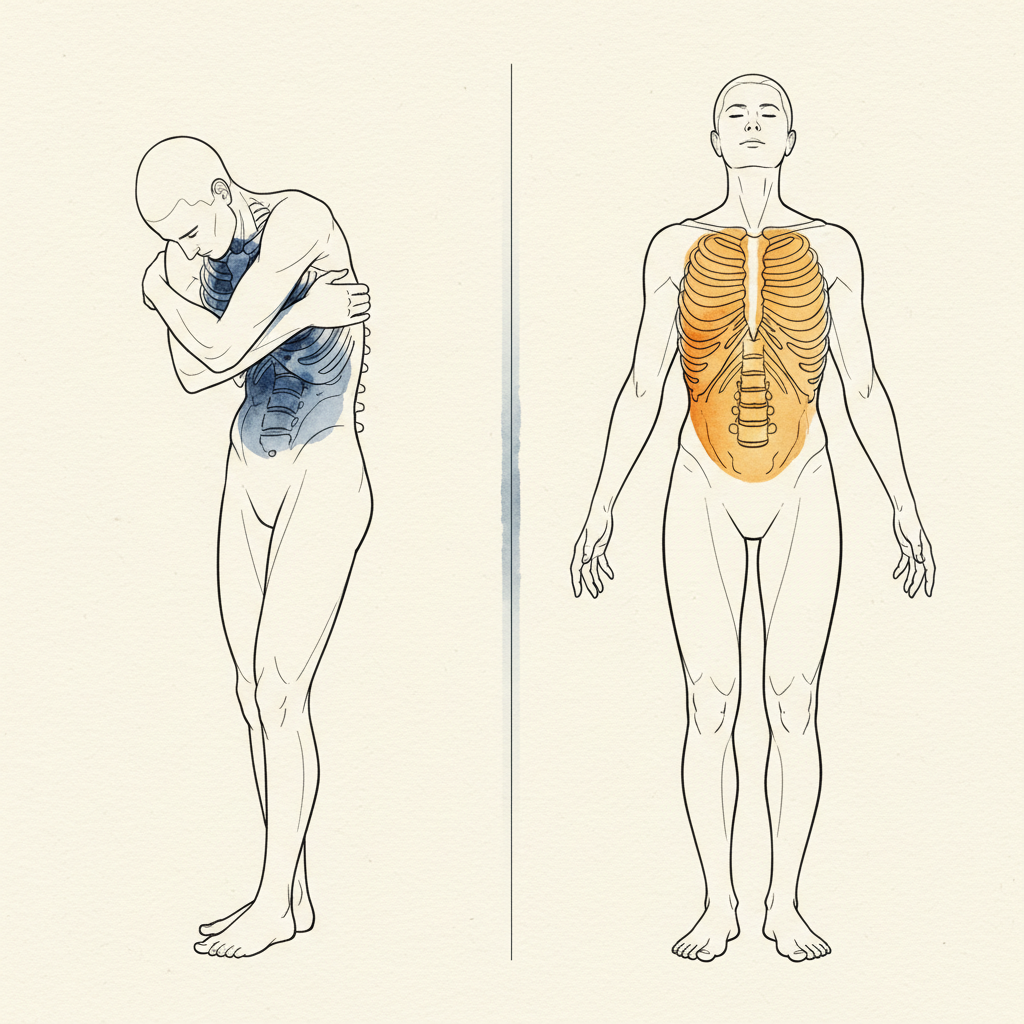
The deeper answer lives in the vagus nerve. Porges’ Polyvagal Theory provides the framework: vagal tone, the parasympathetic system’s capacity to regulate sympathetic response, is both influenced by posture and expressed through posture. High vagal tone correlates with upright, organized shape, emotional resilience, reduced anxiety. Low vagal tone correlates with braced or slumped shape, emotional reactivity, increased anxiety.
The vagus nerve is the physical wire connecting body shape to mental state. Not metaphor. Anatomy.
“Just Fix Your Posture” Is Terrible Advice for Anxiety
“Sit up straight” and “just relax” fail for the same reason. They are conscious overrides aimed at outputs generated below the level of conscious control. The nervous system does not take orders from the thinking mind about its threat assessment. You cannot instruct yourself into a posture that only emerges when the system feels safe.
The path is not instruction. It is evidence.
Sensory evidence that the system processes below awareness and uses to update its prediction about whether the world is safe enough to stop bracing.
Three Inputs That Shift Both Patterns
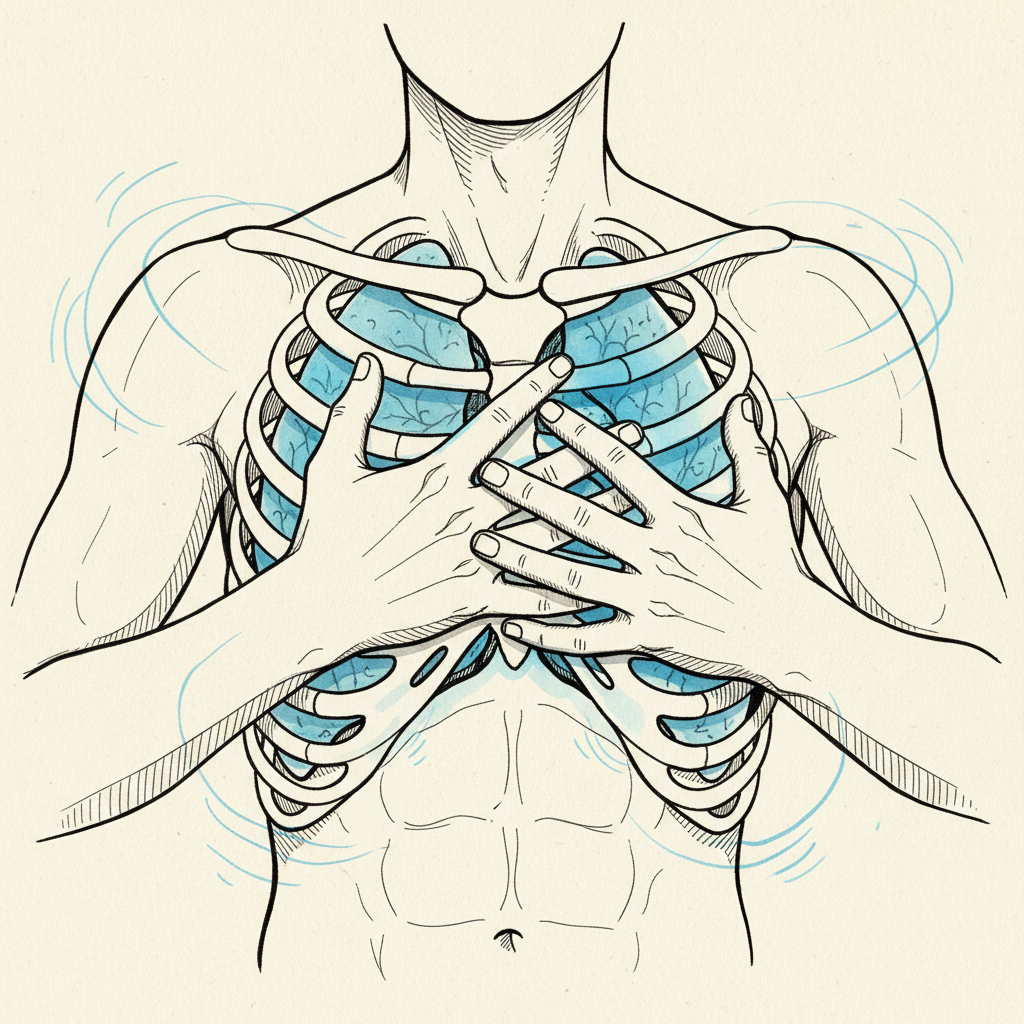
Organized breathing. Not deep breathing. Organized breathing. Extended exhale activates the parasympathetic branch through the vagus nerve. The exhale is the brake pedal. When you extend it, you are mechanically engaging the vagal brake. The bracing softens. The anxious feeling reduces. You did not calm yourself. You changed the autonomic input.
Ground contact. Bare feet on a textured surface. The soles contain the densest concentration of mechanoreceptors in the body. Rich proprioceptive data from the feet tells the system where it is in space. A system that knows where it is braces less than one that does not.
Peripheral vision. Focal vision, the narrow spotlight you are using to read this, is associated with sympathetic activation. Peripheral vision, the wide ambient field, is associated with parasympathetic access. Soften the gaze. Let the edges of the visual field open. The system reads this as evidence that the environment is safe enough to widen the aperture. The bracing softens. The breath deepens.
A Feature, Not a Bug
The co-expression of posture and anxiety is not a design flaw. When genuine threat exists, you want the body braced AND the mind sharp. That simultaneous activation keeps you alive.
The problem is chronicity. Screen time narrows the visual field. Shallow breathing collapses internal pressure. Sedentary posture reduces proprioceptive input. The system interprets the degraded sensory environment as evidence of threat. It is doing exactly what it was built to do with the data it has.
The bracing and the anxiety are both correct responses to corrupted data.
Change the data. Restore the sensory inputs. Give the system evidence of safety through the body’s own channels. The threat assessment updates. The bracing releases. The anxiety softens. Not because you forced either one to change. Because the generator that was producing both of them received new information.
One System
The medical model splits you down the middle. Orthopedist for the shape. Psychiatrist for the feeling. Two charts. Two treatment plans. No shared architecture.
You are one system.
The braced body. The anxious mind. The shallow breath. The clenched jaw. One pattern. One source. You do not need to fix your posture to fix your anxiety. You do not need to fix your anxiety to fix your posture. You need to address the state that is generating both. When the state shifts, both outputs shift with it. The body opens. The mind quiets. One thing addressed. One thing shared.
Sam Miller is the founder of Posture Dojo. He lives inside an 85-degree kyphoscoliosis and has for thirty years. He writes from the inside of that experience.
Syntropic Core Reset
Most posture programs give you exercises. This one updates the system that generates your posture. Four weeks live with Sam Miller. You learn how the hidden map works, why everything else missed it, and how to give your nervous system the evidence it needs to generate a different pattern. Breath. Ground contact. Safety. Sensory input. Floor to standing. You leave with a daily practice that holds because the map itself has changed.
Limited spots. Next cohort enrolling now.
Details and enrollment →Related research
- Forgiveness Is Not Weakness. It Is the Only Way Out.
- Forward Head Posture, Dizziness, and Brain Fog: The Vestibular Connection
- The Vagus Nerve and Posture: How Your Body Reads Safety Through Shape
- Two Papers Just Landed: The Neural Generation Hypothesis and the Generative Posture Framework