Try this before you read another word
Stand up if standing is comfortable for you today, sitting works too.
Now give me the posture you were taught. Shoulders back, chest up, tall. Stay there about ten seconds and keep breathing while you do it. If anything hurts, let it go.
Now stop trying. Think about something else, your inbox will do.
Where did your body go?
See if this matches: within a few seconds it drifts back to the shape it was in before you started. Nobody told it to go there. It went home.
Ten seconds of effort didn’t change where your body goes home to. So what decides the address?
The short answer
The Syntropic Core Reset is the foundation course of Syntropic Core, the method I built for updating the internal model your nervous system uses to generate your posture. It lives inside the Posture Dojo membership as a four-week course, floor to standing. It’s built to bring your breathing, your internal pressure and your sensation back online so your nervous system has new evidence to work from. It doesn’t stretch, strengthen or brace the shape you’re in.
In plain language I describe Syntropic Core as your organizational core. Below are seven small tests you can run in your own body, each one opens one idea about what the Reset trains.
My scoliosis was diagnosed when I was 13. I found this work in my own body first, the research came after. So I’m going to ask you to do it in the same order. Feel it first, then we name it.
What organizational core means
Say the word core and most people picture a plank, a hard stomach, a brace around the middle. The logic is simple, a stronger middle props up the spine.
I get why, it gives you a measurable job. It’s just aimed at the wrong layer. Core strength and core organization are different systems. You can have a strong core that’s poorly organized, strengthen it and you get a stronger core that’s still poorly organized. Your nervous system decides how pressure gets organized inside your trunk, and strength alone doesn’t change that decision.
You might know this body from the inside. Breath sits high and small. The belly is gripped, or it’s gone slack.
And the job of staying upright ends up with the shoulders and the jaw and the low back, which means you’re holding yourself up from the outside all day, and it’s tiring. The inside of the trunk, the part that could be supporting you, has gone quiet.
Syntropy is a word for the tendency of living systems to move toward coherence, and Syntropic Core is the method built on it. In plain words, your organizational core. The idea is that the first job of your core is organizing pressure from the inside so the rest of you can organize around it, which is a different job from being strong.
What I see in this work is that when the center is doing its job, the neck, the shoulders and the hips tend to stop doing that job for it. When the center is stiff or absent they stay recruited, and stretching doesn’t let them off for long.
So organizational core is a job description, and the Reset is where you learn to let that job get done. Easiest way to understand it is to feel a few pieces of it.
Seven small tests
Each one takes two minutes or less. These are small self-guided experiments, not medical treatment. Keep them small and stop the moment anything hurts. What you feel in a test like this is an experience, it isn’t proof of anything and I won’t tell you it lasts. Report to yourself what changed, and leave the word better out of it.
1. Your posture came back
You already ran this one at the top of the page.
You can hold a posture about as long as you can hold a thought. Then an email or a conversation takes your attention, the effort ends, and the shape you were making ends with it. What’s left is the shape your nervous system produces when you’re not managing it. The model I work from says posture is generated moment to moment by a system running underneath your attention. Longer version in why your posture keeps going back.
The Reset starts from that split. There’s the picture you have of your body, and there’s the working map your nervous system actually runs it from (the body schema, if you want the term). You’ve been giving instructions to the picture. The map never got them.
2. The quiet side of your ribs
One side of your ribs may move less than the other when you breathe. You may have stretched that side for years.
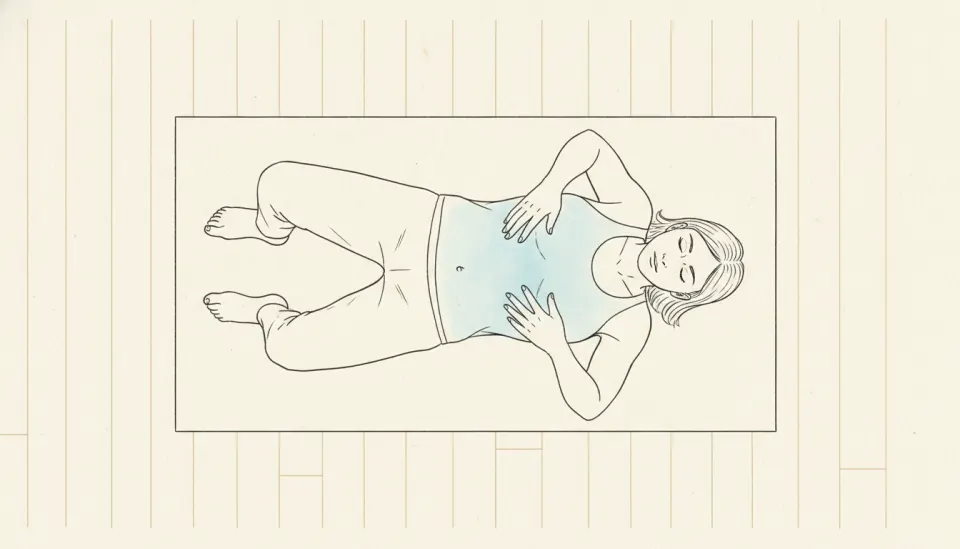
Let one hand rest flat on the quieter side and take three easy breaths. Nothing to push, no air to send anywhere. Keep the breath ordinary, and if you get lightheaded, drop it and come back another day.
Anything? Warmth, a bit of movement, the hand getting nudged from underneath? Nothing at all is an answer too.
If something showed up, look at what you did. You didn’t stretch anything and you didn’t send air anywhere, you just paid attention to a place you’d stopped hearing from. Tight and quiet feel the same from the inside, and they don’t need the same thing.
In the Reset I call these sealed rooms.
The numb regions and the blank spots got sealed by your body to protect something, and the sealing was intelligent. Your body is asking to be heard, not repaired. Touch is one of the tools we use for that, the map sharpens where you touch.
What else has gone quiet?
3. Both heels
Read the whole test before you start, the last step is closing your eyes. Stand within reach of a wall or a chair. Eyes-closed standing sways a little, that’s normal.
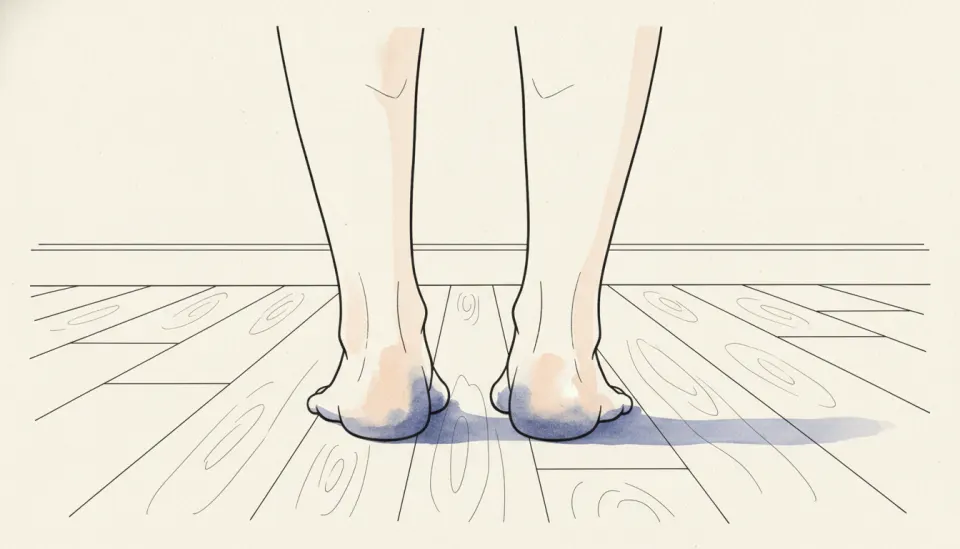
You’re going to compare the contact of your left heel and your right heel for about twenty seconds. Which one is louder? Which one do you have to go looking for? Then open your eyes, walk a few steps, and see whether the quieter heel shows up. Now let your eyes close.
I want to be careful with this one. Your feet aren’t running your posture, your eyes and your jaw rank higher and I’ll come back to them.
But the ground is one of the channels your nervous system reads, and if one heel has been mumbling for a long time the rest of you may have adapted around the gap.
The first stage of the Reset is exactly this kind of work. How to feel your feet. I know how basic that sounds.
4. Ribs without pelvis
Sit on a firm chair with your hands resting on your hips so you can feel them. See if your ribs can turn a tiny bit one way while the hips stay quiet. Tiny, smaller than that. Then the other way. There’s no range to reach here, keep it small and easy.
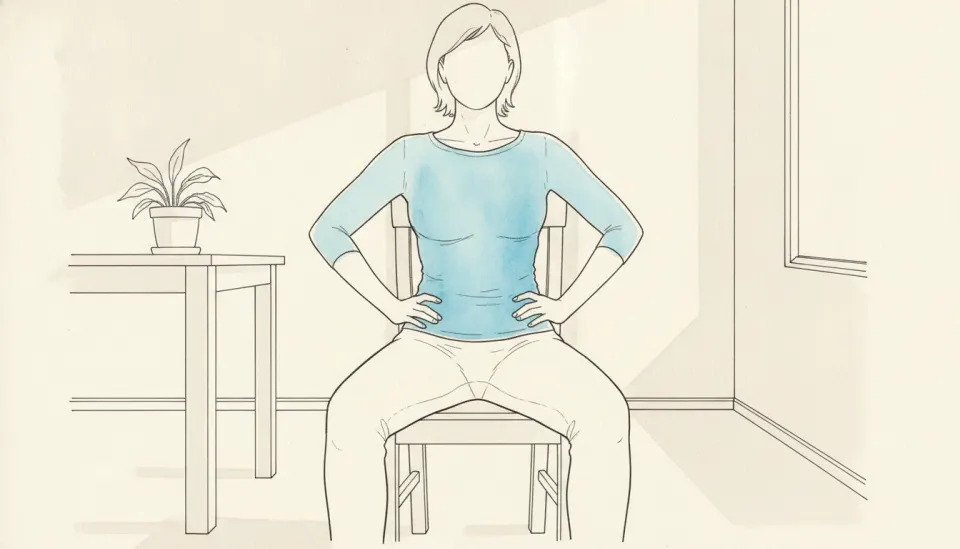
If your hips came along, that’s information. Your body may have been moving those two areas as one block.
In this work the first sign of change is often a small new movement option, and it shows up well before anything could look different in a mirror. Different tissues change on different clocks, the nervous system in minutes to days, connective tissue on a scale of months, bone on a scale of years. I read a new option in your ribs as the fast clock moving, and the fast clock moves first.
In the Reset this tool is called articulation (asking two parts that have been moving as one block to move as two again, gently, by feel).
Which side was harder?
5. Stop trying to fix yourself
Two minutes. No straightening, no shoulders back.
Stand how you normally stand. Then let your attention move through a few things, slowly. Your breath, without changing it. Where your weight sits. Where your feet meet the floor. The space behind your ribs. The pressure inside your torso. Then shake it off and stand how you normally stand again. If standing still is uncomfortable this works in a chair.
Did anything shift? Maybe not. Nothing moved today is an honest result, run it again tomorrow.
If something did shift, here’s the question. You gave your body no posture instructions at all. So what changed its mind?
When you send a movement command your brain also predicts what that movement will feel like, and it turns down the sensation it predicted. That’s why you can’t tickle yourself [2]. I believe the same thing happens when you try hard to stand up straight, the harder you try the less you feel, and feeling is the evidence your nervous system needs. That’s the whole argument of You Can’t Tickle Yourself.
Attention is the lever. Attention in your body, which is a different thing from attention on your posture. One of the first practices in the Reset is noticing your breath without changing it. Harder than it sounds.
6. Stretching the same spot
You know the spot. You’ve stretched it a thousand times.
Give it the stretch you always give it, gently, well inside what’s comfortable. It feels better, it always does. Now stand the way you usually stand and give it a minute.
Is the tightness already on its way back? Same spot, same tightness, for years.
Suppose that muscle is doing its job. Suppose it’s following orders, and the order is to support the shape you keep returning to. Then the tightness is an output, it’s downstream of the pattern, and stretching the output never reaches the thing producing it.
In the Reset we don’t stretch. We work on whatever is giving the orders. We invite expansion from the inside, through breath and pressure, and leave it to the tissue to lengthen when it feels safe to.
7. If you have scoliosis: a direction you can barely feel
If you have scoliosis you’ve probably been told to push against the curve. Try something smaller.
Explore a few directions, one at a time. A breath into one side. A little weight into one foot. A small turn. See if one of them feels faint, like a radio station almost out of range. Nothing to force, just visit and leave whenever you want. You can let your eyes close for this one if you’re sitting or near a wall.
That faint direction may be one your body has stopped using. Nobody can use a direction they can’t feel, however hard they push, so the first step is getting the signal back.
This is what the Reset calls the edge, the place where your map runs out, which is a different place from where it hurts. You don’t push at the edge, you listen there.
Which direction was it for you?
What the seven tests have in common
In the first test and the stretching test you did it the old way, you pushed toward a shape or pulled on a spot and then watched it come back. In the others you changed the information and watched what your body did with it.
Your body doesn’t take instructions, it takes evidence. So we don’t fight the shape, we change the information.
What you actually do in the Reset
It starts on the floor and ends standing, and the order matters because each stage sets up the next.
Safety and sensing first. You learn to feel your feet, to notice your breath without changing it, and to let your body yield its weight into the ground. You learn the Sentinel position, the resting position for the mouth and jaw we use throughout: tongue on the roof of the mouth, molars gently meeting, lips sealed. Soft is not slack. In my model a jaw that hangs open sends no signal, and your nervous system doesn’t read that silence as safety. There’s also a short daily self check-in so you start tracking what you feel.
Then breath organization. You meet your diaphragm and learn a breath that widens the whole trunk, belly and sides and back, in place of one that lifts the chest and shoulders.
Then pressure and sound. You find your first organized pressure and learn to cycle it inside the trunk with the breath and the voice, this is where internal decompression comes in. You also practice moving by feel, no mirror.
Then the edge tools and integration. Pause. Oscillation. Articulation. Pressure expansion. Touch. Sound. Imagination. These are how you work at the place where your map runs out. From there you come up off the floor through the same kind of transitions a baby uses, into standing and into preparation for walking. By the end you put it all together into one floor-to-standing practice you carry with you, plus a one-sentence daily journal.
There are self-assessments before and after so you can compare your own reports. The Reset isn’t a personalized assessment of your spine or your pattern, and it doesn’t give you a diagnosis.
Why start with breath if your eyes and jaw rank higher
I’ve written on this site that your eyes and your jaw are running your posture. In the model I work from, vision and the jaw are the two highest-weighted inputs into whatever generates your posture, they can override your breathing, your hips and your contact with the ground.
The foundation course is still built around the trunk, because breath is the most direct conscious lever you have on a postural system that otherwise runs below awareness. You can’t decide what your cerebellum does with a visual signal. You can decide to attend to an exhale. So the Reset uses the trunk as the most reachable way into a system that’s running automatically, it doesn’t treat the trunk as where the problem started.
The eyes and the jaw are in the Reset from the first stage anyway, the Sentinel position is a jaw practice and soft eyes are part of how we settle.
There’s a ceiling here and I’d rather say it now. If you have a significant visual tracking problem, a jaw asymmetry or a vestibular problem (the inner ear balance system), you may make progress in the Reset and then plateau until that input gets addressed upstream. That usually means a TMJ-aware dentist or a behavioral optometrist, which is a different visit from a routine checkup. I laid out the order in how to sequence a care team.
How it works, in plain words
Here’s the model. Your nervous system generates your posture. It reads your feet, your ribs, your breath, the pressure inside your torso, your jaw and your eyes, and it produces the shape it thinks is safest. Your posture is a prediction, not a position.
The generator, as I understand it, updates in an order. Safety first, then sensing, then tone, then pressure, then movement. Before your body changes anything it has to feel safe enough, and you have to be able to feel it from the inside. That’s what needs to be true before your body can change. Pressure isn’t the first cause of anything, it’s the part of the system you can reach on purpose.
Think of your torso as a can. Empty or crumpled it can be crushed, properly pressurized it stands tall. That’s the image I work from. When the trunk is sealed and the breath pressurizes it, the feeling is of a spine lifted from the inside, suspended and decompressed, which is the opposite feeling from propping yourself upright with your back muscles.
There’s a trap on either side. Fighting your shape blocks the update. Letting go with nothing underneath is collapse. Organized pressure is the third path.
The felt shift I’m pointing at: you stop holding yourself up, you start being held from the inside.
The technical version
I work from the position that posture is the output of a generative, predictive model. The closest established name for it is the body schema. That’s a synthesis of existing research and I treat it as a working model.
Several pieces under it are established. Self-generated sensation is attenuated by the brain’s own prediction, with evidence that the cerebellum is involved in the cancelling signal [2]. The diaphragm has a postural role alongside its breathing role, when the trunk is challenged by repeated arm movement it co-activates with the abdominal muscles, and that co-activation produces a sustained rise in intra-abdominal pressure (the pressure inside the belly) [3]. There’s also evidence that pressure on its own stiffens the lumbar spine. In one small lab study, researchers stimulated the phrenic nerves (the nerves that drive the diaphragm) so the diaphragm contracted while the abdominal and back muscles stayed quiet. Intra-abdominal pressure rose, and lumbar spine stiffness rose by 8 to 31 percent over resting levels [1]. That study had three subjects lying face down, and it says nothing about posture programs.
The model I teach from is called the Sovereign Cylinder. It treats the trunk as one sealed pressure chamber bounded by five valves: the pelvic floor, the deep abdominal wall, the diaphragm, the vocal folds, and the tongue against the palate. What each valve does on its own is established anatomy and physiology, I wrote more about the body’s diaphragms here. The idea that all five operate as one closed chamber is my synthesis. So is the update order above, and so is the idea that practicing organized pressure sharpens your felt sense of your own body. No study has tested any of them directly.
None of the studies above were done on scoliosis, and none of them test the Reset. The two papers behind this model are introduced here.
Who it is for
Adults who’ve lived in a pattern for a long time. Scoliosis. Kyphosis. A persistent asymmetry. A rib cage that doesn’t move. Chronic bracing. A feeling of compression or collapse. A body that works very hard to stay upright.
Often it’s someone who has done the physical therapy, the Schroth, the chiropractic, the yoga. It helped, it didn’t last. If that’s you I’m not asking you to reject the work that helped you, the practitioners weren’t the problem. The mechanical model of the body was. The Reset is meant to sit underneath whatever else you do, the foundation other posture work can build on.
You don’t need a formal diagnosis.
If your curve is structural, your structure is real. Mine is too. How you breathe, brace and carry yourself around that structure is still adaptable, and that’s where we work.
Who it is not for, and what to know about safety
The Reset is self-guided somatic education. It isn’t medical care and it doesn’t replace your doctor or your physical therapist. I make no promise about your spine, your pain or your measurements.
The practices are gentle. Work inside what’s comfortable and stop if something hurts. Some places in your body won’t open during the course, that isn’t failure. They were sealed for a reason, and if they open, they open on their own clock.
See your doctor first if you have new numbness, new changes in bladder or bowel control, chest symptoms, or pain you can’t explain. Those are medical questions and this isn’t a medical program.
It’s also not for someone who wants to try a program for a week. This is a practice, it asks for your attention every day. Attention, not willpower. Nobody can do this for you, a guide only makes it faster.
What the Reset is not
Not a workout. I’d call it closer to an experiment, and the word I use is practice, because a practice repeats with attention and measures itself by ease.
Not stretching either, stretching pulls tissue from the outside and this works from the inside. Bracing is the pattern most people arrive with and we’re moving away from that too.
And it will never tell you what position your body should be in. No outside ruler here. The goal is an organized position your body generates on its own, standing upright is just what that looks like from the outside.
FAQ
What is the Syntropic Core Reset? The Syntropic Core Reset is the foundation course of the Syntropic Core method, created by Sam Miller of Posture Dojo. It is a four-week course inside the Posture Dojo membership that runs from floor-based practice to standing. It works with breath, internal pressure and sensation to give the nervous system new evidence to generate posture from.
What does Syntropic Core mean? Syntropy is a word for the tendency of living systems to move toward coherence. Syntropic Core, in plain language, is your organizational core, the idea that the first job of your core is organizing pressure from the inside so the rest of the body can organize around it. Different job from strength.
Is the Syntropic Core Reset a core strengthening program? No. Core strength and core organization are different systems, a strong core can still be poorly organized. The Reset works on how pressure gets organized inside the trunk, which your nervous system decides and strength alone doesn’t change.
Can I do the Syntropic Core Reset if I have scoliosis or kyphosis? Many of the people I built it for have scoliosis, kyphosis or a long-standing asymmetry. It’s self-guided, gentle education, not medical care, and I make no promise about your curve. What we work on is how you breathe, brace and carry yourself around your structure.
I have already tried breathing exercises. How is this different? Most breathing exercises train the breath as a skill on its own. The Reset uses breath as a way into the system that generates posture, in a set order: safety and sensing first, then breath, then pressure, then movement. I explain the difference in this article on breathing exercises.
How much time does the Syntropic Core Reset take? It’s a four-week course. The daily practice is short. What it asks for is consistency and attention. How long your body takes to change is individual, and I don’t put a number on it.
Are there Syntropic Core Reset reviews? Reviews and member reports have their own page, Syntropic Core Reset reviews.
The first step
One more test. It uses the Sentinel position from the first stage of the Reset and takes two minutes. Sit or stand, whichever is easier today.
Let your eyes go soft, seeing the whole room and looking at nothing in it. Tongue on the roof of your mouth. Molars gently meeting. Lips sealed. Allow your next exhale to finish on its own, all the way to its end, and let the inhale arrive when it wants to. Stay for a few breaths. If any part of this is uncomfortable, leave that part out.
Then ask what changed.
If something showed up, you didn’t hold anything in place to get it. Your system generated it, from better information.
That’s what the Syntropic Core Reset trains, floor to standing, one stage at a time. Whatever else you plan to do for your posture, this is where I’d have you start. Begin with the Syntropic Core Reset.