You have kyphosis. You also have tinnitus. You have been treating them as two separate problems, seeing two separate specialists, doing two separate sets of exercises. Nothing has worked for either one.
For some people they are not two problems. They may be two outputs of the same pattern.
The compensation chain
Thoracic kyphosis increases the forward curvature of your upper back. Your body has one non-negotiable requirement: horizontal gaze. Your eyes must face forward. So the cervical spine compensates. It extends to bring your head back over your shoulders and your eyes to the horizon.
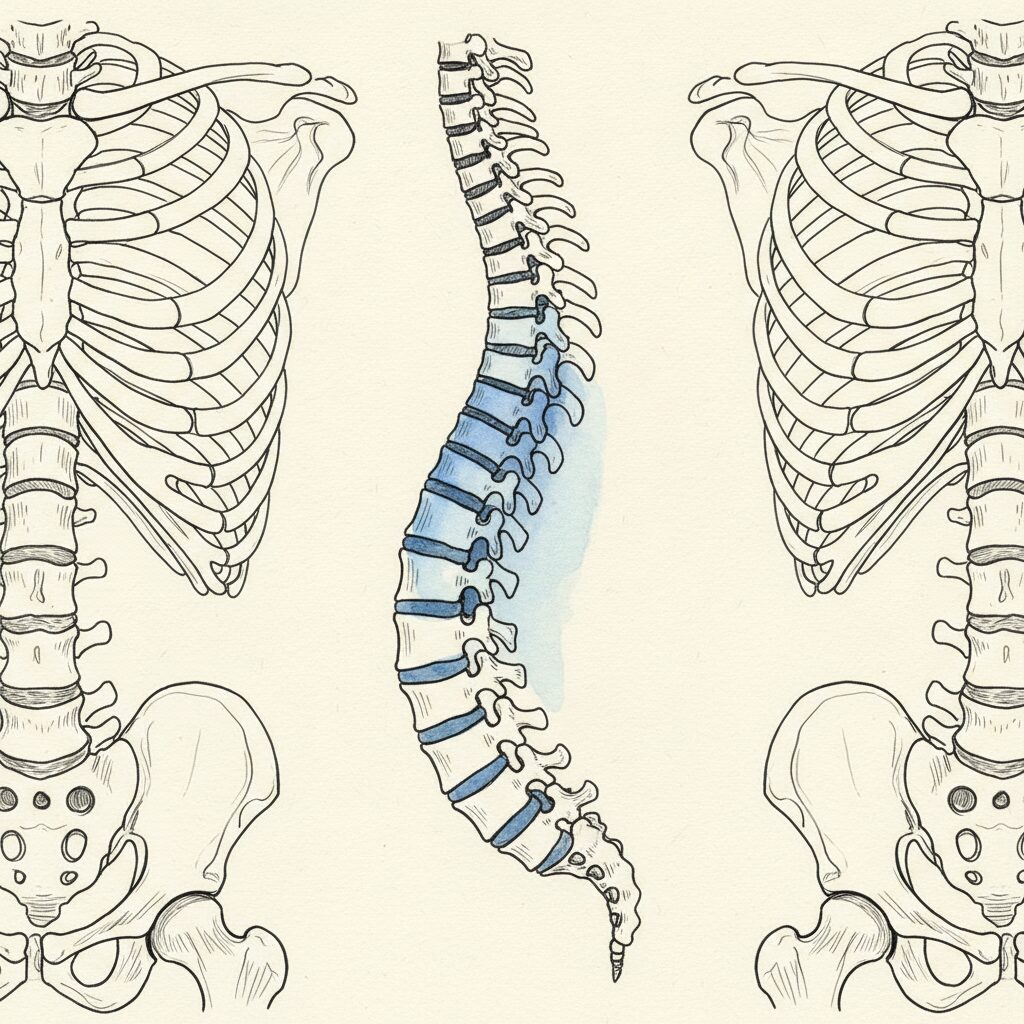
This is not a choice. It is an automatic postural adjustment driven by the vestibular and visual systems. Harrison and colleagues modelled the shape of the neck curve mathematically [3]. The link to the upper back is the ordinary compensation the eyes demand; this paper did not test it. More thoracic kyphosis, more cervical extension. The geometry pushes hard in that direction.
Cervical extension compresses the suboccipital triangle. The four small muscles at the base of your skull, dense with proprioceptors, rich with connections to the dura mater and the vertebral artery. Biondi (2005) documented how suboccipital compression alters vertebral artery hemodynamics and generates referred pain patterns throughout the head and face [1].
This is where the tinnitus enters.
Where sound meets structure
The dorsal cochlear nucleus processes auditory signals. It also receives somatosensory input from the upper cervical spine and the trigeminal nerve. This is not a design flaw. It is integration. The brain uses head and neck position to calibrate auditory processing.
Michiels et al. (2016) ran a small randomized trial in 38 people with both tinnitus and neck complaints [2]. After six weeks of neck physiotherapy, tinnitus scores fell, and 53% reported a substantial improvement. Six weeks later, 24% still did. The proposed mechanism: the dorsal cochlear nucleus receives input from the upper neck, so a neck problem can change how the brain processes sound. For this group of people, neck work helped. It did not help everyone, and it is not the whole story of tinnitus.
Tinnitus has many causes, and some need a doctor. If yours is in one ear, pulses with your heartbeat, came on suddenly or came with hearing loss or dizziness, get it checked first. But if your ears check out and your neck does not, the ringing may be partly a neck signal. And in my model, the neck problem often starts lower, in the thoracic spine, driven less by weak muscles than by a postural prediction that has not updated.
One prediction, two symptoms
Here is the chain as I see it. Some links are studied, some are my synthesis. The nervous system runs one model. That model generates thoracic kyphosis. The kyphosis pushes the neck into extension. Extension loads the small muscles under the skull. That can change the input from the neck to the dorsal cochlear nucleus. And for some people, that shows up as sound.
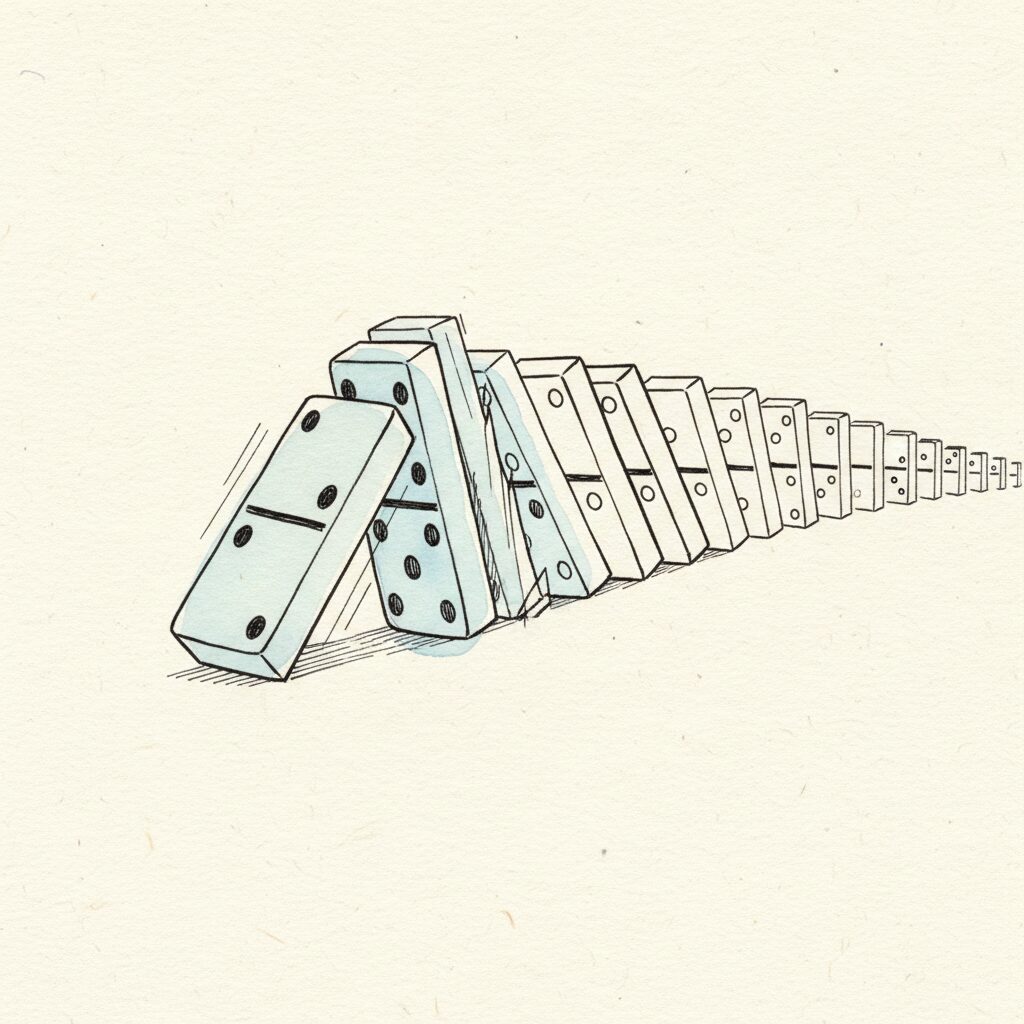
Kyphosis and tinnitus. Two symptoms. One prediction.
Porges (2011) described how the autonomic nervous system governs the middle ear muscles through the vagal system. In a sympathetically dominant state, the tensor tympani and stapedius alter their tension, shifting auditory processing toward threat-relevant frequencies and away from human voice range [4]. In my model, chronic thoracic kyphosis is partly a protective flexion pattern, one that can keep the autonomic system on alert. The tinnitus is not just a mechanical consequence of cervical compression. It is also an autonomic consequence of a nervous system running in a defensive state. The ringing is the sound of a system on alert.
Why treating them separately fails
The ENT finds nothing wrong with your ears. Hearing tests are normal. You are told to habituate. The orthopedist sees the kyphosis and prescribes extension exercises. You do them for months. Neither specialist knows about the other problem. Neither intervention addresses the shared upstream cause.
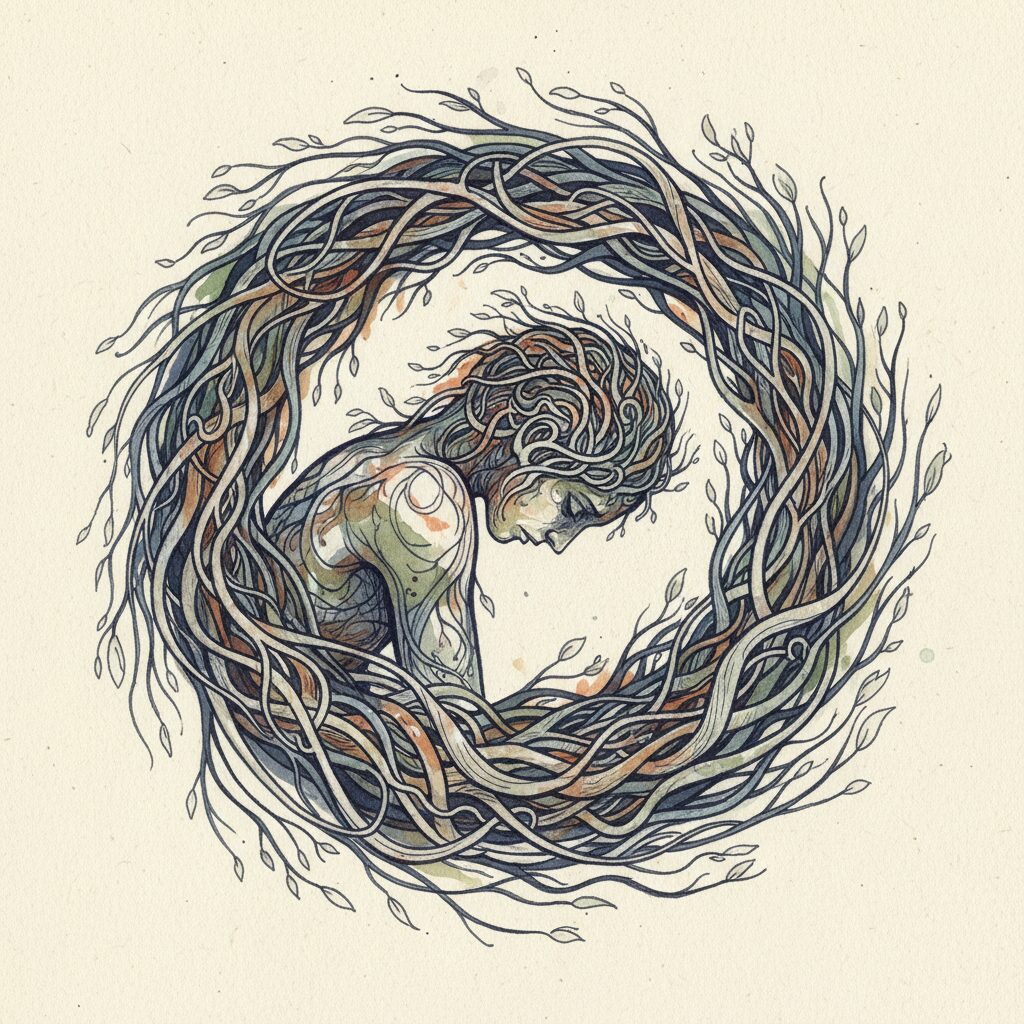
Cervical exercises alone fail because they address the compensation, not the driver. The cervical spine is extending because it has to. While the thoracic pattern stays, the neck tends to go back into extension. For people whose tinnitus is tied to the neck, the ringing can hang on with it.
The exit is not at the neck. It is not at the ear. It is at the prediction.
—
Related: Kyphosis: The Complete Guide | TMJ and Posture: The Jaw Connection | Scoliosis and Breathing Problems
—
Syntropic Core Reset addresses the thoracic prediction. As it updates, compensatory cervical extension is no longer necessary. The aim is that the load on the upper neck eases as the upstream pattern changes. Syntropic principle: restore regulation at the center, and organization ripples outward. See how it works.
Sources
- Biondi, D.M. (2005). Cervicogenic headache: a review of diagnostic and treatment strategies. Journal of the American Osteopathic Association, 105(4 Suppl 2), 16S-22S. PMID: 15928349 [T1]
Suboccipital compression alters vertebral artery flow and generates referred craniofacial symptoms. - Michiels, S., Van de Heyning, P., Truijen, S., Hallemans, A., & De Hertogh, W. (2016). Does multi-modal cervical physical therapy improve tinnitus in patients with cervicogenic somatic tinnitus? Manual Therapy, 26, 125-131. PMID: 27592038 [T1]
Randomized trial, 38 people with tinnitus and neck complaints. Six weeks of neck physiotherapy lowered tinnitus scores; 53% improved substantially after treatment, 24% at six-week follow-up. - Harrison, D.D., et al. (2004). Modeling of the sagittal cervical spine as a method to discriminate hypolordosis. Spine, 29(22), 2485-2492. PMID: 15543059 [T1]
Geometric modelling of the cervical curve in people with and without neck pain. - Porges, S.W. (2011). The Polyvagal Theory: Neurophysiological Foundations of Emotions, Attachment, Communication, and Self-Regulation. W.W. Norton. [T1]
Autonomic state governs middle ear muscle tension and auditory processing. Defensive states shift auditory perception.
Related research
- Best Exercises for Kyphosis: What Actually Changes the Curve
- Cervical Kyphosis, Military Neck, and the Flat Neck Epidemic
- Your Kyphosis Is Not a Mistake Your Body Made
- Kyphosis and Ankylosing Spondylitis: What Surgery Can and Can’t Change
Comments
3 responses to “The Kyphosis-Tinnitus Connection: Why Your Body Didn’t Create Two Separate Problems”
[…] Related: The Complete Guide to Kyphosis | The TMJ-Posture Connection | Tech Neck Is an Eye Problem | The Kyphosis-Tinnitus Connection […]
[…] The Kyphosis-Tinnitus Connection: Why Your Body Didn’t Create Two Separate Problems […]
[…] The Kyphosis-Tinnitus Connection: Why Your Body Didn’t Create Two Separate Problems […]