
Type the word “syntropy” into your phone. Watch it autocorrect to “entropy.” Try again. It will fight you every time.
That is not a glitch. It is a symptom of a bigger problem. The word that describes the single most important force in your body — the force that organizes you from the inside out — is not in your keyboard’s vocabulary. It is not in most people’s vocabulary. And the reason it isn’t tells a story about language, power, timing, and what happens when the right idea arrives in the wrong language at the wrong moment in history.
The Word Exists. Your Keyboard Doesn’t Know It.
Syntropy is in the Merriam-Webster dictionary. It is in the Oxford English Dictionary. It has been a real English word since the 1880s. It is not slang. It is not a neologism. It is not something we invented.
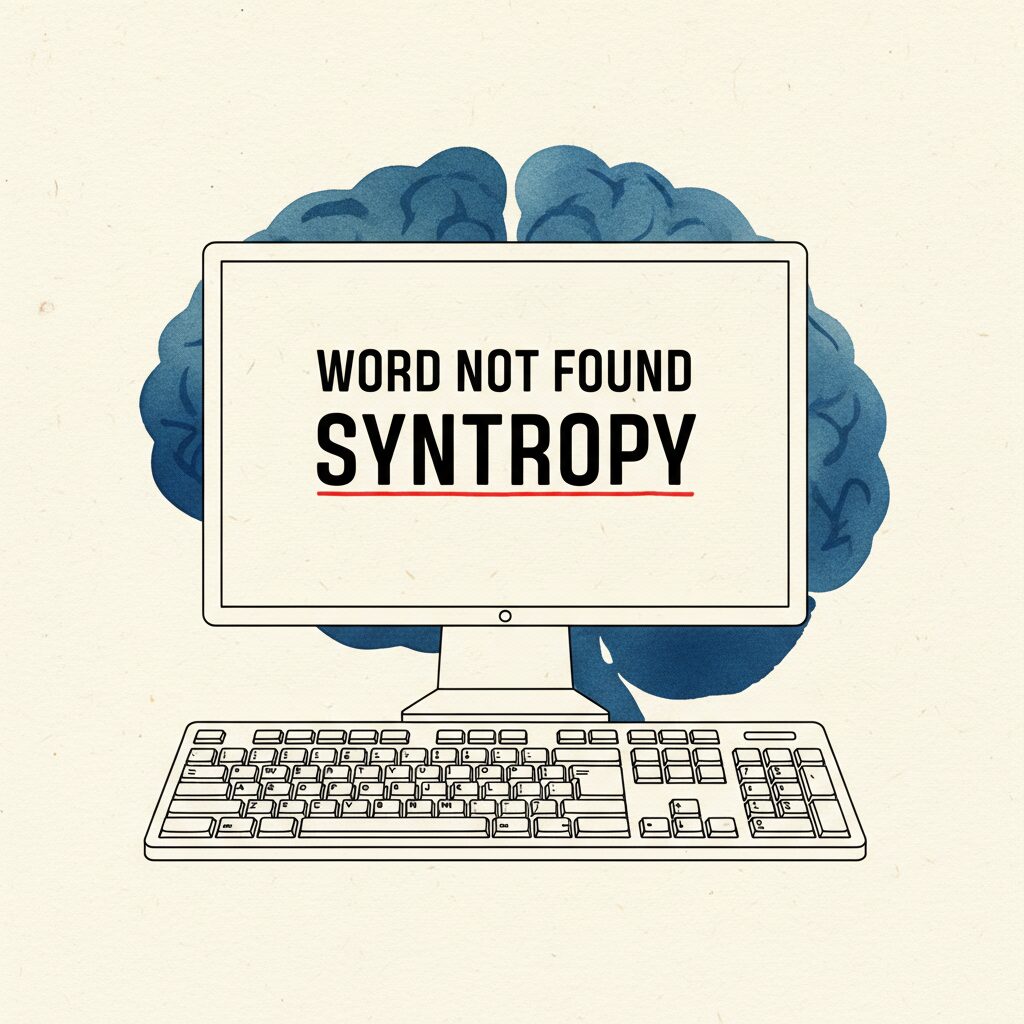
Your keyboard rejects it because autocorrect databases are built from frequency — how often a word appears in newspapers, books, and web text. “Entropy” appears constantly. “Syntropy” almost never. The word is real. It just lost a popularity contest.
Where It Came From
Greek roots. Syn- means together, converging. Tropos means turning, tendency. Syntropy: the tendency to turn together. The tendency toward convergence, organization, complexity.
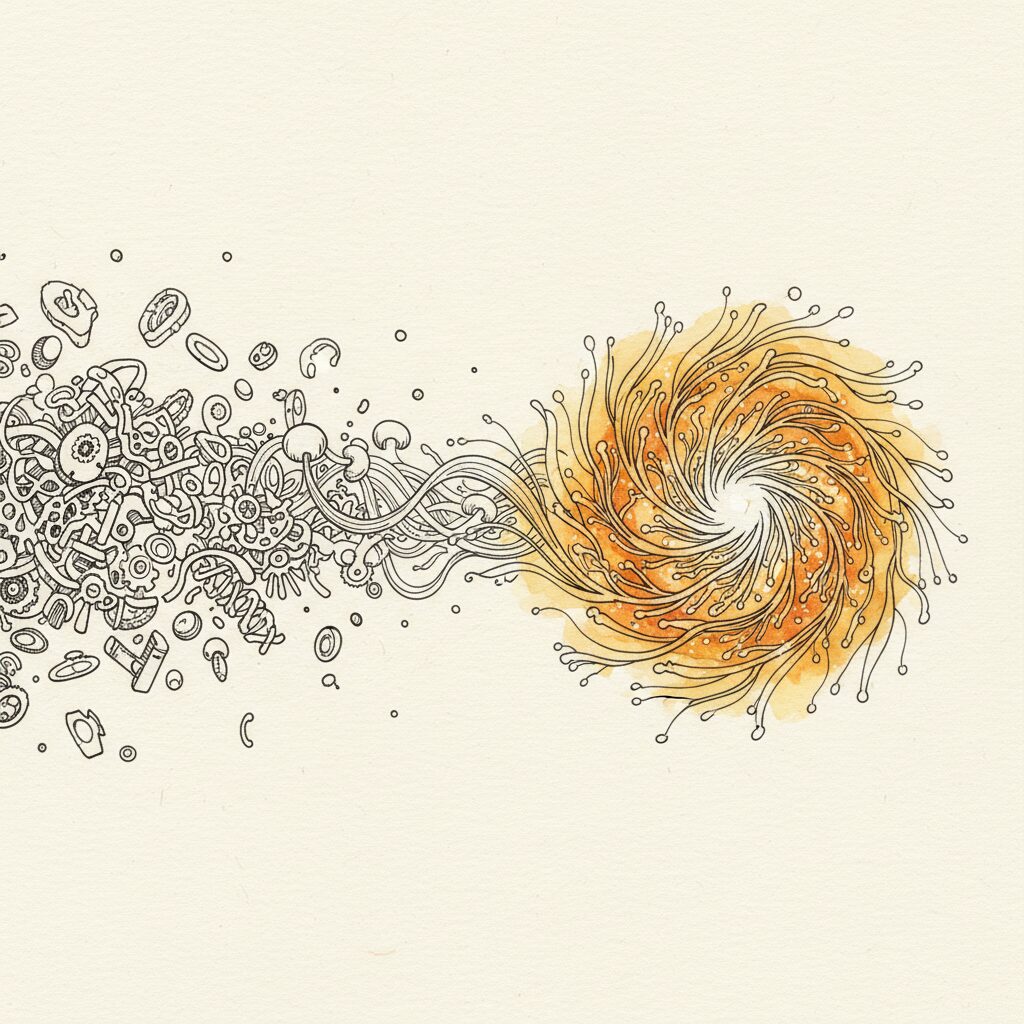
The modern meaning was coined by an Italian mathematician named Luigi Fantappié in December 1941. He was working with the Klein-Gordon equation — one of the foundational equations of quantum physics. The equation has two solutions. One describes energy radiating outward, dispersing, decaying. That is entropy. The other describes energy converging from a future state, organizing, building complexity. Fantappié named that force syntropy.
He called it “the essence of life.”
He presented the theory to the Accademia d’Italia in October 1942. He was a roommate and close friend of Enrico Fermi. The mathematics was rigorous. The timing was catastrophic.
Why You Have Never Heard This Word
Fantappié published in Italian. During World War II. His work never crossed the language barrier at scale.
Three years later, Erwin Schrödinger — Nobel laureate, writing in English — published What is Life? in 1944. In it, he argued that living organisms survive by “feeding on negative entropy.” He used exactly two words where Fantappié had used one. The book became one of the most influential scientific texts of the twentieth century. Every biology student read it. None of them read Fantappié.
Then in 1953, French physicist Léon Brillouin shortened Schrödinger’s phrase to “negentropy” and published it in the Journal of Applied Physics. An American journal. In English. The term entered the vocabulary of information theory and cybernetics instantly.
By 1974, when Nobel laureate Albert Szent-Györgyi — the man who discovered vitamin C — explicitly proposed replacing “negentropy” with “syntropy,” it was too late. He defined syntropy as “a force which causes living things to reach higher and higher levels of organization, order and dynamic harmony.” He described an innate drive in living matter to perfect itself. But he was 81 years old. The proposal appeared in philosophical essays, not experimental papers. The physics and biology communities had already standardized on negentropy.
Syntropy did not lose because it was wrong. It lost because it was Italian in a world that read English. It lost because Schrödinger had better distribution. It lost a language-adoption race.
The science was never in dispute. Only the word.
What Syntropy Actually Means for Your Body
Entropy is the tendency toward disorder. Leave a house unoccupied. It decays. Leave a garden untended. It tangles. Leave a body unattended. It compresses, stiffens, loses variability. The second law of thermodynamics says entropy always increases in isolated systems.
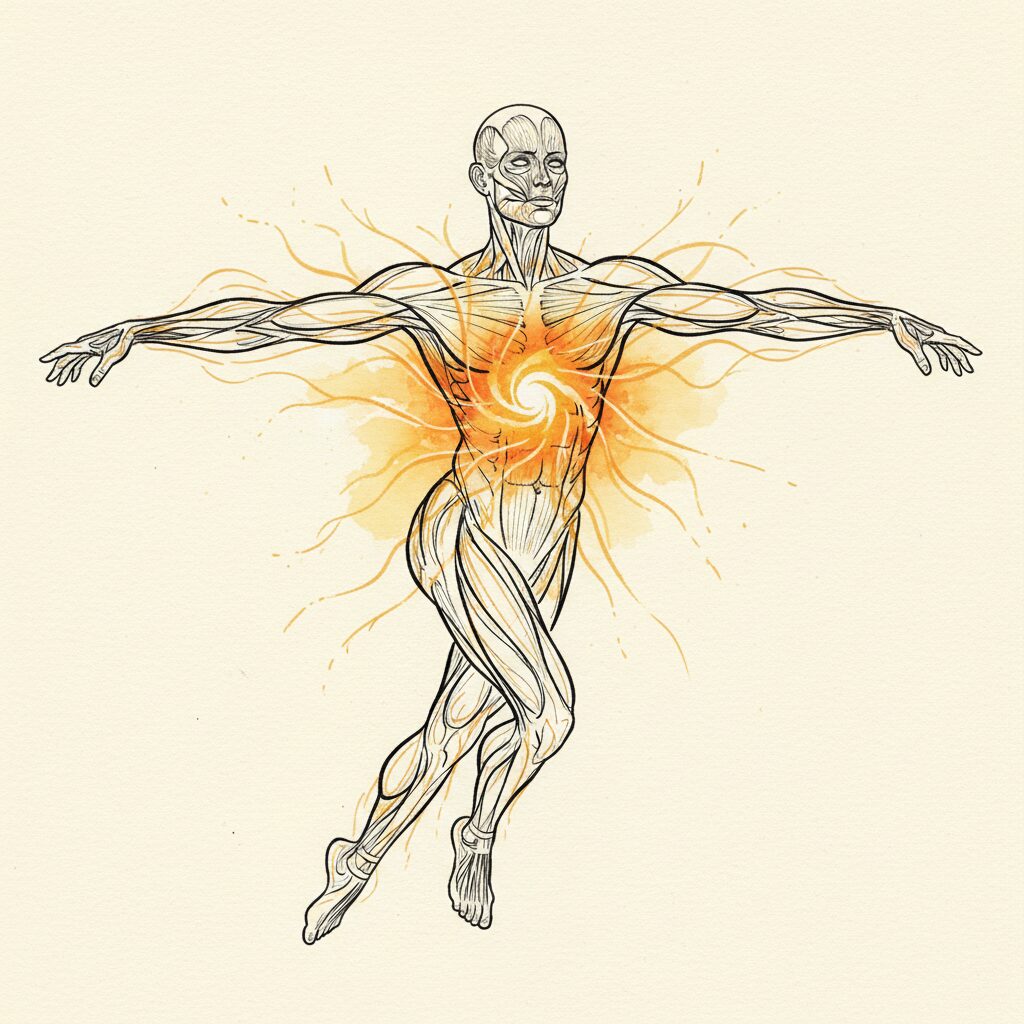
But you are not an isolated system. You are an open system. You take in energy. You take in information. And with the right conditions, your body does something extraordinary: it self-organizes. It builds complexity. It generates structure from chaos.
That is syntropy. It is not a metaphor. It is what your body does every time your nervous system generates organized posture from sensory input. Every time your diaphragm descends and creates hydraulic pressure that supports your spine from the inside. Every time your body schema updates its prediction and your structure reorganizes without you telling it to.
Syntropy is the organizing force. Entropy is what happens when that force is absent.
The Entropic Cascade
When your body drifts toward entropy, it follows a chain:
Degraded attention → suppressed sensory signal → outdated body schema → compensatory posture → tissue adaptation along stress lines → structural identity built around the compensation.
Your thoughts shape your attention. Your attention shapes what your nervous system receives. What it receives shapes the prediction. The prediction generates the posture. The posture, sustained over months and years, reshapes the tissue. The tissue becomes the structure. The structure becomes the identity.
That is the entropic cascade. And it operates in most people’s bodies right now without their knowledge.
The word “idiopathic” — as in adolescent idiopathic scoliosis — means the cause is unknown. Eighty percent of scoliosis cases carry that label. But what if the cause was never unknown? What if it was simply distributed across disciplines that did not communicate? The Neural Generation Hypothesis proposes exactly that: the curve is generated by a body schema operating on degraded sensory input. The mechanism was always there. The measurement was not.
The Syntropic Reversal
Reverse the cascade. Restore the quality of attention. Open the sensory channels. Update the body schema with accurate evidence. Let the prediction reorganize. Let the tissue follow.
That is syntropy applied to posture. That is what the Syntropic Core method is built to do.
The word has been waiting since 1941. A mathematician found it in an equation. A Nobel laureate endorsed it. A farmer in Brazil used it to regenerate a thousand acres of dead land. And now a method built on the Neural Generation Hypothesis uses it to describe what happens when organized pressure, non-demanding attention, and developmental sequencing converge inside a human body.
The body organizes from the inside out. Entropy is your structure declining. Syntropy is the reversal. And the reversal begins at the center — with the breath, the pressure, and the attention that nobody told you were connected.
Your keyboard will learn the word eventually. Your body already knows it.
The Timeline
- 1941 — Luigi Fantappié coins “syntropy” from the Klein-Gordon equation. Calls it “the essence of life.”
- 1944 — Erwin Schrödinger publishes What is Life? using “negative entropy.” The book becomes canonical.
- 1953 — Léon Brillouin shortens it to “negentropy” in the Journal of Applied Physics. The term sticks.
- 1974 — Albert Szent-Györgyi proposes “syntropy” replace “negentropy.” Defines it as the drive in living matter toward higher organization.
- 2026 — The Neural Generation Hypothesis is published, proposing that postural conditions are generated by a neural predictive model. The Syntropic Core method is built from it.
Sources
- Fantappié, L. (1942). The Unified Theory of the Physical and Biological World. Presented to the Accademia d’Italia, 30 October 1942.
- Schrödinger, E. (1944). What is Life? The Physical Aspect of the Living Cell. Cambridge University Press.
- Brillouin, L. (1953). The Negentropy Principle of Information. Journal of Applied Physics, 24(9), 1152-1163. DOI: 10.1063/1.1721463
- Szent-Györgyi, A. (1977). Drive in Living Matter to Perfect Itself. Synthesis, 1(1), 14-26.
- Szent-Györgyi, A. (1983). The Living State: With Observations on Cancer. Marcel Dekker.
- Miller, S.A. (2026). The Neural Generation Hypothesis of Adolescent Idiopathic Scoliosis. SSRN: 6493379
- Santos, C.P. et al. (2018). Biodiversity Agroforestry System: Syntropic Agriculture. DOI: 10.29247/2358-260x.2018v5i3.p140-144
The Posture Dojo is a free community exploring the science of how your body generates posture. No corrections. No exercises. A different operating system. Join the conversation here.
Related research
- Two Papers Just Landed: The Neural Generation Hypothesis and the Generative Posture Framework
- Stand Up Tall, Pull Your Shoulders Back, Brace Your Core: Why the 3 Most Common Posture Cues Are Neuroscience Dead Ends
- How Much Can I Actually Change My Scoliosis? What the Research Shows
- You Can’t Tickle Yourself. That’s Why Your Posture Won’t Change.
Comments
4 responses to “Why Your Keyboard Doesn’t Recognize the Word Syntropy”
[…] Why Your Keyboard Doesn’t Recognize the Word Syntropy […]
[…] Why Your Keyboard Doesn’t Recognize the Word Syntropy […]
[…] Why Your Keyboard Doesn’t Recognize the Word Syntropy […]
[…] Why Your Keyboard Doesn’t Recognize the Word Syntropy […]