You remember the moment you were told.
The X-ray on the light box. The number. The word. Scoliosis. Maybe you were thirteen. Maybe you were thirty-five and the curve had been there the whole time, silently generating, until someone finally measured it.
You remember what happened next. You started fighting.
You did the exercises. You held the corrections. You wore the brace. You showed up for every appointment. You did what you were told. And the curve did not listen.
So you fought harder. More exercises. More discipline. More conscious effort to stand straighter, pull your shoulder back, engage the weak side. And it progressed anyway.
Here is the part nobody told you: the fighting is one of the reasons it progressed.
Research demonstrates that volitional postural correction generates efference copies, internal brain predictions that suppress the proprioceptive feedback needed for the body schema to update. Kilteni and Ehrsson (2020) established that only active, volitional movement generates sensory attenuation, meaning passive or externally generated input does not trigger this suppression. When a person consciously tries to correct their scoliotic curve, the brain’s forward model predicts the sensory consequence of that effort and cancels the incoming proprioceptive signal before it can reach the body schema. In our model, the act of trying to correct the curve turns down the very signal that could help a new pattern last. This creates a neurological trap: effort-based correction suppresses the signal needed for lasting change.
The Model That Traps You
The scoliosis treatment model is built on effort. Correct the curve. Strengthen the weak side. Stretch the tight side. Hold better posture. Five instructions. One assumption underneath all of them: your body got the shape wrong and you need to manually override it.
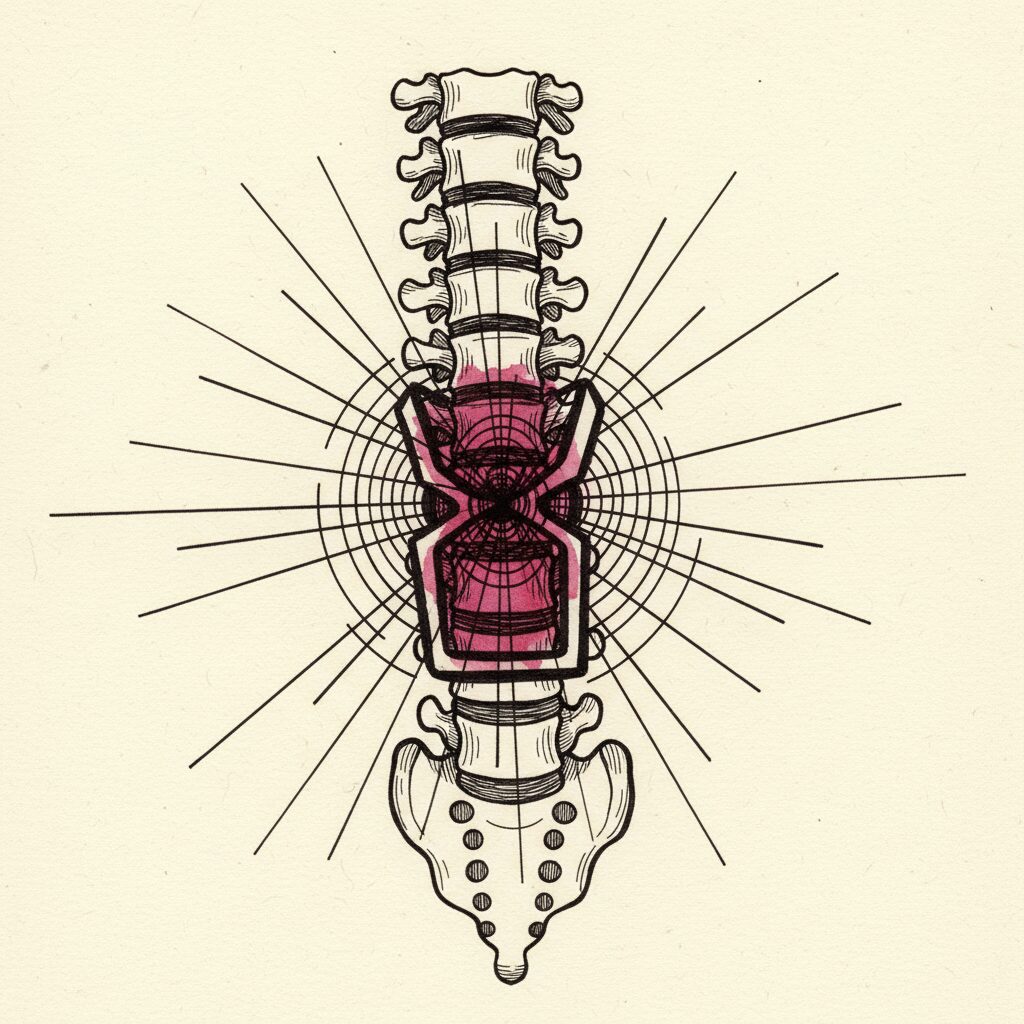
That assumption is the trap.
When you consciously correct your posture, your brain generates a motor command. That motor command produces an efference copy. An internal prediction of what the correction should feel like. That prediction cancels the incoming proprioceptive signal from the area you are trying to correct (Kilteni & Ehrsson 2020, Blakemore, Wolpert & Frith 1999).
Read that again. The act of correcting suppresses the signal needed to make the correction stick.
The cancelling itself is not a metaphor. It is the forward model of motor control, replicated across decades of neuroscience research. Your brain predicts the sensory result of its own actions and turns down the matching input. That is why you cannot tickle yourself. Applying it to posture is my synthesis, and I think it is why it is so hard to correct yourself into a new posture.
Shi et al. (2026) found that physiotherapeutic scoliosis-specific exercises improve Cobb angles, but the improvements depend on sustained conscious effort. The moment the effort stops, the pattern reasserts. Not because the exercises failed. Because the change was installed in the voluntary system, not the automatic one. Conscious effort is temporary by design.
Wang et al. (2026) showed that adolescents with idiopathic scoliosis already recruit widespread compensatory muscle strategies. Their nervous systems are not underactive. They are overactive. Adding more conscious effort to an already over-recruiting system is adding load to a saturated circuit.
A 2026 meta-analysis by Shi et al. examined physiotherapeutic scoliosis-specific exercises (PSSE), finding that combined interventions improve Cobb angles more than isolated approaches, but both types show limitations in long-term maintenance without ongoing conscious effort (PMID: 41891125). Wang et al. (2026) demonstrated through electromyography that AIS patients exhibit diffuse compensatory recruitment patterns, suggesting the nervous system is already generating widespread protective strategies (PMID: 41857081). These findings indicate that the issue is not insufficient muscular effort but rather the body schema’s consolidated prediction driving a compensatory pattern that additional conscious effort reinforces rather than resolves.
The Loop You Cannot See
The problem goes deeper than the exercises.
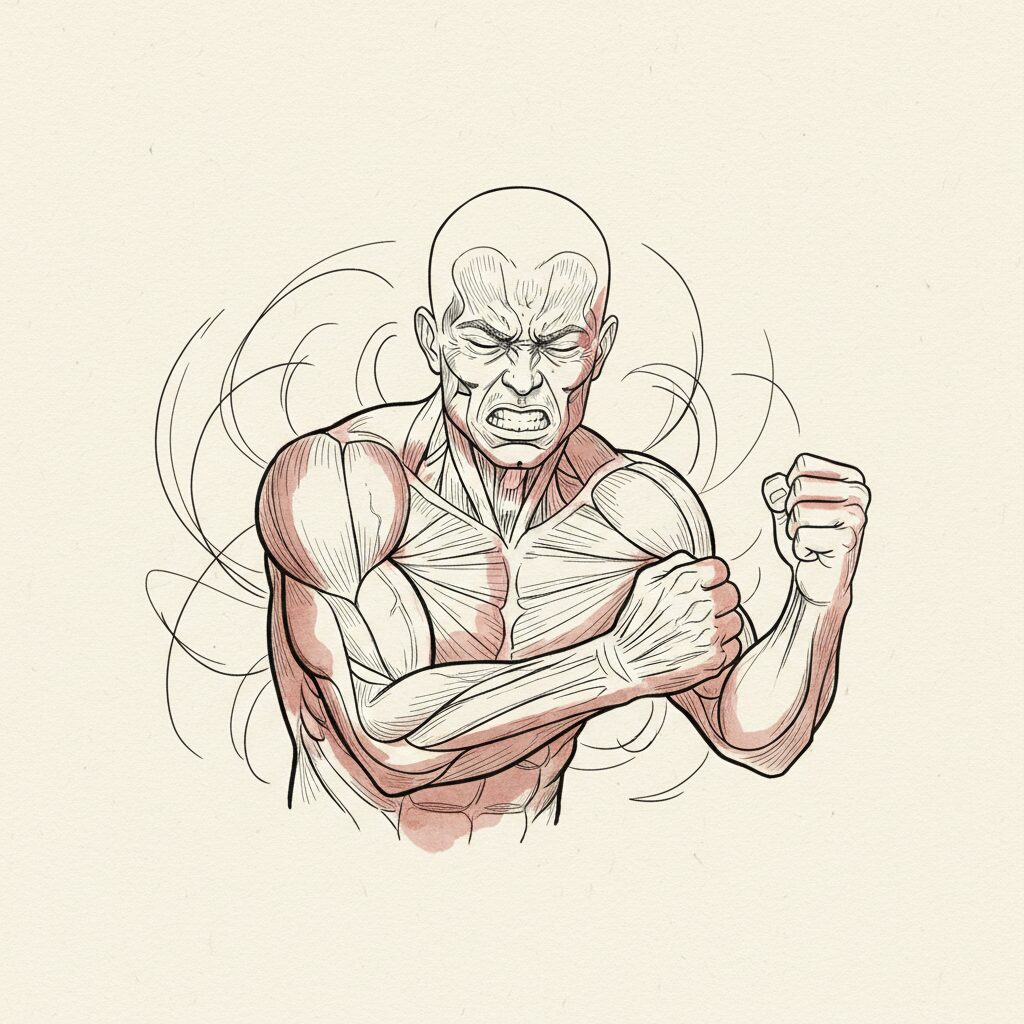
“I have scoliosis.” That sentence is not just a description. It is an identity. And identity drives behavior.
Oyserman et al. (2007) showed that identity-based motivation shapes health behavior more powerfully than knowledge or intention. When scoliosis becomes who you are, every behavior orients around the identity. “I have scoliosis” generates “I’m fighting it.” “I’m fighting it” generates motor commands toward the curve. Those commands generate efference copies. The efference copies suppress the proprioceptive signal. The signal that your body schema needs to update the pattern.
The pattern persists. The curve stays. You look at the X-ray and think: see. I still have scoliosis.
The identity is confirmed. The loop continues.
This is the ILES loop. Identity. Language. Efference. Schema. Each link feeds the next. Each link is documented independently in the research. Morley, Davies and Barton (2005) showed that self-pain enmeshment, the degree to which a person’s identity fuses with their condition, predicts poor adjustment more powerfully than the severity of the condition itself. It is not the curve that traps you. It is the relationship between the curve and who you believe you are.
The fighting IS the loop.
How does identity affect scoliosis outcomes?
Morley, Davies and Barton (2005) introduced the concept of self-pain enmeshment, finding that how far chronic pain had become fused with a person’s hoped-for self predicted their depression and acceptance (PMID: 15836972). Oyserman, Fryberg and Yoder (2007) established that identity-based motivation drives health behavior, showing that people act in ways that are consistent with their salient identities rather than their knowledge or intentions (PMID: 18072851). Applied to scoliosis, when “I have scoliosis” becomes a core identity rather than a description, it drives fighting behavior that generates efference copies, which suppress the proprioceptive signal needed for body schema updating. The identity generates the behavior that maintains the pattern that confirms the identity.
Quicksand
The physics are literal.
When you struggle in quicksand, the movement creates negative pressure underneath you. The harder you fight, the stronger the suction. The fighting pulls you deeper. Every survival instinct says thrash. Every thrash makes it worse.
The only way out is to go horizontal. Increase your surface area. Stop fighting. Let the density differential do the work. The solution is the opposite of the instinct.
Your scoliosis works the same way.
In my view, the effort to straighten can keep the protective pattern running. Each conscious correction adds to the loop instead of loosening it. It does not bend your spine further. Fighting quicksand is intuitive and wrong. Fighting your curve is intuitive and wrong.
Both traps rely on the same structure: the instinctive response reinforces the thing you are trying to escape.
What Schroth Gets Right (And Where It Stops)
Schroth exercises work. They produce measurable changes in Cobb angle. The research supports this.
They also have terrible long-term compliance.
Not because patients are lazy. Not because they lack discipline. Because the nervous system cannot sustain a pattern installed through conscious effort. Conscious effort draws on cortical motor planning. Cortical motor planning is metabolically expensive, attention-dependent, and temporary by design. It was never built to run posture. Posture runs subcortically. Automatically. Below awareness.
A Schroth correction installed through conscious effort is a cortical override of a subcortical program. The moment attention shifts, the subcortical program takes back over. This is not a failure of willpower. It is the architecture of the nervous system doing exactly what it was built to do.
The best Schroth practitioners know this intuitively. They talk about “making the correction automatic.” But the tools they have, voluntary exercise and conscious cueing, generate the efference copies that prevent that automation. The gap is not in their skill. It is in the model they were trained under.
Efference copy theory explains why conscious postural corrections are inherently temporary. Blakemore, Wolpert and Frith (1999) demonstrated that sensory attenuation is proportional to the match between predicted and actual feedback (PMID: 10511643). When a correction is performed volitionally, the brain’s forward model predicts the sensory outcome and attenuates incoming proprioceptive signals. This means each repetition of a conscious correction reinforces the forward model’s prediction rather than delivering novel sensory evidence to the body schema. The correction feels increasingly familiar and generates decreasingly useful information for schema updating. We think this may help explain why compliance drops: continued effort may bring less and less new sensory information. The patient perceives this as the exercises “not working anymore,” when what has actually happened is the efference copy mechanism has attenuated the signal below the threshold needed for schema change.
What Your Body Actually Needs
Your body generated this curve. Not randomly. Not because your genes drew the wrong blueprint. Your body schema ran a predictive model that, given the inputs it was receiving, produced this output. The curve is faithful to the prediction. It is doing exactly what it was told.
The prediction is what needs to change.
Predictions do not change through effort. They change through evidence. Sensory evidence that generates a prediction error large enough to force an update. The kind of evidence that does not get cancelled by the efference copy of trying.
This is the part the mechanical model never addresses. It tells you to override the output. It never asks what generated the output in the first place. And it never considers that the override itself might be blocking the update.
Your body is not broken. It is running a pattern. The pattern was installed for reasons that made sense at the time. It was protective. It was the best prediction your nervous system could generate with the data it had.
The pattern can be updated. But not through fighting. Not through forcing. Not through the five verbs the posture industry gave you: hold, fix, stretch, strengthen, correct. All five generate motor commands. All five suppress the channel.
The Voice From Inside the Trap
Yola, one of our participants, said it exactly right:
“If I allow something in my posture, it will go in further in the wrong direction. That’s what my mind tells me. So I cannot allow.”
She named the trap from inside the trap.
She cannot allow. Because allowing feels like collapse. Her body schema predicts that releasing the brace means the curve wins. That prediction is so confident, so consolidated across years of fighting, that the idea of allowing feels genuinely dangerous.
She cannot fight. Because fighting generates the efference copies that block the update.
Both exits are closed.
But there is a back door. It is neither allowing nor fighting. It speaks to your nervous system through a channel that the protective pattern cannot close. That channel does not require your conscious effort. It does not generate the kind of efference copy that suppresses postural proprioception. It is already running. You are using it right now.
You are breathing.
Your breath is the one continuous motor act that runs without cortical planning. It generates its own sensory consequences. And those consequences reach areas of your body schema that conscious correction cannot touch.
The exit from the loop is not through the front door of effort. It is not through the side door of giving up. It is through a channel your nervous system has been running since the day you were born. One that the protective pattern, for all its vigilance, was never designed to block.
Previous in the series: Why Awareness Changes Posture When Effort Doesn’t
Related: The Scoliosis Gene That Proves It’s a Nervous System Problem | Your Diagnosis Describes a Shape, Not a Cause | Five Words That Keep Your Posture Stuck
Done fighting? The Syntropic Core Reset is built for people who tried everything the mechanical model offered and watched it fail. It does not ask you to try harder. It works with the system that generates your posture. Not against it. Learn what replaces the fight.
Sources
- Kilteni, K., Ehrsson, H.H. (2020). Efference copy is necessary for the attenuation of self-generated touch. iScience, 23(2), 100843. PMID: 32058957 [T1]
Only volitional movement generates efference copies that suppress sensory feedback. Passive movement produces no attenuation. - Blakemore, S.J., Wolpert, D.M., Frith, C.D. (1999). Spatio-temporal prediction modulates the perception of self-produced stimuli. Journal of Cognitive Neuroscience, 11(5), 551-559. PMID: 10511643 [T1]
Sensory attenuation is proportional to the match between predicted and actual sensory feedback. - Shi, Y., Liu, Z., Jiang, J., et al. (2026). Superiority of combined physiotherapeutic scoliosis-specific exercises in spinal deformity and quality of life of adolescents with idiopathic scoliosis: a meta-analysis of randomized controlled trials. Journal of Back and Musculoskeletal Rehabilitation, 39(5), 1609-1620. PMID: 41891125 [T1]
Nine RCTs, 348 participants. PSSE alone and PSSE combined with other methods both improved Cobb angle, rotation and quality of life; combining added a modest extra benefit. - Wang, D., Tsang, R., Li, Q., et al. (2026). Task-specific compensatory joint control strategies in adolescent idiopathic scoliosis during dynamic balance tasks. Scientific Reports, 16, 14217. PMID: 41857081 [T1]
35 adolescents with AIS and 29 controls on an unstable platform. The AIS group showed a much wider spread of joint-to-balance associations, suggesting a diffuse compensatory strategy. - Morley, S., Davies, C., Barton, S. (2005). Possible selves in chronic pain: self-pain enmeshment, adjustment and acceptance. Pain, 115(1-2), 84-94. PMID: 15836972 [T1]
89 people with chronic pain. How much of their hoped-for self they could still reach with pain present predicted depression and acceptance. - Oyserman, D., Fryberg, S.A., Yoder, N. (2007). Identity-based motivation and health. Journal of Personality and Social Psychology, 93(6), 1011-1027. PMID: 18072851 [T1]
Identity-based motivation drives health behavior more powerfully than knowledge or intention.
Related research
- Not Everyone Has The Gene. Here’s What’s Actually Generating the Curve.
- The Scoliosis Gene That Proves It’s Not a Spine Problem
- Why 80% of Scoliosis Has No Explanation (Until Now)
- Schroth vs Functional Patterns vs Somatic Exercises: Which Works for Scoliosis?
Comments
2 responses to “Why Fighting Your Scoliosis Makes It Worse”
[…] Why Fighting Your Scoliosis Makes It Worse […]
[…] fighting your scoliosis […]