The moment you were told you have scoliosis, something changed. Not in your spine. In your nervous system. In the way you think about your body. In the way you move through the world.
Before the diagnosis, you had a back that sometimes hurt. After the diagnosis, you had a condition. A label. A thing that was wrong with you. And slowly, without noticing it, you became that label.
You are not a person with scoliosis anymore. You are a scoliosis patient. The diagnosis became a prediction. The prediction became an identity. And the identity is generating the very pattern you are trying to escape.
How a word becomes a motor command
“You have degenerative disc disease.” “Your curve is progressing.” “You have the spine of a 70-year-old.”
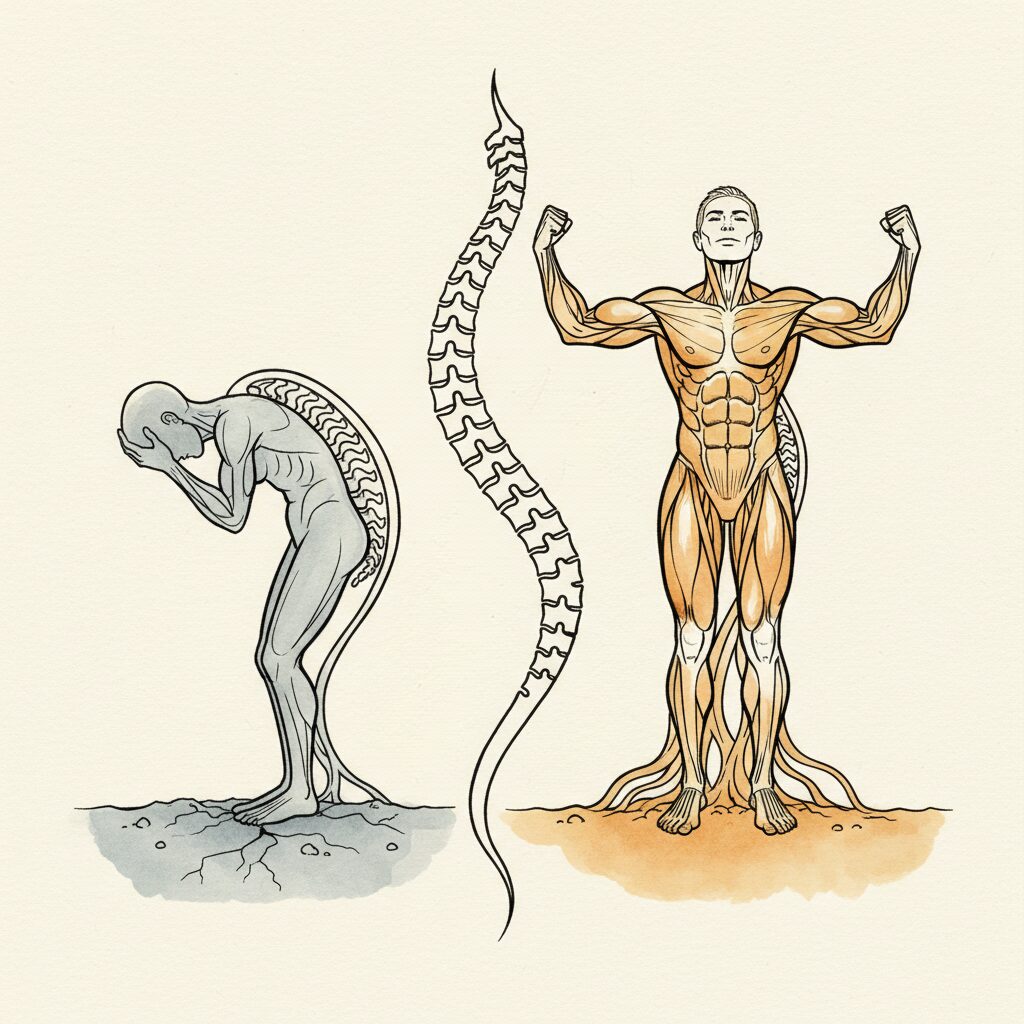
These are not neutral sentences. They are predictions installed by authority figures into a nervous system that takes prediction very seriously. Your brain heard those words and did what brains do: it updated its model. Not just its cognitive model. Its motor model. The model that generates your posture, your movement patterns, your tension, your pain.
The diagnosis became a word. The word became a belief. The belief became a prediction. The prediction became a motor command. And the motor command generates the very posture and pain that confirms the prediction.
This is the loop. And once it seals, everything you do to fight the diagnosis reinforces it.
A review by Darlow et al. (2012) found that what health professionals believe about back pain shows up in what their patients believe, and in the advice they give, like telling people to limit work and activity. Morley, Davies, and Barton (2005) studied what they call “self-pain enmeshment.” In 89 people with chronic pain, how much of their hoped-for self they could still reach with pain present predicted how depressed and how accepting they were. The diagnosis is not information the patient receives passively. It is an identity the patient adopts actively. The label reorganizes the person’s relationship to their own body, shifting from “I have a back that sometimes hurts” to “I am a person with a broken spine.” This shift generates protective behaviors, avoidance patterns, and motor commands that maintain the very condition the diagnosis described.
The identity loop
“I have scoliosis” generates “I need to be careful.” “I need to be careful” generates guarding. Guarding generates tension. Tension generates pain. Pain confirms “I have scoliosis.”
The loop is sealed. Every iteration strengthens it. Every doctor visit, every new X-ray, every conversation where you explain your condition to someone, every time you describe yourself as someone with scoliosis. Each one is a rep. Each one deepens the groove.
This is not psychological weakness. This is how predictive systems work. The brain generates outputs based on its model. The outputs create sensory evidence. The sensory evidence confirms the model. Prediction confirmed. Pattern maintained. The words programming your posture are not metaphors. They are instructions your nervous system is executing.
Vlaeyen and Linton (2000) documented the fear-avoidance cycle in chronic pain: catastrophic interpretation of pain generates fear, fear generates avoidance, avoidance prevents the novel experience that would update the prediction, and the prediction persists [3]. The diagnosis accelerates this cycle by providing a catastrophic framework before the person even begins to move.
The difference between the curve and the identity
The curve is real. Nobody is suggesting you deny it. Your spine has a lateral deviation. It shows on imaging. It is measurable. It exists.
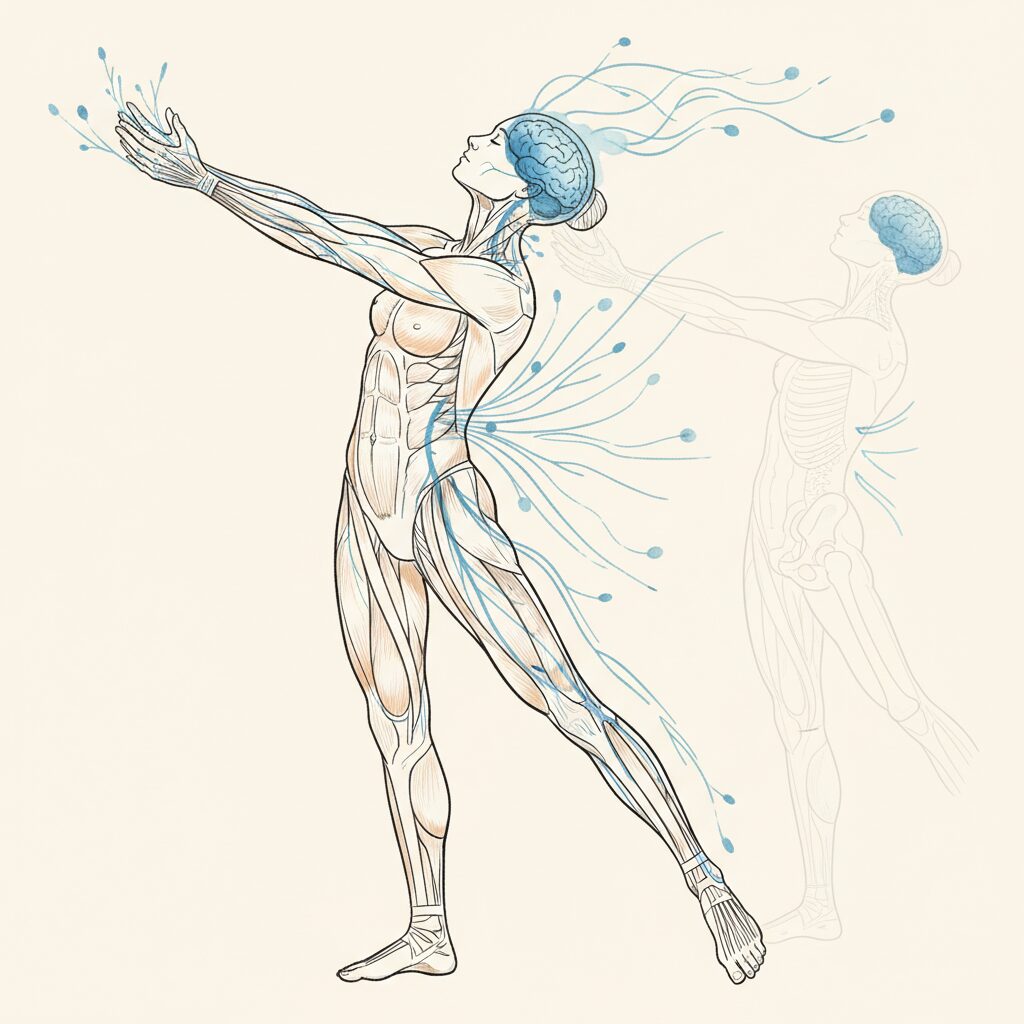
But the curve is an output. It is not who you are. It is what your nervous system is currently generating based on its model. And models can update.
The identity says: this is permanent. This is me. This is what I am dealing with. The identity closes the system. It takes a dynamic, updatable output and freezes it into a fixed truth.
“I have scoliosis” is a closed statement. “My body is running an outdated pattern” is an open one. The first generates resignation or combat. The second generates curiosity.
Resignation and combat both fail. Resignation surrenders to the prediction. Combat fights the prediction, generating more efference copies, more tension, more of the pattern it is trying to change. Curiosity is the only stance that allows the system to update.
Moseley and Flor (2012) demonstrated that cortical representations in chronic pain are not fixed anatomical changes but dynamic neural maps influenced by cognitive, emotional, and identity factors. The cortical reorganization that maintains pain is responsive to the person’s relationship with their body and their diagnosis. When the identity frame shifts from “I am damaged” to “my system is running a pattern that can update,” the cortical representation becomes available for reorganization. This is not positive thinking. It is a change in the predictive model that governs motor output. The identity does not cause the pain directly. It maintains the conditions under which the cortical map cannot reorganize: fear, avoidance, rigidity, and the absence of novel sensory input that would generate prediction error.
The exit is not correction. It is update.
You do not need to correct your scoliosis. You need to update the system that is generating it.
Correction says: this is wrong, force it to be right. Update says: this is outdated, give the system new information.
Correction generates effort. Effort generates efference copies. Efference copies suppress the proprioceptive feedback the system needs to change. The harder you try to fix it, the more you block the update.
Update requires something different. It requires an experience your nervous system was not predicting. A felt shift that did not come from effort. Pressure returning where it has been absent. Tension releasing in a muscle you were not targeting. A change in your body that your identity did not authorize.
That is prediction error. And prediction error is the only thing that cracks identity.
The moment the program updates
You are lying on the floor. You are not trying to fix anything. The conditions are simple: ground contact, reduced gravitational demand, exhale emphasis, safety.
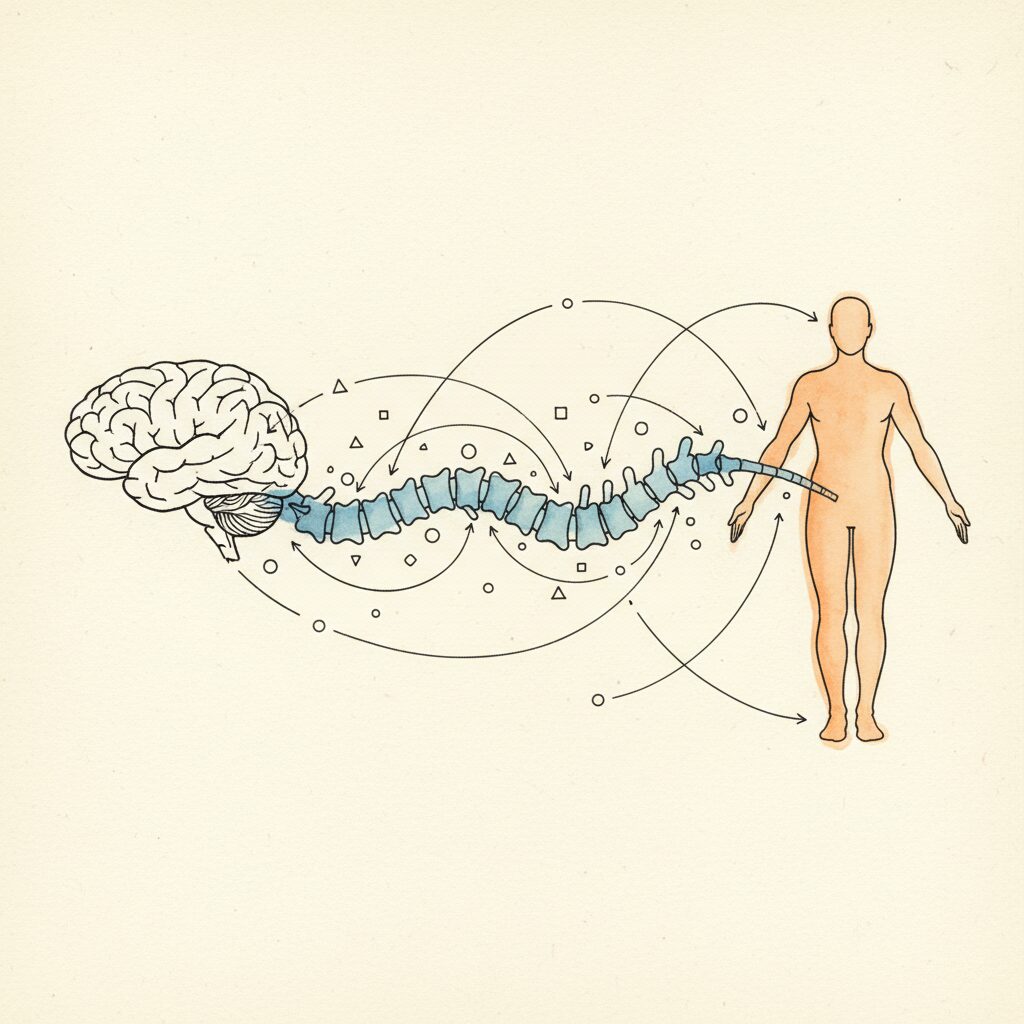
And then something shifts. A release you did not create. Pressure in a space that has been hollow for years. A softening in your jaw that you did not initiate. Your nervous system did something it has not done in a long time: it generated an output that did not match the prediction.
In that moment, the identity cracks. Not because someone told you your body is not broken. Because you felt it. The felt experience contradicted the prediction. And predictions update through experience, not argument.
Your body is not broken. It is running an outdated program. And the program just updated.
—
Related: Words Programming Your Posture | Why Your Nervous System Won’t Let Go of Pain | Your Diagnosis Is Not the Cause
—
Syntropic Core Resets provide the felt experience that breaks the identity loop. Not through cognitive reframing. Through a shift in pressure, tension, and sensation that your nervous system was not predicting. The identity cracks when the body does something the diagnosis said it could not. See how it works.
Sources
- Morley, S., Davies, C., & Barton, S. (2005). Possible selves in chronic pain: self-pain enmeshment, adjustment and acceptance. Pain, 115(1-2), 84-94. PMID: 15836972 [T1]
When pain becomes enmeshed with identity, adjustment worsens. The diagnosis is not information. It is identity. - Darlow, B., Fullen, B.M., Dean, S., Hurley, D.A., Baxter, G.D., & Dowell, A. (2012). The association between health care professional attitudes and beliefs and the attitudes and beliefs, clinical management, and outcomes of patients with low back pain: a systematic review. European Journal of Pain, 16(1), 3-17. PMID: 21719329 [T1]
Systematic review of 17 studies. Clinicians’ beliefs about back pain were associated with their patients’ beliefs and with the advice they gave about work and activity. - Vlaeyen, J.W., & Linton, S.J. (2000). Fear-avoidance and its consequences in chronic musculoskeletal pain. Pain, 85(3), 317-332. PMID: 10781906 [T1]
Fear-avoidance driven by diagnostic identity prevents the prediction error that would update the pattern. - Moseley, G.L., & Flor, H. (2012). Targeting cortical representations in the treatment of chronic pain. Neurorehabilitation and Neural Repair, 26(6), 646-652. PMID: 22331213 [T1]
Cortical reorganization in chronic pain is influenced by cognitive and identity factors. Changing the identity frame changes the cortical representation.
Related Reading
- your body doesn’t need fixing
- posture and pregnancy
- posture for athletes
- desk workers and ergonomics
- tech neck
- TMJ and posture