The shoulders that will not come down
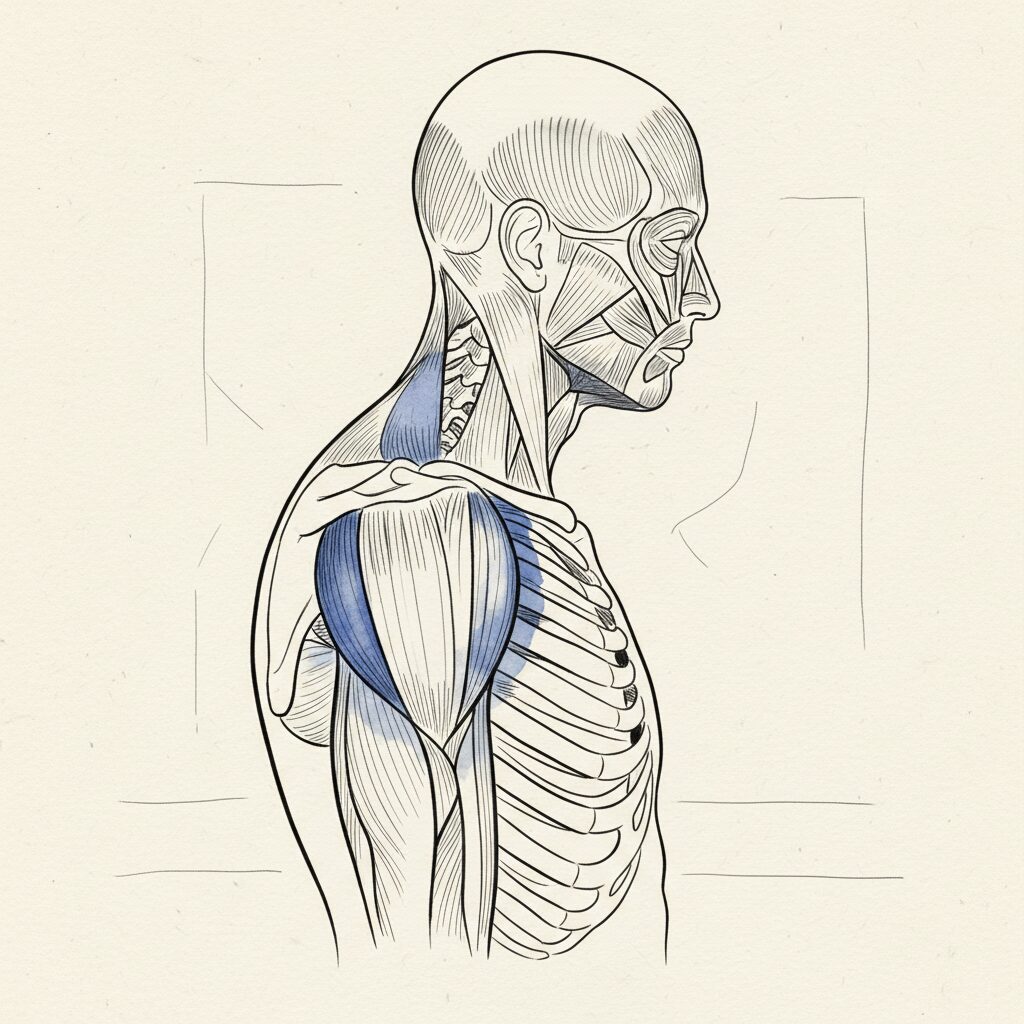
She has done the breathing. She has done the yoga. She has done the chiropractor and the massage therapist and the somatic class on Wednesdays. Her shoulders are still up around her ears.
It is not that she is not trying. She is trying constantly. Every time she catches herself, she takes a breath, lets the shoulders drop, and feels them lift right back up the second she stops thinking about it.
You probably know this body. Maybe you live in it. Chronic neck and shoulder tension that nothing seems to release. A jaw that clenches before you have woken up. A low back that feels braced even on the day you slept eight hours and did nothing physical.
This article is about why that body does not let go. There is a real mechanism behind it. It has a name. And once you understand what it is, the whole game changes.
The 156-word answer
The gamma efferent system is the wiring inside your spinal cord that decides how tight your muscles sit when you are doing nothing. Think of it as the resting volume dial for your entire muscular system. Your brainstem sets this dial moment by moment, based on how safe or unsafe it reads your environment to be. Under threat, the dial gets turned up so your body is pre-loaded for action. After the threat passes, in a healthy nervous system, the dial turns back down. After unresolved trauma, repeated stress, or a thwarted survival response, the dial gets stuck on high and stays there for years. This is why some people cannot relax no matter how hard they try. The conscious mind cannot reach the dial. The relaxation instruction lands on a circuit that was never wired to receive it. Something else is needed to update the setting.
What a muscle spindle is
To explain the dial, I need you to know about a tiny sensor inside every muscle.
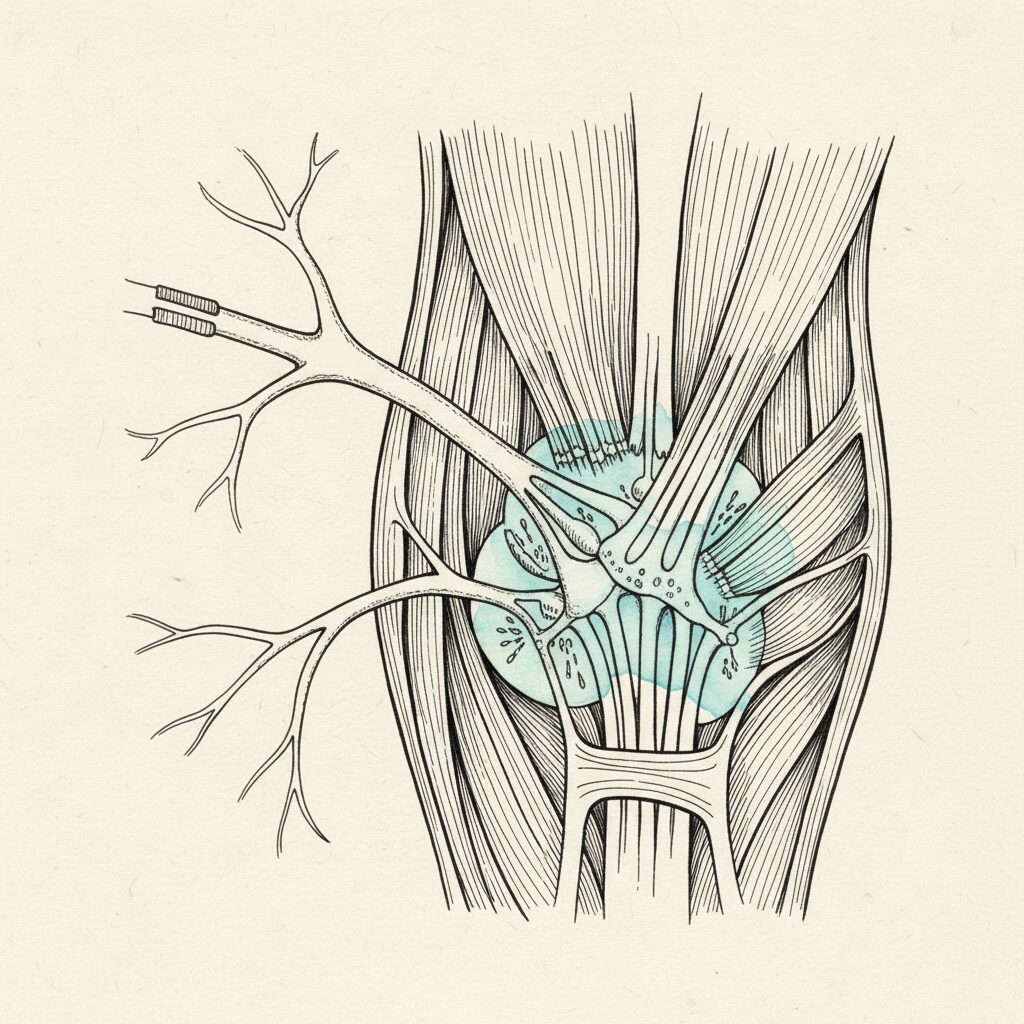
In the middle of every skeletal muscle in your body, there are little stretchy threads called muscle spindles. They are not the muscle. They are sensors inside the muscle. Their job is to report back to your brain how stretched the muscle is, how fast that stretch is changing, and what tension the muscle is currently holding.
Think of them as the speedometers and tachometers buried inside the engine. They do not power the car. They tell the driver what the car is doing.
The muscle spindles report to the spinal cord. The spinal cord runs short-loop reflexes (knee-jerk, balance corrections) and also relays the data up to the brain. This is how you know where your arm is when your eyes are closed. The spindles are sending continuous data.
But here is the trick. The spindles are not passive. Their sensitivity is adjustable. The brain can dial them up so they fire at the smallest stretch, or dial them down so they only fire at a big change. The dial that controls that sensitivity is the gamma efferent system.
What the gamma efferent system actually does
The gamma efferent system is a separate, smaller set of motor neurons that runs from your brainstem and spinal cord to the muscle spindles. These are not the motor neurons that move you. The neurons that move you are called alpha motor neurons. They contract the big muscle fibers.
The gamma motor neurons contract the tiny stretchy fibers inside the muscle spindle. They do not produce force you can feel. What they do is set the resting tension of the spindle. When gamma drive is high, the spindle is pre-stretched, and the muscle spindle screams at the smallest movement. When gamma drive is low, the spindle is loose, and the muscle stays quiet at rest.
In plain language: the gamma efferent system sets your baseline body alertness. High gamma drive means everything is sensitive, everything is loaded, everything is ready to react. Low gamma drive means the system is at rest, the muscles sit at length, and movement can come from neutral.
Now read the textbook version once and you will see why I had to do the plain version first.
The technical version: the gamma efferent system comprises gamma motor neurons in the ventral horn of the spinal cord, originating from the facilitatory reticular formation in the brainstem, projecting to intrafusal muscle fibers within the muscle spindle. Gamma drive sets the gain of the spindle’s stretch reflex. Elevated gamma drive maintains chronic muscle bracing independently of cortical control [2,5].
That is the same thing as the dial. The textbook just hides what it is doing inside the words.
How threat sets the dial
The reason the dial exists at all is that your nervous system is constantly making a prediction about whether you are about to need to fight, flee, or hold still.
When the brainstem reads danger, it raises gamma drive immediately. Your muscle spindles get more sensitive. Your reflexes get faster. Your posture pre-tensions. The body braces. This is the survival response. It is supposed to be temporary. It is supposed to come on, run, and stand down.
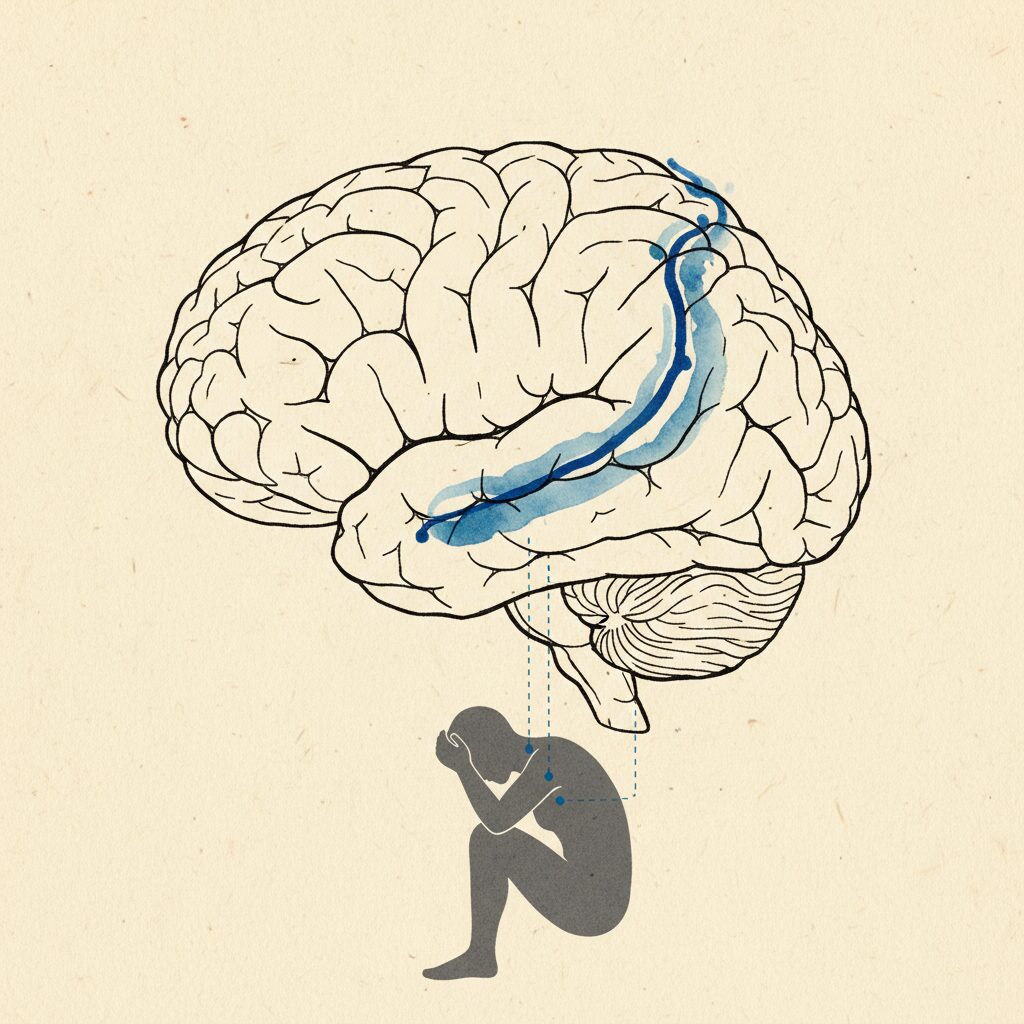
What happens in unresolved trauma, in chronic stress, in the survival response that never finished, is that the brainstem never gets the signal to stand down. The dial stays high. The muscle spindles stay pre-stretched. The chronic muscle tone stays elevated. Months, years, decades after the original threat is gone, the gamma drive is still set to where it was during the worst moment.
Peter Levine called this the thwarted survival response [4]. Stephen Porges called the underlying state sympathetic activation [3]. Thomas Hanna gave it a name that, once you hear it, you cannot unhear: sensory-motor amnesia [1]. The cortex, the conscious thinking part of your brain, lost the program to release the chronic contraction. It cannot find the off switch because the off switch is not in the cortex. It is in the brainstem. And the brainstem is running the survival program from before the conscious mind was even watching.
This is why “just relax” lands on nothing.
Why “just relax” cannot reach it
Try this for a second. Take a breath. Let your shoulders drop. Feel the difference.
Now wait fifteen seconds without paying attention. Where are your shoulders?
If your gamma drive is normal, they stayed down. If your gamma drive is stuck high, they came back up the moment you stopped consciously holding them down.
The conscious instruction to relax runs through the cortex. It hits the alpha motor neurons. The alpha motor neurons do release the gross muscle contraction. For a second.
But the resting tone is set by the gamma system, and the gamma system did not receive the message. As soon as cortical attention moves elsewhere, the gamma-set baseline reasserts itself. Your shoulders go back up. Your jaw goes back to its quiet clench. Your low back goes back to its quiet brace.
You did not fail to relax. You released the part of the muscle the conscious instruction can reach. The deeper layer, the resting baseline, was never under cortical control to begin with.
This is the core insight Thomas Hanna built his entire method around. Most chronic tension is not the muscles being unwilling. It is the muscles being held by a circuit that does not speak conscious-mind language.
What can reach the dial
If the dial is in the brainstem and not in the cortex, what can change it?
The answer turns out to be specific kinds of input the brainstem reads as evidence that the threat is over and the survival response can stand down.
Signals of safety. Slow exhale. Warm pressure on the body. Co-regulation with another calm nervous system. Sound vibration in the chest. Long contact through a held position. The kinds of input the body interprets as “we are not running anymore.”
Sensory-motor practices. Slow, attended movement that introduces new proprioceptive data to the brainstem from the very muscles that are stuck. Feldenkrais. Hanna Somatics. Yoga nidra. The Alexander Technique. These work because they speak the gamma system’s language. They are not telling the muscle to release. They are giving the brainstem new evidence about what state the body is in.
Pressure-driven update. Organized intra-abdominal pressure, the kind the diaphragm generates in deep slow breathing, sends interoceptive signal to the brainstem through a different pathway than proprioception. This is part of why breath-work that is structured (not just deep) can reach the gamma layer when other interventions cannot.
What cannot reach the dial. Trying harder. Stretching the muscle directly (it just gets re-loaded). Strengthening through the brace (it brings the muscle online inside the pre-tensioned state). Talk therapy alone. Telling yourself you are safe.
The dial is not in the conscious mind. It cannot be turned by an instruction. It is turned by evidence.
The connection to your posture
Posture is downstream of everything in this article.
Your posture is the shape your body takes when it is at rest. Resting tone is set by gamma drive. When gamma drive is locked high, your posture is the shape of a person whose body is still preparing to defend itself.
Shoulders up. Jaw forward. Ribs compressed. Low back braced. Head pushed forward to scan. Each of these is a piece of an incomplete survival response, frozen at the baseline.
This is what we mean when we say trauma lives in your posture. It is not poetry. It is the gamma efferent system holding the shape of an old emergency. The body schema, the brain’s internal map of where you are in space, organized itself around a high-gamma baseline and continues to generate posture from that map.
Updating the posture means updating the dial. Updating the dial means giving the brainstem the kind of evidence that the survival response can finally stand down. The order is non-negotiable. Safety first, sensory second, motor third. The motor layer is where your posture lives. It updates last because it depends on everything underneath.
What this means for you
If your shoulders will not come down, your jaw will not unclench, your low back stays braced no matter what you do, you are not weak and you are not failing.
You are living inside a gamma efferent system that learned, somewhere along the way, that the dial needed to be set high to keep you safe. It is doing its job. It is doing the only job it was ever designed to do.
The dial can be turned back down. Not by trying harder. By giving the system a different kind of evidence. Slow signals of safety. Attended sensory input. Organized pressure. Time spent in nervous systems that are not running. Practices that speak the body’s language, not the mind’s.
Your muscles are not holding on. The brainstem is holding for them. And the brainstem can learn.
If you want to work with a practitioner who reads gamma drive and nervous-system state as part of intake, browse the directory filtered by Body Budget or by the upstream chip that matches your case.
FAQ
What is the gamma efferent system in simple terms?
The gamma efferent system is a small set of motor neurons that runs from your brainstem to the tiny stretch sensors inside every muscle. It sets how tense those sensors are when you are doing nothing. Think of it as the resting volume dial for your entire muscular system. The conscious mind cannot turn this dial directly.
Why can’t I relax my muscles even when I want to?
The conscious instruction to relax reaches the muscles that produce force (alpha motor neurons), but does not reach the system that sets resting tone (gamma motor neurons). If your gamma drive is stuck high from chronic stress or unresolved trauma, the muscle will release for a second under conscious instruction, then return to baseline as soon as attention moves away.
Can trauma change muscle tone permanently?
Trauma can lock the gamma efferent system at an elevated baseline that persists for years or decades after the original threat ends. This is what produces chronic muscle bracing that does not respond to stretching, strengthening, or massage. It is not permanent in a deterministic sense. The dial can be turned back down with the right kind of input.
What kind of practice changes the gamma efferent setting?
Practices that give the brainstem evidence the survival response can stand down. Slow attended movement (Feldenkrais, Hanna Somatics, Alexander Technique), signals of safety (slow exhale, warm pressure, co-regulation), organized intra-abdominal pressure (structured breath-work), and time spent in regulated nervous systems. These work because they speak the brainstem’s language, not the cortex’s.
What is sensory-motor amnesia?
A term coined by Thomas Hanna for the state in which the cortex loses the program to release a chronically held muscle contraction. The contraction was set at the brainstem level via the gamma efferent system. The conscious mind cannot release what it cannot reach. Hanna’s work showed that with the right kind of slow, attended movement, the cortex can re-learn the release program and the chronic baseline can shift.
Sources
- Hanna T. Somatics: Reawakening The Mind’s Control Of Movement, Flexibility, And Health. Da Capo Press. 1988.
- Matthews PBC. Mammalian Muscle Receptors and Their Central Actions. Edward Arnold. 1972.
- Porges SW. The Pocket Guide to the Polyvagal Theory: The Transformative Power of Feeling Safe. W. W. Norton & Company. 2017.
- Levine PA. Waking the Tiger: Healing Trauma. North Atlantic Books. 1997.
- Gellhorn E. The physiological basis of neuromuscular relaxation. AMA Arch Intern Med. 1958;102(3):392-399. PMID 13569598.
Comments
One response to “What Is the Gamma Efferent System? The Hidden Brake on Your Muscles”
[…] trauma lives in your posture […]