Tuesday at four o’clock
Every Tuesday at four, he sits in the chiropractor’s chair. The neck cracks. The thoracic spine adjusts. He gets up feeling looser, taller, breathing better. He pays at the front desk. He drives home.
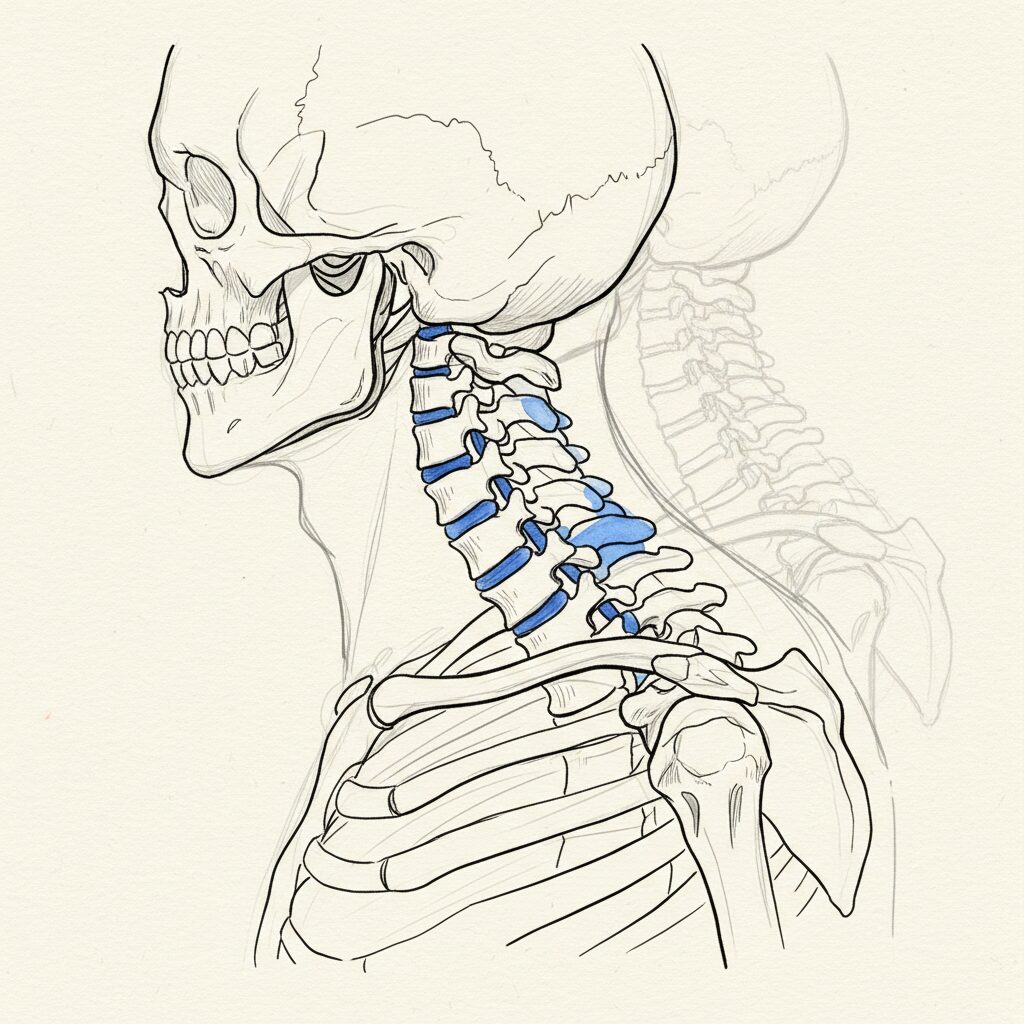
By Thursday afternoon his shoulders are back where they were. By Saturday he is wondering why he is paying for this.
He has been going for two years.
You probably know this story. Maybe you are living it. The chiropractor is competent. The adjustment is real. Something measurable shifts when the bones move. And within days, sometimes hours, the body returns to whatever shape it was making before.
This article is about why that happens. It is not the chiropractor’s fault. It is not your fault either. The pattern is being generated somewhere the adjustment cannot reach.
The 140-word answer
A chiropractic adjustment changes the position of the spine in the moment. It does not change the prediction your brain is using to generate posture in the first place. Your posture is not a position you hold. It is the output of an internal model that runs continuously in your nervous system. That model decides what shape your body should take based on threat history, breath patterns, sensory maps, and where your nervous system thinks danger lives. When the chiropractor moves a vertebra, the brain notices the new position and either accepts it as a temporary detour or, more commonly, restores the position the model is still predicting. To change posture durably, you do not need a better adjustment. You need to update the model that is generating the pattern.
What an adjustment actually does
To understand why the adjustment does not last, you need to know what an adjustment is.
A chiropractic adjustment is a controlled, fast, low-amplitude force applied to a joint. The audible pop you hear is gas releasing from inside the joint capsule as the bones briefly separate. The bones do move. The muscles around the joint do briefly let go. For a moment, the structure is in a different position than it was a second ago.
Think of it like pressing reset on a chair that has been stuck at an angle. The chair clicks back to neutral. Your body feels the click. You walk out feeling reset.
What the adjustment does NOT do is talk to the part of your nervous system that decided the chair should be at an angle in the first place. That decision is being made upstream. The chair is the printout. The adjustment fixed the printout. The printer is still running the same job.
The prediction problem
Here is the part most people never get told.
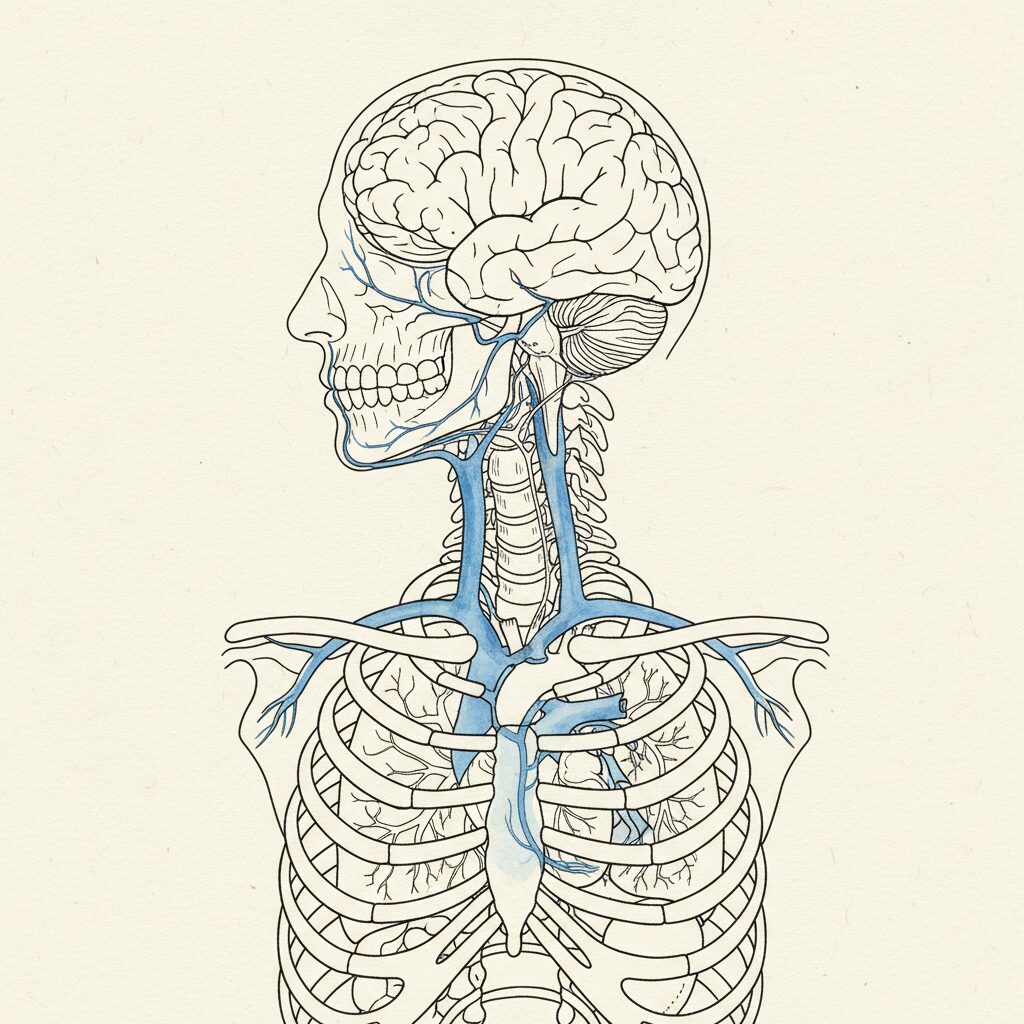
Your brain is not a passive receiver of sensory data. It is constantly running predictions about what your body is doing and what it should be doing. Neuroscience calls this active inference [3]. Every motor command your brain sends carries a prediction of what the sensation will be after the command runs.
When the actual sensation matches the prediction, nothing changes. The model was right. The pattern reasserts. When the actual sensation does NOT match the prediction, the brain has to update the model. That is the moment learning happens.
In plain English: your nervous system only changes when it gets surprised.
A chiropractic adjustment is, from the nervous system’s perspective, not very surprising. The pressure was external. The change in position was passive. The brain did not generate the movement, so the brain did not need to update its prediction. It just notes “something moved my body” and waits for things to settle back to where the model says they belong.
This is the same reason research has shown that passive movement, where someone moves your body for you, does not produce sensory learning [2]. Active movement, the kind where you generate the command yourself, is what writes new entries into the brain’s internal map. The chiropractor’s hands are skilled. They are also the wrong layer for changing the model.
Why your spine springs back
The bone goes back because the prediction that put it there in the first place is still running.
Your posture is shaped by a model in your nervous system called the body schema. The body schema is the brain’s continuously-updated map of where every part of your body is in space, what shape it is in, and what threats it needs to be ready for. This map was built over years. It was shaped by every physical and emotional load your nervous system has handled. Bracing patterns. Old injuries. Time spent in fight-or-flight. Habit. Posture in childhood. The way you held your jaw during the worst year of your job.
The model holds all of that. The model generates your default posture from all of that.
When the chiropractor adjusts you, the model briefly tolerates the new position. But the prediction is still running. The model is still saying “this is what we look like.” Within hours, the muscular system reorganizes around the model’s prediction. The spine returns to the shape the brain expected to find. Not the shape the chiropractor put it in.
This is also why the body holds tension after an adjustment. The muscles that the chiropractor relaxed were holding the shape the body schema was predicting. As soon as the muscles let go, the body schema noticed it was out of pattern and began re-recruiting tone until the pattern restored.
The adjustment was real. The pattern that put the spine there in the first place is more real.
What the chiropractor cannot reach
Three layers of the system sit upstream of the spine, and the adjustment cannot reach any of them.
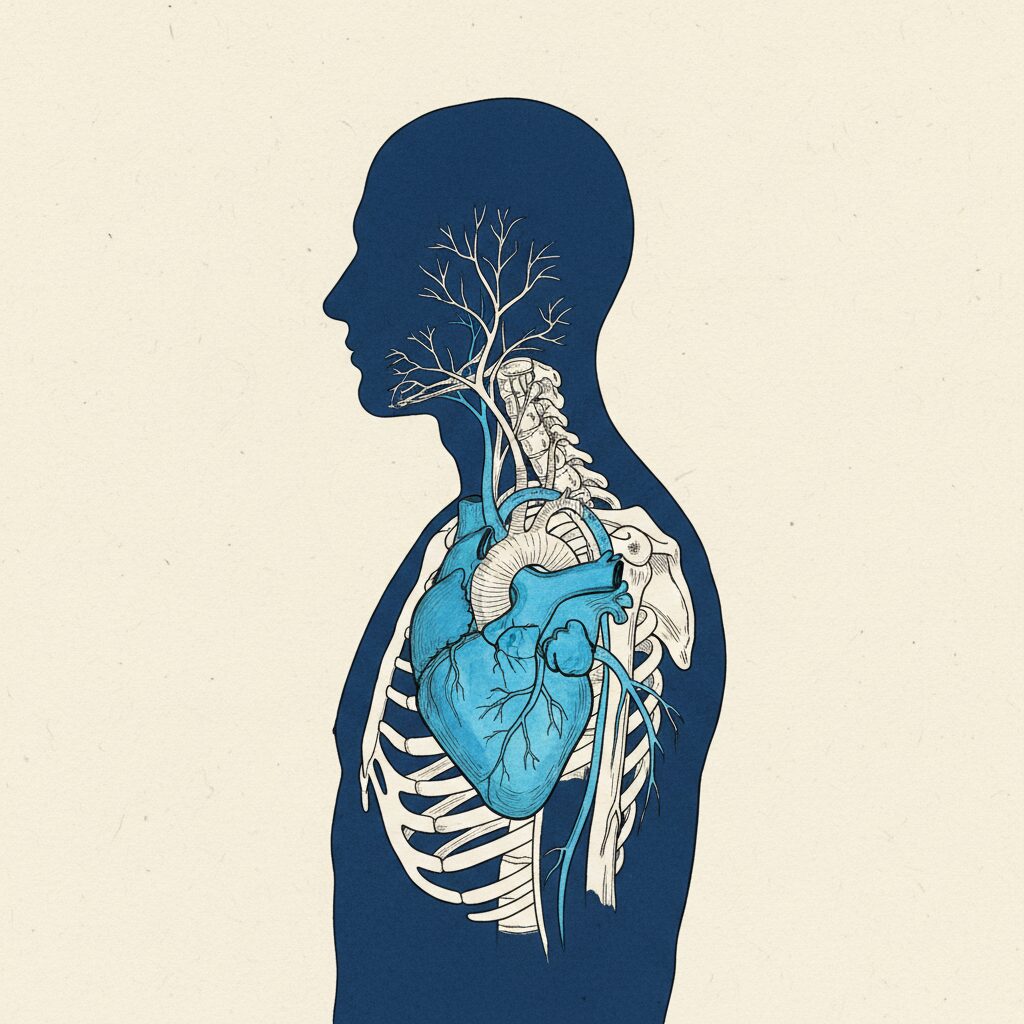
The threat layer. Your nervous system runs a continuous safety assessment, below the level of thought. When it reads the environment as safe, baseline muscle tone drops. When it reads the environment as unsafe, baseline tone rises. This is the polyvagal system Stephen Porges spent decades mapping [4]. The chiropractor cannot tell your nervous system that it is safe. Only direct experience of safety can do that. Slow exhale. Co-regulation. Time in nervous systems that are not running.
The sensory layer. Your body schema is built from continuous sensory input. When that input has gone quiet in certain regions, the map of those regions degrades. The brain’s internal picture of your body becomes lower resolution where the signal is weakest. This is called cortical smudging. The chiropractor cannot un-smudge a region. Only attention plus new sensory experience plus time can do that.
The body-budget layer. Your nervous system runs on a metabolic budget that decides what it can afford to update [5]. When the budget is depleted, the body stops investing in long-horizon changes like rewiring posture. The chiropractor cannot raise your body budget. Only sleep, food, rest, relational support, and meaning can do that.
If any one of these three layers is offline, the spine cannot stay where the adjustment put it. The system simply does not have the resources to hold a position that is not in the model.
What actually updates the pattern
You do not need a better adjustment. You need to update the prediction the adjustment is fighting against.
To update the prediction, you have to do three things, in order.
Settle the threat layer. Before your nervous system can rewrite anything, it has to read the room as safe. Slow exhale. Warm pressure on the body. Long contact through a held position. Time around regulated people. These signals reach the brainstem in a way no instruction can. The system has to stop running before it can be re-tuned.
Re-open the sensory channel. The smudged regions of your body schema have to come back online before the spine can reorganize. This is what slow attended movement, body scan, and conscious breath practices actually do. They are not relaxation. They are sensory re-mapping. The brain is updating its picture of where your body is.
Then, and only then, change the motor layer. Strengthening, mobilizing, adjusting, corrective exercise. All of it works much better when the model has been updated underneath. The same posture cues that bounced off you for years will suddenly land. Not because the cues changed. Because the system underneath them changed.
This is the sequence the chiropractic visit alone cannot deliver. Not because chiropractic is wrong, but because no single hour-long visit can address what is, in fact, a multi-layered, multi-week reorganization of your nervous system.
Your spine is the printout. The printer is the body schema. The chiropractor edits the printout. The printer keeps running.
When chiropractic still belongs in the plan
Nothing in this article is an argument against chiropractic.
For acute issues, a torqued sacroiliac joint, a stuck rib head, a recent whiplash, manual adjustment is often the fastest, cheapest, most appropriate intervention available. The bone is mechanically stuck. Move it.
For relief, an adjustment can break a pain pattern long enough for your nervous system to access calmer states it has not been able to reach. Used that way, chiropractic is a doorway, not the destination.
What does not work is using chiropractic alone to change a chronic postural pattern. The chronic pattern is not a stuck bone. It is a generated output. The adjustment treats the output. The generator is upstream.
The strongest results in clinical practice come from chiropractic paired with nervous-system regulation work, sensory re-mapping, and structural therapy that addresses the body schema. A chiropractor who reads nervous-system state and refers to behavioral optometrists, myofunctional therapists, and somatic practitioners as needed is delivering a different service than one who only adjusts. Both have a place. They are not the same product.
What this means for you
If you have been going to the chiropractor and your posture is not holding, you are not doing anything wrong.
You are paying for an intervention that operates at one layer of a system that has three more layers underneath it. The intervention is real. It is just incomplete on its own.
The next move is not a better chiropractor. The next move is to figure out which of the three upstream layers your nervous system needs first. Safety, sensory, or budget. Address that. Then layer the structural work on top of an updated model. The same adjustment that bounced off you for two years may start holding inside a week, because the system underneath finally agrees that it can.
The spine will hold the shape the model is generating. Your work is not to push the spine. Your work is to update the model.
FAQ
Can a chiropractor fix my posture?
A chiropractor can change the position of your spine in the short term. They cannot, by adjustment alone, change the body schema and threat history that are generating your posture in the first place. For chronic postural patterns, adjustment without nervous-system regulation and sensory re-mapping typically does not produce durable change.
Why does my posture revert after an adjustment?
Because your nervous system is running an internal model that decides what shape your body should be. The adjustment moves the bones. The model has not changed. Within hours or days, the muscular system reorganizes around the model’s prediction, and the spine returns to the previous shape.
Are chiropractors useless for posture?
No. Chiropractic is highly effective for acute injuries, stuck joints, and breaking pain patterns. It is not a complete solution for chronic posture because the chronic pattern is generated upstream of the spine itself. Chiropractic paired with nervous-system work, sensory re-mapping, and structural therapy gives a far better outcome than any of those alone.
How do I update the model my nervous system is running?
Three things in order. Settle the threat layer (slow exhale, warm pressure, co-regulation). Re-open the sensory channel (slow attended movement, breath practice, body scan). Then layer in structural work (strengthening, mobilizing, corrective exercise). The motor layer changes durably only when the layers underneath have been addressed first.
Should I stop going to the chiropractor?
Not necessarily. If chiropractic gives you relief and you enjoy it, keep going. Just understand what it is and is not doing. It is treating the symptom layer, which is valuable. It is not, by itself, changing the pattern. For pattern change, you need to address the layers the adjustment cannot reach.
Sources
- Blakemore SJ, Wolpert DM, Frith CD. Spatio-temporal prediction modulates perception of self-produced stimuli. J Cogn Neurosci. 1999;11(5):551-559. PMID 10511643.
- Kilteni K, Ehrsson HH. Efference copy is necessary for the attenuation of self-generated touch. iScience. 2020;23(2):100843. PMID 32058957.
- Friston K. The free-energy principle: a unified brain theory? Nat Rev Neurosci. 2010;11(2):127-138. PMID 20068583.
- Porges SW. The Pocket Guide to the Polyvagal Theory: The Transformative Power of Feeling Safe. W. W. Norton & Company. 2017.
- Barrett LF. Seven and a Half Lessons About the Brain. Houghton Mifflin Harcourt. 2020.