I built this program, so read this page knowing that
You searched for Syntropic Core Reset reviews, so you should know who’s answering. I’m Sam Miller. I built the Reset, which means this page isn’t an independent review. It’s what members wrote and said, in their own words, including what they found hard.
How the quotes were gathered: the cohorts were groups who went through the Reset together, with live sessions that I recorded. Almost every quote below comes from machine transcripts of those recordings. The rest come from one written form, where the person was asked if their words could be used anonymized and answered yes. I chose which quotes appear. All are anonymized, no names, no places, only the condition the person told me about.
One bias I can’t remove: people who stopped attending weren’t in the room to be recorded, so they’re under-represented here.
The short answer
The Syntropic Core Reset is the four-week foundation course inside the Posture Dojo membership. It teaches breathing and pressure practices, a lot of it learned lying on the floor.
Across the cohorts so far, as of September 2026, these are the changes individual members describe, and each one rests on one or two quotes further down, not on the group. Breath moving out of the upper chest and into the whole torso. A pause after the exhale. Less tension in one specific place, the neck for example. Feeling calmer. Catching their own habits during the day. One member says lying back hurts less than it did.
The complaint I hear most is that what people find on the floor doesn’t carry into sitting and standing. Some hadn’t reliably found the pressure sensation the practice is built on by their final week. Several say there’s too much material. Nobody on this page reports a measured change in their spine, and I don’t have clean before-and-after numbers yet.
A quote tells you what one person noticed. It can’t tell you how likely you are to notice the same.
Most of what people say in a session isn’t a result. I only present a quote as evidence when the person is describing a change in their own body or day. Where a quote only shows what the experience is like, I label it as color.
The transcripts are rough, filler words left in. I haven’t reworded anything.
Where I cut a clause you’ll see […]. Three dots inside a quote are trims made when the quote was first filed. A word in square brackets is the transcriber restoring a word the machine misheard.
Some people went through more than once, and some are quoted more than once. I flag it in places. A quote without a flag isn’t a promise of a new person, so don’t count quotes as heads.
The results page already carries quotes from the first two cohorts and I haven’t repeated them, this page leans on the later cohorts.
What this practice is and is not
The Reset is a self-guided practice. It is education in breathing and pressure. It is not medical treatment and it does not replace your medical care. Experiences vary. If something hurts, stop.
What people noticed in their body
“I have been feeling less tension in my neck and more aware when it begins to build than before. I feel increased general proprioceptive awareness. Specifically how I hold pressure throughout my core and how to create and maintain pressure with breathing.”
A hand on the side of the ribs, feeling where the breath moves and where it does not.
Adult with scoliosis and long-term pain. Cohort 1, written post-reset form.
“This is the first time that I’ve started my breath from the back where I have all that constriction and tightness and curvature, because it’s like a corkscrew in the mid back, and that’s right where that breath starts. I could feel that loosening up as I was taking the breaths on the ground. And then when I stood up I felt that mid back area was probably a little bit looser.”
Adult with scoliosis since the teens. Cohort 3, week 1. Color, not a result.
That was said inside the first session, so I count it as a first impression, not a result. The same member’s final-week report is in the hard section and it’s less tidy.
“First of all, my shoulders, when I lay around [down] and started to have the control, I can relax on my shoulders, I can actually relax on them… and when I focus on the belly and the pelvic floor and start to raise my legs, my knees and my legs and my hands, I actually can move around so much easier… This is nothing that I could do before.”
Adult with long-standing scoliosis. Cohort 6, week 3.
That one’s about ease of movement on the floor, not pain and not the shape of the spine.
“I felt really good after I did all the practices, it got easier, the more I did it, like there is definitely some restriction, like I felt like my rib cage on the left side didn’t want to expand the same way the right side did, but it got easier, the more I practiced.”
Adult with scoliosis that has progressed with age. Cohort 5, week 2.
The restriction is still there in that quote. Easier is the word used, and easier is all I’d take from it.
Breathing, pressure, and what made sense for the first time
The central idea in the Reset is pressure, breath organizing pressure inside the torso. Some of the quotes here are about understanding the idea, others are about feeling it.
“So this is, so this is second time I’m taking this class. […] I am like discovering a lot of things that you explain the first time that I’m undergoing a long while. And I mean, because you, you give us a lot of information.”
Adult with scoliosis, second time through. Cohort 4, week 3. Color, not a result.
No result claimed in that. I include it because it says plainly that one pass is a lot to take in.
“and also your your word you’re using allow to do something instead of work towards this i couldn’t get it at the beginning but i get it now”
Adult with a severe S-curve scoliosis. Cohort 3, week 4, on a second pass.
The word is “allow”, I use it on purpose. This member was on a second pass through the Reset when they said it, and what they describe is understanding, not a change in the body.
“This is the first time I felt where I was using space to move. My breath was being used to move my body, versus exercise, which seems to be more muscular. I’ve never really felt that before.”
Member, Cohort 3, week 3. Color, not a result.
A sensation during a session, it says nothing about what changed afterwards. It’s the clearest description I have of what a session felt like to one person.
“Well, I think it’s getting, you know, quote-unquote, easier. Like, I know, I definitely have more of a pause after I exhale. Like when I first tried to do it, I’m like, there’s no pause. So, now I can totally pause and just wait for the breath. They inhale the start, sort of almost on its own so that feels good.”
Adult with scoliosis. Cohort 4, week 4.
Same member had a pain flare after week 2, it’s in the hard section.
“okay i feel like the last time the first time that i did the four [Syntropic] core sessions i was breathing like all here in my chest and my throat and i spent literally like a month just like trying to breathe with my whole torso and body and i feel like this area really let go so it’s really cool to go through the movements again feeling like i’m doing like whole body breathing rather than this upper chest breathing”
Adult with mild scoliosis, second time through. Cohort 4, week 3.
This member first went through in an earlier cohort. What they describe is an arc of months, not one run of the Reset.
Day to day
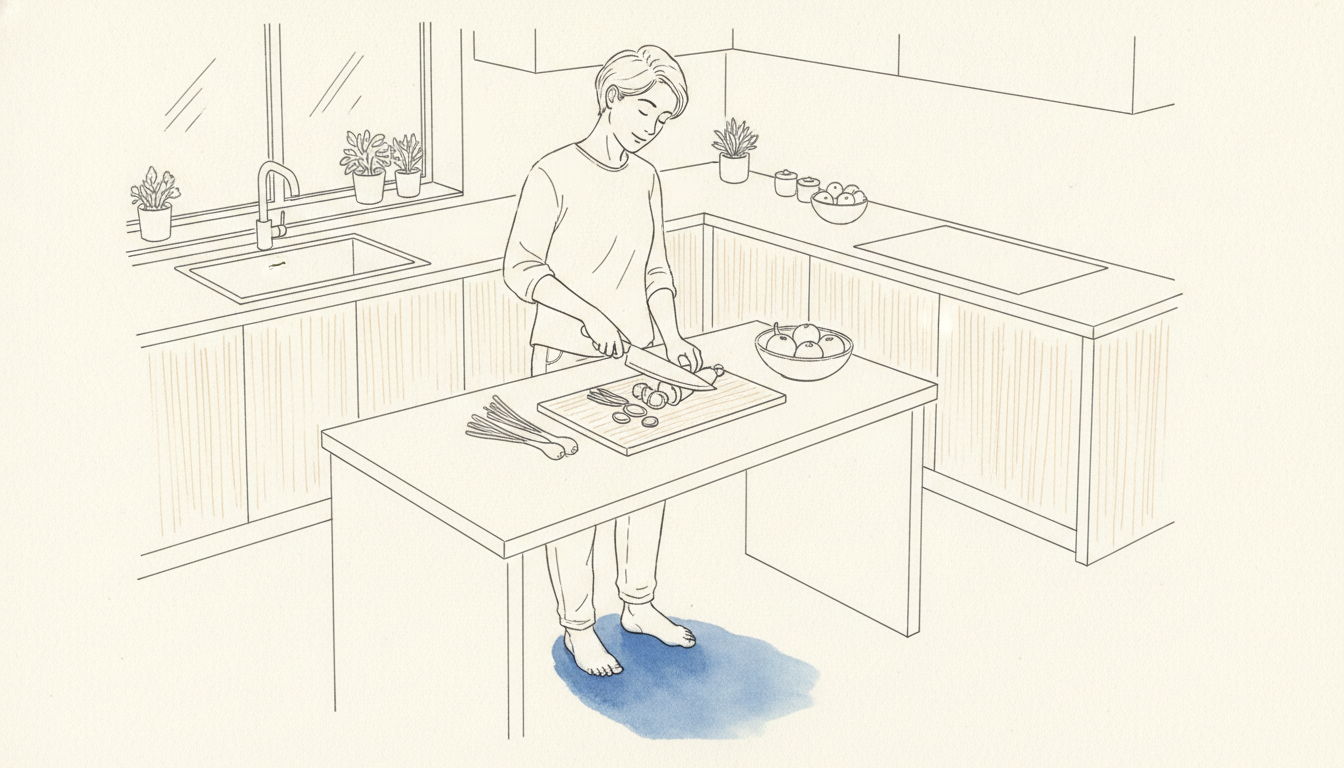
“I was paying more attention to myself in day to day. And I am almost always when I’m going into chopping or something that’s kind of mindless, putting most of my weight on my right foot. And so then I’m like, oh, okay, I got to balance that out.”
Chopping vegetables, and noticing where the weight sits in the feet.
Member, no diagnosis stated. Cohort 3, week 2.
“[Slowing], um, like I was like, I’m allowing myself to slow down.” … “I’m trying less, actually.” … “I’m walking my dog and I’m not trying to organize for the pressure when I’m walking, I’m going slower.”
Adult with scoliosis, second time through. Cohort 4, week 4. Same member who said one pass was a lot. Color, not a result.
Three answers in a row, joined when the quote was filed. The member doesn’t say whether slowing down made anything better, so I count it as color.
“I also very obviously noticed that like I think I’ve mentioned to you anyway that I shake a lot when I meditate whenever I sort of focus well that’s totally diminished like I’m wouldn’t say it’s gone a hundred percent but like it just I just feel way calmer like my body just feels maybe more maybe it’s safe or whatever but yeah way calmer”
Adult with scoliosis. Cohort 4, week 2. Same member as the exhale pause quote.
“I feel I’m stressed so I noticed that and I just take a moment and relax and do the exercise meditation that you told us last week that like standing or sitting but take the time to actually exhale and inhale it’s called [calmed] me down actually”
Adult with long-standing scoliosis. Cohort 6, week 4. Same member as the shoulders quote.
None of these are about the spine.
What people said about pain
Only the first quote here is plainly about pain. The second is about an urge and the third is about tension. Each is one person describing one day or one week, none of them is a claim that the Reset treats pain.
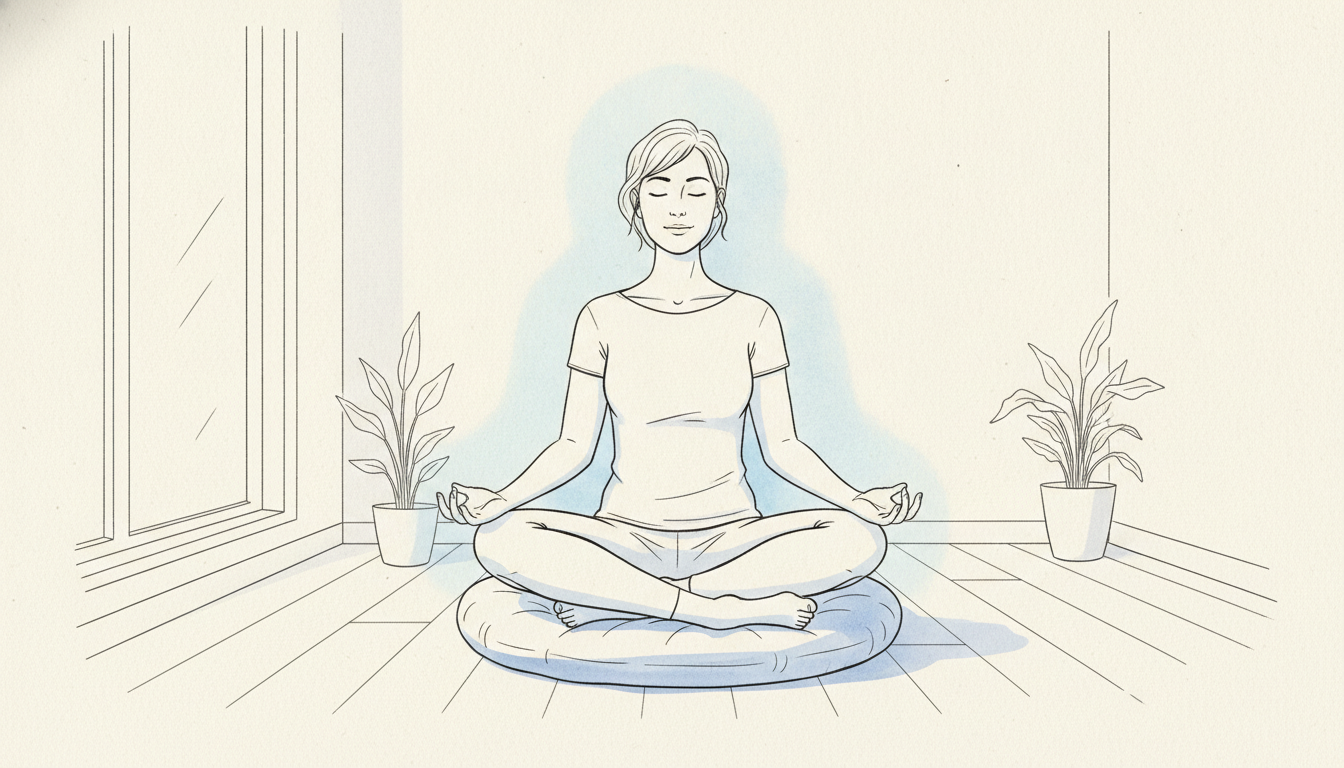
Sitting quietly, noticing what a calmer body feels like from the inside.
“Before it hurts when I lay back. Now it doesn’t hurt that much.”
Adult with long-standing scoliosis. Cohort 5, week 3.
In the same turn this member told me there was too much for them. That half is in the hard section.
“and also a nice thing i was walking in in a park this week […] at the sudden moments uh um everything felt right […] it’s always there i always feel that i have to correct my back and now it was not necessary”
Adult with scoliosis and kyphosis since the teens. Cohort 3, week 4.
In the part I cut, this member went back and forth over whether to call the feeling hurting, so I won’t tell you the pain went away. For a moment in a park, the constant urge to adjust the back wasn’t there.
“I was doing the breathing exercises about three times per day, kind of morning, mid-afternoon, and then right before bed, and that seemed to help mitigate some of that tension that I had in there.”
Adult with scoliosis since the teens. Cohort 3, week 2. Same member as the mid back quote.
Compared with what they had tried before
Some people arrive with a list of what they’ve already tried. Both quotes here are arrival stories, they’re color. They tell you who shows up, and they aren’t evidence that the Reset did anything.
“I’ve looked into muscle I’ve looked into well so many things and nothing seems to work […] I’m just giving up I think nothing is gonna work on the other hand I’m always interested in learning so I’m here just to see like hey what can I get out of this.”
Adult with minor scoliosis and chronic pain. Cohort 6, week 1. Color, not a result.
Two weeks later this same member gave me the sharpest criticism on this page. Read both.
“the classic route is stretching and strengthening, basically. And it’s always just temporary, never really sticks.”
Adult with mild scoliosis below the diagnostic threshold. Cohort 5, week 1. Color, not a result.
I don’t read either quote as a complaint about the practitioners these people saw.
Gratitude
Thanks are the weakest kind of evidence. They’re also part of what was said.
“Thank you so much for all of this. It’s really magnificent to see you do this work, because I’ve been living with this condition for so many years and there’s just really nothing to support you.”
Adult with scoliosis diagnosed in the early teens. Cohort 5, week 2.
“I’ll be in the gym and do these exercises, just to focus, 30 minutes, just to be there and focus to remind myself because hectic day, almost every day. So yeah, I started the last few days and it’s amazing”
Adult with long-standing scoliosis. Cohort 6, week 3. Same member as the shoulders quote.
“all this time before, I had very big problem with calming down. So when we do this practice here in a group and when you’re talking, of course, for me it’s really easy to get in the state of relief in my head, in my brain, first of all, I then the whole body.”
Adult with scoliosis since the teens. Cohort 6, week 3.
That last one is about being in a group with me talking, which is how these cohorts ran. The next thing this member said was that it didn’t yet work alone. Take it as a statement about that room, not about practicing on your own.
What people find hard
There’s a lot of critical feedback in my files. It gets the most room on this page.
On the floor it works, then I stand up
“I’m doing pretty good you know when we’re on the ground but I’m not really feeling that it’s transferring to when I’m sitting like in a chair or standing up”
Adult with scoliosis since the teens. Cohort 3, week 4. Same member as the mid back quote.
The same member added, “I totally lose all posture when I sit or stand”. This is the person who said in week 1 that the mid back felt a little looser on standing up.
This is the complaint I hear most. Another member, in a different cohort, ended the same complaint with “Maybe it takes some time.” I won’t tell you it resolves inside the Reset, for the member quoted above it hadn’t by the final week.
It stays stuck in the old pattern
“when I just try to basically let it go and breathe and let the breath do its work, I don’t feel my body reorganizing. It just stays stuck in the old pattern.”
“I’m a little bit sad that it is not a nice cylinder, basically, that it is a crumpled can.”
Adult with minor scoliosis and chronic pain. Cohort 6, week 3. Same member as the arrival story above.
This member wasn’t heard in the final week, so I have no later word. In that session I said the instruction that confused them was “something I haven’t integrated into every cohort.” So part of that confusion sits with my teaching.
“I feel a little more expansion, but it’s, and I obviously feel like slow, but I feel like slowly a bit more expansion, but I still feel like it’s not where it should be.”
Member, Cohort 4, week 4.
A final-week outcome, stated plainly.
I cannot find the edges
The edges are one of the sensations the practice asks you to find.
“I find it hard to feel the edges. […] I don’t know if I’m just not finding it […] Or if it’s just because I’m doing something wrong.”
Member, Cohort 4, week 4.
“it’s just a shakes and it’s, it feels so muscular. It feels like impossible to not understand this as a muscular.”
Member, Cohort 5, week 3.
My records from the first cohort also note one person for whom the core pressure sensation never arrived consistently.
There is too much of it
“I’m confused about the different stages […] There was too much for me. I don’t know. What should I focus on and do everything?”
Adult with long-standing scoliosis. Cohort 5, week 3. Same turn as the lying back quote above.
“i got lost on the sequence or the number of exercises […] is there like a quick pdf or reference at all for the exercises”
Member, Cohort 3, week 4.
This comes up in more than one cohort. Some of the people quoted above went through a second time, in a later cohort.
I want to quit
“then I get a bit frustrated or something. And then I just want to quit.”
Member, Cohort 2, week 4.
“if I’m not putting effort into something, I don’t feel like I’m doing anything.”
Member, Cohort 4, week 4.
Doing less is the hard part. The instruction here is to allow, and for some people that feels like doing nothing. I’ve said it elsewhere, it feels like letting go of a strength. Expect the moment where you want to quit.
Waiting for the back to change
“when should I start to get notice something in the back or what should I expect”
Member with scoliosis. Cohort 6, week 4.
My answer in the session was that the first things to change are state and skill. I don’t promise structural change from the Reset, and nothing on this page is evidence of it.
Not practicing
“I didn’t do that much practicing. I already feel like I’m falling behind”
Member, Cohort 4.
People say this plainly, and in more than one cohort.
Flare-ups and strong reactions
Some people had strong reactions. I describe these in my own words and don’t quote them. Where I know how long one lasted, I say so.
One member had a pain flare on one side for a day or two after a session. One had a week of new jaw tension. One got lightheaded and shaky in the middle of a practice, and it settled in the session. One felt pressure around the eyes when pushing too hard. One felt panic during the breath pause. One felt burning and numbness at an old injury site when lying on the floor.
This is a self-guided practice. If something hurts, stop.
People dropping off
In more than one cohort, attendance fell as the weeks went on. I never collected the reasons. Some watched the recordings later, and I never reconciled the attendance logs, so I can’t tell you how many finished. The people who left are the ones I most needed to hear from.
The written criticism
“The one thing that I could see improving the cohort would be an explanation of how the practice can be incorporated into the rest of life. […] I am left curious how the syntropic core breathing and pressurizing of the core works in practice for things like working out, weight lifting and heavy load bearing activities”
Adult with scoliosis and long-term pain. Cohort 1, written post-reset form. Same member as the first quote on this page.
The request is fair, and it matches the complaint about standing up.
Who tends to do well, and who it is not for
I can only answer from the quotes, and I chose the quotes. So this is a pattern in what was said, not a finding.
A few of the quotes that describe a change also mention regular practice, the breathing three times a day, or a side that got easier the more the member practiced. The member who describes whole body breathing was on a second pass, and says a month went into the breath alone.
The struggles are in the section above. Two I’d weigh before starting: needing effort to feel like you’re doing something, and waiting for the back to look different by the final week.
It’s not for you if you want medical treatment, or if you need outcome data before you try something, I don’t have that data yet.
And if you want a result by Friday, this will frustrate you.
The numbers I do not have
I do not yet have clean before-and-after numbers.
What I collect: a form before the Reset and a form after it. Both are self-report: pain, stiffness, energy, a self-timed breath test, and a self-scored posture check. As of September 2026, the complete before-and-after pairs I have on file are too few to mean anything. One person’s numbers are a story, not evidence. So I am not publishing them.
The limits would apply even with more forms. Everything is self-reported. There is no comparison group, so I cannot separate a real change from expectation, or from a bad week getting better on its own. People who join early are the most motivated. And the people who stopped attending are among the ones whose forms are missing.
The plan is a short three-question pain scale, asked before and after. It has not been collected for any cohort yet. I will not publish numbers until they are real.
FAQ
Is the Syntropic Core Reset legit? It’s a real course. I built it, I have scoliosis myself, and real people went through it in groups. Their words are above, including the member who said their body stayed stuck in the old pattern. It isn’t independently reviewed, clinically tested, or backed by outcome numbers.
Does the Syntropic Core Reset work? Some people describe changes in breathing, tension, calm, and what they notice during the day. Others say the floor work didn’t carry into standing, or that their body stayed in the old pattern. I can’t give you a success rate, because I don’t have one.
Does it work for scoliosis? Most of the quotes here come from people with scoliosis. One describes a restricted side of the rib cage getting easier to breathe into with practice. Two quotes describe less tension. One member said their body didn’t reorganize. Nobody reports a measured change in their spine, and I make no claim about one. The Reset is education in breathing and pressure, it isn’t a scoliosis treatment.
How long until people notice something? It varies, and I promise nothing. One member described a slightly looser mid back inside the first session, which I count as a first impression, not a result. Several of the quotes about change come from week two. One member spent a month on the breath alone before it let go. Some hadn’t found the pressure sensation by their final week.
Are these reviews edited? I selected them and trimmed some, cuts marked […]. Nothing is reworded. Names and places are removed.
Did anyone have a bad reaction? Yes. A pain flare that lasted a day or two, a week of jaw tension, lightheadedness that settled in the session, panic in the breath pause. The full list is in the hard section. If something hurts, stop.
The first step
The first step is always the Reset itself. You lie on the floor, you breathe, and you find out what your own body does with it.
If you want the mechanism first, read what the Reset is. Then read the hard section again. If you still want to find out for yourself, the Reset is where you start.
Sam Miller is the founder of Posture Dojo and creator of Syntropic Core Reset. He was diagnosed with 85-degree scoliosis at 18 and spent 20 years developing a nervous system approach to postural change. He works with adults with scoliosis, kyphosis, and chronic pain that hasn’t responded to conventional treatment. Read more about Sam