You have heard these a thousand times
Stand up tall. Pull your shoulders back. Brace your core.
From personal trainers, physical therapists, your mother, the internet, every posture article ever written. These three cues are so universal they feel like natural law. Like gravity. Like something that must be true because everyone says it.
I think they are wrong. They are three versions of the same mistake. The research behind that view has been sitting in peer-reviewed journals for over two decades. Putting it together is my synthesis.
What posture actually is
Before we can understand why these cues fail, we need to understand what they are trying to change.
Your posture is not a position. It is a prediction.
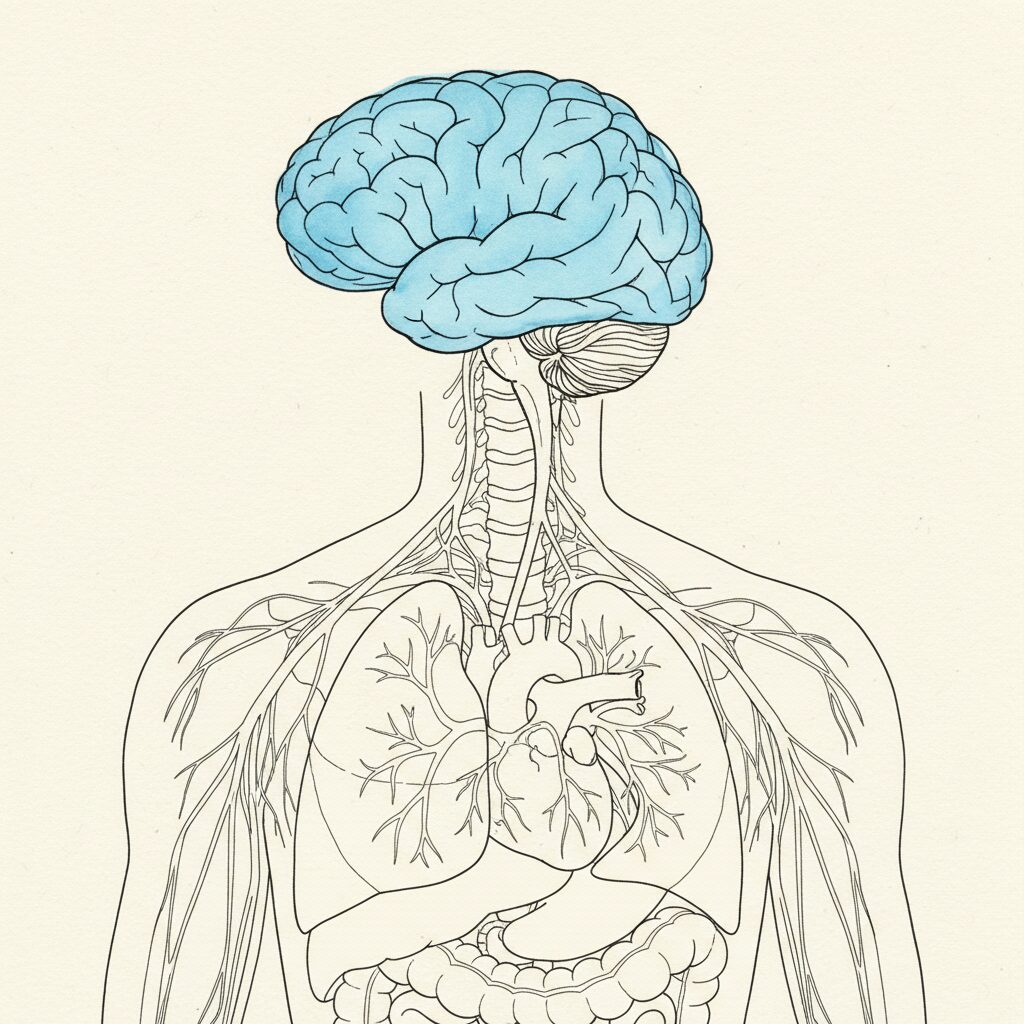
Your brain runs a predictive model called the body schema [10]. This model generates your posture as its best guess about how to organize your body based on all incoming sensory data: proprioception, vision, vestibular input, interoception. Your posture at this moment is the output of that model. It is being generated right now, continuously, without your conscious participation.
Changing posture means changing the model’s prediction. And that requires new sensory information that the model did not expect. Neuroscientists call this prediction error. No prediction error, no update. No update, no change.
My view is that effective posture work delivers prediction error to the body schema, and ineffective work does not. The three cues below, I will argue, do worse than fail to deliver it. They get in its way.
Cue 1: “Stand up tall”
This is the most intuitive posture cue in the world. And it is a neurological trap.
When you decide to stand up tall, your brain does two things simultaneously. It sends a motor command to your postural muscles. And it generates a copy of that command, called an efference copy, which it sends ahead to your sensory cortex [1].
The efference copy’s job is to predict what the movement will feel like and cancel the expected sensation before it arrives. This is the same mechanism that makes it impossible to tickle yourself [1]. When you run your own fingers across your ribs, the sensation is muted because your brain predicted exactly what would happen. When someone else does it, the sensation is vivid because no efference copy was sent.
When you stand up tall, your brain predicted exactly what standing up tall would feel like. The sensation arrives. It matches the prediction. Cancelled [2]. The body schema, the model that actually generates your posture, receives no new information. No prediction error. No update.
You stood up tall. You felt yourself stand up tall. And the system that runs your posture learned absolutely nothing.
The cancelling part is not a theory. Shergill and colleagues showed it in a 2003 paper in Science [2]. Applying it to posture is my step, not theirs. In a force-matching experiment, participants consistently pressed too hard when trying to match a force applied to their finger. The efference copy suppressed the sensation of their own pressing, so they overshot. Every time. The harder they tried, the more the brain cancelled.
The harder you try, the less you feel.
Jeannerod showed it gets worse: motor imagery alone generates efference copies [4]. The intention to correct your posture, even before you move, begins suppressing the proprioceptive signal from the area you are about to correct. You lose resolution on the exact area you are trying to change.
This is why you stand up tall, feel better for ten minutes, and then wake up the next morning at the same default. The conscious experience of “better posture” was real. The body schema update was not. You updated the experience. The map that runs the system never got the memo because every memo was stamped “self-generated” and deleted at the gate.
Cue 2: “Pull your shoulders back”
This cue treats a symptom as a cause.
Your shoulders did not round because your rhomboids are weak. Your shoulders rounded because your nervous system is running a protective pattern.
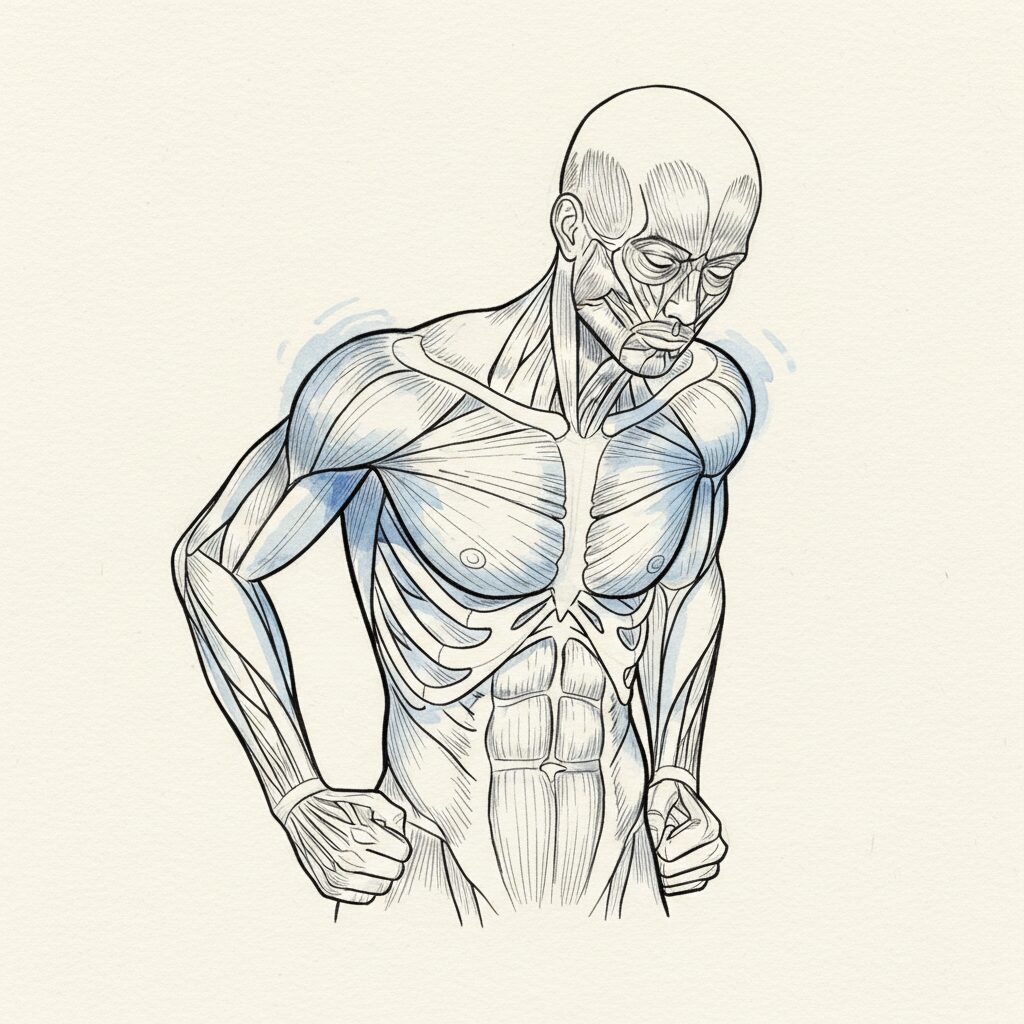
When the autonomic nervous system detects threat, whether physical, social, or psychological, it triggers a predictable motor cascade [5]. The suboccipitals tighten, pulling the head back at the upper cervical junction. The traps and levator scapulae activate, hiking the shoulders. The thoracic extensors brace. The diaphragm flattens and locks. The jaw clenches. This is systemic extension: the fetal curl attempting to happen while standing upright.
The rounded shoulders are Step 3 in a ten-step cascade that begins with threat perception and ends with structural lockdown. Pulling them back addresses Step 3 while Steps 1 through 10 continue running.
It gets worse. “Pull your shoulders back” is a motor-command internal focus cue. Attentional focus research long argued that this kind of instruction interferes with smooth movement [11]. The idea is that a motor-command cue pulls conscious control into a job the cerebellum and basal ganglia usually do on their own.
A 2024 Bayesian meta-analysis by McKay and colleagues, published in Psychological Bulletin, found that the supposed advantage of external focus cues over internal ones was largely a publication artifact [6]. So the size of that effect is now in doubt. What I still think holds: commanding a movement and sensing the body are different operations. “Pull your shoulders back” is a command. In my view it gets in the way of the automatic coordination it is trying to improve.
And here is the part nobody talks about: the human body is not symmetrical. Your organs are asymmetrical. Your diaphragm attaches differently on the left and right. “Pull your shoulders back” assumes bilateral symmetry that does not exist. It imposes a geometric ideal onto a system that was never designed to be geometrically ideal.
The shoulders are output. If you want to change the output, you have to change the input. The input is the autonomic state, the pressure system, and the sensory data feeding the body schema. None of those change when you retract your scapulae.
Cue 3: “Brace your core”
This is the most dangerous of the three. Not because it causes immediate injury, but because it systematically dismantles the mechanism that actually stabilizes the spine.
Your spine is not stabilized by muscular force alone. Pressure does a large share of the work.
The abdominal cavity is a sealed, fluid-filled container. When the diaphragm descends, it pressurizes this container. Pascal’s Law: pressure in a confined fluid transmits equally in all directions. This omnidirectional pressure braces the spine from inside out. Cresswell and colleagues measured it directly in 1992: intra-abdominal pressure generated by diaphragm descent provides a significant portion of the spinal extensor moment [8]. This is hydraulic engineering, not muscular effort.
Hodges and Richardson showed that in healthy subjects, the transversus abdominis fires automatically before limb movement, without conscious effort [7]. The feedforward stabilization system is reflexive. It does not need your help. It needs to not be overridden.
When you brace your core, you create muscular co-contraction. The abdominal wall becomes rigid. The diaphragm cannot descend because there is no room. Breathing shifts to the upper chest. The hydraulic pressure system goes offline.
Cholewicki and McGill demonstrated that spinal stability requires surprisingly low levels of muscular co-contraction [9]. Excessive bracing actually increases compressive loading on the spine. You are adding force to a system that needed pressure. Force is directional and fatiguing. Pressure is omnidirectional and self-sustaining.
And then, in my model, a cascade can follow. Chronic bracing can hold the diaphragm flat. Breathing becomes shallow and fast. Carbon dioxide drops. Chemoreceptors detect the CO2 change and activate the sympathetic nervous system. Sympathetic activation triggers posterior chain bracing. More threat. More tension. More bracing.
The cue creates the problem it claims to solve.
What all three have in common
Every one of these cues is a motor command. Motor commands come with an efference copy, and the efference copy turns down the matching sensation. My claim is that this includes the signal the body schema needs to update.
They all treat posture as a mechanical problem with a muscular solution. But posture is a prediction problem with a sensory solution.
The body schema does not update because you forced a position. It updates because it received sensory information it did not predict. The technical term is prediction error. And prediction error cannot come from a movement you planned, because the planning itself generated the prediction that cancels the signal.
What the research says works instead
The body schema has a back door. Two of them.
The first is interoceptive sensing [12]. When organized internal pressure activates visceral mechanoreceptors and baroreceptors, those signals travel on a neural pathway through the insular cortex that has no established efference copy gating mechanism. The motor system does not send prediction copies to cancel visceral sensation because visceral states are not consequences of voluntary motor commands. My hypothesis is that this signal arrives with much less gating, so the body schema can take it as real news.
The second is non-demanding awareness. When you attend to a body region without intending to change it, no motor plan forms. No efference copy generates. The sensory channel stays open. “Feel where breath arrives” recruits the insular sensing pathway. “Fix your posture” recruits motor cortex override [11]. Same words, different neural circuits, opposite outcomes.
The alternative to these three cues is not a better cue. It is a different category of input entirely.
The bottom line
“Stand up tall” suppresses the signal that would update the map. “Pull your shoulders back” addresses a symptom while the cause continues running. “Brace your core” disables the hydraulic system that does what bracing claims to do.
These cues persist not because they work, but because the temporary conscious experience of “better posture” feels like evidence. You stood taller. You felt it. So it must have worked. But the feeling was the efference copy’s prediction playing back to you, not a genuine sensory update reaching the model that runs the system.
The pieces of this research have been around for over twenty years. The harder you try to fix your posture, the less your body learns from the attempt. The solution is not trying harder. It is learning to listen.
Sam Miller is the author of UPRIGHT and creator of the Syntropic Core method. He writes about posture as a nervous system phenomenon at posturedojoresearch.com.
References
[1] Blakemore SJ, Wolpert DM, Frith CD. Why can’t you tickle yourself? NeuroReport. 2000;11(11):R11-R16.
[2] Shergill SS, Bays PM, Frith CD, Wolpert DM. Two eyes for an eye: the neuroscience of force escalation. Science. 2003;301(5630):187.
[3] Kilteni K, Ehrsson HH. Efference copy is necessary for the attenuation of self-generated touch. iScience. 2020;23(2):100843.
[4] Jeannerod M. Neural simulation of action: a unifying mechanism for motor cognition. NeuroImage. 2001;14(1 Pt 2):S103-S109.
[5] Porges SW. The Polyvagal Theory. New York: W.W. Norton; 2011.
[6] McKay B, et al. Reporting bias, not external focus. Psychol Bull. 2024;150(11):1347-1362.
[7] Hodges PW, Richardson CA. Feedforward contraction of transversus abdominis is not influenced by the direction of arm movement. Exp Brain Res. 1997;114(2):362-370.
[8] Cresswell AG, Grundstrom H, Thorstensson A. Observations on intra-abdominal pressure and patterns of abdominal intra-muscular activity in man. Acta Physiol Scand. 1992;144(4):409-418.
[9] Cholewicki J, McGill SM. Mechanical stability of the in vivo lumbar spine. Clin Biomech. 1996;11(1):1-15.
[10] Friston K. The free-energy principle: a unified brain theory? Nat Rev Neurosci. 2010;11(2):127-138.
[11] Wulf G. Attentional focus and motor learning: a review of 15 years. Int Rev Sport Exerc Psychol. 2013;6(1):77-104.
[12] Saradjian AH. Sensory modulation of movement, posture and locomotion. Neurophysiol Clin. 2015;45(4-5):255-267.
Comments
3 responses to “Stand Up Tall, Pull Your Shoulders Back, Brace Your Core: Why the 3 Most Common Posture Cues Are Neuroscience Dead Ends”
[…] Stand Up Tall, Pull Your Shoulders Back, Brace Your Core: Why the 3 Most Common Posture Cues Are Neu… […]
[…] Stand Up Tall, Pull Your Shoulders Back, Brace Your Core: Why the 3 Most Common Posture Cues Are Neu… […]
[…] Stand Up Tall, Pull Your Shoulders Back, Brace Your Core: Why the 3 Most Common Posture Cues Are Neu… […]